

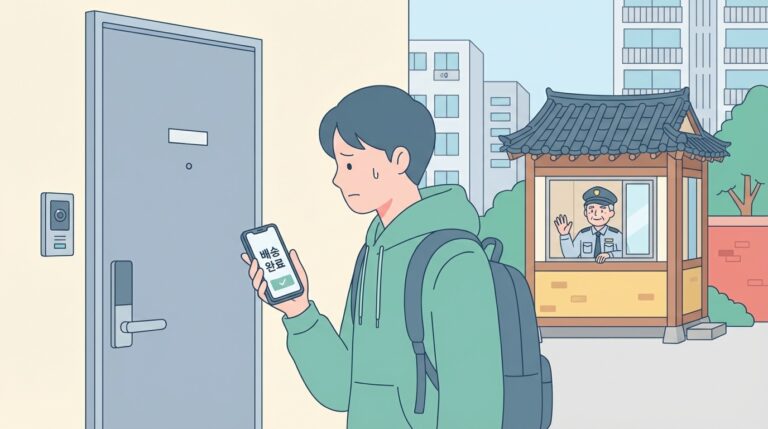
Phase 1: The Panic — “Delivery Complete,” But No Package? 📦😱
Hello! This is your Daily Hangul editor. 👋
Imagine this: You’ve been waiting weeks for that limited edition K-Pop album or those viral skincare products you saw on TikTok. Your phone buzzes. It’s a text from the delivery driver (Taekbae gisa-nim): “[배송 완료] 문 앞 (Delivery Complete: Front Door).”
Your heart races. You rush to your door, ready for the unboxing ceremony… but there’s nothing there. Empty.
Panic sets in. Did someone steal it? Did it go to the wrong house? In K-Dramas, this is usually where the protagonist runs to the Security Office (Gyeongbisil) and dramatically asks for help.
Today, we aren’t just learning words; we are solving a crisis. We are going to the security office to track down your precious cargo without losing your cool (or your dignity). Let’s get your package back!
Phase 2: Deep Dive — The Magic Words 🗣️
Here are the 3 essential phrases you need to survive this encounter.
1. 혹시 제 택배 여기 있나요?
(Hoksi je taekbae yeogi innayo?)
- Pronunciation: [Hok-shi] + [je] + [taek-bae] + [yeo-gi] + [in-na-yo?]
- Sound-alike: “Hokey Pokey” + “She” / “Tech” + “Bae” (like baby)
- Meaning: “Is my package here by any chance?”
- K-Culture Moment: You hear “Hoksi…” (혹시) constantly in dramas. It’s the “Magic Cushion Word.” Even if you are 100% sure you are right, starting with “Hoksi” makes you sound polite, humble, and non-confrontational.
- Editor’s Insight: The security guard (Gyeongbi ajeossi) is likely an elder. Storming in and asking “Where is it?” is a fast way to get zero help. “Hoksi” softens the blow.
- Situation Spectrum:
[🚫 Formal Biz] ———— [✅ Security Guard/Stranger] ———— [✅ Shop Owner]- 🤔 Think About It: Why does Korean culture value “softening” a question so much? Does it reflect a desire to avoid burdening the other person?
2. 배송 완료 문자를 받았는데요…
(Baesong wallyo munja-reul badanneundeyo…)
- Pronunciation: [Bae-song] + [wal-lyo] + [moon-ja-reul] + [ba-dan-neun-de-yo]
- Meaning: “I received a delivery completion text, but… (implying: I don’t see it).”
- Grammar Gem: The ending ~는데요 (~neundeyo) is crucial for B1 learners. It provides background information and leaves the sentence open, waiting for the listener to react. It’s much more natural than saying “I received a text.” (Period).
- K-Culture Moment: Think of a scene where a character is wrongly accused. They don’t shout “I didn’t do it!” They say “저는 안 했는데요…” (But I didn’t do it…) trailing off to show confusion.
- Situation Spectrum:
[✅ General Prob Solving] ———— [✅ Talking to Customer Service]3. 몇 호 사세요? / 000호요.
(Myeot ho saseyo? / [Number] ho-yo.)
- Pronunciation: [Myeot-ho] [sa-se-yo]?
- Meaning: “Which unit (apartment number) do you live in?” / “Unit [Number].”
- Editor’s Insight: In Korea, your identity in an apartment complex is your unit number. The guard might not know your name, but he knows “Unit 501.”
- K-Pop Connection: Just like K-Pop groups have “fanchants,” Korean numbers have a rhythm. Practice saying your address smoothly!
Phase 3: Textbook vs. Real Life 🥊
| Situation | 📖 Textbook Korean | 🗣️ Real Korean (Street Smart) | 💡 Why the difference? |
|---|---|---|---|
| Entering the office | 실례합니다. (Excuse me.) | (Knock knock) 계세요? (Are you there?) | “Shillyehamnida” is too stiff for a security booth. “Gyeseyo?” is friendly and checks if he’s awake/available. |
| Asking for package | 제 소포가 도착했습니까? (Has my parcel arrived?) | 저 501호인데요, 택배 온 거 있어요? (I’m 501, anything come for me?) | Identification by unit number is faster and more efficient for the guard. |
| Saying thanks | 안녕히 계십시오. (Goodbye.) | 수고하세요~ (Work hard / Thank you) | “Sugohaseyo” acknowledges his labor. It’s the standard “bye” to workers. |
Phase 4: Cultural Context — The “Gyeongbi” Ecosystem 🏢
4-1. The Gatekeeper: Gyeongbi Ajeossi
In Korean apartments, the Gyeongbi ajeossi (Security Guard Uncle) is a powerful figure. He manages parking, recycling, complaints, and yes, your packages.
– Non-verbal Tip: When you enter the small security booth, remove your headphones. Bow slightly. If he hands you the package with two hands, receive it with two hands (or at least support your right arm with your left hand).
– Nunchi (Eye-measure): If he is eating lunch or napping (common in the afternoon), say “Sorry to disturb you” (Jwesonghandeyo) before anything else.
4-2. The “Ppalli-Ppalli” Delivery Culture
Korean delivery is famous for being fast (sometimes same-day!). But because drivers are rushing (Ppalli-ppalli culture), they might mark it “Delivered” 10 minutes before actually dropping it off, or leave it at the security office without buzzing you to save time. Don’t panic immediately; wait 10-15 minutes after the text.
Phase 5: Immersive Roleplay 🎬
Setting: 7:00 PM. The small security office at the entrance of your building. A small TV is playing the news. The guard is sorting mail.
Characters:
* YOU: Anxious resident waiting for a new winter coat.
* Guard (Mr. Kim): 60s, wearing a uniform, looks a bit tired but kind.
(Dialogue Start)
YOU: (Knocking on the glass window) 계세요?
(Gyeseyo?)
(Is anyone there?)
Guard: 네, 들어오세요. 무슨 일이야?
(Ne, deureo-oseyo. Museun iriya?)
(Yes, come in. What’s the matter?)
YOU: 안녕하세요. [ 1 ]
(Annyeonghaseyo. [ 1 ])
(Hello. [ 1 ])
Guard: 잉? 문 앞에 없어요?
(Ing? Mun ape eopseoyo?)
(Huh? It’s not in front of the door?)
YOU: 네, 없더라고요. [ 2 ]
(Ne, eopdeoragoyo. [ 2 ])
(No, it wasn’t there. [ 2 ])
🔀 Decision Point: Fill in the blanks!
Option A:
[1] 제 택배 내놔요. (Give me my package.)
[2] 아저씨가 가져갔죠? (Did you take it, mister?)
-> Result: 💀 GAME OVER. You are now the rude foreigner in Unit 501. He will never help you with recycling again.Option B:
[1] 택배 때문에 왔는데요.
[2] 혹시 경비실에 맡겨 두셨나 해서요.
-> Result: 🏆 SUCCESS! polite and logical.
(Continuing with Option B)
Guard: 아~ 501호? 아까 택배 기사가 바빠서 여기 두고 갔어. 저기 구석에 봐봐요.
(Ah~ 501-ho? The driver was busy so he left it here. Check that corner.)
YOU: 아! 여기 있네요! 감사합니다, 아저씨!
(Ah! Here it is! Thank you, sir!)
Guard: 그래요, 수고해요~
(Okay, take care~)
Phase 6: 10-Second Shadowing Drill 🎧
Practice this until it rolls off your tongue!
Sentence: “Since I got a text saying it arrived, could you check just once?”
🇰🇷 도착 문자를 / 받아서 그런데요, / 혹시 / 확인 한번만 / 해주실 수 있나요?
Pronunciation: Dochak munjareul / badaseo geureondeyo, / hoksi / hwagin hanbeonman / haejusil su innayo?
- Emotion: 🥺 Worried but Polite (Brows slightly furrowed, soft voice)
- Intonation: Go up slightly at “geureondeyo” (soft pause), and keep “innayo?” gentle, not demanding.
Phase 7: K-Culture Mini Glossary 📘
| Korean | Rom. | Meaning | Context |
|---|---|---|---|
| 택배 | Taekbae | Parcel Service | The lifeline of modern Korea. Often refers to the box itself too. |
| 경비실 | Gyeongbisil | Security Office | Small booth at the entrance/ground floor of apartments. |
| 운송장 | Unsongjang | Tracking Label | The sticker on the box with the barcode and numbers. |
| 착불 | Chakbul | Cash on Delivery | Receiver pays shipping fee upon arrival (rare now, but happens). |
Phase 8: Traveler’s Survival Kit 🧳
Even if you aren’t living in an apartment, you might face delivery issues at a hotel or Airbnb.
🆘 Survival Phrases for Travelers
– 🇰🇷 “제 방으로 배달 시켰어요.” (Je bang-euro baedal sikyeosseoyo.)
– “I ordered a delivery to my room.”
– 🇰🇷 “호텔 프론트에 맡겨주세요.” (Hotel peuronteu-e matgyeo-juseyo.)
– “Please leave it at the hotel front desk.”
– 📍 Where to use: Hotel lobby, talking to delivery drivers on the phone.📌 Editor’s Travel Note:
If you are staying at an Airbnb, always ask the host for the exact address format in Korean before ordering. One wrong digit in the “Dong” (Building) or “Ho” (Unit) can send your package to the next building!
Phase 9: Think Deeper — “High Trust vs. High Tech” 🧠
The Mystery of the Doorstep Package:
In Korea, you will often see piles of Amazon boxes or Coupang deliveries sitting unguarded in front of apartment doors for hours. Why aren’t they stolen?
- CCTV Culture: Korea is one of the most surveilled countries. Almost every elevator and hallway has a camera. This creates a “Panopticon effect” where people behave because they might be watched.
- Communal Trust: There is a strong social contract. Touching someone else’s taekbae is considered a major taboo.
💬 Your Turn: In your country, if a package is left at the door, what happens? Do you have “Porch Pirates”? How would you explain your culture to a Korean friend?
Phase 10: FAQ & Troubleshooting 🛠️
Q: The driver called me, but I don’t speak Korean! What do I do?
A: Panic is natural! Just say: “문 앞에 놔 주세요” (Mun ape nwa juseyo – Please leave it in front of the door). It’s the magic answer to 90% of delivery calls.
Q: My package is truly lost. Can I ask the security guard to check CCTV?
A: ⚠️ Caution. You can ask, but you usually need the police or the building management’s permission for privacy reasons. Start with: “CCTV 확인이 가능할까요?” (Is it possible to check the CCTV?) politely.
❌ Common Mistake: Tipping the security guard with money for finding a package.
✅ Better Way: If they help you find a heavy or lost item, give them a small drink (Vita500 or Bacchus) or a small snack. It’s called Jeong (정).
Phase 11: Wrap-up & Mission 🚀
Today’s Summary: Don’t get angry at the missing box; use “Hoksi” and “~nundeyo” to softly investigate at the security office!
🎯 Action Missions:
– 🥉 Bronze: Practice saying your address (Unit number + ho) out loud 5 times.
– 🥈 Silver: Check a Korean tracking app (like CJ Logistics or Coupang) and try to read the status (배송중, 배송완료).
– 🥇 Gold: Next time you see your security guard, greet him loudly with “안녕하세요! 수고하십니다!”
K-Culture Mission: Watch a scene in a drama where the lead receives a package. Do they open it with scissors or rip it open? (Koreans often use scissors carefully to save the box for returns!)
Phase 12: Quiz — Interactive Challenge 📝
- Situation Judgment: You enter the security office. The guard is on the phone. What do you do?
- A) Tap him on the shoulder immediately.
- B) Wait quietly until he finishes, then bow.
- C) Shout “Taekbae!”
- Fill in the Blank:
- “___________ 제 택배 왔나요?” (Is my package here by any chance?)
- Hint: The Magic Cushion Word.
- True or False:
- It is rude to ask the security guard to check for a package if you haven’t received a text yet. (True/False)
Answers:
1. B (Patience and respect are key!)
2. 혹시 (Hoksi)
3. True (Wait for the text first, otherwise you are just sending him on a wild goose chase!)
Frequently Asked Questions (FAQ)
Q: What does "~는데요" mean in Korean and how do you pronounce it?
A: In Korean, "~는데요" is pronounced [~neundeyo] and means: is crucial for B1 learners. It provides
Q: What does ""CCTV 확인이 가능할까요?"" mean in Korean and how do you pronounce it?
A: In Korean, ""CCTV 확인이 가능할까요?"" is pronounced [Is it possible to check the CCTV?] and means: politely.







