

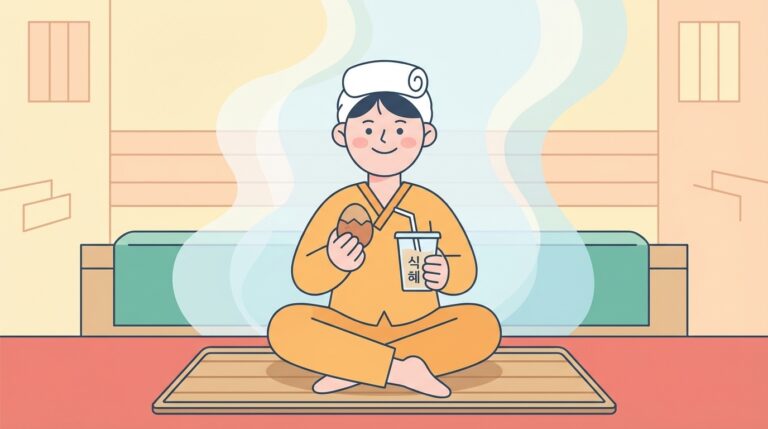
Phase 1: The ‘Ahhh~’ Moment – Welcome to the Jjimjilbang!
Hello! This is your Daily Hangul Editor.
Have you ever watched a K-Drama where the main characters are sitting in a room that looks like a giant oven? They are wearing towels rolled up like sheep horns on their heads (Yang-meori), cracking hard-boiled eggs on each other’s foreheads, and sipping a sweet rice drink.
Then, they walk out of a scorching hot room, their faces red and sweaty, and shout with a huge smile:
“Ah! Siwonhada!” (It’s cool!)
Wait a minute. They are sweating buckets, but they say it’s cool?
Today, we are going to learn the magic words you need to express that unique sense of relief and refreshment in a Korean Jjimjilbang (Sauna/Spa). Knowing these expressions isn’t just about vocabulary; it’s about understanding the Korean soul that finds relief in the heat.
Let’s get sweaty and refreshed!
Phase 2: Deep Dive – The Art of Feeling Refreshed
Here are the top 3 expressions you need to sound like a local after a hot bath.
1. 개순해요 (Ga-un-hae-yo)
- Pronunciation: [Gae-un-hae-yo] – Sounds a bit like “Ga-oon-hey-yo”
- Meaning: I feel refreshed / I feel light.
- Nuance: Use this when a heavy feeling is gone. It’s the feeling after brushing your teeth, washing your face, or stepping out of a sauna. It implies you feel “clean and light.”
- K-Culture Moment: In reality shows like I Live Alone, when a celebrity finishes cleaning their messy house or takes a shower, the caption often says ‘개순!’
- Situation Spectrum:
[Ὢ9 Boss] ———— [✅ Coworkers] ———— [✅ Friends]
(Note: For friends, just say “개순해!” (Ga-un-hae!))- ᾑ4 Think About It: Why is physical cleanliness linked to emotional lightness in Korean? Do you have a word that means both “clean” and “feeling good” in your language?
2. 시원해요 (Si-won-hae-yo)
- Pronunciation: [Si-won-hae-yo] – Think of “See-won” (like ‘see one’) + “hey-yo”
- Meaning: It’s cool / It’s relieving.
- The Paradox: This is the most confusing word for foreigners! It literally means “cool” (temperature), but when used in a hot bath or eating hot soup, it means “relieving” or “my muscles are melting.”
- Editor’s Insight: If you say this inside a 80°C sauna room, Koreans will look at you with respect. It means you are enjoying the “pain” as relief!
- Situation Spectrum:
[Ὢ9 Boss] ———— [⚠️ Mixed Group] ———— [✅ Friends]3. 피로가 풀려요 (Pi-ro-ga pul-ryeo-yo)
- Pronunciation: [Pi-ro-ga pul-ryeo-yo]
- Meaning: My fatigue is dissolving/releasing.
- Key Word: 풀려요 (Pul-ryeo-yo) literally means “untying a knot.” You are untying the knot of stress in your body.
- K-Drama Scene: The hardworking father comes home, sits in a massage chair, and sighs, “Ah, piro-ga pullinda (fatigue is releasing).”
Phase 3: Textbook vs. Real Life
| Situation | Ὅ6 Textbook Korean | 3️ Real Korean (Jjimjilbang Mode) | Ὂ1 Why is it different? |
|---|---|---|---|
| After a bath | 기분이 조아요. (I feel good.) |
아~ 개순해! (Ah~ So refreshing!) |
“Feel good” is too generic. Koreans prefer specific physical sensations. |
| In a hot tub | 타뜨ᅪ해요. (It is warm.) |
지자 시원하다~ (Seriously relieving~) |
“Warm” describes temperature; “Siwonhada” describes the effect on your body. |
| Leaving the spa | 아끄후이 없어요. (I have no pain.) |
따 개운해졌어. (I’m completely refreshed.) |
We focus on the change of state (from heavy to light). |
Editor’s Note: When saying these “Real Korean” phrases, you must add a sound effect like “Ahhh~” or “Kyaa~” at the beginning to sound authentic!
Phase 4: Cultural Context — The “Ajusshi” Sound
4-1. Non-verbal Communication: The Sound of Relief
Have you heard older Korean men make a groaning sound like “Euh-ahhh~” when entering a hot bath? In Korea, this isn’t a sound of pain; it’s a sound of extreme relaxation. Don’t be afraid to make a small sigh of relief yourself. It shows you are truly enjoying the culture.
4-2. K-Drama Connection: The Towel Hat
That sheep head towel (Yang-meori) isn’t just a drama trope; people actually do it! It keeps your hair from dripping sweat into your eyes. If you go to a Jjimjilbang and don’t make a Yang-meori, did you even really go? (Search “How to make Yang-meori” on YouTube before you go!)
Phase 5: Interactive Roleplay — Inside the “Bul-gama”
Setting: A popular Jjimjilbang in Seoul. You are wearing the orange sauna clothes. It is 3 PM on a Sunday. You are with your Korean friend, Minji.
Characters:
* YOU: An enthusiastic foreigner trying Jjimjilbang for the first time.
* Minji (25): Your bubbly Korean friend who loves saunas.
(Scene Start)
Minji: (Wiping sweat) 노무 떠워! 아이스방(어름방)에 가자. ᾗ6
(Nomu deowo! Ice-bang-e gaja.)
“It’s too hot! Let’s go to the Ice Room.”
YOU: (You step into the freezing Ice Room. It feels amazing after the heat.)
Ἲ4 Your Line: _________?
ὐ0 Decision Point: What do you say?
- A) “아, 시원해요!” (Ah, si-won-hae-yo!)
- B) “아, 개순해요!” (Ah, gae-un-hae-yo!)
- C) “아, 마시따!” (Ah, ma-si-tta!)
✅ Best Choice: A) “Ah, si-won-hae-yo!”
Reason: While B is okay, A is perfect here because ‘Siwonhada’ is the best word for temperature relief (hot to cold OR cold to hot).
⚠️ Choice C: Means “It’s delicious.” Unless you are eating the ice (don’t do that!), this is weird!
Minji: 그ᄎᅒ? 우리 이제 아시ᄀ(시켸)랑 계란 먹자! ᾕA
(Geuchi? Uri ije sikhye-rang gyeran meokja!)
“Right? Let’s eat sweet rice punch (Sikhye) and eggs now!”
(Stage Direction: Minji buys the snacks using her locker key bracelet.)
Phase 6: 10-Second Shadowing Drill
Read these aloud. Pay attention to the emotion!
- ὠC The “After Shower” Feeling (Bright & Clean)
- 아~ / 진짜 / 개순해요!
- (Ah~ / jinjja / gae-un-hae-yo!)
- “Ah, I feel truly refreshed!”
- ᾝ6♂️ The “Hot Tub” Paradox (Deep Relief)
- 아… / 때게 / 시원하다~
- (Ah… / ddae-ge / si-won-ha-da~)
- “Ah… this is really cool (relieving).”
Phase 7: K-Culture Mini Glossary
| Korean | Romanization | Meaning | Context |
|---|---|---|---|
| 찜질방 | Jjimjilbang | Korean Sauna/Spa | A public bathhouse with hot rooms, sleeping areas, and entertainment. |
| 에리 | Ttemiri | Body Scrub | The act of scrubbing off dead skin (or the person who does it). Very painful but results in maximum “Gae-un-hae-yo”! |
| 시켸 | Sikhye | Sweet Rice Punch | The #1 drink at a sauna. Sweet, cold, and has rice grains inside. |
| 언머리 | Yang-meori | Sheep Head | The cute towel style everyone wears on their head. |
Phase 8: Traveler’s Survival Kit — Jjimjilbang Edition
Visiting a Jjimjilbang is a must-do, but it can be shocking for first-timers. Here is your survival card.
Ἑ8 Survival Expression #1: Buying Entry
– 07 “성인 한 명이요.” (Seong-in han-myeong-i-yo.)
– 3️ Meaning: One adult, please.
– Ὂ1 Tip: They will give you a key and clothes (shorts and t-shirt).Ἑ8 Survival Expression #2: Buying Eggs
– 07 “계란 두 개 주세요.” (Gye-ran du-gae ju-se-yo.)
– 3️ Meaning: Two eggs, please.
– Ὂ1 Tip: You pay by tapping your locker key bracelet on the sensor. You pay the bill at the exit when you leave!Ὅ6 Editor’s Travel Note: The Naked Truth
Please remember: In the gender-segregated bath areas, you must be completely naked. No swimsuits allowed! It might be shy at first, but nobody is looking at you. It’s a part of the “Gae-un-han” experience!
Phase 9: Think Deeper — “Why is Pain Refreshing?”
Language & Culture: The Paradox of “Siwonhada”
Why do Koreans eat boiling hot spicy soup or sit in 90-degree saunas and say “Ah, refreshing”?
In Western culture, “refreshing” usually implies cooling down (like iced tea). But in Korea, relief often comes from fighting fire with fire (이열치열, I-yeol-chi-yeol). Sweating is seen as releasing toxins and stress. The word ‘Siwonhada’ focuses on the internal release of tension, not just the external temperature.
5 Your Turn: Does your culture enjoy saunas or spicy food to relieve stress? How do you express that feeling? Share in the comments!
Phase 10: FAQ & Troubleshooting
- Q: Can I wear my swimsuit in the bath area?
- NO. This is the #1 mistake foreigners make. You must be naked in the wet bath area. You only wear clothes in the common dry sauna area (Jjimjilbang).
- Q: Can I use “Gae-un-hae-yo” for food?
- Yes! If you eat a soup that is clear and spicy (like clam soup) that clears your sinuses, you can say “Gungmul-i (soup) gae-un-hae-yo!” It means the taste is clean, not greasy.
- Q: I have tattoos. Can I enter?
- Maybe. Some strict places forbid large tattoos because of old gangster associations. However, most modern places in tourist areas (like Seoul) are okay with it, but you might get some stares from older people.
❌ Common Mistake: Don’t wear your shoes past the front desk! You must put them in the shoe locker first.
Phase 11: Wrap-up & Mission
One-Liner Summary: Use “개순해요” for a clean feeling, and “시원해요” for deep relief (even if it’s hot!).
Ὠ0 Action Missions:
- ᾔ9 Bronze: Say “Ah~ Gae-un-hae-yo!” loudly after your shower tonight.
- ᾔ8 Silver: Watch a “Jjimjilbang Mukbang” on YouTube and listen for the word “Siwonhada.”
- ᾔ7 Gold: Visit a Korean spa (or a sauna in your country), wrap a towel on your head, and post a selfie with the hashtag #DailyHangul!
Phase 12: Interactive Quiz
- Situation: You just drank a very cold iced coffee on a hot summer day. What is the BEST thing to say?
- A) 개순해요 (Gae-un-hae-yo)
- B) 시원해요 (Si-won-hae-yo)
- C) 피로가 풀려요 (Piro-ga pul-ryeo-yo)
- True or False (K-Culture): You should wear a swimsuit inside the hot tubs at a Korean Jjimjilbang.
- [ True / False ]
- Fill in the Blank: After getting a massage, your friend asks how you feel. You say: “Ah, real stress relief! 피로가 _________!”
- (Hint: It melts/unties)
ὄ7 Scroll down for answers!
Ἰ9 Quiz Answers:
1. B (Siwonhada is perfect for cold drinks. Gaeunhada is more about ‘feeling clean’.)
2. False (Naked is the rule!)
3. 풀려요 (Pul-ryeo-yo)
Frequently Asked Questions (FAQ)
Q: What does "개순해요 (Ga-un-hae-yo)" mean in Korean and how do you pronounce it?
A: In Korean, "개순해요 (Ga-un-hae-yo)" is pronounced [Gae-un-hae-yo] and means: I feel refreshed / I feel light.
Q: What does "시원해요 (Si-won-hae-yo)" mean in Korean and how do you pronounce it?
A: In Korean, "시원해요 (Si-won-hae-yo)" is pronounced [Si-won-hae-yo] and means: It’s cool / It’s relieving.
Q: What does "피로가 풀려요 (Pi-ro-ga pul-ryeo-yo)" mean in Korean and how do you pronounce it?
A: In Korean, "피로가 풀려요 (Pi-ro-ga pul-ryeo-yo)" is pronounced [Pi-ro-ga pul-ryeo-yo] and means: My fatigue is dissolving/releasing.







