

Phase 1: The Hook — Don’t Freeze Your Tips! ❄️
Hello! This is your Daily Hangul Editor.
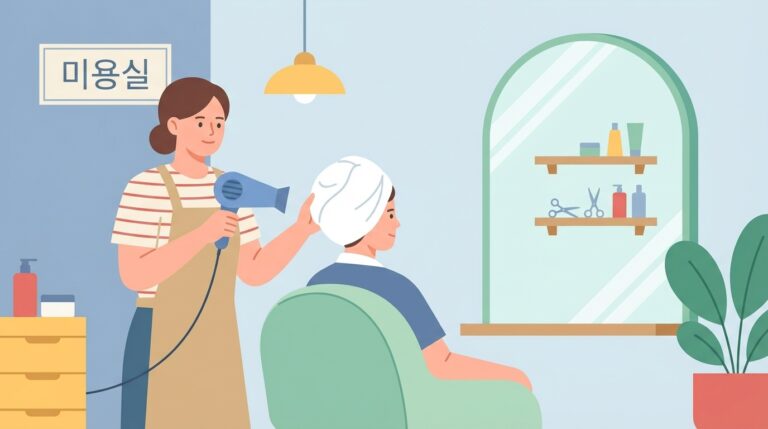
Picture this: You’ve just finished a refreshing shampoo at a trendy hair salon in Hongdae. The assistant wraps a towel around your head like a sheep (yang-meori style often seen in K-Dramas set in saunas 🧖♀️). But then… silence.
You check your watch. You have a date at a cafe in 20 minutes, and outside, the winter wind is blowing fierce enough to freeze wet hair instantly. You want to say, “Please dry my hair quickly!” but the words stick in your throat.
In Korea, “Meori” (Head/Hair) is serious business. From K-Pop idols’ perfectly volumized roots to the “wet hair look” seen in fashion editorials, how you finish your salon visit matters. Today, we’ll learn how to ask for the most basic yet crucial service: “Please dry my hair.”
Let’s make sure you don’t walk out looking like a wet puppy! 🐶
Phase 2: Deep Dive — 3 Key Expressions 🎤
1. 머리 말려주세요 (Meori mallyeo-juseyo)
- Pronunciation: [Meo-ri mal-lyeo-ju-se-yo]
- Tip: ‘Meo’ sounds like the ‘mu’ in ‘mud’. ‘R’ is soft, like a flap ‘t’ in ‘water’.
- Meaning: Please dry my hair.
- K-Culture Moment: Think of a K-Drama scene where the lead actor gently dries the heroine’s hair with a towel. It’s a romantic trope! In a salon, it’s a standard request.
- Editor’s Insight: This literally means “Please dry my head.” In Korean, we often use “head” (meori) to mean “hair” (meori-karak). Context is king!
- Situation Spectrum:
[🚫 Formal Boss] ———— [✅ Friendly/Polite] ———— [✅ Casual]
- Note: This is polite (
-yoending) and safe for any salon staff.- 🤔 Think About It: Why do Koreans use the same word for “Head” and “Hair”? It highlights a holistic view of the body—the hair is an extension of the head, not just an accessory.
2. 바짝 말려주세요 (Bajjak mallyeo-juseyo)
- Pronunciation: [Ba-jjak mal-lyeo-ju-se-yo]
- Tip: ‘Ba-jjak’ sounds like a sharp, crisp crunch. Say the ‘jj’ strongly!
- Meaning: Please dry it completely/thoroughly.
- K-Culture Moment: Imagine Korean Fried Chicken. It is fried bajjak (crispy/thoroughly). We use the same word for hair to mean “no moisture left.”
- Editor’s Insight: Use this in winter! If you don’t say this, some stylists might leave it slightly damp to protect your hair condition.
- Situation Spectrum:
[⚠️ Boss] ———— [✅ Staff] ———— [✅ Friends]- 🤔 Think About It: Korean has many “mimetic” words (words that mimic textures or states). Bajjak implies intensity. Can you feel the dryness in the sound?
3. 그냥 두세요 (Geunyang duseyo)
- Pronunciation: [Geu-nyang du-se-yo]
- Meaning: Just leave it / Let it be.
- K-Culture Moment: Sometimes in reality shows like I Live Alone, celebrities let their hair air-dry to be natural. If you want that vibe, use this.
- Editor’s Insight: Useful if you are in a rush or prefer air-drying to avoid heat damage.
- Situation Spectrum:
[✅ Polite/General]
Phase 3: Textbook vs. Real Life 🥊
| Situation | 📖 Textbook Korean | 🗣️ Real Korean | 💡 Why the difference? |
|---|---|---|---|
| Asking to dry | 머리카락을 건조해 주십시오. (Please desiccate my hair strands.) |
머리 좀 말려주세요. (Dry my hair [a little], please.) |
“Gun-jo” (desiccate) sounds like a science experiment. “Mal-li-da” is the daily verb. |
| Too hot! | 바람이 너무 뜨겁습니다. (The wind is too hot.) |
아, 뜨거워요! (Ah, hot!) |
In pain or discomfort, short exclamations work best. No need for full sentences! |
Bottom Note: In real spoken Korean, adding “Jom” (a little) softens the request. “Meori jom mallyeo-juseyo” sounds much more polite than a direct command.
Phase 4: Cultural Context — The “Service” Culture 💇♀️
4-1. Non-verbal: The Head Bob
When the stylist is drying your hair, they will move your head left, right, and down.
– The Rule: Don’t stiffen your neck! Be like a ragdoll. Let them move you. If you try to help by holding your head up, it actually makes their job harder. Trust the hands!
4-2. K-Culture Connection: K-Beauty & “Volume”
In K-Pop and K-Dramas, “Ppuri Volume” (Root Volume) is life.
– If the stylist asks: “Deo-rai hae deuril-kkayo?” (Shall I do a “dry” for you?)
– WARNING: In a Korean salon, the English word “Dry” (Deu-ra-i) often means “Styling/Blow-out,” not just removing water.
– If you say “Yes,” you might get big K-Drama waves (and possibly an extra charge). If you just want water removal, stick to “Mallyeo-juseyo” (Just dry).
Phase 5: Roleplay Scenario — At “Daily Hair” in Gangnam 🎬
Setting: It’s Saturday afternoon. The salon is buzzing with K-Pop hits playing in the background. You are sitting in the chair with wet hair.
Characters:
– YOU: A foreign student who needs to go to a study group.
– Designer Kim: A stylish hairdresser with silver-dyed hair.
(Dialogue Start)
Designer Kim: 샴푸 끝났습니다. 개운하시죠?
(Shampoo kkeut-nass-seumnida. Gae-un-ha-si-jyo?)
(English) Shampoo is done. Feels refreshing, right?
YOU: 네, 감사합니다.
(Ne, gamsahamnida.)
(English) Yes, thank you.
Designer Kim: (Picking up the dryer) 드라이 예쁘게 해 드릴까요?
(Deurai yeppeuge hae deurilkkayo?)
(English) Shall I style (“dry”) it prettily for you?
🔀 Decision Point! How do you answer?
- Option A: “Yes, please!” (You want the K-Pop idol look)
- Option B: “No, just dry it.” (You are in a rush/saving money)
👉 If you choose A (Styling):
YOU: 네, C컬로 해 주세요! (Ne, C-curl-lo hae juseyo!)
(Yes, please do a C-curl style!)👉 If you choose B (Just Drying – ✅ BEST for today’s lesson):
YOU: 아니요, 그냥 바짝 말려주세요. (Aniyo, geunyang bajjak mallyeo-juseyo.)
(No, just dry it thoroughly please.)
Designer Kim: 아, 네! 알겠습니다. 뜨거우면 말씀하세요.
(Ah, ne! Algetseumnida. Tteugeoumyeon malssue-maseyo.)
(English) Ah, okay! Tell me if it’s too hot.
(Dialogue End)
Phase 6: 10-Second Shadowing Drill 🎧
Repeat after the guide. Focus on the intonation!
- Polite Request: 😊
머리 좀 / 말려 / 주세요.
(Meori jom / mallyeo / juseyo.) -
Winter Survival: 🥶
바~짝 / 말려 / 주세요!
(Ba~jjak / mallyeo / juseyo!)
Note: Stretch the “Ba~” slightly to emphasize ‘completely’. -
Too Hot!: 🥵
잠시만요! / 너무 / 뜨거워요.
(Jamsimanyo! / Neomu / tteugeowoyo.)
Phase 7: K-Culture Mini Glossary 📘
| Korean | Romanization | Meaning | Context |
|---|---|---|---|
| 드라이 | Deu-ra-i | Blow-dry / Styling | Confusing! Usually means “styling with a dryer,” not just drying water. |
| 뿌리 | Ppuri | Roots (Hair) | Stylists often ask if you want “Root volume” (Ppuri volume). |
| 손님 | Sonnim | Guest / Customer | How staff will address you if they don’t know your name. |
| 영양 | Yeongyang | Nutrition (Treatment) | Often an upsell: “Your hair needs nutrition.” |
Phase 8: Traveler’s Survival Kit (Salon Edition) 🧳
Visiting a Korean salon is a must-do activity! Here is your cheat sheet.
🆘 Survival Phrases TOP 3
1. “얼마예요?” (Eol-ma-ye-yo?) – How much is it?
2. “예약했어요.” (Ye-yak-haess-eo-yo.) – I have a reservation.
3. “사진이랑 똑같이 해 주세요.” (Sa-jin-irang ttok-gachi hae ju-se-yo.) – Please do it exactly like this photo.
💡 Pro Tip: Showing a photo of a K-Pop idol is the most accurate language! Don’t be shy; everyone does it.📌 Editor’s Travel Note:
– Reservation: Essential for popular spots in Gangnam/Hongdae. Use Naver Maps or Kakao Hair Shop to book.
– Drinks: Most salons offer free iced coffee or tea. If they ask “Cha deurilkkayo?” say “Coffee, please!”
Phase 9: Think Deeper — “Jeong” and the Extra Service 🧠
Topic: Food & Identity (Service Culture)
Have you noticed that Korean salons often give you snacks, drinks, and sometimes a hand massage while you wait? This connects to the Korean concept of “Jeong” (affection/bonding) combined with fierce competition. Providing “Service” (freebies) isn’t just about value; it’s about treating the customer like a guest in one’s home. In many Western salons, water might be extra, but in Korea, feeding you is part of caring for you.
💬 Your Turn: Does your country’s salon culture include free snacks or drinks? Or is it strictly business? Share in the comments!
Phase 10: FAQ & Troubleshooting 🛠️
Q: Do I need to tip the stylist?
A: NO! 🚫 Korea has a no-tipping culture. The service charge is included. If you try to give money, they might run after you to return it, thinking you forgot it!
Q: Can I close my eyes while they dry my hair?
A: YES! It’s perfectly normal. Many Koreans sleep during the process. The stylist will tap your shoulder when done.
❌ Common Mistake:
– Saying: “Meori dry juseyo.” (Mixing English grammar)
– Correction: Say “Deu-ra-i hae-juseyo” (Do a styling) or “Mallyeo-juseyo” (Dry it).
Phase 11: Wrap-up & Action Mission 🚀
Summary: Today we learned how to ask to dry hair (Mallyeo-juseyo), emphasize dryness (Bajjak), and the difference between drying and styling (Deu-ra-i).
🎯 Action Mission:
– 🥉 Bronze: Stand before a mirror with a hair dryer and say, “Bajjak mallyeo-juseyo!” 3 times.
– 🥈 Silver: Watch a K-Drama makeover scene and listen for the word “Meori” or “Style.”
– 🥇 Gold: Go to a Korean salon (or a Korean-owned salon in your country) and try ordering a style using a photo!
K-Culture Mission: Next time you wash your hair, try the “Cold Blast” finish. Korean stylists often finish with cold air to set the style and add shine. Try it and see if your hair feels more “K-Style”!
Phase 12: Interactive Quiz 🧩
1. Situation Judgment:
It is -10°C outside. You are leaving the salon. What is the BEST phrase to use?
– A) 그냥 두세요 (Just leave it)
– B) 바짝 말려주세요 (Dry it thoroughly)
– C) 드라이 하지 마세요 (Don’t style it)
2. True or False (K-Culture):
In a Korean salon, if the staff asks if you want “Dry” (Deu-ra-i), they imply strictly removing water only.
– (True / False)
3. Fill in the blank:
To sound polite, add this word before the verb: “Meori [ _____ ] mallyeo-juseyo.”
– Hint: Starts with ‘J’.
answers:
1. B (You don’t want to freeze!)
2. False (It usually implies styling/blow-out!)
3. Jom (좀)
See you next time! Stay stylish! ✨
Frequently Asked Questions (FAQ)
Q: What does "머리 말려주세요 (Meori mallyeo-juseyo)" mean in Korean and how do you pronounce it?
A: In Korean, "머리 말려주세요 (Meori mallyeo-juseyo)" is pronounced [Meo-ri mal-lyeo-ju-se-yo] and means: a key conversational Korean expression covered in this lesson.
Q: What does "바짝 말려주세요 (Bajjak mallyeo-juseyo)" mean in Korean and how do you pronounce it?
A: In Korean, "바짝 말려주세요 (Bajjak mallyeo-juseyo)" is pronounced [Ba-jjak mal-lyeo-ju-se-yo] and means: a key conversational Korean expression covered in this lesson.
Q: What does "그냥 두세요 (Geunyang duseyo)" mean in Korean and how do you pronounce it?
A: In Korean, "그냥 두세요 (Geunyang duseyo)" is pronounced [Geu-nyang du-se-yo] and means: Just leave it / Let it be.







