

Phase 1: Immersive Hook
Hello! This is your Senior Editor at Daily Hangul.
Imagine this scene from a recent K-Drama: A successful office worker, perhaps someone like the team leader in Misaeng or a high-pressure professional in Sky Castle, pauses in the middle of a bustling Gangnam street. The camera zooms in. They aren’t crying, but they are gasping for air, clutching their chest. The subtitles might say “panic attack,” but the cultural weight behind that moment is massive.
In Korea, mental health has long been a taboo subject, often brushed off as a lack of willpower. But times are changing. You might have noticed your favorite K-Pop idols taking a hiatus for “health reasons” (often a code for anxiety or burnout).
If you are living in Korea and feeling the weight of the high-paced lifestyle, knowing how to navigate a mental health clinic—specifically regarding cost (bi-yong) and medical records (gi-rok)—is not just a language skill; it is a survival skill. Today, we are going deep into the real Korean required to seek help without fear.
Phase 2: Deep Dive into Key Expressions
1. 정신건강의학과 (Jeongsin-geongang-uihak-gwa)
- Pronunciation:
[Jeong-sin-geon-gang-ui-hak-gwa]
(Think of it as four blocks: Spirit-Health-Medicine-Department) - Meaning: Department of Mental Health Medicine (Psychiatry)
- Context: In the past, Koreans used 정신과 (Jeongsin-gwa). However, to reduce social stigma, the official name was changed to include “Health” (Geongang).
- Editor’s Insight: If you search for a clinic on Naver Maps, use the full term 정신건강의학과. Using the old term Jeongsin-gwa can sometimes carry a slightly colder, more “severe” nuance in conversation, though it is still widely used colloquially.
- Situation Spectrum:
[🚫 Formal/Polite] ———— [⚠️ Semi-formal] ———— [✅ Medical/Official]
(Use the full term when booking appointments or searching online. Use ‘Jeongsin-gwa’ only with close friends.)
2. 기록에 남나요? (Giroge namnayo?)
- Pronunciation:
[Gi-ro-ge nam-na-yo?] - Meaning: “Does this leave a record?”
- K-Culture Moment: This is the single most common question asked at reception desks in Korea. Due to fears about employment background checks or insurance denial, many Koreans are terrified of the F-code (the medical insurance code for psychiatric diagnoses).
- Editor’s Insight: This isn’t just a question; it’s a plea for privacy. Asking this signals you understand the Korean system.
- 🤔 Think About It: Why is the fear of a “record” so potent in Korea compared to your home country? Does it reflect the intense competition for employment?
3. 비급여로 해주세요 (Bigeupyeo-ro hae-juseyo)
- Pronunciation:
[Bi-geup-yeo-ro hae-ju-se-yo] - Meaning: “Please process this as non-insured (out-of-pocket).”
- Context: 급여 (Geupyeo) is covered by National Health Insurance. 비급여 (Bigeupyeo) is not.
- Editor’s Insight: If you pay Bigeupyeo, it is significantly more expensive (3 to 4 times more), but the detailed diagnosis is not sent to the National Health Insurance Service in the same way. This is the “secret phrase” used by those who want maximum privacy.
Phase 3: Textbook vs. Real Life
| Situation | 📖 Textbook Korean | 🗣️ Real Korean | 💡 Why the difference? |
|---|---|---|---|
| Describing Symptoms | “저는 우울합니다.” (I am depressed.) | “요즘 무기력하고 잠이 잘 안 와요.” (Lately I’m lethargic and can’t sleep.) | Koreans often express depression physically (somatization) rather than emotionally. Direct emotional statements can feel too intense. |
| Asking for Cost | “진료비는 얼마입니까?” (How much is the medical fee?) | “초진 비용 대략 얼마나 나올까요?” (Roughly how much will the first visit cost?) | 초진 (Chojin) means ‘first visit.’ First visits include testing fees and are much pricier than follow-ups. Specificity matters. |
| Insurance Inquiry | “보험이 됩니까?” (Does insurance work?) | “이거 실비 청구 되나요?” (Can I claim this on my private indemnity insurance?) | Most Koreans have private insurance (Silbi) on top of national insurance. This is the financial question that actually matters. |
Bottom Note: At a C2 level, stop saying “sad.” Start using specific symptoms: 불면증 (Insomnia), 식욕 부진 (Loss of appetite), 가슴 답답함 (Tightness in chest).
Phase 4: Cultural Deep Dive
4-1. The Waiting Room Etiquette (Non-verbal)
In a typical Korean internal medicine clinic, people chat or watch TV. In a Jeongsin-geongang-uihak-gwa, silence is the rule.
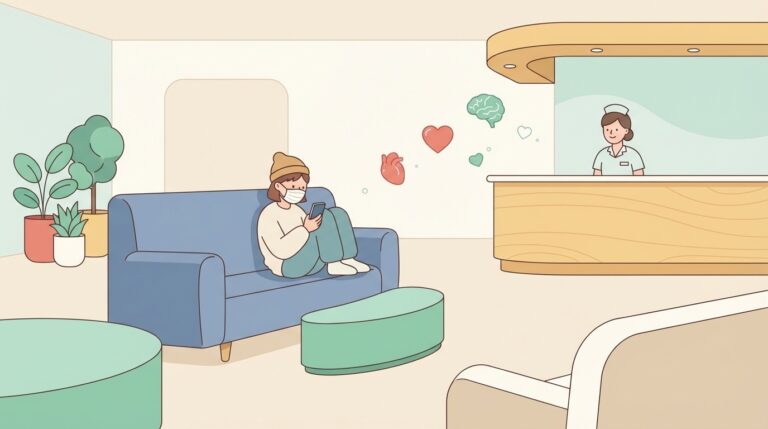
* The Mask: Even before COVID-19, wearing a mask and a hat low over your eyes was common here.
* The Gaze: Do not make eye contact with other patients. It is a rigorous unspoken rule to protect everyone’s anonymity. Pretend you are the only person in the room.
4-2. The “Hwabyung” (화병) Phenomenon
You might hear older Koreans say they have Hwabyung. Literally “Fire Illness,” this is a culture-bound syndrome recognized medically. It comes from repressing anger and frustration for years (often due to patriarchal structures or workplace hierarchy) until it manifests as physical pain and heat in the chest.
* Critical Perspective: While the West might classify this as depression or anxiety, understanding it as Hwabyung validates the patient’s suffering as a result of enduring unfairness, which is viewed somewhat virtuously in traditional culture.
Phase 5: Immersive Roleplay
Setting: A quiet clinic reception in Mapo-gu. It is your first visit (초진). You are nervous about your visa status and privacy.
Characters:
* YOU: An expat professional experiencing burnout.
* Receptionist (Siljang-nim): Efficient, professional, speaking rapidly.
Dialogue:
Receptionist: 초진이시죠? 여기 문진표 작성해 주시고, 신분증 주시겠어요?
(Chojinisijyo? Yeogi munjinpyo jakseonghae jusigo, sinbunjeung jusigesseoyo?)
(It’s your first visit, right? Please fill out this questionnaire and give me your ID.)
YOU: 네, 알겠습니다. 저… 혹시 여쭤볼 게 있는데요.
(Ne, algesseumnida. Jeo… hoksi yeojwobol ge inneundeyo.)
(Yes, understood. Um… I have something to ask.)
Receptionist: 네, 말씀하세요.
(Ne, malsseumhaseyo.)
(Yes, go ahead.)
🔀 Decision Point! How do you ask about privacy?
- Option A: “사람들이 제가 여기 온 걸 알 수 있나요?” (Can people know I came here?)
- Option B: “진료 기록이 남으면 취업이나 비자에 불이익이 있나요?” (If there’s a record, is there a disadvantage for employment or visas?)
- Option C: “비밀로 해주세요.” (Please keep it a secret.)
✅ Best Choice: B. This is the specific, adult concern. It shows you understand the systemic implications.
Analysis: Option A is too vague. Option C sounds childish. Option B addresses the real fear: 불이익 (Disadvantage/Penalty).
(Continuing from B)
Receptionist: 국민건강보험 적용하시면 기록은 남지만, 본인 외에는 열람 불가능해요. 그래도 걱정되시면 비급여로 하실 수 있는데, 비용이 3배 정도 비싸요.
(If you use National Insurance, a record remains, but no one can view it except you. If you’re still worried, you can do Non-insured, but it’s about 3 times more expensive.)
YOU: 아, 그렇군요. 상담 비용은 대략 어느 정도인가요?
(Ah, geureokunyo. Sangdam biyongeun daeryak eoneu jeongdoingayo?)
(Ah, I see. Roughly how much is the counseling fee?)
Phase 6: 10-Second Shadowing Drill
Let’s practice the sentence that protects your wallet and your privacy.
- Emotion: 😟 Cautious but Clear (Asking a sensitive question quietly)
- Sentence:
혹시 / 비급여로 진행하면 / 상담 비용이 / 대략 얼마나 나올까요?
(Hoksi / bigeupyeo-ro jinhaenghamyeon / sangdam biyong-i / daeryak eolmana naol-kkayo?) - Meaning: By any chance, if I proceed as non-insured, roughly how much will the counseling fee be?
Phase 7: K-Culture Mini Glossary
| Korean | Romanization | Meaning | Context |
|---|---|---|---|
| 번아웃 | Beon-aut | Burnout | Extensively used in Korea. Often treated as a valid reason for sick leave in modern startups. |
| 상담센터 | Sangdam-senteo | Counseling Center | Different from a clinic (hospital). They cannot prescribe meds, but are often strictly private (no insurance records). |
| F코드 | F-code | F-Code | The classification code for psychiatric disorders in insurance. A symbol of stigma. |
| 약물 치료 | Yakmul chiryo | Medication Therapy | Treatment using antidepressants/anxiolytics. |
Phase 8: Traveler’s & Expat’s Survival Kit
Since you are C2 level, you are likely living in Korea or staying long-term. Here is the Mental Health Survival Kit.
🆘 Survival Phrases
* To the Doctor: “잠을 깊게 못 자고, 자꾸 깨요.” (I can’t sleep deeply, and I keep waking up.) — Focus on sleep; it’s the easiest gateway symptom to discuss.
* At the Pharmacy: “수면유도제 있나요?” (Do you have sleep inducers?) — Different from prescription sleeping pills (Suyeon-je). Over-the-counter mild help.
* Emergency: “1393” (Korea’s Mental Health Crisis Hotline).📌 Editor’s Pro Note: Cost Reality
* With Insurance (National): A consult + meds usually costs 15,000 ~ 30,000 KRW ($12~$25). Extremely affordable.
* Without Insurance (Bigeupyeo): Can range from 80,000 to 150,000 KRW ($70~$130) per session.
* Expat Tip: English-speaking clinics are concentrated in Itaewon and Gangnam, and they often charge a premium or do not accept National Insurance directly. Always ask: “건강보험 적용 되나요?” (Is National Health Insurance applied?)
Phase 9: Think Deeper — Language & Stigma
🧠 Language as a Shield
Notice how the terminology has shifted? 정신병자 (Mental patient) is now a severe slur. Even 우울증 (Depression) is sometimes softened to 마음의 감기 (A cold of the mind).
This metaphor—”A cold of the mind”—is fascinating. It implies that (1) anyone can catch it, (2) it’s temporary, and (3) you need medicine to fix it, just like a flu. This linguistic shift is a deliberate attempt by Korean society to medicalize the issue to make it palatable in a Confucian society where “mental control” was historically seen as a virtue. By calling it a “cold,” we give ourselves permission to be sick without moral failure.
💬 Your Turn: Does your language have metaphors that soften the blow of mental illness? Or is it more direct?
Phase 10: FAQ & Troubleshooting
- Q: Will my company know if I use National Insurance?
- A: generally, NO. Companies cannot see what hospital you went to or why. They only see that you used the insurance. However, for certain high-security government jobs or pilots, detailed background checks might require you to submit health records, but this requires your explicit consent.
- Q: Can I just go to a Counseling Center (상담센터) instead?
- A: Yes. These are private businesses, not medical clinics. They do not leave medical F-code records. However, they cannot prescribe medication and are usually much more expensive (100,000 KRW+ per hour).
- ❌ Common Mistake: Expecting Western-style “Talk Therapy” at a regular Clinic.
- Reality: A standard National Insurance psychiatric visit in Korea is often 5-10 minutes, focused on symptoms and medication adjustment. If you want 50-minute talk therapy, you must specifically book 상담 치료 (Counseling Therapy) or go to a private center.
Phase 11: Wrap-up
One-Liner: mental health in Korea is accessible and affordable, provided you know the difference between Geupyeo (Insured) and Bigeupyeo (Non-insured).
🚀 Action Missions:
* 🥉 Bronze: Search for “정신건강의학과” on Naver Maps near your home just to see where they are.
* 🥈 Silver: Practice the shadowing sentence about “Bigeupyeo” until it sounds natural.
* 🥇 Gold: If you are feeling overwhelmed, visit a clinic. Use the phrase “요즘 잠이 안 와요” (I can’t sleep) to start the conversation safely.
K-Culture Mission: Watch the drama Daily Dose of Sunshine (정신병동에도 아침이 와요). It creates a vivid, accurate, and touching portrayal of a Korean psychiatric ward and the stigma patients face.
Phase 12: Interactive Quiz
1. Situation Judgment
You are at a company dinner. You are feeling depressed. Your boss asks why you look down. What is the culturally safest C2-level response?
* A) “사실 우울증 치료를 받고 있습니다.” (Actually, I am getting treatment for depression.)
* B) “요즘 컨디션이 좀 안 좋네요. 몸살 기운이 있나 봐요.” (My condition isn’t great lately. I think I have body aches.)
* C) “부장님 때문에 스트레스 받아서요.” (I’m stressed because of you, Boss.)
Correct: B. In a semi-formal work setting, somaticizing (blaming physical condition/body ache) is the most socially accepted way to excuse low energy without stigmatizing yourself or ruining the mood (Bunuigi).
2. True or False
* “If you visit a psychiatrist in Korea, your visa will be automatically cancelled.”
* Answer: False. Seeking help is not grounds for visa cancellation. However, severe instability requiring hospitalization might complicate renewals, but simple outpatient care does not.
Stay healthy, both in body and mind. See you next time!
Frequently Asked Questions (FAQ)
Q: What does "정신건강의학과 (Jeongsin-geongang-uihak-gwa)" mean in Korean and how do you pronounce it?
A: In Korean, "정신건강의학과 (Jeongsin-geongang-uihak-gwa)" is pronounced [Jeong-sin-geon-gang-ui-hak-gwa] and means: Department of Mental Health Medicine (Psychiatry)
Q: What does "기록에 남나요? (Giroge namnayo?)" mean in Korean and how do you pronounce it?
A: In Korean, "기록에 남나요? (Giroge namnayo?)" is pronounced [Gi-ro-ge nam-na-yo?] and means: "Does this leave a record?"
Q: What does "비급여로 해주세요 (Bigeupyeo-ro hae-juseyo)" mean in Korean and how do you pronounce it?
A: In Korean, "비급여로 해주세요 (Bigeupyeo-ro hae-juseyo)" is pronounced [Bi-geup-yeo-ro hae-ju-se-yo] and means: "Please process this as non-insured (out-of-pocket)."







