

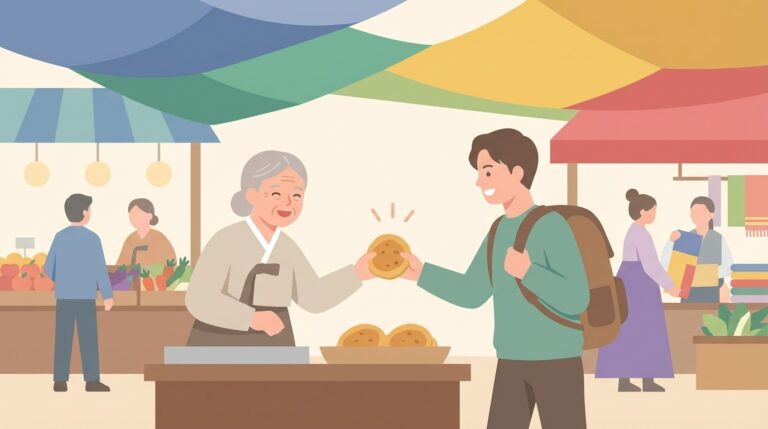
The Secret to Surviving Korean Markets: Finding the ‘Human Scent’
Phase 1: Immersive Hook
Hello! I’m your Daily Hangul Editor, your local culture navigator and veteran tutor from Seoul.
Imagine this: You’re watching a K-Drama. The main character has just been fired or gone through a bad breakup. Where do they go? Not to a fancy restaurant, but to a noisy, steaming street food stall (Pojangmacha) or a bustling traditional market. The vendor hands them an extra piece of fried food, clicking her tongue with sympathy, and says, “Eat up, you look tired.”
There’s no polite corporate greeting here. It’s loud, a bit chaotic, and wonderfully warm. In Korean, we call this vibe 사람 냄새 (saram naemsae)—literally, the “smell of people.” It means a place full of human warmth, affection, and genuine connection.
If you only rely on your textbook Korean, traditional markets like Gwangjang Market or Namdaemun Market can feel intimidating. Vendors speak fast, prices aren’t always written down, and standard textbook phrases sound a bit… robotic.
But don’t worry! I’ve spent years taking my foreign students to these very markets. In this lesson, we’ll learn the real, vibrant language of the market so you can stop feeling like a lost tourist and start getting treated like a regular!
Phase 2: Deep Dive into Core Expressions
Let’s break down the essential phrases you need to navigate these places like a pro.
1. 사장님 / 이모님 (Boss / Auntie)
- Pronunciation: sa-jang-nim / ee-mo-nim [sah-jahng-neem / ee-moh-neem]
- Meaning: Boss / Auntie (Real nuance: A respectful yet friendly way to call a vendor or restaurant owner)
- K-Culture Moment: In a busy market, raising your hand and shouting “Excuse me!” (저기요) often gets drowned out. Instead, you’ll hear Koreans shouting “이모님~” (Auntie) with an affectionate tone to order another bottle of Soju or more side dishes.
- Editor’s Insight: Sajang-nim is the safest bet for anyone. But if the vendor is a middle-aged or older woman, Imo-nim builds instant rapport. It creates a “we are family” vibe, which often leads to extra food!
- Situation Spectrum:
[🚫 절대 금지] ———— [⚠️ 주의] ———— [✅ 자유롭게]
- Casual (Market/Street food): ✅
- Semi-formal (Nice restaurant): ⚠️ (Stick to Sajang-nim here)
- Formal (Corporate meeting): 🚫
- 🤔 Think About It: Why do Koreans use family terms like “Aunt” or “Uncle” for complete strangers? How does this reflect the traditional Korean concept of community?
2. 덤 많이 주세요~ (Please give me some extra!)
- Pronunciation: deom ma-ni ju-se-yo~ [dum mah-nee joo-seh-yo]
- Meaning: Please give me a lot of Deom (Real nuance: Throw in a little something extra for me, please!)
- K-Culture Moment: You buy a bag of tangerines. As the vendor bags them, you smile and say this. She chuckles and tosses in two extra tangerines. That’s Deom—the beautiful Korean culture of giving extra items for free out of affection.
- Editor’s Insight: Textbooks teach you “깎아주세요” (Please give me a discount). But honestly? Bargaining is fading, even in markets. Asking for Deom (extra goods) is much more culturally acceptable and fun!
- Situation Spectrum:
[🚫 절대 금지] ———— [⚠️ 주의] ———— [✅ 자유롭게]
- Casual (Market fruit/vegetable stalls): ✅
- Semi-formal (Supermarkets/Franchises): 🚫 (Prices are fixed!)
- Formal: 🚫
- 🤔 Think About It: In your home country, if you ask for “extra” at a market, how would the vendor react? Does the concept of Deom exist in your culture?
3. 많이 파세요! (Sell a lot!)
- Pronunciation: ma-ni pa-se-yo! [mah-nee pah-seh-yo]
- Meaning: Sell a lot! (Real nuance: Have a great business day / Goodbye)
- K-Culture Moment: When leaving a mom-and-pop store or a market stall, saying “안녕히 계세요” (Goodbye) is fine, but saying “많이 파세요!” makes you sound incredibly local and considerate.
- Editor’s Insight: This phrase acknowledges the vendor’s hard work. It’s the ultimate “I see you and I wish you success” parting greeting.
- Situation Spectrum:
[🚫 절대 금지] ———— [⚠️ 주의] ———— [✅ 자유롭게]
- Casual (To market vendors): ✅
- Semi-formal (To taxi drivers/service workers): ✅
- Formal (To your company CEO): ⚠️ (A bit awkward, use standard greetings)
- 🤔 Think About It: Korean greetings are often tied to people’s well-being and daily struggles (like asking “Did you eat?”). Why do you think acknowledging someone’s business success became a standard way to say goodbye?
Phase 3: Textbook vs Real Life
| 상황 (Situation) | 📖 교과서 한국어 (Textbook) | 🗣️ 진짜 한국어 (Real Korean) | 💡 왜 다를까? (Why the difference?) |
|---|---|---|---|
| Calling a vendor | 저기요 (Excuse me) | 사장님~ / 이모님~ | Relational titles build Jeong (affection) faster than neutral pronouns. |
| Asking the price | 이것은 얼마입니까? | 이모(님), 이거 얼마예요? | Standard formal (-입니까) sounds stiff. A friendly -예요 works best. |
| Asking for a deal | 가격을 깎아주세요. | 조금만 깎아주세요~ or 덤 많이 주세요~ | Direct demands sound aggressive; adding “조금만” (just a little) softens the blow. |
| Saying Goodbye | 안녕히 계세요. | 맛있게 잘 먹었습니다. 많이 파세요! | Wishing them good business shows deep cultural empathy. |
Phase 4: Cultural Deep Dive
4-1. Non-verbal Communication & Nunchi
In a bustling market, your body language speaks volumes.
– The Two-Hand Rule: Even in a chaotic market, when handing over cash or receiving your food, try to use two hands (or support your right arm with your left hand). It’s a quick sign of respect.
– Market Nunchi: If the stall is packed and people are waiting, eat quickly and leave. Don’t linger to chat. The vendor’s income depends on table turnover!
4-2. K-Culture Connection: Food & Jeong (정)
Traditional markets are the absolute best places to experience K-Food in its rawest form. When you sit at a Pojangmacha (tent stall), you’re not just buying a plate of Tteokbokki; you’re buying into the communal atmosphere.
In many K-Dramas, you’ll see characters sharing a tiny bench, bumping elbows with strangers while eating hot Odeng (fish cake) skewers. The vendor might suddenly pour hot soup into your cup without asking. This isn’t aggressive; it’s Jeong (정)—an unspoken, deeply ingrained feeling of care and connection. The vendor sees you shivering, so she gives you hot soup. That is saram naemsae.
Phase 5: Immersive Roleplay Scenario
Setting: Friday afternoon, Mangwon Market. The smell of freshly fried Jeon (Korean pancakes) fills the air. You are hungry, holding 10,000 won in cash, and you stop at a bustling stall.
Characters:
– YOU: A B1-level Korean learner, excited but slightly nervous to order.
– Vendor (Auntie): A fast-talking, warm-hearted woman in a floral apron.
Vendor: 어서 오세요! 뭐 드릴까? (Welcome! What can I give you?)
(Romanization) eoseo oseyo! mwo deurilkka?
(Stage Direction: She is quickly flipping pancakes on a large iron grill.)
YOU: 안녕하세요! 이 호떡 얼마예요?
(Romanization) annyeonghaseyo! i hotteok eolmayeyo?
(English) Hello! How much is this Hotteok?
Vendor: 호떡은 한 개에 이천 원~ 세 개 하면 오천 원에 줄게!
(Romanization) hotteogeun han gaee icheon won~ se gae hamyeon ocheon wone julge!
(English) Hotteok is 2,000 won for one~ If you buy three, I’ll give it to you for 5,000 won!
🔀 Your Turn! How do you respond?
– A) “비싸요. 안녕히 계세요.” (It’s expensive. Goodbye.)
– B) “우와, 진짜요? 그럼 세 개 주세요! 이모님 최고!” (Wow, really? Then please give me three! Auntie, you’re the best!)
– C) “하나만 깎아주세요.” (Please discount just one.)✅ Best Choice: B — You acknowledge her generous offer (3 for 5k is a deal!) and praise her. This is how you win over a market vendor.
⚠️ Choice A & C Analysis: ‘비싸요’ (It’s expensive) directly to a vendor can be rude unless said playfully. Asking for a discount on a single cheap item is usually frowned upon.
(Assuming you chose B)
Vendor: (Laughs loudly) 아이고, 학생 말 참 예쁘게 하네. 자, 여기 하나는 서비스!
(Romanization) aigo, haksaeng mal cham yeppeuge hane. ja, yeogi hananeun seobiseu!
(English) Oh my, you speak so beautifully, student. Here, one extra on the house!
(Stage Direction: She slips a fourth Hotteok into your paper bag.)
YOU: 헉, 감사합니다! 많이 파세요!!
(Romanization) heok, gamsahamnida! mani paseyo!!
(English) Gasp, thank you! Sell a lot!!
Bonus Scenario: The Street Food Stand
You are eating Odeng. You want more of the hot broth, which is self-service, but you don’t know where the ladle is.
YOU: 이모님, 국물 좀 더 먹어도 돼요?
(Auntie, can I have some more broth?)
Vendor: 그럼~ 거기 국자 있지? 마음껏 퍼 먹어!
(Of course~ The ladle is right there, right? Scoop and eat as much as you want!)
Phase 6: 10-Second Shadowing Drill
Let’s practice the rhythm! Pay attention to the pauses (/) and emotions.
😊 이모님~ / 이거 / 조금만 / 더 주세요!
(ee-mo-nim~ / i-geo / jo-geum-man / deo ju-se-yo!)
Auntie~ Please give me just a little bit more of this!
🙏 맛있게 / 잘 먹었습니다! / 많이 / 파세요!
(ma-sit-ge / jal meo-geot-sseum-ni-da! / ma-ni / pa-se-yo!)
I ate well! (It was delicious!) Sell a lot!
Phase 7: K-Culture Glossary
| 한국어 (Korean) | Romanization | Meaning | K-Culture Context |
|---|---|---|---|
| 사람 냄새 | saram naemsae | “Human scent” | The feeling of human warmth, compassion, and authentic connection in a community. |
| 정 | jeong | Affection/Attachment | The deep emotional bond between Koreans. It’s why vendors give you extra food. |
| 덤 | deom | Extra / Bonus | Giving a little extra product for free out of generosity, common in traditional markets. |
| 서비스 | seobiseu | “Service” / On the house | Similar to deom, free items given at restaurants (like a free soda or egg roll). |
| 단골 | dangol | Regular customer | If you go to the same stall often, you become a dangol, which guarantees endless jeong! |
Phase 8: Traveler’s Survival Kit
If you are visiting a Korean traditional market, you MUST know these.
🆘 Survival Phrases TOP 3
1. 🇰🇷 “이거 얼마예요?” (i-geo eol-ma-ye-yo?)
– 🗣️ English: How much is this?
2. 🇰🇷 “계좌이체 될까요?” (gye-jwa-i-che doelkkayo?)
– 🗣️ English: Can I do a bank transfer? (Useful if you have a Korean bank account but no cash).
3. 🇰🇷 “포장해 주세요.” (po-jang-hae ju-se-yo.)
– 🗣️ English: Please pack this to go. / Takeout, please.📌 Editor’s Travel Note
– Cash is King: While Korea is a “card-only” society almost everywhere else, traditional market stalls often prefer cash or direct bank transfers (계좌이체). Always bring some 10,000 won bills!
– Tipping: DO NOT tip! Giving a tip in Korea is confusing and sometimes seen as condescending. If you want to show appreciation, simply say “맛있게 잘 먹었습니다!” (I ate very well!).
Phase 9: Think Deeper – “한 발 더 깊이”
Food & Identity: The Power of ‘Deom’ in a Lonely Era
In modern Seoul, people tap their credit cards at self-serve kiosks, eat alone while watching YouTube, and rarely speak to cashiers. Efficiency has replaced connection. However, traditional markets remain the last stronghold of Jeong (정) and Saram naemsae. When an elderly vendor slips an extra apple into your bag (Deom) or scolds you to “dress warmly,” it’s not a business tactic. It reflects Korea’s historical agricultural identity, where surviving harsh winters and poverty relied entirely on village sharing and mutual care.
💬 Your Turn: Have you ever experienced a sudden act of hospitality or “extra” kindness from a stranger in your travels? Does your culture have a concept similar to Saram naemsae? Share in the comments!
Phase 10: FAQ & Troubleshooting
Q: Can I use “이모님” (Imo-nim) to male vendors?
No! Imo specifically means “Aunt” (mother’s sister). For male vendors, use 사장님 (Sajang-nim – Boss) or 삼촌 (Samchon – Uncle).
Q: I heard the word “아줌마” (Ajumma). Can I use that?
❌ Common Mistake Alert! Please avoid calling vendors Ajumma. While it literally means a middle-aged woman, it has developed a slightly dismissive or rude nuance in modern times. Always upgrade it to 이모님 (Imo-nim) or 사장님 (Sajang-nim) to be safe and polite.
Q: What if they don’t have price tags and I feel like I’m being overcharged?
Politely ask, “이거 오천 원어치만 주실 수 있어요?” (Can you just give me 5,000 won worth of this?). This sets your budget firmly before they pack the items.
Phase 11: Wrap-up & Action Items
One-Liner Summary: To truly experience the human warmth (Saram naemsae) of Korea, drop the formal textbook phrases and embrace friendly terms like Imo-nim, Deom, and Mani paseyo!
Your Missions:
– 🥉 Bronze: Stand in front of a mirror and cheerfully practice saying “사장님~ 많이 파세요!” 3 times.
– 🥈 Silver: Leave a comment below using the word Deom or Jeong to describe a Korean cultural experience you’ve had (or want to have).
– 🥇 Gold: Next time you visit a Korean market or a local Korean restaurant in your city, use “이모님” or “사장님” to get the waiter’s attention!
🇰🇷 K-Culture Mission:
Open Google Maps or KakaoMap Street View, drop the little yellow man into Gwangjang Market (광장시장) in Seoul. Walk down the virtual aisles, spot a food stall, and imagine saying “이모님, 이거 얼마예요?” to the vendor on the screen!
Phase 12: Interactive Quiz
Let’s test your market Nunchi!
1. You are leaving a small souvenir stall in Namdaemun Market. The vendor was very kind. What is the most ‘local’ way to say goodbye?
A) 안녕히 가세요 (Annyeonghi gaseyo)
B) 많이 파세요 (Mani paseyo)
C) 수고하세요 (Sugohaseyo)
2. True or False: If you receive excellent service at a traditional market food stall, you should leave a 10% tip on the table.
3. Fill in the blank: The Korean concept of giving extra items to a customer out of affection and generosity is called ________.
(Highlight the blank space below to see the answers!)
- B (A is ‘please go in peace’ used when the OTHER person is leaving. C is okay, but B is the warmest market greeting!)
- False (Korea has no tipping culture! Just express your thanks verbally.)
- Deom (덤) or Service (서비스)
How did you do? Ready to hit the markets and smell the Saram naemsae? Let me know in the comments!
Frequently Asked Questions (FAQ)
Q: What does "사장님 / 이모님 (Boss / Auntie)" mean in Korean and how do you pronounce it?
A: In Korean, "사장님 / 이모님 (Boss / Auntie)" is pronounced [sa-jang-nim / ee-mo-nim [sah-jahng-neem / ee-moh-neem] and means: Boss / Auntie (Real nuance: A respectful yet friendly way to call a vendor or restaurant owner)
Q: What does "덤 많이 주세요~ (Please give me some extra!)" mean in Korean and how do you pronounce it?
A: In Korean, "덤 많이 주세요~ (Please give me some extra!)" is pronounced [deom ma-ni ju-se-yo~ [dum mah-nee joo-seh-yo] and means: Please give me a lot of Deom (Real nuance: Throw in a little something extra for me, please!)
Q: What does "많이 파세요! (Sell a lot!)" mean in Korean and how do you pronounce it?
A: In Korean, "많이 파세요! (Sell a lot!)" is pronounced [ma-ni pa-se-yo! [mah-nee pah-seh-yo] and means: Sell a lot! (Real nuance: Have a great business day / Goodbye)







