

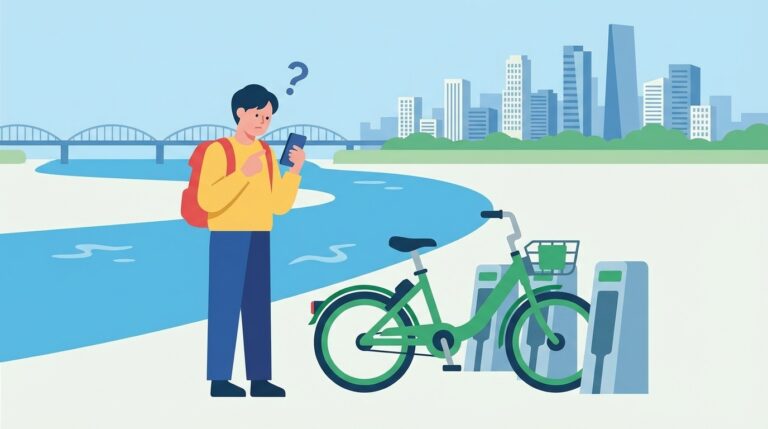
Phase 1: Immersive Hook
Hello there! It’s your lead editor at Daily Hangul, your veteran tutor and local cultural navigator here in Seoul.
Close your eyes and picture this: You’re watching your favorite K-Drama. The main characters have just had an emotionally exhausting day. To clear their minds, they head to the Han River (한강) as the sun sets, hopping on those iconic green public bicycles, pedaling with the city lights sparkling on the water. Or perhaps you’ve seen a vlog of your favorite K-Pop idol (like BTS’s RM!) doing exactly this on a cool autumn night.
You arrive in Seoul, determined to live out this main character moment. You find a docking station full of those green bikes—called Ttareungi (따릉이). You download the app, but suddenly, you are hit with a barrage of Korean tech terms, system errors, and unspoken etiquette rules of the Seoul bike paths. Your romantic K-Drama moment is quickly turning into an IT troubleshooting nightmare.
Don’t worry! By the time you finish reading this, you won’t just know how to rent a bike; you’ll know how to navigate the app’s glitches, politely pass pedestrians like a local, and understand the cultural nuances of Korea’s shared infrastructure. Let’s get you on that saddle!
Phase 2: Deep Dive (Core Expressions for C1 Learners)
Since you are an advanced (C1) learner, we’re skipping the basic “How much is it?” and diving straight into the real, functional language you need for public tech and navigation.
1. QR코드 스캔하고 잠금장치를 해제하세요.
- Pronunciation: [QR-kodeu seukaenhago jamgeumjangchireul haejehaseyo]
Sound-alike guide: ‘haeje’ sounds like “heh-jeh” (a quick sigh out).- Meaning: Scan the QR code and unlock the locking mechanism.
- K-Culture Moment: This is the robotic, formal system text you’ll read on the app or hear from the bike’s speaker. In K-Dramas, right after the main character successfully does this, the bike makes a cheerful little “Tta-reung!” sound, signaling freedom.
- Editor’s Insight: The word 해제 (haeje) means to lift, clear, or deactivate (a lock, a ban, a warning). It’s a Sino-Korean word used heavily in tech and administration. Using native Korean like “풀다” (pulda – to untie/unlock) is common in speech, but interfaces always use “해제”.
- Situation Spectrum:
[🚫 ---------------- ⚠️ -------- ✅]
- App interface/System voice: ✅
- Explaining to a friend (Casual): ⚠️ (A bit too formal, you’d usually say “그냥 큐알 찍고 풀면 돼”)
- 🤔 Think About It: Why does Korean rely so heavily on Sino-Korean words (Hanja) for formal instructions and technology? How does this dual vocabulary system (Native vs. Sino) compare to Latin/Germanic roots in English?
2. 앱이 자꾸 튕겨서 연동이 안 돼요.
- Pronunciation: [Aebi jakku twinggyeoseo yeondongi an dwaeyo]
Sound-alike guide: ‘twing’ sounds like the “twing” of a rubber band snapping.- Meaning: The app keeps crashing, so it won’t sync/connect.
- K-Culture Moment: You’re standing at the bike rack with a local friend, getting frustrated. This is exactly what a native Korean twenty-something would say while aggressively tapping their screen.
- Editor’s Insight: 튕기다 (twinggida) literally means “to bounce off” or “to flick.” In modern Korean tech slang, it means “to crash” or “be booted out” of an app/game. 연동 (yeondong) means linkage or syncing (e.g., syncing your credit card or transit card to the app).
- Situation Spectrum:
[🚫 -------- ⚠️ ---------------- ✅]
- Friends/Everyday tech talk: ✅
- Formal IT presentation: 🚫 (Use ‘종료되다’ instead of ‘튕기다’)
- 🤔 Think About It: “튕기다” is also used in dating to describe someone “playing hard to get.” Isn’t it fascinating how the same verb is applied to an unresponsive app and an unresponsive crush?
3. 지나갈게요~ / 잠시만요!
- Pronunciation: [Jinagalgeyo~ / Jamsimanyo!]
Sound-alike guide: Make the “yo” at the end long and sing-songy. It softens the phrase!- Meaning: Passing by! / Excuse me!
- K-Culture Moment: Riding along the Han River, you encounter a group of people walking on the bike path holding their fried chicken (K-Food!). You don’t want to aggressively ring your bell, so you use your voice in a friendly, high-pitched tone.
- Editor’s Insight: In Korea, aggressively ringing a bicycle bell can be perceived as rude, demanding “Get out of my way!” Instead, locals often softly say “지나갈게요~” (I will pass by). It’s assertive yet polite, heavily relying on tone.
- Situation Spectrum:
[🚫 ---------------- -------- ✅ ✅]
- Crowded bike paths: ✅
- Speaking to elders blocking the path: ✅ (With a very soft tone!)
Phase 3: Textbook vs Real Life
Let’s look at how the textbook teaches bike rentals versus what you’ll actually hear at the Han River.
| Situation | 📖 Textbook Korean | 🗣️ Real Korean (C1 Level) | 💡 Why the Difference? |
|---|---|---|---|
| Telling a friend to rent a bike | 자전거를 대여합시다. (Let’s rent a bicycle.) | 우리 따릉이 탈까? (Shall we ride a Ttareungi?) | Locals rarely use the formal “대여하다” for everyday items, and the brand name “따릉이” acts as a generic noun. |
| App isn’t working | 어플리케이션에 오류가 발생했습니다. (An error occurred in the application.) | 아, 앱 또 먹통이네. / 자꾸 튕겨. (Ah, the app is frozen again. / It keeps crashing.) | Internet slang favors vivid, physical metaphors (먹통 = deaf/mute block of ink, 튕기다 = bounce). |
| Returning the bike | 자전거 반납을 완료했습니다. (I have completed the bicycle return.) | 나 반납 처리 다 됐어. (My return processing is all done.) | Adding “처리” (processing) is a very native way to talk about completing administrative tasks. |
Bottom Note: At the C1 level, mastering words like “먹통” (unresponsive) and “연동” (syncing) immediately elevates your Korean from “classroom foreigner” to “Seoul resident.”
Phase 4: Cultural Deep Dive
4-1. Non-verbal Communication & Nunchi on the Road
Korean Nunchi (눈치)—the art of reading the room—extends to the bike paths. The Han River paths are strictly divided into pedestrian lanes (usually red/brown) and bike lanes (usually grey/black). However, lines blur. When approaching a pedestrian in the bike lane, Nunchi dictates you don’t blast your bell. You slow down, softly say “잠시만요~” (Excuse me) or click your brake levers a few times to make a mechanical clicking sound. This indirect warning is considered much more polite than a direct bell ring!
4-2. The K-Culture Connection: The Han River Ritual
Why is renting a Ttareungi such a big deal? In Korea, it’s rarely just about transportation; it’s a lifestyle ritual.
In countless K-Dramas (like Start-Up or Record of Youth), characters ride bikes when they need to make a big life decision. Furthermore, it directly connects to K-Food. The ultimate Seoul weekend itinerary is:
1. Rent a Ttareungi.
2. Ride from Yeouido to Banpo.
3. Return the bike (DO NOT forget to lock it and hear the system say “반납되었습니다”).
4. Spread a mat, order delivery Chimaek (Chicken and Maekju/Beer), and enjoy the night view.
Critical View: While dramas make it look effortless, the reality is that the Ttareungi app for foreigners can be notoriously buggy regarding credit card payments. Buying a “Foreigner Pass” via the web browser is often much smoother than fighting with the app!
Phase 5: Immersive Roleplay Scenario
Setting: Friday evening, 6:30 PM. The golden hour at Yeouido Hangang Park. The air smells like instant ramen and fried chicken. You and your Korean coworker, Min-su, just got off work and decided to bike to Mapo.
Characters:
– YOU: An expat working in Seoul, excited but struggling with the Korean bike app.
– Min-su (32): Your friendly, slightly impatient but helpful Korean coworker.
Dialogue:
Min-su: 날씨 진짜 좋죠? 빨리 따릉이 빌려서 마포 쪽으로 넘어가요! 🚴♂️
(Nalssi jinjja jotjyo? Ppalli ttareungi billyeoseo mapo jjogeuro neomeogayo!)
[The weather is really great, right? Let’s quickly rent a Ttareungi and head over to Mapo!]
YOU: 좋아요! 근데 저 아직 회원가입을 안 했는데, 이거 비회원도 되나요?
(Joayo! Geunde jeo ajik hoewongaipeul an haenneunde, igeo bihoewondo doenayo?)
[Sounds good! But I haven’t registered as a member yet, can non-members do this?]
Min-su: 네, 앱 깔고 일일권 구매하시면 돼요. 연동할 카드 있으시죠?
(Ne, aep kkalgo irilgwon gumaehasimyeon dwaeyo. Yeondonghal kadeu isseusijyo?)
[Yes, just install the app and buy a daily pass. You have a card to sync, right?]
(🎭 Stage Direction: Min-su points to the QR code on the green bike.)
YOU: 아, 네. 결제했어요! 이제 어떻게 하죠?
(A, ne. Gyeoljehaesseoyo! Ije eotteoke hajo?)
[Ah, yes. I paid! What do I do now?]
Min-su: 자전거 뒤쪽에 있는 QR코드 스캔하고 잠금장치 푸시면 돼요.
(Jajeongeo dwijjoge inneun QR-kodeu seukaenhago jamgeumjangchi pusimyeon dwaeyo.)
[Just scan the QR code on the back of the bike and unlock the lock.]
YOU: 어? 스캔했는데 앱이 자꾸 튕겨요. 먹통인데요?
(Eo? Seukaenhaenneunde aebi jakku twinggyeoyo. Meoktongindeyo?)
[Huh? I scanned it, but the app keeps crashing. It’s totally frozen?]
Min-su: 앗, 가끔 그래요. 앱 껐다가 다시 켜서 해보세요.
(At, gakkeum geuraeyo. Aep kkeotdaga dasi kyeoseo haeboseyo.)
[Ah, it does that sometimes. Try closing the app and turning it on again.]
(🎭 Stage Direction: You restart the app, scan the code, and the bike clicks open with a voice prompt: “대여가 시작되었습니다” [Rental has started]. You both start riding. Suddenly, a couple is walking right in the middle of the bike lane ahead.)
Min-su: 조심해요! 앞에 사람 있어요.
(Josimhaeyo! Ape saram isseoyo.)
[Careful! There are people ahead.]
🔀 Your Turn! How do you respond to the people blocking the path?
– A) (Loudly) “비키세요!” (Get out of the way!)
– B) (Ringing the bell furiously) Tring tring tring tring!
– C) (Softly, slightly slowing down) “저기요~ 지나갈게요!” (Excuse me~ Passing by!)✅ Best Choice: C — Why? As discussed, it’s the polite Seoulite way. Option A is aggressive and sounds like you are ordering them around. Option B is considered rude unless it’s a dangerous emergency.
YOU: (Following Choice C) 저기요~ 지나갈게요!
(Jeogiyo~ Jinagalgeyo!)
[Excuse me~ Passing by!]
(🎭 The couple quickly steps aside, apologizing.)
Min-su: 오~ 한국 사람 다 되셨는데요? 자, 이제 좀 달려볼까요!
(O~ Hanguk saram da doesyeonneundeyo? Ja, ije jom dallyeobolkkayo!)
[Oh~ You’ve become completely Korean! Now, shall we pick up the pace?]
Phase 6: 10-Second Shadowing Drill
Let’s practice the timing and emotion of our key phrases. Follow the pauses (/) and emotional tags!
- 😤 Frustrated with tech:
아, / 어플이 자꾸 튕겨서 / 연동이 안 돼요.
(A, / eopeuri jakku twinggyeoseo / yeondongi an dwaeyo.) -
😊 Friendly but assertive on the road:
저기요~ / 잠시만 지나갈게요! / 감사합니다~
(Jeogiyo~ / jamsiman jinagalgeyo! / Gamsahamnida~)
Phase 7: K-Culture Glossary (Ttareungi Edition)
| Korean | Romanization | English | Contextual Meaning |
|---|---|---|---|
| 따릉이 | ttareungi | Ttareungi | Seoul’s official public bike. The name comes from “ttareureung,” the onomatopoeia for a bicycle bell. |
| 연동 | yeondong | Sync / Linkage | Crucial C1 tech vocabulary. Linking your transit card/credit card to an app. |
| 먹통 | meoktong | Frozen / Unresponsive | Slang for when electronics stop working completely. (Lit. a block of ink). |
| 일일권 | irilgwon | Daily Pass | What tourists usually buy. Contrasts with 정기권 (jeonggigwon – commuter pass). |
| 반납 | bannap | Return | Returning a rented item. If you don’t hear “반납되었습니다,” you will be charged extra! |
Phase 8: Traveler’s Survival Kit
If you are visiting Seoul, renting a Ttareungi is a must. But the system can be tricky for non-residents. Here are your lifesavers:
🆘 Survival Expression #1: Confirming the Return
– 🇰🇷 “이거 반납 처리 제대로 된 거 맞나요?”
– 🗣️ Pronunciation: [Igeo bannap cheori jedaero doen geo mannayo?]
– 📍 Where to use: If the app glitches when you dock the bike, and you ask a passing local or call customer service.
– 💡 Pro Tip: ALWAYS check your app or listen for the voice prompt “반납되었습니다” (It has been returned). If the lock isn’t fully engaged, the timer keeps running!📌 Editor’s Travel Note
– The Foreigner Loophole: The native Ttareungi app requires Korean phone number verification. If you don’t have one, DO NOT use the app. Go to the Ttareungi website on your mobile browser, select English, and buy a “Foreigner Pass” using a credit card (Discover/Visa/Mastercard). It gives you a temporary passcode to punch into the bike’s LCD or app!
– Kakao T Bikes: If Ttareungi is too complicated, you can rent Kakao T electric bikes using the Kakao T app, provided you’ve attached a valid card. They are yellow, electric, and more expensive, but easier to use.
Phase 9: Think Deeper — “One Step Further”
Theme: Infrastructure & High-Trust Society
🧠 Think Deeper:
Have you ever wondered why thousands of public bikes are left unlocked or barely secured on the streets of Seoul, yet rarely get stolen? The success of systems like Ttareungi is deeply tied to Korea being a high-trust society (고신뢰 사회), combined with world-class tech infrastructure (ubiquitous CCTVs and mandatory phone ID verification). Furthermore, the communal mindset dictates that “public property” is truly shared. Stealing a Ttareungi isn’t just a crime; it’s considered socially embarrassing and practically impossible to get away with.💬 Your Turn: Does your home country or city have a public bike-sharing system? How is the etiquette or security different from Seoul? Share in the comments below!
Phase 10: FAQ & Troubleshooting
- “Can I ride Ttareungi on the sidewalk?”
Technically, no. Bicycles are legally considered vehicles in Korea. You should ride in the designated bike lane or the rightmost lane of the road. However, reality check: many locals ride slowly on wide sidewalks if there is no bike lane. Just yield to pedestrians! -
“I hear people saying ‘따릉이’ (Ttareungi) but also ‘자전거’ (Jajeongeo). Which one should I use?”
Use “자전거” for bicycles in general. But if you are talking specifically about renting the public green bikes, definitely say “따릉이.” It sounds incredibly natural and local!
❌ Common Mistake #1: Forgetting to manually slide the lock down.
✅ How to fix: Newer QR Ttareungi bikes require you to manually pull down the lever on the back wheel to return it. Simply docking it into the station is not enough!
Phase 11: Wrap-up & Action Items
One-Liner Summary: Renting a Ttareungi involves mastering Sino-Korean tech terms like “연동” (syncing) and “해제” (unlocking), while navigating the Han River with polite “지나갈게요” (passing by) etiquette.
Action Mission:
– 🥉 Bronze (Solo): Read the shadowing drill sentences out loud, pretending you are frustrated with a freezing app.
– 🥈 Silver (Online): Change your phone’s language setting to Korean for 1 hour and see if you can spot words like 해제 or 앱 종료.
– 🥇 Gold (Real Life): Go to the Han River, successfully rent a Ttareungi, and buy a canned coffee at the convenience store using Korean!
K-Culture Mission:
Go to YouTube and search “RM Han River bike vlog” (or your favorite idol). Watch how they interact with the environment. Can you hear the specific “click” of the Ttareungi lock?
Did you ever get lost on a bike in Korea or fight with a Korean app? Vent to me in the comments! 😉
Phase 12: Interactive Quiz
1. Situational Judgment: You are returning your Ttareungi, but the lock is stiff and the app says you are still riding. You see a local who just returned theirs. What is the most natural C1-level question to ask?
A) 자전거를 어떻게 끝내요? (How do I finish the bicycle?)
B) 저기요, 이거 반납 처리가 안 되는데 어떻게 푸셨어요? (Excuse me, the return processing isn’t working on this, how did you unlock/solve yours?)
C) 시스템에 오류가 있습니다. (There is an error in the system.)
2. Fill in the Blank:
“아 짜증나… 카카오맵 켰는데 또 ( ______ ).”
(Ugh, annoying… I opened KakaoMap but it crashed/froze again.)
Hint: The word for bouncing off.
3. True or False – K-Culture Edition:
If a pedestrian is in the bike lane, the most polite thing to do is ring your bell continuously until they move. (T/F)
(Answers: 1. B – Uses natural tech phrasing like 반납 처리. / 2. 튕겨 or 먹통이야 / 3. False – Softly say “지나갈게요” instead!)
Frequently Asked Questions (FAQ)
Q: What does "QR코드 스캔하고 잠금장치를 해제하세요." mean in Korean and how do you pronounce it?
A: In Korean, "QR코드 스캔하고 잠금장치를 해제하세요." is pronounced [QR-kodeu seukaenhago jamgeumjangchireul haejehaseyo] and means: Scan the QR code and unlock the locking mechanism.
Q: What does "앱이 자꾸 튕겨서 연동이 안 돼요." mean in Korean and how do you pronounce it?
A: In Korean, "앱이 자꾸 튕겨서 연동이 안 돼요." is pronounced [Aebi jakku twinggyeoseo yeondongi an dwaeyo] and means: The app keeps crashing, so it won't sync/connect.
Q: What does "지나갈게요~ / 잠시만요!" mean in Korean and how do you pronounce it?
A: In Korean, "지나갈게요~ / 잠시만요!" is pronounced [Jinagalgeyo~ / Jamsimanyo!] and means: Passing by! / Excuse me!







