

Phase 1: Immersive Hook
Hello! This is your Daily Hangul Editor, your local Seoulite friend and veteran tutor.
Picture this: It’s 2 AM in Seoul. You’re lying in bed watching a live stream of your favorite K-Pop idol. Suddenly, they sigh deeply and say the most relatable sentence in Korean culinary history: “One packet is too little, but two packets are too much.”
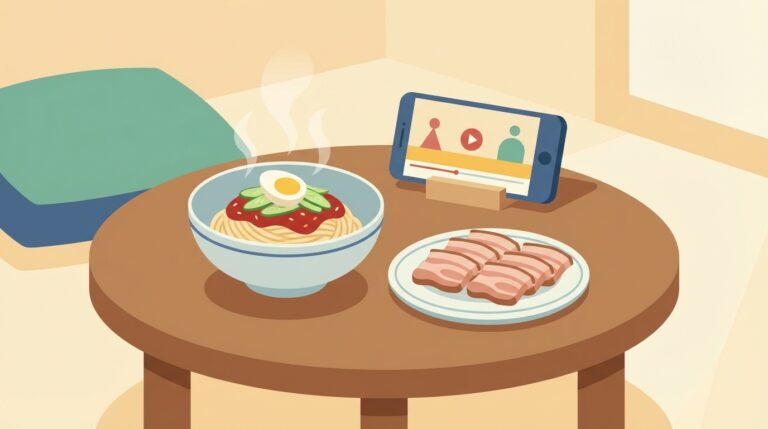
If you know, you know. They are talking about Bibimmyeon (비빔면)—Korea’s iconic spicy, sweet, and tangy cold instant noodles. It’s the ultimate summer comfort food, the mandatory K-Drama camping snack, and the undisputed king of midnight cravings (야식).
But here is the catch: cooking Bibimmyeon isn’t like cooking regular ramen. If you treat it like normal soup-based instant noodles, your Korean friends will gasp in horror. Today, we are not just learning vocabulary; we are mastering the art of the K-Midnight Snack. Let’s dive into the B2-level Korean expressions you need to cook, mix, and devour Bibimmyeon like a true local.
Phase 2: Deep Dive into Key Expressions
1. 찬물에 헹구다 (To rinse in cold water)
- Pronunciation: chanmure haeng-guda [chan-moo-reh heng-goo-dah]
- Meaning: Literal: To rinse in cold water / Real nuance: To shock the noodles in ice-cold water to achieve maximum chewiness.
- K-Culture Moment: In reality shows like In the SOOP, you’ll always see idols frantically running to the sink to wash the boiled noodles under the coldest tap water possible.
- Editor’s Insight: The verb ‘헹구다’ means to rinse out (like rinsing soap off dishes or shampoo out of hair). But in the kitchen, it’s the secret to reviving the noodles. If you don’t do this, your noodles will be a soggy disaster!
- Situation Spectrum:
[🚫 절대 금지] ———— [⚠️ 주의] ———— [✅ 자유롭게]- Casual/Friends: ✅
- Coworkers/Semi-formal: ✅
- Formal/Boss: ✅ (It’s an objective cooking term!)
- 🤔 Think About It: Why are Koreans so obsessed with the temperature of their food? Think about ‘이열치열’ (fighting fire with fire) for hot stews in summer, but demanding ice-cold water for noodles. Does your culture have strict rules about food temperature?
2. 물기를 쫙 빼다 (To drain the water completely)
- Pronunciation: mulgireul jjak ppaeda [mool-gee-reul jjahk ppeh-dah]
- Meaning: Literal: To subtract the moisture completely / Real nuance: To aggressively shake the strainer until not a single drop of water remains.
- K-Culture Moment: You’re at an MT (Membership Training) with your university club. The senior points at you and says, “물기 쫙 빼!” (Drain it completely!). If you leave water in, the spicy sauce will get diluted, and you’ll ruin the late-night vibe.
- Editor’s Insight: The magic word here is 쫙 (jjak). It’s a mimetic word (ideophone) that sounds like a wet sponge being squeezed dry in one swift motion. B2 learners, adding words like ‘쫙’ instantly makes your Korean sound 10 times more natural.
- Situation Spectrum:
- Casual/Friends: ✅
- Coworkers/Semi-formal: ⚠️ (Use ‘쫙 빼주세요’ to be polite)
- Formal/Boss: ⚠️
3. 꿀조합 (Honey combination / Perfect match)
- Pronunciation: kkul-jo-hap [kkool-jo-hahp]
- Meaning: Literal: Honey combination / Real nuance: A legendary food pairing that elevates the dish to heavenly status.
- K-Culture Moment: If you scroll through Korean food Instagram, every post about Bibimmyeon will feature 삼겹살 (Samgyeopsal – pork belly) or 골뱅이 (Golbaengi – sea snails). These aren’t just sides; they are ‘꿀조합’.
- Editor’s Insight: In Korean slang, adding ‘꿀’ (honey) to a noun means “amazing” or “highly beneficial” (e.g., 꿀팁 = great tip, 꿀알바 = easy/good part-time job).
- Situation Spectrum:
- Casual/Friends: ✅
- Coworkers/Semi-formal: ✅
- Formal/Boss: ⚠️ (A bit too trendy for a boardroom, but okay at a casual company dinner)
Phase 3: Textbook vs Real Life Korean
| Situation | 📖 Textbook Korean | 🗣️ Real Korean | 💡 Why is it different? |
|---|---|---|---|
| Mixing the noodles | 면과 소스를 섞으세요. (Mix the noodles and sauce.) | 오른손으로 비비고~ 왼손으로 비비고~ (Mix with the right hand~ with the left hand~) | Koreans rarely use ‘섞다’ (to blend/mix) for noodles. We use ‘비비다’ (to rub/mix aggressively). The phrase is from a legendary 1984 TV commercial that every Korean knows! |
| Suggesting a side dish | 삼겹살과 같이 먹으면 맛있습니다. (It is delicious if you eat it with pork belly.) | 삼겹살은 국룰이지! 완전 꿀조합이야. (Pork belly is the national rule! It’s a honey combo.) | ‘국룰’ (National Rule = unwritten societal rule) and ‘꿀조합’ reflect the Korean internet culture of sharing ultimate food hacks. |
| Emptying the water | 물을 버려주세요. (Please throw away the water.) | 물기 쫙 빼! (Drain it completely!) | ‘물을 버리다’ just means throwing out the liquid, but ‘물기를 빼다’ emphasizes removing the moisture from the noodles themselves. |
Bottom Note: For B2 learners, knowing the difference between 섞다 (mixing ingredients in a bowl) and 비비다 (tossing/rubbing noodles or rice with sauce, like in Bibimbap) is crucial for sounding fluent!
Phase 4: Cultural Deep Dive
4-1. Non-verbal Communication: The Art of ‘Nunchi’ in Portion Control
When someone asks, “Should I boil one or two?” your Nunchi (social awareness) must kick in. One is too little, but if you boil two, you might get full halfway. The unwritten K-Culture rule? Boil three packets for two people. It is the golden ratio of Korean late-night snacking.
4-2. K-Food Connection: The Symphony of Texture
Why do Koreans wash hot noodles in ice water? It’s all about 쫄깃함 (Jjolgit-ham), which translates to ‘chewiness’. But to a Korean, ‘jjolgit’ isn’t just a texture; it’s a culinary philosophy. Whether it’s tteokbokki, cold noodles, or pork belly skin, if it lacks that bouncy, elastic chew, it’s considered a failure. Rinsing Bibimmyeon removes the excess starch and shocks the wheat proteins, creating that perfect ‘jjolgit’ bite.
Phase 5: Immersive Roleplay Scenario
🎬 Setting: Friday night, 11:30 PM. You are staying at an Airbnb in Mapo-gu, Seoul, with your Korean friend, Minsu. You guys just finished watching a thrilling K-Drama episode, and the midnight cravings have hit hard. Minsu grabs two blue packets of Paldo Bibimmyeon from the cupboard.
Characters:
* YOU: An intermediate Korean learner who wants to prove your K-Food prowess.
* Minsu (30): Your best Korean friend. Takes his instant noodles very seriously.
[Dialogue begins]
Minsu: 아, 배고프다. 우리 비빔면 끓여 먹을래?
(Ah, baegopeuda. Uri bibimmyeon kkeuryeo meogeullae?)
[Ah, I’m hungry. Should we boil some Bibimmyeon?]
YOU: 완전 좋지! 내가 끓일까?
(Wanjeon jochi! Naega kkeurilkka?)
[Absolutely! Should I make it?]
Minsu: 오~ 자신 있어? 면발이 생명인 거 알지?
(O~ jasin isseo? Myeonbari saengmyeong-in geo alji?)
[Oh~ you confident? You know the noodle texture is life, right?]
YOU: 당연하지. 일단 면부터 삶고…
(Dangyeonhaji. Ildan myeonbuteo samgo…)
[Of course. First I’ll boil the noodles…]
(3 minutes later, the noodles are boiling vigorously)
Minsu: 야, 불 꺼! 지금이야! 빨리 가서 물 버려!
(Ya, bul kkeo! Jigeumiya! Ppalri gaseo mul beoryeo!)
[Hey, turn off the heat! Now’s the time! Hurry and throw the water away!]
🔀 Your Turn! How should you respond and act next?
- A) “응, 알겠어. 뜨거운 물 조금 남길게.” (Okay, I’ll leave a little hot water.)
- B) “응! 찬물에 헹궈서 물기 쫙 빼올게! 얼음 있어?” (Yeah! I’ll rinse it in cold water and drain it completely! Do we have ice?)
- C) “면을 소스랑 같이 끓일게!” (I’ll boil the noodles together with the sauce!)
✅ Best Choice: B — You not only know to rinse in cold water (찬물에 헹구다) and drain it completely (물기 쫙 빼다), but asking for ice proves you are a top-tier K-Food expert. Ice makes it extra jjolgit!
⚠️ Choice A/C Analysis: Leaving hot water or boiling the sauce like Jjapagetti will result in hot, mushy Bibimmyeon. Minsu might actually cry.
(You rinse the noodles in ice water and bring them to the table)
Minsu: 와, 물기 쫙 뺐네? 폼 미쳤다.
(Wa, mulgi jjak ppaetne? Pom michyeotda.)
[Wow, you completely drained the water? Your form is insane (slang for amazing).]
YOU: 당연하지. 오른손으로 비비고~ 왼손으로 비비고~
(Dangyeonhaji. Oreunsoneuro bibigo~ oensoneuro bibigo~)
[Of course. Mix with the right hand~ mix with the left hand~]
Minsu: ㅋㅋㅋ 너 한국인 다 됐구나. 참, 냉장고에 삼겹살 남은 거 있는데 구울까?
(Kkk neo hangugin da dwaetguna. Cham, naengjanggo-e samgyeopsal nameun geo itneunde gu-ulkka?)
[Hahaha you’ve practically become Korean. Oh, by the way, there’s some leftover pork belly in the fridge, should I grill it?]
YOU: 대박! 비빔면에 삼겹살은 진짜 꿀조합이지! 당장 구워!
(Daebak! Bibimmyeone samgyeopsareun jinjja kkuljohabiji! Dangjang guwo!)
[Awesome! Bibimmyeon and pork belly is truly a honey combo! Grill it right now!]
Phase 6: 10-Second Shadowing Drill
Let’s practice your natural Korean intonation! Pay attention to the pauses (/) and emotion tags.
😊 비빔면은 / 무조건 / 삼겹살이랑 / 먹어야죠! / 완전 꿀조합이에요!
(Bibimmyeoneun / mujogeon / samgyeopsarirang / meogeoyajyo! / wanjeon kkuljohabieyo!)
[You absolutely have to eat Bibimmyeon with pork belly! It’s a total honey combo!]
Pro-tip: Put heavy emphasis on ‘무조건’ (absolutely/unconditionally) and stretch the ‘완~전’ (completely) to sound like a true foodie.
Phase 7: K-Culture Glossary
| 한국어 (Korean) | Romanization | English | Cultural Context |
|---|---|---|---|
| 비비다 | bibida | To mix/rub | The action of mixing ingredients together without broth, like Bibimbap or Bibimmyeon. |
| 쫄깃쫄깃하다 | jjolgit-jjolgit-hada | Chewy/Bouncy | The most desired texture in Korean carbs (noodles, rice cakes). |
| 야식 | yasik | Midnight snack | A huge part of Korean culture, usually eaten between 10 PM and 2 AM. |
| 꿀조합 | kkul-jo-hap | Perfect pairing | Used for food, clothing, or even K-pop idol member units! |
| 국룰 | gung-nul | Unwritten rule | ‘National Rule’. Something everyone agrees is the right way to do things (e.g., Bibimmyeon + Meat). |
Phase 8: Traveler’s Survival Kit (Convenience Store Edition)
You are traveling in Korea, it’s midnight, and you want to make Bibimmyeon at your guesthouse. You head to the local GS25 or CU.
🆘 Survival Expressions TOP 3
- 🇰🇷 “얼음컵 제일 큰 거 어디 있어요?” (eoreum-keop jeil keun geo eodi isseoyo?)
- 🗣️ Where is the biggest ice cup? (You need ice to shock the noodles if your tap water isn’t cold enough!)
- 🇰🇷 “이거 전자레인지에 돌려도 돼요?” (igeo jeonja-reinji-e dollyeodo dwaeyo?)
- 🗣️ Can I microwave this? (Crucial for other foods, but remember: NO microwave for Bibimmyeon!)
- 🇰🇷 “같이 먹을 소시지 추천해 주실 수 있어요?” (gachi meogeul sosiji chucheonhae jusil su isseoyo?)
- 🗣️ Can you recommend a sausage to eat with this? (If you can’t grill pork belly, a convenience store sausage is your next best ‘꿀조합’.)
📌 Editor’s Travel Note
– Hot Water Dispenser: Korean convenience stores have hot water dispensers for cup noodles. If you buy Cup Bibimmyeon (컵비빔면), pour the hot water, wait 3 minutes, and look for the special puncture holes on the lid to drain the water safely into the sink. Do not drink that water!
Phase 9: Think Deeper — K-Food & Identity
🫠 Think Deeper: The Philosophy of Synergy in Korean Cuisine
In Korean food culture, dishes rarely exist in isolation. The concept of ‘꿀조합’ (Honey combination) reflects a broader cultural mindset: the belief in synergy. Just as Korean society historically relied on strong communal bonds (like agricultural co-ops called Pumasi), Korean food is about how different elements support each other. The cold, spicy tang of Bibimmyeon cuts through the rich, greasy fat of Samgyeopsal perfectly. They are incomplete without each other. This shows that in Korea, harmony isn’t just a social ideal; it’s served on a dinner plate.
💬 Your Turn: Does your culture have a “꿀조합” (perfect food pairing) that locals swear by? Share it in the comments below!
Phase 10: FAQ & Troubleshooting
- Q: Can I use “비비다 (bibida)” when I stir my coffee?
- A: NO! ⚠️ ‘비비다’ involves rubbing solid or semi-solid things together (like noodles and thick paste). For liquids like coffee or soup, you must use 저어주다 (jeo-eo-juda – to stir).
- Q: Can I say “꿀조합” to my boss at a formal dinner?
- A: Maybe. It’s slang, so if your boss is very traditional, stick to “잘 어울립니다” (It goes well together). But if it’s a casual, friendly team dinner (회식), using ‘꿀조합’ will make you sound very trendy and approachable!
❌ Common Mistake: Treating Cup Bibimmyeon like normal Cup Ramen.
Many foreigners accidentally add the spicy red sauce before pouring the hot water, creating a weird, watery red soup.
✅ How to do it right: Hot water first → Wait 3 mins → DRAIN ALL WATER (물기 짜 빼다!) → Add the red sauce → Mix (비비다).
Phase 11: Wrap-up & Action Missions
One-Liner Summary: To master the Korean midnight snack, remember to rinse your Bibimmyeon in cold water (찬물에 헹구다), drain it completely (물기 쫙 빼다), and find its perfect soulmate (꿀조합)!
Your Action Missions:
* 🥉 Bronze: Stand in your kitchen and practice saying “물기 쫙 빼주세요!” with a swift, hand-shaking motion.
* 🥈 Silver: Go to a Korean language forum or Twitter, and write a post: “비빔면이랑 (Your favorite food) 완전 꿀조합이에요!”
* 🥇 Gold: Head to a Korean supermarket, buy Paldo Bibimmyeon and some pork belly, and cook it for a friend while explaining the “Right hand, Left hand” mixing technique!
Phase 12: Interactive Challenge (Quiz)
1. Situational Judgment: You are at a Korean convenience store. You bought Cup Bibimmyeon. What must you NOT do?
* A) Look for the hot water dispenser.
* B) Add the red sauce packet along with the hot water before waiting 3 minutes.
* C) Poke holes in the lid to drain the water into the sink.
2. Fill in the Blank:
“치킨과 맥주(치맥)는 한국의 영원한 [ ]이다.”
(Fried chicken and beer is Korea’s eternal [ ].)
3. True or False – K-Culture Edition:
In Korean supermarkets, instant noodles (라면) are usually sold as single packets rather than bundles of 4 or 5. (T/F)
👉 Click here to see the answers!
- B (NEVER add the Bibimmyeon sauce into the hot water. It’s not soup! Drain the water first, then add the sauce.)
- 꿀조합 (kkul-jo-hap) – The perfect combination.
- False (F) – Koreans consume so much instant ramen that it is overwhelmingly sold in multi-packs (번들/묶음) rather than individual packets!
Frequently Asked Questions (FAQ)
Q: What does "찬물에 헹구다 (To rinse in cold water)" mean in Korean and how do you pronounce it?
A: In Korean, "찬물에 헹구다 (To rinse in cold water)" is pronounced [chanmure haeng-guda [chan-moo-reh heng-goo-dah] and means: Literal: To rinse in cold water / Real nuance: To shock the noodles in ice-cold water to achieve maximum chewiness.
Q: What does "물기를 쫙 빼다 (To drain the water completely)" mean in Korean and how do you pronounce it?
A: In Korean, "물기를 쫙 빼다 (To drain the water completely)" is pronounced [mulgireul jjak ppaeda [mool-gee-reul jjahk ppeh-dah] and means: Literal: To subtract the moisture completely / Real nuance: To aggressively shake the strainer until not a single drop of water remains.
Q: What does "꿀조합 (Honey combination / Perfect match)" mean in Korean and how do you pronounce it?
A: In Korean, "꿀조합 (Honey combination / Perfect match)" is pronounced [kkul-jo-hap [kkool-jo-hahp] and means: Literal: Honey combination / Real nuance: A legendary food pairing that elevates the dish to heavenly status.







