

Hello! I’m the Senior Editor of Daily Hangul. As someone who has lived in Seoul for over a decade and taught Korean to countless expats and travelers, I know exactly what your first ‘panic moment’ in Korea will be.
Picture this: You are at a beautiful, aesthetic café in Seongsu-dong. You’ve just finished your delicious iced Americano. Nature calls. You find the restroom door, but wait… there’s a glowing digital keypad. You pull the handle, but it’s locked. You rush back to the counter, panicking, but the barista is busy making lattes. How do you ask for the password?
In K-Dramas, you rarely see the main characters asking for bathroom codes. But in real life? This is a true survival skill in Korea. Knowing how to navigate the ‘digital lock’ culture will instantly make you look like a local insider.
Let’s dive into the ultimate guide to surviving Korean restrooms!
Phase 2: Deep Dive into Core Expressions
1. 화장실 비밀번호가 뭐예요?
- Pronunciation: [hwajangsil bimilbeonhoga mwoyeyo?] (hwa-jang-shil sounds like ‘hwa’ + ‘jang’ + ‘sheel’. ‘bimil’ sounds like ‘bee-meal’.)
- Meaning: What is the restroom password? (Literal: Restroom secret number is what?)
- K-Culture Moment: You’ll use this everywhere—cafés, restaurants, and PC bangs. In Korea, almost every door has a digital keypad!
- Editor’s Insight: ‘비밀’ (bimil) means ‘secret’, and ‘번호’ (beonho) means ‘number’. It sounds like a spy movie, right? But it’s just the everyday word for ‘password’ or ‘code’.
- Situation Spectrum:
[🚫 절대 금지] ———— [⚠️ 주의] ———— [✅ 자유롭게]
- Close Friends (Casual): ⚠️ (Friends usually don’t know the café’s code!)
- Café Staff/Strangers (Polite/Formal): ✅
- 🤔 Think About It: Why does Korean use the word “secret number” instead of just “code”? It reflects how privacy and security are embedded in modern Korean living!
2. 영수증 밑에 있어요.
- Pronunciation: [yeongsujeung mite isseoyo.] (yeong-soo-jeung mee-teh ee-sseo-yo.)
- Meaning: It’s at the bottom of the receipt.
- K-Culture Moment: You ask the busy barista for the code, and they just point at the tiny piece of paper on your tray. This is the phrase you will hear the most!
- Editor’s Insight: Don’t throw away your receipt in Korea until you’ve used the bathroom! Staff often print the Wi-Fi and restroom passwords there to save time.
- Situation Spectrum:
[🚫 절대 금지] ———— [⚠️ 주의] ———— [✅ 자유롭게]
- Listening to Staff: ✅
- 🤔 Think About It: How does printing the password on the receipt reflect the famous ‘Pali-pali’ (hurry up) culture of Korea?
3. 휴지 있어요?
- Pronunciation: [hyuji isseoyo?] (hue-jee ee-sseo-yo?)
- Meaning: Is there toilet paper?
- K-Culture Moment: In older buildings, the toilet paper isn’t inside the stall. It’s on a giant roll outside the restroom or right next to the café counter!
- Editor’s Insight: Always check for ‘휴지’ before you enter. If you don’t see any inside, you might have to do the ‘awkward walk’ back to the counter.
- Situation Spectrum:
[🚫 절대 금지] ———— [⚠️ 주의] ———— [✅ 자유롭게]
- Asking staff/friends: ✅
Phase 3: Textbook vs Real Life
| Situation | 📖 Textbook Korean | 🗣️ Real Korean | 💡 Why is it different? |
|---|---|---|---|
| Asking the code | 화장실 비밀번호를 알려주시겠습니까? (Could you please inform me…) | 화장실 비밀번호요. (Restroom password, please.) | Koreans prefer efficient, shortened phrases in fast-paced service environments. |
| Answering | 화장실 비밀번호는 1234번 입니다. (The code is 1234.) | 일이삼사(1234)에 별(*)이요. (1234 and the star key.) | Staff skip the pleasantries and give you exactly the buttons you need to press. |
Bottom Note: For A2 learners, simply adding ‘요 (yo)’ to the end of a noun (like 비밀번호요) is a perfectly polite and natural way to ask for something quickly!
Phase 4: Cultural Deep Dive
4-1. Non-verbal Communication (The Art of Nunchi)
Before you ask the staff, use your 눈치 (Nunchi – situational awareness). Look at your receipt first! Also, look around the pickup counter. Often, there is a small chalkboard or a laminated sign that says “WIFI / 화장실 (Restroom)” with the codes written on it.
4-2. K-Culture Connection: The Giant Keychain Trope
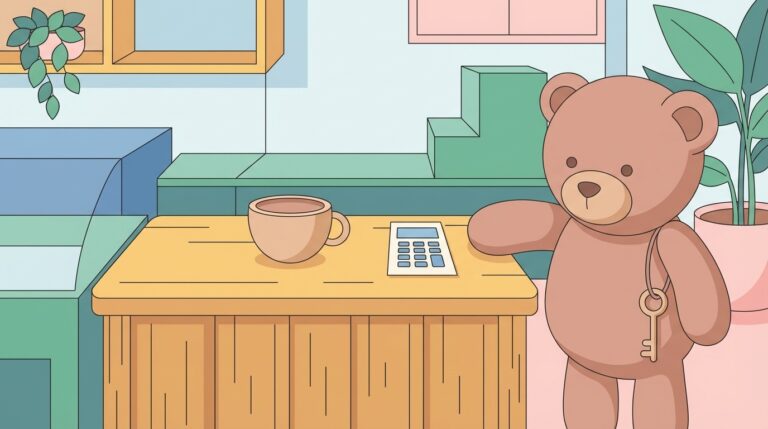
Sometimes, instead of a password, the café staff will hand you a physical key. But wait—it’s attached to a giant, 50cm-long Ryan plushie, a wooden ladle, or a massive plastic flower!
Why? Because people kept losing or stealing the small keys. It’s a hilarious part of Korean café culture. If a staff member hands you a giant teddy bear when you ask “화장실 어디예요?” (Where is the restroom?), just hug it and walk confidently to the bathroom. You are experiencing true local culture!
Phase 5: Immersive Roleplay
Setting: It’s 2 PM on a Saturday at a trendy, crowded café in Hongdae. You really need to go to the bathroom. You walk up to the busy barista.
YOU: 저기요! (Excuse me!)
(jeogiyo!)
[Translation: Excuse me!]
(🎭 Stage Direction: The barista looks up from the espresso machine.)
Barista: 네, 주문하시겠어요? ☕
(ne, jumunhasigesseoyo?)
[Translation: Yes, would you like to order?]
YOU: 아, 아니요.
(a, aniyo.)
[Translation: Oh, no.]
🔀 Your Turn! How do you ask for the code?
– A) “화장실 비밀번호를 알려주시겠습니까?”
– B) “화장실 비밀번호요!”
– C) “비밀번호 줘!”
✅ Best Choice: B — It’s polite but efficient. Perfect for a busy café!
⚠️ Choice A Analysis: It’s grammatically perfect but sounds like a robot or a news anchor.
🚫 Choice C Analysis: This is casual/informal (Banmal). Never use this with service staff!
(Assuming you chose B)
Barista: 아, 영수증 하단에 적혀있어요. 🧾
(a, yeongsujeung hadane jeokhyeoisseoyo.)
[Translation: Oh, it’s written at the bottom of the receipt.]
YOU: 영수증… 아! 찾았어요. 감사합니다!
(yeongsujeung… a! chajasseoyo. gamsahamnida!)
[Translation: Receipt… Ah! Found it. Thank you!]
Barista: 별표() 꼭 누르세요!
*(byeolpyo kkok nureuseyo!)
[Translation: Make sure to press the star key!]
Phase 6: 10-Second Shadowing Drill
Let’s practice the most important sentence. Speak it out loud with the right emotion!
🥺 저기요, / 화장실 비밀번호가 / 뭐예요?
(jeogiyo, / hwajangsil bimilbeonhoga / mwoyeyo?)
Tip: Pause slightly at the slashes (/). Say it with a slight look of urgency (🥺) so the barista knows it’s an emergency!
Phase 7: K-Culture Glossary
| 한국어 (Korean) | Romanization | English | Cultural Context |
|---|---|---|---|
| 도어락 | doeorak | Digital Door Lock | Found on 99% of doors in Korea, from homes to public restrooms. |
| 영수증 | yeongsujeung | Receipt | The holy grail of café info. Holds Wi-Fi and restroom codes. |
| 별표 | byeolpyo | Star key (*) | Most Korean digital locks require you to press * after the numbers. |
| 우물정 | umuljeong | Pound key (#) | Sometimes used instead of the star key to enter the code. |
| 화장실 | hwajangsil | Restroom/Toilet | Literally means “makeup room.” |
Phase 8: Traveler’s Survival Kit
🆘 Survival Phrases for Restrooms
– 🇰🇷 “화장실 어디예요?” (hwajangsil eodiyeyo?) – Where is the restroom?
– 🇰🇷 “휴지 있어요?” (hyuji isseoyo?) – Do you have toilet paper?
– 🇰🇷 “여기 열쇠…” (yeogi yeolsoe…) – Here is the key… (When returning the giant plushie key!)📌 Editor’s Travel Note
– Free Bathrooms: If you can’t find a café, look for a subway station! Korean subway stations have incredibly clean, free public restrooms. Just follow the toilet icon.
– Don’t Flush It!: In some older buildings, you will see a small trash can next to the toilet. This means the plumbing is old, and you should throw used toilet paper in the bin, NOT the toilet.
Phase 9: Think Deeper — “One Step Further”
Trust Culture (Laptops vs. Bathrooms)
🧠 Think Deeper:
Have you noticed the funny irony in Korean cafés? You can leave your $2,000 MacBook, your iPhone, and your wallet on a table to reserve your seat, and absolutely no one will steal them. Korea is famous for this high-trust culture. Yet, the restroom door is strictly locked with a 4-digit code! Why?
It’s not about fearing theft; it’s about maintenance and hygiene. In dense cities like Seoul, café owners lock restrooms to ensure only paying customers use them, keeping them perfectly clean. The digital lock is a boundary of service, not a barrier of distrust.💬 Your Turn: Does your country have locked restrooms in cafés? How do people reserve seats in your culture? Tell me in the comments!
Phase 10: FAQ & Troubleshooting
Q: “Can I just walk into a café and use the restroom without buying anything?”
A: Usually, no. The digital lock is specifically there to prevent this. However, if it’s a true emergency, you can buy a cheap bottled water or politely ask, “정말 죄송한데, 화장실 좀 써도 될까요?” (I’m so sorry, but may I use the restroom?).
Q: “The code is 1234. Do I read it as Hana-Dul-Set-Net or Il-Ee-Sam-Sa?”
A: Great question! For passwords and phone numbers, Koreans use Sino-Korean numbers: Il-Ee-Sam-Sa.
❌ Common Mistake #1: Forgetting to press the * (Star) or # (Pound) key at the end.
✅ Do this instead: Most Korean door locks won’t open just by typing the numbers. You almost always have to press * or # to ‘enter’ the code. Listen for the satisfying digital ti-ri-ri-ring! sound.
Phase 11: Wrap-up & Action Items
One-Liner Summary: To survive Korean cafés, always check your receipt (영수증) for the restroom password (비밀번호) before asking the staff!
🎯 Action Missions:
– 🥉 Bronze (Solo): Look at a piece of paper and practice saying “화장실 비밀번호가 뭐예요?” out loud 3 times.
– 🥈 Silver (Online): Comment below with the Korean word for “Receipt”!
– 🥇 Gold (Real Life): Next time you are at a Korean café or restaurant, find the restroom code on your own by checking the receipt or the counter signs!
🌟 K-Culture Mission:
Next time you watch a K-Vlog on YouTube of someone café-hopping in Seoul, look closely at their tray. Can you spot the receipt with the code printed on it?
Phase 12: Interactive Quiz
Let’s test your survival skills!
1. You ask the barista for the code, and they say “영수증 하단에 있어요.” What should you do?
A) Ask them to speak English.
B) Look at the bottom of your receipt.
C) Wait for them to write it down.
2. Fill in the blank: “화장실 __________가 뭐예요?” (What is the restroom password?)
A) 전화번호 (jeonhwabeonho – phone number)
B) 비밀번호 (bimilbeonho – password)
C) 주민번호 (juminbeonho – ID number)
3. True or False – K-Culture Edition:
If a café staff member hands you a giant stuffed Ryan doll when you ask for the bathroom, it means you won a prize! (T/F)
(Scroll down for answers)
Answers:
1. B (yeongsujeung = receipt, hadan = bottom)
2. B (bimilbeonho = secret number/password)
3. False (It’s just the bathroom key attached to a plushie so you don’t lose it!)
Frequently Asked Questions (FAQ)
Q: What does "화장실 비밀번호가 뭐예요?" mean in Korean and how do you pronounce it?
A: In Korean, "화장실 비밀번호가 뭐예요?" is pronounced [hwajangsil bimilbeonhoga mwoyeyo?] and means: What is the restroom password? (Literal: Restroom secret number is what?)
Q: What does "영수증 밑에 있어요." mean in Korean and how do you pronounce it?
A: In Korean, "영수증 밑에 있어요." is pronounced [yeongsujeung mite isseoyo.] and means: It's at the bottom of the receipt.
Q: What does "휴지 있어요?" mean in Korean and how do you pronounce it?
A: In Korean, "휴지 있어요?" is pronounced [hyuji isseoyo?] and means: Is there toilet paper?







