

Phase 1: 공감 — 몰입형 오프닝 (Immersive Hook)
Hello, language learners! It’s your Daily Hangul Editor here.
Imagine this: You’re sitting in a beautiful, brightly lit banquet hall in Seoul. You’ve just finished your first plate from the luxurious buffet. Suddenly, the lights go out. A cinematic countdown flashes on the big screen, followed by epic background music that sounds like a blockbuster movie trailer. But the star of this movie? A one-year-old baby.
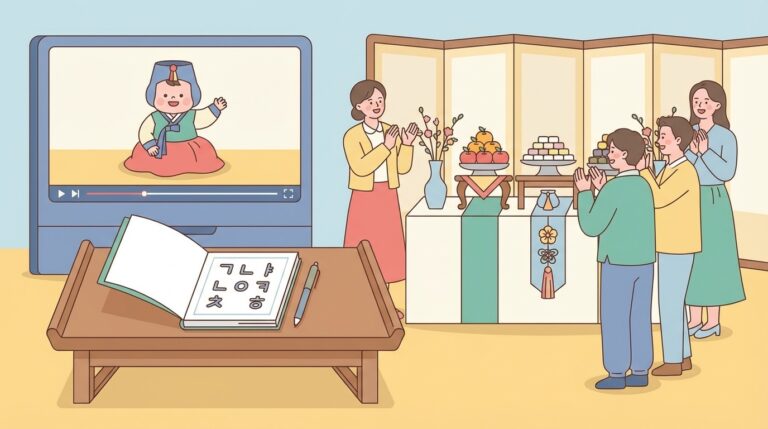
Welcome to the highlight of a Doljanchi (돌잔치, Korean first birthday party)—the 아기 성장 동영상 (Baby Growth Video) screening!
If you’re invited to a Korean colleague’s or friend’s baby’s first birthday, you are witnessing one of the most important milestones in Korean culture. But as the video plays—showing the baby’s birth, their first steps, and funny bloopers—you might hear the Korean guests around you gasping, laughing, and constantly making comments.
If you just sit there silently eating your cake, you’ll miss a huge opportunity to show your Jeong (정, affection/connection). Knowing the right things to say at this exact moment will instantly upgrade your status from ‘foreign guest’ to ‘beloved insider.’ This guide is based on real SOS messages from my expat students who felt awkward during these videos. Let’s dive in!
Phase 2: 핵심 표현 심층 분석 (Deep Dive)
Here are the top 3 expressions you need to actively react during the video.
1. 아기 진짜 많이 컸네요!
- Pronunciation: [agi jinjja mani keonneyo] -> (ah-gi jeen-jja mah-ni kuh-neh-yo)
- Meaning: The baby has really grown a lot! (Literal) / Look how big they’ve gotten! (Real nuance)
- K-Culture Moment: You’ll hear this exactly when the video transitions from the newborn hospital photos to the baby walking around the living room.
- Editor’s Insight: This isn’t just an observation; it’s a compliment to the parents. It acknowledges their hard work over the past year. Emphasize the ‘진짜’ (really) for extra sincerity.
- Situation Spectrum:
[🚫 절대 금지] ———— [⚠️ 주의] ———— [✅ 자유롭게]
- Casual (Friends): ✅ (Drop the ‘요’ -> 아기 진짜 많이 컸네!)
- Semi-formal (Coworkers): ✅
- Formal (Boss/Elders): ⚠️ (Use ‘아기가 정말 많이 컸습니다’)
- 🤔 Think About It: Why do Koreans focus so much on commenting about growth and eating well? How does your culture compliment babies?
2. 엄마(아빠)랑 똑같이 생겼어요!
- Pronunciation: [eomma(appa)-rang ttokgachi saenggyeosseoyo] -> (um-ma/ah-ppa-rang ttok-gah-chi sang-gyuh-ssuh-yo)
- Meaning: Looks exactly like mom (or dad)!
- K-Culture Moment: Usually, the video features side-by-side photos of the parents when they were babies next to the birthday baby. This is your cue to say this!
- Editor’s Insight: The word ‘똑같이’ means ‘exactly the same.’ It sounds like ‘ttok’ (like the sound of two identical puzzle pieces clicking together). It’s a massive crowd-pleaser for the parents.
- Situation Spectrum:
[🚫 절대 금지] ———— [⚠️ 주의] ———— [✅ 자유롭게]
- Casual: ✅
- Semi-formal: ✅
- Formal: ⚠️
- 🤔 Think About It: In Korean families, finding physical resemblances is a big bonding activity. Who do you look like in your family?
3. 영상 보니까 눈물 날 것 같아요.
- Pronunciation: [yeongsang bonikka nunmul nal geot gatayo] -> (young-sang bo-ni-kka noon-mool nal gut gah-tah-yo)
- Meaning: Watching the video, I think tears will come out. (Literal) / This video is making me tear up. (Real nuance)
- K-Culture Moment: At the end of the video, there is almost always a slow-motion montage of the baby sleeping, paired with an emotional ballad (like a K-Drama OST) and a heartfelt letter from the parents on the screen.
- Editor’s Insight: You don’t actually have to cry! In Korea, expressing that something makes you emotional is a polite way of praising how touching the moment is.
- Situation Spectrum:
[🚫 절대 금지] ———— [⚠️ 주의] ———— [✅ 자유롭게]
- Casual: ✅
- Semi-formal: ✅
- Formal: ✅
- 🤔 Think About It: Why is sharing emotions (even mild sadness or being moved to tears) so socially acceptable and even encouraged in Korean group settings?
Phase 3: 교과서 vs 진짜 한국어 (Textbook vs Real Life)
| 상황 | 📖 교과서 한국어 | 🗣️ 진짜 한국어 | 💡 왜 다를까? |
|---|---|---|---|
| Reacting to a cute scene | 아기가 참 귀엽습니다. (The baby is very cute.) | 헐, 너무 귀여워! ㅠㅠ (Heol, so cute! [crying eyes]) | ‘헐’ (Heol) is a versatile exclamation of pleasant surprise. Textbook Korean is too stiff for babies! |
| Parent asks if you liked the video | 네, 아주 잘 보았습니다. (Yes, I watched it very well.) | 와, 완전 감동이었어요! (Wow, it was totally touching!) | Koreans love adding ‘완전’ (totally/completely) to emphasize emotional reactions. |
| Commenting on the baby’s health | 아기가 건강해 보입니다. (The baby looks healthy.) | 통통해서 진짜 예뻐요! (So pretty because they are chubby!) | In baby context, ‘통통하다’ (chubby) is a huge compliment implying good health. |
Phase 4: 문화적 맥락 — K-Culture 딥다이브 (Cultural Deep Dive)
4-1. 비언어적 요소 (Non-verbal Communication)
In Korea, Nunchi (눈치) is everything. During the video, you shouldn’t just stare blankly like you’re watching a boring lecture.
– The ‘Awww’ Factor: You must actively make sound effects. “아이고~” (Aigo~) when the baby falls over, or “우와~” (Ooh-wa~) when they do something smart.
– Clapping: When the video ends, clap enthusiastically!
4-2. K-Culture Connection: The ‘Blockbuster’ Baby Video
If you watch K-Dramas, you know Koreans are masters of editing. This skill spills over into everyday life! Parents often hire professional editors or spend weeks editing the Doljanchi video themselves.
They frequently parody famous K-Movie trailers, K-Drama openings, or even K-Pop music videos. You might see the baby’s face photoshopped onto an Iron Man suit, or dramatic subtitles like “In the year 2023… a crying hero was born.” Recognizing the effort put into the video and reacting like it’s a real movie premiere is the best way to show your support.
Phase 5: 실전 롤플레이 시나리오 (Immersive Roleplay)
시나리오 A: 메인 롤플레이 (Main Scenario)
- Setting: A Saturday afternoon at an upscale buffet in Gangnam. The 5-minute baby growth video just finished playing. The lights come back on, and the MC is walking to the stage.
- Characters:
- YOU: An expat working in Korea, attending your team leader’s baby’s Doljanchi.
- Minsu (32): Your friendly Korean coworker sitting next to you.
Minsu: 와, 영상 진짜 잘 만들었네요. 그쵸?
(wa, yeongsang jinjja jal mandeureonneyo. geucho?)
[Wow, they made the video really well. Right?]
(🎭 Stage Direction: Minsu wipes a fake tear from his eye and smiles at you)
YOU: 네! 영화 예고편인 줄 알았어요.
(ne! yeonghwa yegopyeonin jul arasseoyo.)
[Yes! I thought it was a movie trailer.]
Minsu: 팀장님 아기, 팀장님이랑 완전 붕어빵이지 않아요?
(timjangnim agi, timjangnimirang wanjeon bungeoppangiji anayo?)
[The team leader’s baby is a total ‘Bungeoppang’ (exact lookalike) of the team leader, right?]
🔀 당신의 차례! 어떻게 대답할까요? (Your Turn!)
– A) “아니요, 엄마를 더 닮았어요.” (No, they look more like the mom.)
– B) “맞아요! 아빠랑 똑같이 생겼어요!” (That’s right! Looks exactly like the dad!)
– C) “붕어빵이 뭐예요? 먹는 거 아니에요?” (What is Bungeoppang? Isn’t that food?)✅ Best Choice: B — Agreeing enthusiastically creates a great bonding moment.
⚠️ Choice C Analysis: ‘Bungeoppang’ is a fish-shaped pastry, but in slang, it means two people look exactly identical (like pastries from the same mold). Asking is okay, but it breaks the emotional flow!
시나리오 B: K-Culture 보너스 롤플레이 (Bonus Scenario)
After the event, you run into the Team Leader (the baby’s dad) at the exit while receiving your Damnyepum (thank-you gift).
Team Leader: 와주셔서 감사합니다. 식사는 괜찮으셨어요?
(wajusyeoseo gamsahamnida. siksaneun gwaenchaneuseosseoyo?)
[Thank you for coming. Was the meal okay?]
YOU: 네, 정말 맛있었어요! 영상 보니까 눈물 날 것 같았어요.
(ne, jeongmal masisseosseoyo! yeongsang bonikka nunmul nal geot gatasseoyo.)
[Yes, it was really delicious! Watching the video made me feel like crying.]
Team Leader: 하하, 예쁘게 봐주셔서 감사합니다!
(haha, yeppeuge bwajusyeoseo gamsahamnida!)
[Haha, thank you for looking at it so kindly!]
Phase 6: 10초 섀도잉 드릴 (Shadowing Drill)
Practice this out loud! Listen to the emotion.
🥺 아이고~ / 영상 보니까 / 눈~~~물 날 것 같아요!
(ai-go~ / young-sang bo-ni-kka / noon~~~mool nal gut gah-tah-yo!)
Tip: Drag out the ‘눈’ (noon) to sound genuinely moved! Pause slightly at the slashes.
Phase 7: K-Culture 미니 사전 (K-Culture Glossary)
| 한국어 | Romanization | English | 맥락 설명 |
|---|---|---|---|
| 돌잔치 | Doljanchi | First Birthday Party | A huge celebration in Korea. Historically, surviving the first year was a big deal. |
| 돌잡이 | Doljabi | Fortune Draw | The baby chooses an item (money, stethoscope, thread, etc.) predicting their future. |
| 축의금 | Chuguigeum | Congratulatory Money | You bring cash in a white envelope instead of a physical toy. Usually 50k-100k KRW. |
| 답례품 | Damnyepum | Return Gift | A small gift (usually nice towels, soap, or salt) given to guests as they leave. |
| 붕어빵 | Bungeoppang | Look-alike | Slang for someone who looks identical to their parent. |
Phase 8: 여행자 서바이벌 키트 (Traveler’s Survival Kit)
Even if you aren’t attending a Doljanchi, you will encounter cute babies while traveling in Korea (on the subway, at cafes, etc.). Here is how to navigate those moments safely!
🆘 서바이벌 표현 TOP 3
– 🇰🇷 “아기가 참 예쁘네요!” (agiga cham yeppeuneyo! – The baby is so pretty!)
– 🇰🇷 “몇 개월이에요?” (myeot gaeworieyo? – How many months old are they?)
– 🇰🇷 “안녕~” (an-nyeong~ – Bye/Hello! Only say this to the baby, not the parents!)📌 Editor’s Travel Note
– Look, don’t touch! In the past, older Koreans would easily touch a stranger’s baby out of affection. Today, modern parents strongly dislike this. Praise them from a distance!
– Picture Etiquette: Never take photos of Korean babies without explicit permission. Privacy laws and awareness are very strict here.
Phase 9: 비판적 사고 코너 — “한 발 더 깊이” (Think Deeper)
🧠 Think Deeper: 언어와 사회 (Language & Society)
Why is a baby’s first birthday such a massive, expensive event in Korea? Historically, before modern medicine, many infants didn’t survive their first year. Doljanchi was a village-wide celebration of survival. Today, with Korea having one of the lowest birth rates in the world, a baby is precious on a whole different level. The elaborate growth videos and luxury buffets reflect modern parents pouring all their resources and love into their (often only) child. It’s a mix of deep tradition and modern social pressure.
💬 Your Turn: How is a baby’s first birthday celebrated in your culture? Is it a family-only event, or a huge party? Share in the comments!
Phase 10: FAQ & 오해 방지 (Troubleshooting)
Q: Do I have to bring a physical gift for the baby?
No! In fact, parents prefer 축의금 (Chuguigeum – Congratulatory Money). Put crisp new bills in a white envelope with your name on it. For a coworker, 50,000 KRW is standard; for a close friend, 100,000 KRW.
Q: The baby is a boy. Can I still say “예쁘다” (pretty)?
Yes! In Korean, ‘예쁘다’ applied to babies or children means ‘cute/adorable’ regardless of gender.
❌ 흔한 실수 (Common Mistake):
Saying “아기가 뚱뚱해요” (The baby is fat).
✅ 이렇게 하세요 (Do this instead):
Say “아기가 통통하네요!” (The baby is delightfully chubby/healthy!). ‘뚱뚱하다’ has a negative, clinical nuance. ‘통통하다’ is cute and positive.
Phase 11: 요약 및 액션 아이템 (Wrap-up)
One-Liner Summary: Treat the Doljanchi baby video like a movie premiere—react with bright eyes, ‘awwws,’ and tell the parents how much the baby has grown!
Action Mission 3단계:
– 🥉 Bronze: Say “아기 진짜 많이 컸네요!” 3 times in front of the mirror with a big smile.
– 🥈 Silver: Search “돌잔치 성장 동영상” (Doljanchi growth video) on YouTube and watch one to see the K-Drama style editing!
– 🥇 Gold: Next time you see a Korean friend’s baby photo on Instagram, leave a comment: “우와~ 엄마(아빠)랑 똑같이 생겼어요!”
Phase 12: 퀴즈 — 인터랙티브 챌린지 (Interactive Quiz)
1. 상황 판단 (Situational Judgment):
The video shows a photo of the baby’s dad when he was little. The baby looks exactly like him. What is the most natural thing to say?
– A) 아기가 뚱뚱하네요!
– B) 헐, 아빠랑 붕어빵이에요!
– C) 영상을 잘 보았습니다.
2. True or False – K-Culture Edition:
“If you see a cute baby on the Seoul subway, it is perfectly fine to reach out and hold their hand to show affection.”
(Answers below!)
정답 보기 (Click for Answers)
1. B (‘붕어빵’ is the perfect slang for looking exactly alike. A is rude, C is too robotic.)
2. False (Modern Korean parents are very protective. Always admire from a distance and avoid touching strangers’ babies!)
Frequently Asked Questions (FAQ)
Q: What does "아기 진짜 많이 컸네요!" mean in Korean and how do you pronounce it?
A: In Korean, "아기 진짜 많이 컸네요!" is pronounced [agi jinjja mani keonneyo] and means: The baby has really grown a lot! (Literal) / Look how big they've gotten! (Real nuance)
Q: What does "엄마(아빠)랑 똑같이 생겼어요!" mean in Korean and how do you pronounce it?
A: In Korean, "엄마(아빠)랑 똑같이 생겼어요!" is pronounced [eomma(appa] and means: Looks exactly like mom (or dad)!
Q: What does "영상 보니까 눈물 날 것 같아요." mean in Korean and how do you pronounce it?
A: In Korean, "영상 보니까 눈물 날 것 같아요." is pronounced [yeongsang bonikka nunmul nal geot gatayo] and means: Watching the video, I think tears will come out. (Literal) / This video is making me tear up. (Real nuance)







