

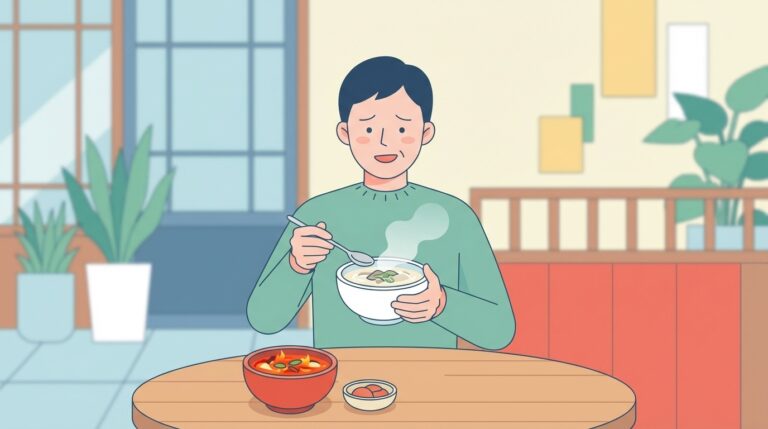
Phase 1: Immersive Hook — The Spicy Survival Secret
Hello! I’m the Daily Hangul Editor, your local Korean friend and veteran tutor.
Picture this: You are watching a K-Drama. The main characters are sitting at a cozy local restaurant, drinking Soju, and eating a bubbling, fiery red stew. Fast forward to reality—you are in Seoul, you sit at a similar restaurant, but there’s a problem. You cannot handle spicy food.
You open your translator app, panicking, trying to figure out how to say “Please don’t make it spicy!” But what if I told you that the secret to surviving Korean food and shopping just comes down to knowing one simple color?
Yes, today we are talking about White (흰색).
Knowing how to use the color “white” in Korea isn’t just about describing a cloud or a T-shirt. It is your ultimate survival tool for ordering mild food, navigating shopping districts, and understanding Korean history. Let’s dive in!
Phase 2: Deep Dive into Core Expressions
1. 하얀색 (White color)
- Pronunciation: [Hayan-saek] Sounds like “Hah-yan-sack”
- Meaning: White (Literal) / Clean, pure, non-spicy (Real nuance)
- K-Culture Moment: Think of K-Pop idols wearing matching angelic “Hayan-saek” outfits for their comeback stages, or a K-Drama scene where the first snow (첫눈) falls, covering the world in white.
- Editor’s Insight: This is the most common and friendly way to say “white” in daily conversation. It has a soft, warm feeling to it.
- Situation Spectrum:
[🚫 절대 금지] ———— [⚠️ 주의] ———— [✅ 자유롭게]
- Casual with friends: ✅
- Semi-formal (Co-workers): ✅
- Formal (Boss/Elders): ✅ (It’s just a color! Safe to use anywhere.)
- 🤔 Think About It: Why do you think K-Dramas place such a huge emphasis on the “first white snow”? How does your culture view snow?
2. 흰색 (White color)
- Pronunciation: [Huin-saek] Sounds like “Heen-sack” (say ‘H’ and ‘een’ together quickly)
- Meaning: White (Literal)
- K-Culture Moment: When you are shopping in Myeongdong or Hongdae, you’ll point at a shirt and say, “Do you have this in Huin-saek?”
- Editor’s Insight: ‘흰색’ is slightly shorter and very commonly used when shopping for clothes, shoes, or cars. It’s perfectly interchangeable with ‘하얀색’ for A1 learners.
- Situation Spectrum:
[🚫 절대 금지] ———— [⚠️ 주의] ———— [✅ 자유롭게]
- Casual with friends: ✅
- Semi-formal: ✅
- Formal: ✅
- 🤔 Think About It: Does your language have multiple words for the same color based on whether it’s an adjective or a noun?
3. 하얀 국물 (White broth)
- Pronunciation: [Hayan gungmul] Sounds like “Hah-yan goong-mool”
- Meaning: White broth (Literal) / Mild, non-spicy soup (Real nuance)
- K-Culture Moment: This is your K-Food lifesaver! Many Korean soups, like Seolleongtang (bone broth), are naturally white. If you ask for “Hayan gungmul,” the chef won’t add the spicy red pepper paste.
- Editor’s Insight: Instead of struggling to say “not spicy,” just ask for the white broth. It instantly makes you sound like a true local!
- Situation Spectrum:
[🚫 절대 금지] ———— [⚠️ 주의] ———— [✅ 자유롭게]
- At any restaurant: ✅
- 🤔 Think About It: Korean cuisine perfectly balances fiery red dishes with calming white dishes. What is the “calming” food in your home country?
Phase 3: Textbook vs Real Life
| 상황 (Situation) | 📖 교과서 한국어 (Textbook) | 🗣️ 진짜 한국어 (Real Life) | 💡 왜 다를까? (Why the difference?) |
|---|---|---|---|
| Ordering non-spicy soup | 안 맵게 해 주세요. (Make it not spicy.) | 하얀 국물로 주세요. (Give me white broth.) | Asking for “white broth” is a cultural shorthand for “leave out the spicy red paste.” |
| Buying a white shirt | 백색 셔츠 있습니까? (Do you have a white-colored shirt?) | 흰색 있어요? / 하얀색 있어요? (Do you have white?) | ‘백색’ (Baek-saek) is a formal Sino-Korean word. Locals use native Korean words for colors in daily life. |
Bottom Note: As an A1 beginner, stick to 하얀색 (Hayan-saek) or 흰색 (Huin-saek). You don’t need to worry about complex grammar yet—just say the color + “주세요” (ju-se-yo / please give me).
Phase 4: Cultural Deep Dive — K-Culture & The Color White
4-1. Non-verbal Communication: The “White” Etiquette
In Korea, white is the color of purity and respect. Traditionally, Koreans were called 백의민족 (Baeguiminjok), meaning “the white-clad people,” because commoners wore white hanbok daily. Even today, at traditional Korean funerals, you will often see white chrysanthemums used to show respect.
4-2. K-Food Connection: The Red vs. White Battle
If you watch K-Dramas, you’ll see characters eating bright red Tteokbokki or Kimchi Jjigae when they are stressed. But what do they eat in the morning to soothe their stomach? A steaming bowl of white Seolleongtang (ox bone soup) or Hwangtae Guk (dried pollack soup).
Critical Insight: Why are Korean foods so spicy? Historically, red chili peppers were introduced late to Korea, but they quickly became a cheap way to add robust flavor and preserve food. However, the true “soul food” of Korea—the deep, slow-boiled bone broths—are almost always proudly white. Knowing this duality is the key to mastering Korean dining!
Phase 5: Immersive Roleplay Scenario
Scenario A: The K-Food Survival Test
Setting: It’s 12:30 PM. You are at a bustling traditional Gukbap (soup and rice) restaurant near Gangnam Station. The ajumma (restaurant auntie) is rushing around. You are with your Korean coworker, Minsu. You want to order soup, but you see red chili paste on everyone’s tables.
Characters:
– YOU: A hungry foreigner who cannot eat spicy food.
– Minsu (32): Your friendly Korean coworker.
– Ajumma (50s): The fast-paced restaurant owner.
Dialogue:
Minsu: 여기 국밥 진짜 맛있어요! 주문할까요? 🍲
(yeogi gukbap jinjja masisseoyo! jumunhalkkayo?)
[This soup is really delicious here! Shall we order?]
YOU: 좋아요. 하지만 저는 매운 거 잘 못 먹어요.
(joayo. hajiman jeoneun maeun geo jal mot meogeoyo.)
[Sounds good. But I can’t eat spicy food well.]
Minsu: 아, 맞다! 사장님! 여기 국밥 두 그릇 주세요!
(a, matda! sajangnim! yeogi gukbap du geureut juseyo!)
[Ah, right! Boss! Two bowls of soup here, please!]
Ajumma: 네~ 다대기(매운 양념) 넣어서 줄까요?
(ne~ dadaegi(maeun yangnyeom) neo-eoseo julkkayo?)
[Okay~ Should I put the spicy seasoning in?]
🔀 Your Turn! How will you respond to the Ajumma?
– A) “I don’t know! Help!” (Panic in English)
– B) “하얀 국물로 주세요!” (Hayan gungmul-lo juseyo!)
– C) “빨간색 주세요!” (Ppalgan-saek juseyo! / Give me red!)✅ Best Choice: B — “Please give me the white broth!” The Ajumma will immediately understand and smile, bringing you a mild, savory soup.
⚠️ Choice C Analysis: If you say red (Ppalgan-saek), you are asking for maximum fire! Only choose this if you are ready to sweat!
(Roleplay Continues…)
YOU: 하나는 하얀 국물로 주세요!
(hananeun hayan gungmul-lo juseyo!)
[Please give one as a white broth!]
Ajumma: 오! 한국말 잘하네~ 하얀 거 하나, 빨간 거 하나!
(o! hangungmal jalhane~ hayan geo hana, ppalgan geo hana!)
[Oh! You speak Korean well~ One white, one red!]
Scenario B: Bonus Shopping K-Drama Moment
Setting: A trendy clothing store in Hongdae.
Clerk: 찾으시는 색상 있으세요? (chajeusineun saeksang isseuseyo? / Are you looking for a specific color?)
YOU: 이거, 흰색 있어요? (igeo, huin-saek isseoyo? / Do you have this in white?)
Clerk: 네! 흰색 인기 정말 많아요. (ne! huin-saek ingi jeongmal manayo. / Yes! The white color is very popular.)
Phase 6: 10-Second Shadowing Drill
Let’s practice your pronunciation! Follow the slashes for natural pauses, and match the emotion.
🥺 Pleading at a restaurant:
이모님, / 하얀 국물로 / 주~~~세요!
(i-mo-nim, / ha-yan gung-mul-lo / ju~~~se-yo!)
[Auntie, / please give me / the white broth!]
😊 Brightly while shopping:
이거 / 흰색 / 있어요?
(i-geo / huin-saek / i-sseo-yo?)
[This one / in white / do you have it?]
Phase 7: K-Culture Glossary (White Edition)
| 한국어 (Korean) | Romanization | English | Cultural Context |
|---|---|---|---|
| 첫눈 | cheotnun | First snow | In K-Dramas, watching the first white snow with someone means your love will come true. |
| 백반 | baekban | White rice meal | A traditional Korean home-style meal featuring a bowl of white rice, soup, and many side dishes. |
| 화이트데이 | hwaiteudei | White Day | March 14th in Korea. Men give candy to women (a month after Valentine’s Day). |
| 하얀 거짓말 | hayan geojinmal | White lie | Just like in English, a harmless lie told to protect someone’s feelings. |
Phase 8: Traveler’s Survival Kit 🧳
Here are the top survival phrases for your trip to Korea, focusing on shopping and eating!
🆘 Survival Phrase #1: Ordering Mild Food
– 🇰🇷 “하얀 국물로 주세요.” (hayan gungmul-lo juseyo.)
– 🗣️ Sounds like: Hah-yan goong-mool-lo joo-seh-yo.
– 📍 Where to use: Gukbap restaurants, stew (Jjigae) places.🆘 Survival Phrase #2: Shopping for Clothes
– 🇰🇷 “흰색 있어요?” (huin-saek isseoyo?)
– 🗣️ Sounds like: Heen-sack ee-sseo-yo?
– 📍 Where to use: Underground shopping malls, Hongdae boutiques.📌 Editor’s Travel Note
– Stains: If you wear a 흰색 (white) shirt to a K-BBQ or Tteokbokki place, ask for an apron! Say: “앞치마 주세요” (Apchima juseyo – Please give me an apron). It will save your outfit!
– Card vs. Cash: When shopping in underground malls, offering cash for a “흰색 티셔츠” (white T-shirt) might get you a slight discount!
Phase 9: Think Deeper — “One Step Further”
Food & Identity: The Harmony of Korean Cuisine
When foreigners think of Korean food, they immediately think of “spicy and red.” However, Korean traditional philosophy is deeply rooted in balance—the harmony of Yin and Yang. A spicy red dish is almost always accompanied by a mild, calming element, like white rice (흰쌀밥), white radish pickles (단무지), or a soothing white bone broth.
Learning to ask for “하얀 국물” isn’t just a survival tactic for your stomach; it’s a way to experience the gentler, foundational side of Korean gastronomy.
💬 Your Turn: Does your culture have a concept of balancing “strong/spicy” flavors with “calm/mild” flavors? Share with us in the comments!
Phase 10: FAQ & Troubleshooting
Q: Can I use the word ‘백’ (Baek) for white?
Yes, but mostly in compound words! ‘백’ (Baek) is a Chinese-character-based word. You’ll hear it in ‘백조’ (swan/white bird) or ‘백반’ (white rice meal). For daily shopping and talking about colors, stick to 하얀색 or 흰색.
Q: Is it rude to ask for “하얀 국물” if the restaurant only sells spicy food?
Not rude, but they might just say “No.” If it’s a specialty spicy food place (like a famous spicy Jjamppong restaurant), they might not have a white base. But in most traditional soup restaurants, it’s totally acceptable!
❌ Common Mistake #1: Pronouncing 흰색 as “Hin-sack”.
✅ How to fix it: The ‘ㅢ’ (ui) vowel can be tricky. Smile widely, make an ‘ee’ sound, and breathe out an ‘H’ at the start. “Heen!”
Phase 11: Wrap-up & Action Missions
One-Liner Summary: Knowing “흰색” (Huin-saek / White) and “하얀 국물” (Hayan gungmul / White broth) will save both your fashion choices and your stomach in Korea!
Action Mission:
– 🥉 Bronze (Solo): Look at your closet right now. Point to 3 white items and say “흰색!” out loud.
– 🥈 Silver (Online): Comment on this post using the Korean word for your favorite color!
– 🥇 Gold (Real Life): Next time you visit a Korean restaurant, ask the server: “하얀 국물 있어요?” (Do you have white broth?)
K-Culture Mission: Turn on a K-Drama today. Every time you see someone eating a white soup or wearing a white winter coat, shout “하얀색!”
Phase 12: Interactive Challenge (Quiz)
1. Fill in the Blank:
You are at a restaurant and the spicy stew is too much for you. Next time, you will ask for:
“______ 국물로 주세요.” (Please give me the mild/white broth).
(Hint: Hah-yan)
2. Situational Judgment:
You are shopping in Hongdae and see a black T-shirt, but you want it in white. What should you say?
A) 하얀 국물 주세요!
B) 흰색 있어요?
C) 백색 셔츠 줘.
3. True or False – K-Culture Edition:
In Korea, “백반” (Baekban) refers to a spicy red soup. (T / F)
(Answers below)
Click here for answers!
1. 하얀 (Hayan)
2. B (흰색 있어요?). A means “Give me white broth!” (don’t say this to a clothing clerk!), and C is too formal and impolite.
3. False. Baekban is a traditional meal centered around a bowl of “white” rice and various side dishes.
Frequently Asked Questions (FAQ)
Q: What does "하얀색 (White color)" mean in Korean and how do you pronounce it?
A: In Korean, "하얀색 (White color)" is pronounced [Hayan-saek] and means: White (Literal) / Clean, pure, non-spicy (Real nuance)
Q: What does "흰색 (White color)" mean in Korean and how do you pronounce it?
A: In Korean, "흰색 (White color)" is pronounced [Huin-saek] and means: White (Literal)
Q: What does "하얀 국물 (White broth)" mean in Korean and how do you pronounce it?
A: In Korean, "하얀 국물 (White broth)" is pronounced [Hayan gungmul] and means: White broth (Literal) / Mild, non-spicy soup (Real nuance)







