

Phase 1: The Immersive Hook
안녕하세요! Welcome to Daily Hangul.
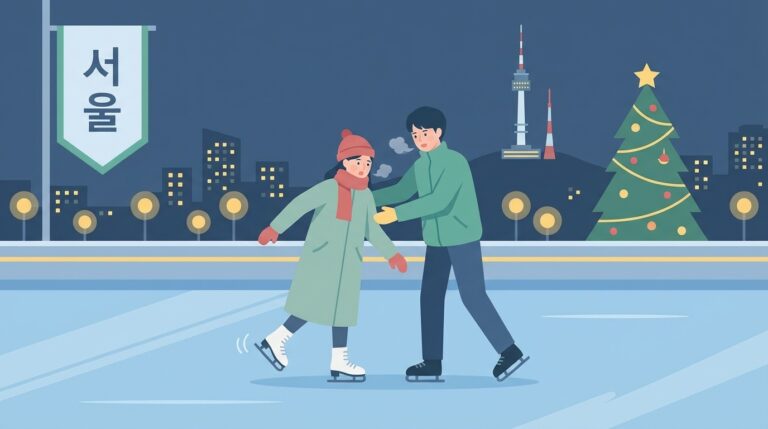
Imagine this scene: You are at the outdoor skating rink in front of Seoul City Hall. The giant Christmas tree is lit up, K-Pop ballads are playing softly over the speakers, and your breath puffs out in little white clouds.
Suddenly, your feet wobble. You lose your balance. In a K-Drama, this is the moment the lead actor swoops in, catches you by the waist, and time stops. “괜찮아요?” (Are you okay?)
But in reality? If you don’t know the right Korean expressions, you might just flail your arms, fall on your butt, and mutter an awkward “Sorry…” while your date watches.
Today, we are going to upgrade your winter romance game. We aren’t just learning how to skate; we are learning how to navigate the subtle “Skinship” (physical affection) opportunities that a Korean skating rink date offers. Ready to be the protagonist of your own drama?
Phase 2: Deep Dive into Key Expressions
1. 잡아 줄까요? (Jaba julkkayo?)
- Pronunciation: [Jaba jul-kka-yo?] (Think of ‘Jabba the Hutt’ but stop at ‘Jabba’ + ‘Jewel’ + ‘Ka-yo’)
- Meaning:
- Literal: Shall I catch/hold [it] for you?
- Real Nuance: “Do you want to hold my hand/arm?” (Polite but suggestive)
- K-Culture Moment: This is the ultimate “Green Light” signal in a sseom (flirting) relationship. When the ice is slippery, offering physical support is the perfect excuse to break the touch barrier without being too aggressive.
- Editor’s Insight: Note the grammar structure ‘-아/어 주다’ (to do something for someone). It frames your action as a favor to them, not a desire of yours. It’s the Korean art of indirect kindness.
- Situation Spectrum:
[🚫 Boss] ———— [⚠️ Colleague] ———— [✅ Date/Friend] - 🤔 Think About It: Why does Korean culture often frame romantic advances as “helping” the other person? Is it to save face if rejected?
2. 넘어질 뻔했어요 (Neomeojil ppeonhaesseoyo)
- Pronunciation: [Neo-meo-jil bbeon-hess-eo-yo] (‘Bbeon’ sounds like ‘Bun’ with a very strong B)
- Meaning:
- Literal: I almost fell.
- Real Nuance: “That was close!” (Used to exaggerate a situation for dramatic effect or relief)
- Grammar Point: -(으)l 뻔하다 is crucial for B2 learners. It means “almost happened (but didn’t).” It adds drama to your storytelling.
- Editor’s Insight: Use this even if you only stumbled slightly. It gives your partner a chance to say, “Be careful!” or “Stay close to me.”
- Situation Spectrum:
[✅ Everyone] ———— [✅ Boss] ———— [✅ Friends]
3. 몸 좀 녹이러 갈까요? (Mom jom nogireo galkkayo?)
- Pronunciation: [Mom jom no-gi-reo gal-kka-yo?]
- Meaning:
- Literal: Shall we go to melt our bodies a little?
- Real Nuance: “It’s freezing. Let’s go to a cafe/restaurant and warm up.”
- K-Culture Moment: ‘Melting’ (녹이다) is the standard verb for warming up from the cold. It implies going from a frozen, stiff state to a relaxed, warm state. This is your transition phrase from the active date (skating) to the conversation date (cafe).
- Situation Spectrum:
[✅ Everyone] ———— [✅ Boss] ———— [✅ Date]
Phase 3: Textbook vs. Real Life
| Situation | 📖 Textbook Korean | 🗣️ Real Korean (Insa Style) | 💡 Why different? |
|---|---|---|---|
| Suggesting to hold hands | 손을 잡아도 됩니까? (May I hold your hand?) | 저 잡고 타세요. (Ride while holding onto me.) | The textbook version is too formal and asks for permission. The real version is an assertive offer of help. |
| Feeling cold | 날씨가 너무 추워요. (The weather is too cold.) | 으~ 얼어 죽겠어요! (Ugh, I’m going to freeze to death!) | Koreans love exaggeration (hyperbole) to express shared suffering. |
| Complimenting skating skills | 스케이트를 잘 타시네요. (You ride skates well.) | 선수 같아요! (You’re like an athlete/pro!) | Comparing someone to a ‘pro’ (seonsu) is the highest casual compliment. |
Phase 4: Cultural Deep Dive
4-1. The “Skinship” Excuse
In Western dating cultures, you might just ask, “Can I hold your hand?” In Korea, especially in the early stages (sseom), direct physical contact can be shyly avoided. Winter sports provide the perfect tactical excuse. The ice is slippery, so holding hands becomes a matter of “safety,” not just romance. This allows both parties to enjoy the intimacy without the awkwardness of defining the relationship right that second.
4-2. K-Food Connection: The Eomuk (Fish Cake) Stop
After skating, you don’t go straight to a Michelin star restaurant. The classic course is to find a Pojangmacha (street stall) nearby.
* The Vibe: Standing up, eating hot Eomuk (fish cake skewers), and drinking the broth from a paper cup.
* The Phrase: “국물 좀 주세요” (Please give me some broth). The steam from the cup fogging up your glasses is part of the winter romance aesthetic seen in countless dramas like Weightlifting Fairy Kim Bok-joo.
Phase 5: Immersive Roleplay
Setting: Grand Hyatt Seoul Ice Rink (outdoor). Evening. Romantic lights are on. You are with Min-jun (a Korean friend you have a crush on).
Min-jun: (Laughing) 와, 사람 진짜 많네요. 스케이트 얼마 만에 타는 거예요?
(Wa, saram jinjja manneyo. Skate eolma mane taneun geoyeyo?)
(Wow, so many people. How long has it been since you skated?)
YOU: 음… 기억도 안 나요. 저 넘어질 뻔할 수도 있어요.
(Eum… gieokdo an nayo. Jeo neomeojil ppeonhal sudo isseoyo.)
(Hmm… I don’t even remember. I might almost fall.)
Min-jun: (Extends his arm slightly) 그럼 위험하니까 제 팔 잡으세요.
(Geureom wiheomhanikka je pal jabeuseyo.)
(Then, since it’s dangerous, hold my arm.)
🔀 Decision Point: How do you respond?
- A) “네, 감사합니다!” (Grab his arm firmly)
- B) “아니에요, 혼자 할 수 있어요!” (Show independence)
- C) “손 잡아 주면 더 잘 탈 수 있을 것 같은데…” (Flirty & Bold)
✅ Best Choice: A or C
* A is safe and polite. It accepts his “protection.”
* C (“I think I could skate better if you held my hand…”) is a high-level flirting move. Use this if you are 90% sure he likes you!
* B rejects the skinship opportunity. In a dating context, this might signal “I’m not interested.”
(Scene continues after skating)
YOU: 와, 진짜 재밌었어요. 근데 이제 발이 꽁꽁 얼었어요.
(Wa, jinjja jaemisseosseoyo. Geunde ije bari kkongkkong eoreosseoyo.)
(Wow, that was fun. But now my feet are frozen solid.)
Min-jun: 그죠? 우리 따뜻한 거 마시면서 몸 좀 녹이러 갈까요?
(Geujyo? Uri ttatteuthan geo masimyeonseo mom jom nogireo galkkayo?)
(Right? Shall we go warm up with something hot to drink?)
Phase 6: 10-Second Shadowing Drill
Listen to the rhythm. Korean is not monotone!
- (Concerned & Caring)
미끄러우니까 / 제 손 / 꽉 잡으세요!
(Mig-geu-reo-u-ni-kka / je son / kkwak ja-beu-se-yo!)
Since it’s slippery / my hand / hold it tight! -
(Relieved)
와 / 진짜 / 넘어질 뻔했어요!
(Wa / jin-jja / neo-meo-jil bbeon-hess-eo-yo!)
Wow / seriously / I almost fell!
Phase 7: K-Culture Mini Glossary
| Korean | Romanization | Meaning | Context |
|---|---|---|---|
| 썸 | Sseom | ‘Some’ (Flirting phase) | The ambiguous stage before officially dating. Skating dates often happen here. |
| 스킨십 | Skinship | Physical affection | Konglish for touching (holding hands, hugging). |
| 핫팩 | Hot pack | Hand warmer | A small heat packet. Giving one to your date is a huge sign of care. |
| 장갑 필수 | Jang-gap Pil-su | Gloves Mandatory | Most Korean rinks require gloves for safety. No gloves = No entry. |
Phase 8: Traveler’s Survival Kit (Skating Rink Edition)
🆘 Survival Phrases
1. “장갑 여기서 살 수 있어요?” (Can I buy gloves here?)
* Why: You forgot your gloves, and the staff won’t let you in.
2. “물품 보관함 어디예요?” (Where are the lockers?)
* Why: You need to store your shoes and bags.
3. “발 사이즈 240(이백사십) 주세요.” (Please give me size 240.)
* Tip: Know your size in millimeters (mm) beforehand! (US 7 ≈ 240mm, US 8 ≈ 250mm).📌 Editor’s Pro Tip
The “Coin” Issue: Many lockers at older rinks or parks still require 500 KRW coins. Even in our cashless society, keep two 500 won coins in your pocket just in case!
Phase 9: Think Deeper — Language & Culture
The Art of “Woori” (Us) and Indirectness
Did you notice that Min-jun said “Since it’s dangerous…” before offering his arm? In Korean culture, justifying an action with an external cause (safety, weather, crowd) makes the intimacy less burdensome. It removes the pressure of “I want to touch you” and replaces it with “I want to protect you.”
Also, consider the word “녹이다” (to melt). We don’t just say “get warm.” We say “melt the body.” It reflects a culture that deeply values the physical sensation of temperature—think of Ondol (heated floors) and hot stews. Heat is synonymous with comfort and rest in Korea.
🧠 Your Turn: In your culture, do you need an excuse to hold hands on a first date, or do you just ask? Share in the comments!
Phase 10: FAQ & Troubleshooting
- Q: Can I take selfies while skating?
- A: generally, yes! But stand near the wall (safe zone). If you stop in the middle of the rink to take a selfie, the “Safety Patrol” (staff with whistles) will blow their whistle at you immediately. It’s embarrassing. Don’t do it.
- Q: Is it okay to use “Banmal” (casual speech) on a date?
- A: Only if you have agreed to it! Even if you are flirting, if you haven’t done the “Shall we speak comfortably?” ritual (말 놓을까요?), stick to polite language (Yo-form). It’s safer and can actually be more romantic/respectful.
- ❌ Common Mistake: Wearing ankle socks.
- Why: Rental skates are stiff and cold. You will get blisters. Wear thick, long socks. If you didn’t bring any, buy them at a nearby convenience store (pyeoneui-jeom) before entering.
Phase 11: Wrap-up & Mission
Summary: Today we learned how to turn a slippery situation into a romantic one using “잡아 줄까요?”, added drama with “-을 뻔했어요”, and warmed up with “몸 좀 녹여요.”
🚀 Action Mission:
* 🥉 Bronze: Stand on one leg (safely!), wobble, and practice saying “어! 넘어질 뻔했어요!” three times.
* 🥈 Silver: Watch a winter K-Drama scene (e.g., True Beauty) and spot the “Hot Pack” moment. How do they give it?
* 🥇 Gold: Go to a Korean restaurant, order hot soup, and when you take the first sip, say “아~ 몸이 녹는다” (Ah, my body is melting).
Phase 12: Interactive Quiz
- Situation: Your date slips on the ice. You want to offer your hand. What is the most natural and polite thing to say?
- a) 내 손을 잡아라! (Grab my hand! – Commander style)
- b) 손 잡으실래요? (Would you like to hold hands? – A bit formal/direct)
- c) 미끄러우니까 저 잡으세요. (Since it’s slippery, hold onto me. – Caring/Justified)
- True or False?
- In Korea, you must always take off your gloves when skating to show respect.
Answers:
1. c) This is the “K-Style” indirect kindness. It gives a reason (slippery) so the partner doesn’t feel pressured.
2. False! Gloves are mandatory for safety. If you take them off, you might get kicked out!
Frequently Asked Questions (FAQ)
Q: What does "잡아 줄까요? (Jaba julkkayo?)" mean in Korean and how do you pronounce it?
A: In Korean, "잡아 줄까요? (Jaba julkkayo?)" is pronounced [Jaba jul-kka-yo?] and means: Literal: Shall I catch/hold [it] for you?
Q: What does "넘어질 뻔했어요 (Neomeojil ppeonhaesseoyo)" mean in Korean and how do you pronounce it?
A: In Korean, "넘어질 뻔했어요 (Neomeojil ppeonhaesseoyo)" is pronounced [Neo-meo-jil bbeon-hess-eo-yo] and means: Literal: I almost fell.
Q: What does "몸 좀 녹이러 갈까요? (Mom jom nogireo galkkayo?)" mean in Korean and how do you pronounce it?
A: In Korean, "몸 좀 녹이러 갈까요? (Mom jom nogireo galkkayo?)" is pronounced [Mom jom no-gi-reo gal-kka-yo?] and means: Literal: Shall we go to melt our bodies a little?







