

Phase 1: The ‘Cash Only’ Panic — An Immersive Opening
Hello! This is your Daily Hangul Senior Editor.
Picture this: You are walking down a street in Hongdae. The smell of sweet, baking batter hits your nose. It’s a Bungeoppang (fish-shaped pastry) stall! You stand in line, mouth watering, watching the K-Drama moment unfold. You order three cream puffs. As you hand over your credit card, the sweet grandmother smiles awkwardly and points to a handwritten cardboard sign: ‘계좌이체 or 현금 (Bank Transfer or Cash Only).’
Cue the dramatic OST sound effect.
Korea is 99% a cashless society, but that magical 1% — street food, traditional markets, and T-Money card reloads — strictly requires hard cash. You rush into the nearest convenience store (GS25 or CU), stand before the ATM, and freeze. The screen is full of complex Hanja (Sino-Korean characters).
Don’t panic. Today, we turn that machine from a scary robot into your best friend. Let’s get that cash and go eat those Bungeoppang.
Phase 2: Deep Dive — The ‘Screen Words’
ATMs speak a formal language that is different from spoken Korean. Here are the B1-level words you strictly need to survive.
1. 해외 카드 (or 글로벌 서비스)
- Pronunciation: [Hae-oe Ka-deu] / [Geul-lo-beol Seo-bi-seu]
- Meaning: Foreign Card / Global Service
- K-Culture Moment: In travel variety shows like Youth Over Flowers, you often see cast members frantically looking for this button at airports. If you don’t press this first, the machine will reject your foreign card instantly.
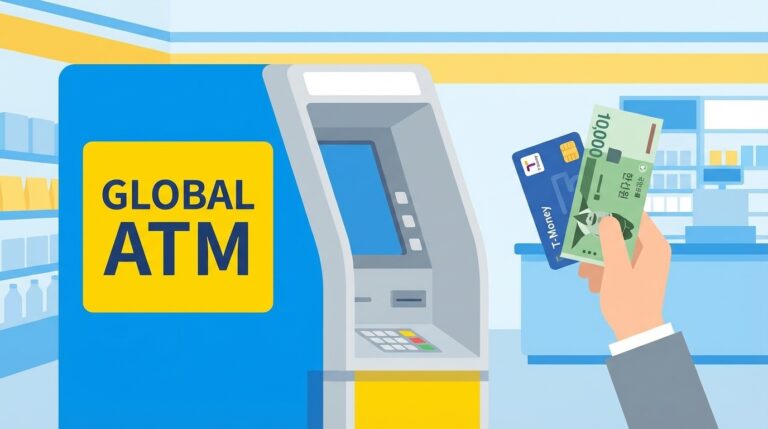
- Editor’s Insight: Before you insert your card, look for the button (usually at the bottom right) or a physical yellow sticker on the machine that says ‘Global ATM.’ If it’s not there, that machine acts like a local-only club — you can’t get in.
- Situation Spectrum:
[🚫 Local Only] ———— [⚠️ Check Sticker] ———— [✅ Global ATM]- 🤔 Think About It: Why do some older ATMs in Korea still not accept foreign cards despite the massive influx of tourists? (Hint: It’s related to domestic banking networks vs. international VISA/Mastercard networks.)
2. 출금 (vs. 입금)
- Pronunciation: [Chul-geum] ‘Chul’ sounds like ‘chew’ with an L.
- Meaning: Withdrawal (Literally: Out + Gold)
- Editor’s Insight: You will see two main buttons. 출금 (Withdrawal) and 입금 (Deposit). Think of ‘출’ (出) as ‘Exit’ (Ex-boyfriend/girlfriend leaves your life). Think of ‘입’ (入) as ‘In’ (Into your account). You want the money to Exit the machine.
- Situation Spectrum: This is formal terminology.
[🚫 Spoken to friends] ———— [✅ On Screens/Forms]- 🤔 Think About It: In spoken Korean, we rarely say “출금하러 가.” We say “돈 뽑으러 가” (Go to pull/pluck money). Why do we use such a physical verb like ‘pluck’ for money?
3. 수수료
- Pronunciation: [Su-su-ryo]
- Meaning: Commission / Service Fee
- K-Culture Moment: That sad moment in a webtoon where a broke university student tries to withdraw 10,000 won, but the machine says “수수료 1,300원” (Fee: 1,300 won), and they can’t afford it.
- Editor’s Insight: Convenience store ATMs are notorious for high 수수료 (often 3,000+ KRW for foreign cards). If you see this word pop up with a scary number, don’t be shocked. It’s the price of convenience.
Phase 3: Textbook vs. Real Life
| Situation | 📖 Textbook Korean | 🗣️ Real Korean | 💡 Why is it different? |
|---|---|---|---|
| Telling a friend you need cash | “현금을 출금하고 싶어요.” (I want to withdraw cash.) | “돈 좀 뽑아야 돼.” (I gotta pull out some money.) | ‘출금’ is too formal/banking term. ‘뽑다’ (pluck/pull) is vivid and active. |
| Asking if the ATM works | “이 기계는 외국 카드가 됩니까?” (Does this machine accept foreign cards?) | “이거 해외 카드 먹히나요?” (Does foreign card get eaten/work here?) | ‘먹히나요’ (literally: is it eaten/accepted) is slang for “does it work/apply?” |
💡 Note: ‘먹히나요?’ is very casual (B2 level nuance). For B1, stick to “해외 카드 돼요?” (Do foreign cards work?).
Phase 4: Cultural Deep Dive — The Invisible Privacy Wall
4-1. Non-verbal: The ‘Gap’ (Give Space)
In K-Dramas, you might see a thug leaning over someone at an ATM. In reality, Koreans value extreme privacy at the machine. Even if you are with a close friend, when they start punching in their PIN (비밀번호), turn your body away slightly. Do not look at the screen. It’s a silent rule of ‘Nunchi’ (social sense).
4-2. K-Culture Connection: The ‘Cash’ Season
Winter in Korea is known as the “Cash Season” (현금의 계절). Why? Because of Bungeoppang (fish bread), Hotteok (sweet pancakes), and Gun-goguma (roasted sweet potatoes). K-Pop idols often post pictures of themselves holding 3,000 won in cash, captioning it “Ready for Bungeoppang.” Using an ATM in winter isn’t just banking; it’s preparation for a feast.
Phase 5: Immersive Roleplay — The Rejected Card
Setting: It is 11:00 PM. A small CU convenience store near your hotel. You are hungry. You need cash for the food truck outside. The store is quiet, except for the humming of the fridge.
Characters:
* YOU: A hungry traveler holding a foreign VISA card.
* Min-su: Part-time worker (Alba), 20s, wearing a vest, watching a YouTube video on his phone.
(Dialogue Start)
YOU: (Staring at the ATM, looking confused because the screen is stuck)
… 어? 왜 안 되지?
(Eo? Wae an doe-ji?)
(Uh? Why isn’t it working?)
Min-su: (Notices you struggling, puts phone down)
학생, 무슨 문제 있으세요?
(Hak-saeng, museun munje isseu-seyo?)
(Student/Customer, is there a problem?)
YOU: 네… 돈을 좀 뽑고 싶은데, 카드가 안 읽히네요.
(Ne… doneul jom ppopgo sipeunde, kadeuga an ilki-neyo.)
(Yes… I want to pull out some money, but the card isn’t reading.)
Min-su: 아, 구형 기계라서 그럴 수 있어요. 혹시 Global ATM 마크 확인하셨어요?
(Ah, guhyeong gigye-raseo geureol su isseoyo. Hoksi Global ATM mark hwagin-hasyeosseoyo?)
(Ah, it’s an old machine so that might happen. Did you check for the Global ATM mark?)
YOU: 아! 안 보고 그냥 넣었어요.
(Ah! An bogo geunyang ne-eosseoyo.)
(Ah! I didn’t look and just put it in.)
🔀 Decision Point: Min-su points to another machine in the corner. What do you say?
- A) “다시 해볼게요. 감사합니다!” (I’ll try again. Thank you!)
- B) “여기 수수료 비싸요?” (Is the fee expensive here?)
- C) “돈 좀 빌려주실 수 있어요?” (Can you lend me some money?)
✅ Best Choice: B — Asking about the fee is a very ‘local’ thing to do. Min-su will likely warn you it’s expensive.
⚠️ Choice C Analysis: Unless you are filming a hidden camera show, never ask a part-timer to lend money. It puts them in a very uncomfortable position!
Phase 6: 10-Second Shadowing Drill
Let’s practice the sentence you will scream internally when you see the street food.
Context: You realize you have zero cash for Tteokbokki.
Emotion: 😢 Regretful & Urgent
아, 현금을 / 미리 뽑아 둬걸 / 그랬어요!
(Ah, hyeon-geum-eul / mi-ri ppob-a dul-geol / geu-raess-eo-yo!)
Ah, I should have / pulled out cash in advance / (regret)!
Phase 7: K-Culture Mini Glossary
| Korean | Romanization | Meaning | Context |
|---|---|---|---|
| 명세표 | Myeong-se-pyo | Receipt/Slip | The ATM will ask: “명세표를 출력하시겠습니까?” (Do you want a receipt?). Usually, we press 아니오 (No) to save paper. |
| 잔액 | Jan-aek | Balance | The number that tells you how much money you have left. Sometimes seeing this number hurts. |
| 만 원 | Man-won | 10,000 Won Bill | The standard unit for withdrawal. Most ATMs only dispense 10,000 or 50,000 won notes. |
| 티머니 | T-money | Transport Card | The #1 reason tourists need cash. You cannot reload T-money with a credit card at machines! |
Phase 8: Traveler’s Survival Kit — The ‘Cash Hunt’
Going to a traditional market or recharging T-Money? You need this kit.
🆘 Survival Phrases TOP 3
1. “여기 글로벌 ATM 있어요?” (Yeogi Global ATM isseoyo?)
– Is there a Global ATM here? (Ask the convenience store clerk immediately).
2. “5만 원권도 듼요?” (O-man-won-gwon-do dwaeyo?)
– Do you accept 50,000 won bills? (Useful at taxis or small street stalls that might not have change).
3. “영수증 버려 주시겠어요?” (Yeong-su-jeung beoryeo ju-si-gess-eoyo?)
– Could you throw away the receipt for me? (If you accidentally printed it).📌 Editor’s Travel Note
* Where to find Global ATMs: Convenience stores (CU, GS25, 7-Eleven) usually have them, but Woori Bank or KB Bank branches are safer bets for lower fees and better connection.
* T-Money Rule: Always keep 10,000 KRW in cash in your wallet just for emergency transport reloading.
Phase 9: Think Deeper — The Cashless Paradox
Topic: The Generation Gap in Payment
Korea is one of the most cashless societies in the world. You can pay for a 500-won candy with a credit card, and Samsung Pay is everywhere. Yet, why do we still have “Cash Only” signs at markets?
It reflects the digital divide. While the younger generation lives phone-first, the older generation (often running the street stalls) prefers the tangible certainty of cash. Also, ‘Account Transfer’ (계좌이체) has replaced cash for many locals at these stalls, leaving tourists (who don’t have Korean bank apps) as the only ones truly needing physical bills.
🧠 Think Deeper: In your country, is using cash seen as old-fashioned, or is it still king? How would you feel if a store rejected cash entirely?
Phase 10: FAQ & Troubleshooting
Q: The ATM swallowed my card! What do I do?
A: Don’t cry! Look for a phone attached to the machine. Lift it, and it usually autodial to the security center. Say: “기계가 카드를 먹었어요” (The machine ate my card). Most centers have English interpretation services.
Q: Can I use foreign cash (USD/EUR) in these machines?
A: No. Convenience store ATMs are for withdrawing Korean Won from your account. You cannot insert USD bills to exchange them.
❌ Common Mistake #1: Trying to withdraw “15,000 Won.”
✅ Fix: Most machines only dispense 10,000 or 50,000 Won bills. You must withdraw in multiples of 10,000 (e.g., 20,000).
Phase 11: Wrap-up & Mission
One-Liner Summary: Look for the Global ATM sticker, prepare for the fee (수수료), and use the word 뽑다 (pull) when talking to friends!
🚀 Action Mission:
* 🥉 Bronze: Say “돈 좀 뽑아야 돼” (I gotta pull some cash) three times to your mirror.
* 🥈 Silver: Open Google Maps or Naver Maps and search “ATM” nearby to see where they are located.
* 🥇 Gold: Go to a Korean convenience store, find the ‘Global ATM’ sticker, and successfully withdraw 10,000 won for street food!
🎭 K-Culture Mission: Watch a K-Drama scene where a character is poor. Do they use cash or card? Watch how they sigh when looking at the ‘Balance’ (잔액) screen!
Phase 12: Interactive Quiz
1. Which button must you press first if you have a foreign card?
a) 예금인출 (Savings Withdrawal)
b) 수수료 (Fee)
c) 글로벌 서비스 (Global Service)
2. True or False?
“You can recharge your T-Money card using a credit card at the subway ticket machine.”
3. Situation Check:
You are at a street food stall. The total is 4,500 won. You hand over a 50,000 won bill. The owner looks troubled. What should you say?
a) “잔돈 없으세요?” (Do you not have change?)
b) “카드 해주세요.” (Do card please.)
🔑 Answers:
1. (c) Global Service is mandatory for foreign cards.
2. False. T-Money machines usually require cash to reload.
3. (a) If they don’t have change, you might need to run to a convenience store to break the bill (buy a gum!).
Frequently Asked Questions (FAQ)
Q: What does "해외 카드 (or 글로벌 서비스)" mean in Korean and how do you pronounce it?
A: In Korean, "해외 카드 (or 글로벌 서비스)" is pronounced [Hae-oe Ka-deu] and means: Foreign Card / Global Service
Q: What does "출금 (vs. 입금)" mean in Korean and how do you pronounce it?
A: In Korean, "출금 (vs. 입금)" is pronounced [Chul-geum] and means: Withdrawal (Literally: Out + Gold)
Q: What does "수수료" mean in Korean and how do you pronounce it?
A: In Korean, "수수료" is pronounced [Su-su-ryo] and means: Commission / Service Fee







