

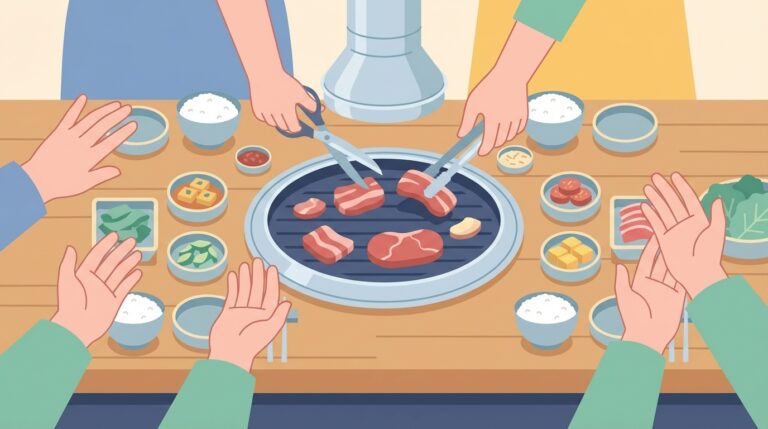
Don’t Just Stand There! How to Read the Room Like a K-Drama Star 🎭
Phase 1: The Invisible Language of Korea
“안녕하세요! This is your Daily Hangul Editor.”
Imagine this: You are watching a K-Drama. The main character walks into a pojangmacha (street food tent), looking heartbroken. Before he even speaks, the ajumma (middle-aged lady) places a bottle of Soju and a glass in front of him.
He didn’t order it. She just knew.
Or think about a K-Pop fan meeting. The idol looks slightly thirsty, and instantly, a fan in the front row holds up a water bottle. The idol smiles and nods. No words were exchanged.
This, my friends, is the superpower known as Nunchi (눈치). Specifically, the art of “Mal an haedo ara-seo cheok-cheok” (말 안 해도 알아서 척척)—doing things perfectly without being told.
If you master this, you aren’t just a “foreigner who speaks Korean”; you become an “Insider.” If you don’t? Well, you might find people sighing quietly around you. But don’t worry! I’ve been teaching this “invisible language” for years, and today, we’re going to decode it together.
Phase 2: Core Expressions Deep Dive 🕵️♂️
1. 알아서 하다 (Ara-seo hada)
- Pronunciation: [Ara-seo hada] (Sounds like: “Ah-lah-saw” + “Ha-da”)
- Meaning:
- Literal: To know and do.
- Real Nuance: To take care of it on one’s own initiative; to figure it out without needing instructions.
- K-Culture Moment: In the hit drama Misaeng (Incomplete Life), the interns who survive aren’t the ones who ask “What should I do?” every 5 minutes. They are the ones who “Ara-seo” prepare the meeting room before the boss arrives.
- Editor’s Insight: This is the magic phrase for independence. If a Korean friend asks, “Do you need help with the subway map?” and you want to show confidence, say this!
- Situation Spectrum:
[🚫 To Boss (Risky)] ———— [⚠️ Colleagues] ———— [✅ Friends/Juniors]- Note: Saying “I’ll do it ara-seo” to a boss can sound arrogant unless you are very polite.
- 🤔 Think About It: Why does Korean culture value “guessing” what is needed over “asking” what is needed?
2. 센스 있다 (Sense it-da)
- Pronunciation: [Sense it-da] (The ‘Sen’ is short and crisp, not long like English ‘Sense’)
- Meaning:
- Literal: To have sense.
- Real Nuance: To be socially intelligent; to have great Nunchi; to be witty and considerate.
- K-Culture Moment: You’re at a K-BBQ restaurant. The smoke is getting in everyone’s face. You silently adjust the ventilation pipe. Everyone at the table will look at you and say, “Wa, sense!”
- Editor’s Insight: Being called “Sense it-da” is the highest compliment in Korean social life. It means you are observant and care about others’ comfort.
- Situation Spectrum:
[✅ Everyone loves this!]
3. 눈치(가) 빠르다 (Nunchi-ga ppareuda)
- Pronunciation: [Nun-chi-ga bba-reu-da] (The ‘ppa’ is a tense sound, like holding your breath before releasing ‘P’)
- Meaning:
- Literal: Eye-measure is fast.
- Real Nuance: To be quick-witted; to catch on quickly to the atmosphere.
- Editor’s Insight: If someone says this to you, congratulations! You successfully read the room.
- 🤔 Think About It: In many Western cultures, being “direct” is a virtue. In Korea, being “indirect but quick to understand” is the virtue. How does this change the way people bond?
Phase 3: Textbook vs. Real Life 🥊
| Situation | 📖 Textbook Korean | 🗣️ Real Korean (Insider) | 💡 Why? |
|---|---|---|---|
| Offering help | “제가 도와드릴까요?” (Shall I help you?) | “제가 알아서 할게요!” (I’ll take care of it!) | Koreans prefer proactive action over asking for permission to help. |
| Praising action | “정말 착하시네요.” (You are very kind.) | “오~ 센스쟁이!” (Oh~ Sense-master!) | “Kind” sounds childish; “Sense” acknowledges social IQ. |
| Noticing a cue | “왜 그러세요?” (Why are you doing that?) | (Silence + Handing a tissue) | Words can break the flow; action maintains the mood. |
Phase 4: Cultural Deep Dive — The Art of Non-Verbal Nunchi 🤫
4-1. The “K-BBQ” Test
In Korea, eating isn’t just about food; it’s a team sport.
* The Empty Glass: If your elder’s soju glass is empty, do not wait for them to ask. Pour it immediately with two hands. This is Nunchi 101.
* The Side Dishes: If the kimchi plate is empty, don’t just stare at it. Use your eyes to catch the server’s attention or go to the self-bar.
4-2. K-Drama Connection: The “Jacket” Move
We’ve all seen it. The female lead shivers slightly (maybe just rubs her arms). She never says, “I’m cold.” Immediately, the male lead puts his jacket on her shoulders.
* Why? In Korea, verbalizing a need (“I am cold, give me your coat”) can feel demanding or burdening. The ideal relationship is one where the other person notices before you speak.
Phase 5: Immersive Roleplay 🎬
Setting: Friday night, 8 PM. A busy Samgyeopsal (pork belly) restaurant in Gangnam. You are with your Korean coworkers, Min-ji (28) and Manager Kim (45).
Manager Kim: (Sighs happily) Ah, works ends, meat begins!
(Kim pours Soju for everyone)
Min-ji: Thank you, Manager!
(The meat on the grill starts sizzling loudly. Manager Kim is busy talking.)
🔀 YOUR TURN! The meat is cooking fast. What do you do?
- A) Sit quietly and wait for Min-ji or the Manager to flip it.
- B) Say, “Manager, the meat is burning!”
- C) Silently pick up the tongs (jip-ge) and scissors, and start grilling.
✅ Best Choice: C)
* Why: This is the definition of “Mal an haedo ara-seo cheok-cheok” (Doing it without being told). Manager Kim will notice and think, “Wow, this employee has sense.”
⚠️ Choice B Analysis: Pointing out a problem without fixing it can be seen as lacking nunchi, especially if you are the youngest/newest.
(Selecting C – You pick up the tongs)
YOU: (Smiling) 제가 구울게요! 타면 안 되잖아요.
(Je-ga gu-eul-ge-yo! Ta-myeon an doe-ja-na-yo.)
[I’ll grill it! We can’t let it burn.]
Manager Kim: 오~ OO씨, 센스 있는데? 고기 굽는 솜씨가 보통이 아니야!
(Oh~ [Your Name], you have sense! Your grilling skills are no joke!)
Phase 6: 10-Second Shadowing Drill 🎤
Let’s practice the “Proactive Attitude.” Repeat this with confidence!
- Sentences:
- 😊 걱정 마세요! / 제가 / 알아서 할게요!
- (Geok-jeong ma-se-yo! / Je-ga / a-ra-seo hal-ge-yo!)
- [Don’t worry! / I / will take care of it!]
- Note: Emphasize “Ara-seo” to show reliability.
Phase 7: K-Culture Mini Glossary 📘
| Korean | Romanization | English | Context |
|---|---|---|---|
| 눈치 | Nunchi | Eye-measure | The ability to gauge others’ moods and handle situations socially. |
| 센스 | Sense | Wits/Social IQ | Used when someone does something helpful without being asked. |
| 척척 | Cheok-cheok | Automatically/Smoothly | An onomatopoeia for things proceeding perfectly without a hitch. |
| 눈치(를) 보다 | Nunchi-reul boda | Walking on eggshells | Being overly conscious of others’ reactions (negative nuance). |
Phase 8: Traveler’s Survival Kit 🧳
Even if you are just traveling, showing Sense makes you a beloved guest.
🆘 Survival Expression: The “Self-Service” Nunchi
* Scenario: You want water, but the server is busy.
* Action: Look for a sign that says “물은 셀프입니다” (Water is Self).
* Phrase: “사장님, 물은 제가 가져갈게요!” (Boss, I’ll get the water myself!)
* 💡 Pro Tip: Saying this instead of shouting “Water please!” makes you look like a localized expert.
Phase 9: Think Deeper — “High Context Culture” 🧠
Language & Connection:
Korea is a “High Context Culture.” This means communication depends heavily on the underlying context rather than just spoken words. In English, we are taught, “If you want something, ask for it.” In Korean, the ideal interaction is, “I care about you, so I already know what you want.”
This isn’t just about guessing; it’s about Jeong (정 – affection/bonding). By anticipating needs, Koreans reassure each other: “We are connected. I am paying attention to you.”
💬 Your Turn: Does your culture prefer direct requests or silent anticipation? Share in the comments!
Phase 10: FAQ & Troubleshooting 🛠️
- Q: Can I use “Ara-seo” to my boss?
- A: Be careful! If you say “알아서 하세요” (You figure it out), it’s extremely rude. But if you say “제가 알아서 하겠습니다” (I will take care of it myself), it shows responsibility. Context is everything!
- Q: I’m stressed. Do I always have to read minds?
- A: Even Koreans find Nunchi stressful sometimes! It’s okay to miss cues. If you are unsure, just smile and ask politely. As a foreigner, you get a “Nunchi Pass” (exemption) most of the time.
- ❌ Common Mistake: staring blankly when someone enters the room.
- ✅ Fix: Even a slight nod or bow shows you are aware of their presence (Basic Nunchi).
Phase 11: Wrap-up & Action Mission 🚀
Summary: Today we learned that in Korea, action speaks louder than words. Being “Sense-ful” means acting before being asked.
🎯 Action Missions:
* 🥉 Bronze: Stand in front of a mirror and practice the “Ara-seo hal-ge-yo” face (Confident & Reliable).
* 🥈 Silver: Watch a K-Drama scene involving a meal. Spot who is pouring the water or cutting the meat. That character has Nunchi.
* 🥇 Gold: Go to a Korean restaurant. Place your spoon and chopsticks on a napkin before the food arrives. If you are with a Korean friend, watch their eyes widen!
Phase 12: Quiz — Do You Have Nunchi? 📝
Situation: You are in an elevator. Someone runs towards the closing doors with heavy bags.
- Directly: Shout “Hurry up!”
- Passive: Do nothing and let the doors close.
- Nunchi Master: Press the ‘Open’ button silently and move back to make space.
Correct Answer: 3. You didn’t speak, but you solved the problem. That is the essence of “Mal an haedo ara-seo cheok-cheok”!
See you in the next lesson! 안녕! 👋
Frequently Asked Questions (FAQ)
Q: What does "알아서 하다 (Ara-seo hada)" mean in Korean and how do you pronounce it?
A: In Korean, "알아서 하다 (Ara-seo hada)" is pronounced [Ara-seo hada] and means: Literal: To know and do.
Q: What does "센스 있다 (Sense it-da)" mean in Korean and how do you pronounce it?
A: In Korean, "센스 있다 (Sense it-da)" is pronounced [Sense it-da] and means: Literal: To have sense.
Q: What does "눈치(가) 빠르다 (Nunchi-ga ppareuda)" mean in Korean and how do you pronounce it?
A: In Korean, "눈치(가) 빠르다 (Nunchi-ga ppareuda)" is pronounced [Nun-chi-ga bba-reu-da] and means: Literal: Eye-measure is fast.







