

Phase 1: The “Secret Currency” of Korean Life 🗑️
Hello! This is your Daily Hangul Editor.
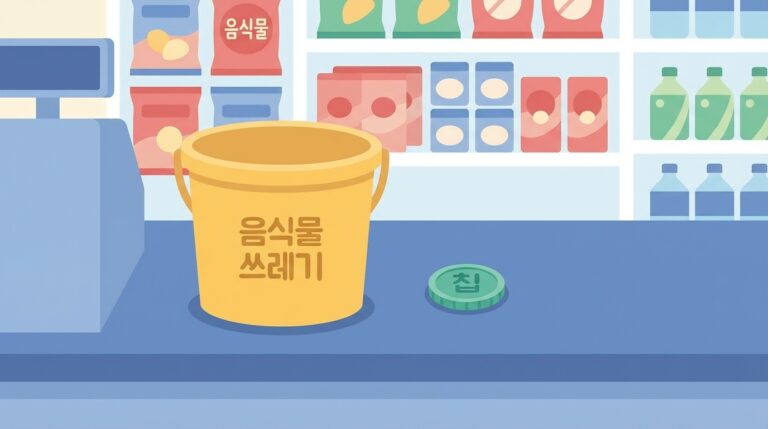
Imagine this: You’ve finally moved into your dream apartment in Seoul, maybe a cozy Oktapbang (rooftop room) like in the K-Drama Rooftop Prince. You cook a delicious Kimchi Stew, but now you have leftovers. You see a small yellow bucket in the corner. You open the lid, dump the food in, and take it outside.
Stop! 🛑
If you leave that bucket out without a “Chip,” the garbage collectors won’t touch it. Even worse, you might find a penalty sticker on it the next day. In many districts in Korea, throwing away food isn’t free—you need to buy a specific plastic chip (or sticker) that acts as a “ticket” for your trash.
Today, we are going to the convenience store (pyeoneui-jeom) to buy these mysterious chips. It’s a rite of passage for anyone living in Korea!
Phase 2: Key Expressions Deep Dive 🗣️
1. [음식물 칩 있어요?]
- Pronunciation: [eumsingmul chip isseoyo?]
- Sound Analogy: Eum (like ‘um’ when thinking) + Sing (song) + Mul (water) + Chip (potato chip) + E-sso-yo.
- Meaning: “Do you have food waste chips?”
- Literal: Food waste chip, exists?
- K-Culture Moment: In reality shows like I Live Alone, you often see celebrities running to the convenience store late at night in sweatpants just to buy this because their bucket is full.
- Editor’s Insight: Not every store sells them! Only stores in your specific neighborhood (Dong) will carry the correct chips. If you ask this, the clerk knows you are a local resident, not a tourist.
- Situation Spectrum:
[🚫 Formal Boss] ———— [✅ Store Clerk] ———— [✅ Neighbor] - 🤔 Think About It: Why does Korea charge for food waste specifically? In your country, is food waste separated, or does it go with regular trash?
2. [3리터짜리 주세요.]
- Pronunciation: [sam-niteo-jjari juseyo]
- Sound Analogy: Sam (Samsung without sung) + Ni-teo (Liter) + Jja-ri (sounds like ‘Jah-ree’) + Ju-se-yo.
- Meaning: “Please give me the 3-liter one.”
- Note: Change “3” (Sam) to the size of your bucket (e.g., 5L = O-liteo).
- K-Culture Moment: Just like ordering beer (500cc) or buying garbage bags, size matters! If you buy the wrong size chip, it won’t fit the slot on your bucket.
- Editor’s Insight: The suffix -jjari (-짜리) is super useful. It means “worth” or “value.” You can use it for money too (e.g., “1,000-won-jjari”).
- Situation Spectrum:
[🚫 Formal Meeting] ———— [✅ Store/Market] ———— [✅ Casual] - 🤔 Think About It: Why do you think Korea uses “Liters” (volume) for trash instead of weight? (Hint: It relates to the size of the standard bags/buckets!)
3. [현금만 돼요?]
- Pronunciation: [hyeon-geum-man dwaeyo?]
- Sound Analogy: Hyeon (like Hyun Bin) + Geum (Gum) + Man (Man) + Dwae-yo (sounds like ‘Day-o’).
- Meaning: “Is it cash only?”
- Literal: Cash only, does it work?
- Editor’s Insight: This is a Pro Tip. In many convenience stores, government trash bags and food waste chips cannot be bought with a credit card because they are essentially a local tax. Always bring some cash!
- Situation Spectrum:
[🚫 Close Friend] ———— [✅ Store/Restaurant] ———— [✅ Taxi]
Phase 3: Textbook vs. Real Life 🥊
| Situation | 📖 Textbook Korean | 🗣️ Real Korean | 💡 Why different? |
|---|---|---|---|
| Asking for chips | 음식물 쓰레기 납부 필증 있습니까? (Do you have the food waste payment certificate?) | 음식물 칩 있어요? (Got food chips?) | “납부 필증” is technically correct but sounds like a lawyer speaking. Everyone says “Chip.” |
| Checking Size | 용량이 어떻게 됩니까? (What is the capacity?) | 몇 리터예요? (How many liters is it?) | Koreans prefer efficiency. “How many liters” is faster. |
| Paying | 신용카드로 결제 가능한가요? (Is payment by credit card possible?) | 카드 돼요? (Card okay?) | In busy stores, short questions are polite because they save time. |
Phase 4: Cultural Deep Dive 🌏
4-1. The “Dong” (Neighborhood) Rule
In K-Dramas, you might see a character move houses and suddenly realize their trash bags from the old house don’t work. Korea’s waste system is hyper-local. If you live in “Gangnam-gu,” you cannot use chips/bags from “Mapo-gu.”
Non-verbal Tip: If you don’t know your bucket size, take a picture of your bucket with your phone and show it to the clerk. They will know instantly! 📸
4-2. K-Food Connection: The “Banchan” Effect
Why is food waste such a big deal in Korea? Because of Banchan (side dishes)! A traditional Korean meal has many small sides. This creates a lot of leftovers. The “Chip” system makes people conscious of how much food they throw away because you literally pay for every liter of waste. It encourages people to finish their meals!
Phase 5: Roleplay Scenario 🎬
Setting: A small CU convenience store near your house. It is 11 PM. You are wearing comfortable clothes.
Characters:
* YOU: A foreign student living alone.
* Part-timer (Alba): A university student working the night shift, wearing a vest.
Dialogue:
(You walk to the counter)
YOU: 저기요, 음식물 칩 있어요?
(Jeogiyo, eumsingmul chip isseoyo?)
(Excuse me, do you have food waste chips?)
Alba: 네, 있어요. 몇 리터요?
(Ne, isseoyo. Myeot liteo-yo?)
(Yes, we do. How many liters?)
🔀 Decision Point: What size is your bucket?
* A) “이거요.” (Show a photo on your phone) — Safe & Smart! 🌟
* B) “아마… 큰 거?” (Maybe… the big one?) — Risky! You might buy the wrong one. ⚠️
* C) “3리터짜리 주세요.” (Give me the 3L one.) — Confident! ✅
(Let’s choose C)
YOU: 3리터짜리, 다섯 개 주세요.
(Sam-niteo-jjari, daseot-gae juseyo.)
(Give me five of the 3-liter ones, please.)
Alba: 네, 1,500원입니다. 현금만 돼요.
(Ne, cheon-o-baek-won imnida. Hyeon-geum-man dwaeyo.)
(Okay, that’s 1,500 won. Cash only.)
YOU: 아, 잠시만요… 여기요!
(Ah, jamsimanyo… yeogiyo!)
(Ah, one moment… here you go!)
Phase 6: 10-Second Shadowing Drill 🎤
Listen to the rhythm and repeat. Don’t be robotic!
Situation: You just remembered you need chips and ran to the store.
Emotion: 😊 Polite but Urgent
사장님, / 음식물 칩 / 3리터짜리 / 있어요?
(Sajang-nim, / eumsingmul chip / sam-niteo-jjari / isseoyo?)
(Boss, / do you have / the 3-liter / food waste chips?)
Phase 7: K-Culture Glossary 📖
| Korean | Romanization | Meaning | Context |
|---|---|---|---|
| 종량제 봉투 | Jongnyangje Bongtu | Standard Garbage Bag | The specific government-issued bags you MUST use for general trash. |
| 분리수거 | Bunli-sugeo | Recycling | Literally “Separate Collection.” A major weekly event in apartment complexes. |
| 편의점 | Pyeoneui-jeom | Convenience Store | The hub of daily life. You buy trash bags, chips, subway cards, and late-night snacks here. |
| 현금 | Hyeon-geum | Cash | Necessary for buying “local tax” items like trash bags/chips in some stores. |
Phase 8: Traveler’s Survival Kit 🧳
Even if you aren’t living in Korea long-term, you will generate trash in your Airbnb or hotel.
🆘 Survival Phrases for Trash
1. 🇰🇷 “쓰레기통 어디 있어요?” (Sseuregitong eodi isseoyo?)
* Meaning: Where is the trash can?
* Use: In a cafe, subway, or park.
2. 🇰🇷 “이거 버려주세요.” (Igeo beoryeo-juseyo.)
* Meaning: Please throw this away for me.
* Use: When handing empty wrappers to a street food vendor (polite).📌 Editor’s Travel Note:
Public trash cans are rare in Korea! This surprises many tourists. You usually have to carry your trash to the nearest subway station or your hotel. Don’t just leave your coffee cup on a random wall—that’s a major faux pas!
Phase 9: Think Deeper — Why “Pay” to Throw? 🧠
Topic: The “Pay-As-You-Throw” System
Korea has one of the world’s highest recycling rates. Why? Because hitting people’s wallets works. By forcing people to buy specific bags or chips, the government makes citizens feel the “cost” of their waste.
💬 Your Turn: In your culture, do you pay for the amount of trash you create, or is it a flat tax? Does paying for trash bags seem annoying or efficient to you?
Phase 10: FAQ & Troubleshooting 🛠️
Q: Can I use a “Food Waste Chip” for general trash?
A: No! General trash goes in a standard plastic bag (Jongnyangje Bongtu). Food waste goes in the bucket with a chip. If you mix them, the collectors won’t take it.
Q: I bought chips in Hongdae, but I live in Gangnam. Can I use them?
A: No. Chips and bags are specific to the District (Gu). You must buy them in the neighborhood where you live.
❌ Common Mistake: Freezing food waste in the freezer.
✅ Editor’s Note: Many foreigners (and Koreans!) do this to prevent smell. While clever, some strict roommates or landlords hate it because of hygiene concerns. Always ask first!
Phase 11: Wrap-up & Mission 🎁
One-Liner: To throw away food in Korea, you need the right “Chip” for your neighborhood and some cash in your pocket!
🚀 Action Missions:
* 🥉 Bronze (Solo): Look at a bottle of water. Say aloud in Korean: “This is [Number] Liters.” (I-geo [Number] Liteo-yeyo.)
* 🥈 Silver (Online): Search for images of “음식물 쓰레기 칩” (Food waste chip) on Google. See what they look like!
* 🥇 Gold (Real Life): Go to a convenience store (GS25, CU, 7-Eleven) and ask the clerk, “음식물 칩 얼마예요?” (How much are food chips?) just to practice!
Phase 12: Quiz — The “Recycling Pro” Challenge 🧩
1. [Situation] You moved to a new neighborhood. You have leftover chips from your old house. What should you do?
* A) Use them anyway. No one looks.
* B) Give them to a friend in the old neighborhood and buy new ones here.
* C) Glue two chips together.
2. [True or False] You can usually buy food waste chips with a credit card at every store.
* (True / False)
3. [Fill in the Blank] To ask for the 3-liter size, you say: “3_______ 주세요.”
* A) 킬로 (Kilo)
* B) 리터짜리 (Liteo-jjari)
* C) 개 (Gae)
(Answers below)
Click to see answers
- B) Chips are district-specific. Old ones won’t work!
- False. Many places require cash for government waste items.
- B) 리터짜리 (Liter-sized/worth).
Frequently Asked Questions (FAQ)
Q: What does "[음식물 칩 있어요?]" mean in Korean and how do you pronounce it?
A: In Korean, "[음식물 칩 있어요?]" is pronounced [eumsingmul chip isseoyo?] and means: a key conversational Korean expression covered in this lesson.
Q: What does "[3리터짜리 주세요.]" mean in Korean and how do you pronounce it?
A: In Korean, "[3리터짜리 주세요.]" is pronounced [sam-niteo-jjari juseyo] and means: a key conversational Korean expression covered in this lesson.
Q: What does "[현금만 돼요?]" mean in Korean and how do you pronounce it?
A: In Korean, "[현금만 돼요?]" is pronounced [hyeon-geum-man dwaeyo?] and means: a key conversational Korean expression covered in this lesson.







