

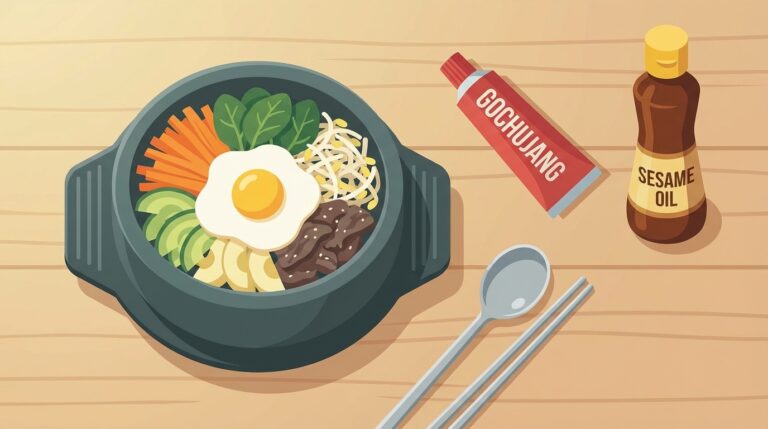
Don’t Just Eat It! How to Survive Your First Bibimbap 🍲
Phase 1: The ‘Mix’ Magic 🥄
Hello! This is your Daily Hangul Editor.
Have you ever watched a K-Drama scene where the main character is heartbroken or stressed? They usually sit in their living room, take a giant silver bowl, dump in leftover rice and side dishes, add a huge spoon of red paste, and mix it aggressively while crying. 😭🍛
That chaotic but delicious mess is Bibimbap (비빔밥).
But here is the problem: Many first-time visitors to Korea receive this beautiful bowl arranged like a colorful flower… and start eating it carefully, one ingredient at a time.
Stop! 🛑 If the restaurant owner sees you, they might run over, grab your spoon, and mix it for you while saying, “No, no! Mix! Mix!”
Today, we will learn how to order, customize, and eat Bibimbap like a true local, not a tourist.
Phase 2: Deep Dive into Key Expressions 🧠
Here are the 3 essential phrases you need to survive a Bibimbap restaurant.
1. 비벼요 (Bibyeoyo)
- Pronunciation: [Bi-byeo-yo] (Sounds like “BB” cream + “yo”-yo)
- Meaning: “I mix it” or “Please mix it.”
- K-Culture Moment: The word Bibimbap comes from Bibida (to mix) + Bap (rice). In K-Pop variety shows, you often see the “Bibim” game where they must mix ingredients perfectly.
- Editor’s Insight: You don’t usually say this to the waiter. You say this to describe what you are doing. It’s the action that makes the food tasty!
- Situation Spectrum:
[🚫 Formal Speech] ———— [⚠️ Polite/Daily] ———— [✅ Casual]
- Friends: “비벼!” (Bibyeo! – Mix it!)
- Restaurant/Polite: “비벼요.” (Bibyeoyo – I mix it.)
- 🤔 Think About It: Why does mixing make it taste better? Is it just physical, or is there a cultural meaning of “coming together”?
2. ~ 빼 주세요 (~ ppae juseyo)
- Pronunciation: [~ ppae ju-se-yo] (“Ppae” sounds like the pa in “Pay”, but say it sharply with tension in your lips!)
- Meaning: “Please remove ~” / “Please take out ~”
- K-Food Reality: Bibimbap often contains raw beef (Yukhoe), cucumbers (Oi), or raw egg. If you can’t eat these, this phrase is your lifesaver.
- Editor’s Insight: Use this before you order. Koreans are very accommodating if you ask nicely!
- Target: 오이 (Oi – Cucumber), 고기 (Gogi – Meat).
3. 고추장 (Gochujang)
- Pronunciation: [Go-chu-jang] (“Go” like “Go!” + “Chu” like “Choo-choo train” + “Jang”)
- Meaning: Red Chili Paste
- K-Culture Moment: This is the sauce that makes Bibimbap red. In dramas, adding more Gochujang often symbolizes rising anger or passion!
- Editor’s Insight: It is spicy but sweet. If it is too spicy, don’t put it all in!
Phase 3: Textbook vs. Real Life 🗣️
| Situation | 📖 Textbook Korean | 🗣️ Real Street Korean | 💡 Why is it different? |
|---|---|---|---|
| Ordering | 비빔밥 하나 주십시오. (Bibimbap hana jusipsio) |
비빔밥 하나요~ (Bibimbap hanayo~) |
“-yo” is polite enough for restaurants. Ending with “~” makes you sound friendly. |
| Too spicy? | 이것은 맵습니까? (Igeoseun maepseumnikka?) |
이거 매워요? (Igeo maewoyo?) |
Textbook is for news anchors. Real life is short and direct. |
| Calling Staff | 저기요 (Jeogiyo – Excuse me) | 사장님! / 이모님! (Sajangnim! / Imonim!) |
Calling the owner “Boss” (Sajangnim) or “Auntie” (Imonim) gets you better service! |
💡 Bottom Note: As an A1 beginner, sticking to “Jeogiyo” is safe, but trying “Sajangnim” will make them smile!
Phase 4: Cultural Deep Dive — The Art of ‘Dolsot’ 🔥
4-1. Non-verbal: The Sizzle Warning
Most foreigners burn themselves on the Dolsot (Stone Pot).
If you order “Dolsot Bibimbap,” it comes in a boiling hot stone bowl.
* Rule #1: Do not touch the bowl!
* Rule #2: Listen to the sound. The rice crackling at the bottom creates Nurungji (scorched rice). It is the best part! Don’t mix immediately if you want crispy rice. Wait 1 minute.
4-2. K-Drama Connection: The “Shared” Spoon?
In older K-Dramas, you might see families sharing a giant bowl of Bibimbap. While sharing side dishes is common, Bibimbap is usually an individual meal in restaurants. However, if you are with close Korean friends at home, mixing a giant bowl together is a sign of true bonding (Jeong, 정).
Phase 5: Immersive Roleplay 🎭
Setting: A cozy, noisy lunch spot in Jeonju (the hometown of Bibimbap). It smells like sesame oil. You are hungry.
Characters:
* YOU: A hungry traveler who hates cucumbers.
* Imo (Auntie): The busy but kind owner.
Dialogue:
Imo: 어서 오세요! 뭐 드릴까요? 👋
(Eoseo oseyo! Mwo deurilkkayo?)
(Welcome! What can I give you?)
YOU: 안녕하세요! 비빔밥 하나 주세요.
(Annyeonghaseyo! Bibimbap hana juseyo.)
(Hello! Please give me one Bibimbap.)
Imo: 네~ 알겠습니다.
(Ne~ Algetseumnida.)
(Okay, understood.)
YOU: 아, 잠시만요! 오이 빼 주세요. 🥒❌
(Ah, jamsimanyo! O-i ppae juseyo.)
(Ah, wait a moment! Please remove cucumbers.)
Imo: 오이요? 알겠어요. 고추장은요?
(O-iyo? Algesseoyo. Gochujang-eunyo?)
(Cucumbers? Okay. How about Gochujang/Sauce?)
🔀 YOUR TURN! The sauce looks very red. What do you say?
- A) “많이 주세요!” (Mani juseyo! – Give me a lot!)
- B) “조금만 주세요.” (Jogeumman juseyo. – Give me just a little.)
- C) “따로 주세요.” (Ttaro juseyo. – Give it separately.)
✅ Best Choice for Beginners: C (Ttaro juseyo).
Why? You can control the spice level yourself! If it comes inside, you can’t take it out.
Phase 6: 10-Second Shadowing Drill 🎤
Listen to the rhythm. Copy the emotion!
- Ordering confidently:
😊 사장님! / 비빔밥 / 하나 주세요!
(Sa-jang-nim! / Bi-bim-bap / ha-na ju-se-yo!) -
Requesting clearly (Important!):
🙅♂️ 오이는 / 빼 주세요.
(O-i-neun / ppae ju-se-yo.) -
Asking for water (Spicy emergency!):
🥵 물 / 좀 / 주세요!
(Mul / jom / ju-se-yo!)
Phase 7: K-Culture Mini Dictionary 📖
| Korean | Romanization | English | Context |
|---|---|---|---|
| 참기름 | Chamgireum | Sesame Oil | The “perfume” of Korean food. Essential for Bibimbap aroma. |
| 반찬 | Banchan | Side dishes | Free refills! Kimchi, beansprouts, etc. |
| 누룽지 | Nurungji | Scorched Rice | The crispy rice at the bottom of a stone pot (Dolsot). |
| 돌솥 | Dolsot | Stone Pot | Keeps food hot until the last bite. Be careful! |
| 비비다 | Bibida | To mix | The verb root of Bibimbap. |
Phase 8: Traveler’s Survival Kit 🎒
Ordering Food in Korea: The Essentials
🆘 Survival Phrase #1
* 🇰🇷 “따로 주세요” (Ttaro juseyo)
* 🗣️ Sound: “Tta-ro” (Separate) + “Ju-se-yo”
* 📍 Use when: You are scared of spicy sauce. Ask for the sauce on the side.🆘 Survival Phrase #2
* 🇰🇷 “잘 먹겠습니다” (Jal meok-get-seum-ni-da)
* 🗣️ Meaning: “I will eat well.”
* 📍 Use when: The food arrives. It shows you have manners (Yeui, 예의).📌 Editor’s Travel Note
* Chopsticks vs. Spoon: In Bibimbap, use chopsticks to mix! Why? Spoons mash the rice grains. Chopsticks fluff them up. Then, use the spoon to eat.
* Payment: In many modern shops, you pay at a Kiosk (Self-order machine) at the entrance. Look for the machine first!
Phase 9: Think Deeper — “Harmony in a Bowl” 🧠
Food & Identity:
Have you noticed that Bibimbap is about “Harmony” (Johwa, 조화)?
Separately, carrots, spinach, and rice are just ingredients. But when mixed with Gochujang and Sesame Oil, they become something entirely new. This reflects Korean society’s value of collectivism—where the group comes together to create a better result than the individual.
💬 Your Turn: In your culture, do you mix food together, or do you keep everything separate on the plate? Why?
Phase 10: FAQ & Troubleshooting 🛠️
Q: Can I eat Bibimbap without mixing it?
* Editor: Technically… yes. But it is considered very strange. You will miss the intended flavor balance. Try mixing it at least a little bit!
Q: Is it rude to lift the bowl to drink the soup?
* Editor: Not rude! It shows you are enjoying it. But usually, with rice bowls (stainless steel), we leave them on the table.
Q: Can I ask for more side dishes (Banchan)?
* Editor: YES! Just say “Refill juseyo” or point and say “Deo juseyo” (Give more please). It is usually free.
❌ Common Mistake:
* Touching the Dolsot (Stone pot) with your bare hands because it looks like a normal bowl.
* ✅ Fix: Assume every black bowl is lava-hot until proven otherwise!
Phase 11: Wrap-up & Mission 🚀
Summary: Bibimbap means “Mixed Rice.” Don’t be afraid to mix it messy! Use “Ppae juseyo” to remove things you dislike.
🎯 Action Missions:
* 🥉 Bronze: Say “Bi-bim-bap ha-na ju-se-yo” 3 times in front of a mirror.
* 🥈 Silver: Go to a Korean restaurant (or Asian market) and identify Gochujang and Chamgireum.
* 🥇 Gold: Order Bibimbap at a restaurant and say “Gochujang ttaro juseyo” (Sauce separately)!
🎬 K-Culture Mission:
* Watch a “Mukbang” (Eating show) of Bibimbap on YouTube. Observe how they hold the spoon and how they mix it!
Phase 12: Quiz — Are You Ready to Order? 📝
1. You are allergic to meat. What do you say?
A) Gogi juseyo. (Meat please.)
B) Gogi ppae juseyo. (Meat remove please.)
C) Gogi bibyeoyo. (Meat mix.)
2. The stone pot (Dolsot) is very hot. What happens if you wait 1 minute before mixing?
A) The food gets cold.
B) You get delicious crispy rice (Nurungji).
C) The owner gets angry.
3. True or False?
Using chopsticks to mix Bibimbap is better than using a spoon because it protects the rice texture.
Answers:
1. B (Ppae = Remove)
2. B (The best part!)
3. True (Pros use chopsticks to mix, spoons to eat!)
Frequently Asked Questions (FAQ)
Q: What does "비벼요 (Bibyeoyo)" mean in Korean and how do you pronounce it?
A: In Korean, "비벼요 (Bibyeoyo)" is pronounced [Bi-byeo-yo] and means: "I mix it" or "Please mix it."
Q: What does "~ 빼 주세요 (~ ppae juseyo)" mean in Korean and how do you pronounce it?
A: In Korean, "~ 빼 주세요 (~ ppae juseyo)" is pronounced [~ ppae ju-se-yo] and means: "Please remove ~" / "Please take out ~"
Q: What does "고추장 (Gochujang)" mean in Korean and how do you pronounce it?
A: In Korean, "고추장 (Gochujang)" is pronounced [Go-chu-jang] and means: Red Chili Paste







