

Phase 1: The Immersive Hook
Hello! This is your Daily Hangul Editor.
We’ve all seen that scene in a K-Drama: The protagonist, perhaps a hardworking office manager or a frantic parent, is holding their phone to their ear, face turning red, pacing around the Han River park. They aren’t shouting at a villain—they’re shouting at a voice-activated system: “No! I want to talk to a person! A PERSON!” (아니! 상담원 연결해 달라고요!)
Or maybe you’ve watched a K-Pop variety show where an idol gives a robotic reaction to a joke, and the caption reads “영혼 가출” (Soul left the body).
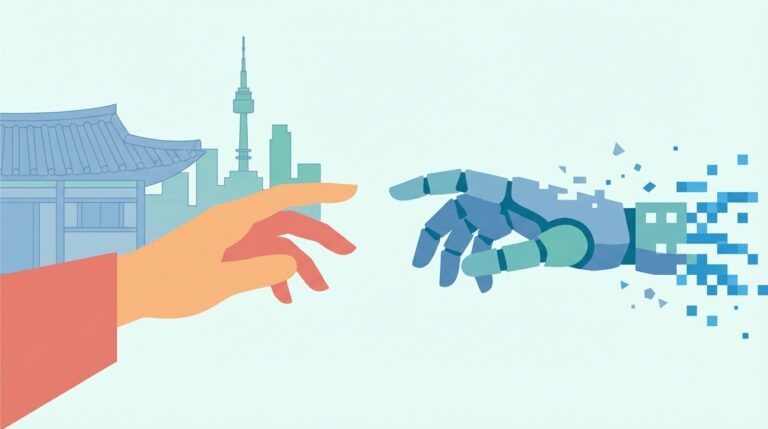
We are living in the era of AI. In Korea, a country obsessed with Ppalli-Ppalli (Hurry, Hurry) and high-tech efficiency, chatbots have taken over everything from banking to ordering fried chicken. But here’s the catch: Korean culture is deeply rooted in Jeong (정 – affection/bond) and Nunchi (눈치 – emotional intelligence).
Can an AI truly replace the emotional labor required to soothe an angry customer who just wants their K-Pop concert refund? Today, we dive into the C2-level Korean needed to navigate this digital frustration and the deep cultural meaning behind “Service with a Soul.”
Phase 2: Deep Dive into Core Expressions
1. 영혼이 없다 (Yeonghoni eopda)
- Pronunciation: [Yeong-hon-i eop-da] (Think of: “Young” + “Horn” + “E” + “Op” + “Da”)
- Meaning: Literal: “To have no soul.” / Real nuance: Robotically, mechanically, or insincerely doing something.
- K-Culture Moment: You’ll see this constantly in K-Pop content. If a member gives a dry compliment like “Wow, you are so funny,” the editors will slap a caption: “영혼 없는 리액션” (Soulless reaction). It’s the perfect description for a chatbot that says, “I understand your frustration,” but clearly doesn’t.
- Editor’s Insight: This is a critique of sincerity. In a high-context culture like Korea, how you say something matters more than what you say.
- Situation Spectrum:
[🚫 Formal Report] ———— [✅ Casual/Semi-Formal] - 🤔 Think About It: Why is “sincerity” (Jinsim) so highly valued in Korean service? Is a polite robot better than a rude human?
2. 감정 노동 (Gamjeong nodong)
- Pronunciation: [Gam-jeong no-dong]
- Meaning: Emotional Labor.
- K-Culture Moment: This is a buzzword in Korean news and documentaries. You might hear a tired protagonist in a slice-of-life drama sigh and say, “Today, the emotional labor was severe.” (오늘 감정 노동이 너무 심했어.)
- Editor’s Insight: This implies that managing one’s feelings to keep others comfortable is recognized as actual work. Chatbots save companies money because they don’t suffer from this, but they also can’t provide the healing that comes from it.
- Situation Spectrum:
[✅ Formal/Academic] ———— [✅ Serious Conversation]
3. 답답하다 (Dapdaphada)
- Pronunciation: [Dap-dap-ha-da]
- Meaning: Literal: Stuffy/Suffocating. / Real nuance: Frustrated because things aren’t working out; feeling blocked.
- K-Culture Moment: Imagine eating a dry sweet potato without water. That feeling in your chest? That’s dapdap. It’s the #1 word used when dealing with AI customer service.
- Editor’s Insight: This is a physical manifestation of an emotional state. It’s closely related to Hwabyung (a stress-induced illness peculiar to Koreans).
- Situation Spectrum:
[✅ Universal] - 🤔 Think About It: Does your language have a word that describes frustration as a physical sensation in the chest?
Phase 3: Textbook vs. Real Life
| Situation | 📖 Textbook Korean | 🗣️ Real Korean (C2 Vibe) | 💡 Why the difference? |
|---|---|---|---|
| Asking for a human | 상담원과 통화하고 싶습니다. (I want to speak with an agent.) | 사람 연결 좀 해줘요, 사람! (Connect me to a PERSON, please!) | Emphasizing the “human” element shows desperation and the failure of the bot. |
| Complaint about AI | 이 시스템은 불편합니다. (This system is inconvenient.) | 말귀를 못 알아들어서 속 터져요. (My insides are bursting because it can’t understand speech.) | “Malgwi” (ear for speech) implies the ability to understand context, not just syntax. |
| Empathy | 죄송합니다. (I am sorry.) | 마음 고생 많으셨죠? (You suffered a lot emotionally, right?) | Real Korean service acknowledges the customer’s suffering, not just the error. |
Phase 4: Cultural Deep Dive — The “Nunchi” Gap
Why do Koreans hate Chatbots more than others?
It comes down to Nunchi (눈치). In Korea, communication is often indirect. You don’t just say “Refund me.” You explain, “I was really looking forward to this concert for my anniversary, but…”
A human agent with Nunchi picks up on the “anniversary” cue and offers empathy (
Frequently Asked Questions (FAQ)
Q: What does "영혼이 없다 (Yeonghoni eopda)" mean in Korean and how do you pronounce it?
A: In Korean, "영혼이 없다 (Yeonghoni eopda)" is pronounced [Yeong-hon-i eop-da] and means: Literal: "To have no soul." / Real nuance: Robotically, mechanically, or insincerely doing something.
Q: What does "감정 노동 (Gamjeong nodong)" mean in Korean and how do you pronounce it?
A: In Korean, "감정 노동 (Gamjeong nodong)" is pronounced [Gam-jeong no-dong] and means: Emotional Labor.
Q: What does "답답하다 (Dapdaphada)" mean in Korean and how do you pronounce it?
A: In Korean, "답답하다 (Dapdaphada)" is pronounced [Dap-dap-ha-da] and means: Literal: Stuffy/Suffocating. / Real nuance: Frustrated because things aren't working out; feeling blocked.







