

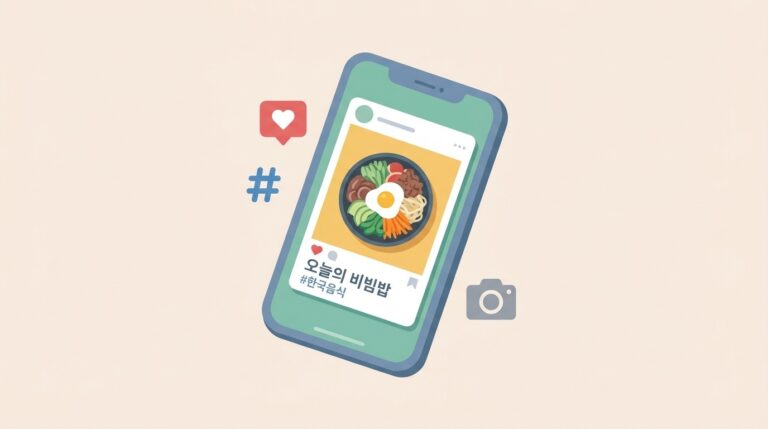
Phase 1: Immersive Hook — The “Camera Eats First” Ritual 📸
Hello! This is your Daily Hangul Senior Editor.
Imagine this scene: You are in a trendy restaurant in Yeonnam-dong, Seoul. The waiter places a steaming hot plate of Tteokbokki topped with perfectly melted cheese and a flower-shaped fried squid on the table. Your instinct tells you to pick up your chopsticks.
Stop! ✋
If you start eating immediately, everyone at the table might look at you in shock. In Korea, there is an unwritten rule: The camera eats first.
We see this in K-Dramas all the time. The characters don’t just eat; they hold their phones high above the table (the famous “air shot”), adjust the lighting, and snap the perfect picture to share their daily life. Whether you are an aspiring influencer or just want to show your friends back home what you’re eating, knowing how to caption these moments is crucial.
Today, we aren’t just learning words; we are learning how to become a part of the Korean “Foodie” community on Instagram. Let’s make your feed look (and sound) delicious!
Phase 2: Deep Dive — 3 Key Expressions
1. 비주얼 대박이다 (Bijueol daebagida)
- Pronunciation: [Bi-ju-eol dae-bak-i-da]
- Tip: “Bi-ju-eol” is just the English word “Visual.” “Dae” sounds like Day, and “bak” sounds like Bark (without the r).
- Meaning:
- Literal: The visual is a big hit.
- Real Nuance: “The presentation looks insane!” or “It looks too good to eat!”
- K-Culture Moment: You know those scenes in variety shows like I Live Alone (Na Honja Sanda) where the panel gasps “Wooooah!” when food appears? This is the verbal equivalent of that gasp.
- Editor’s Insight: This is the perfect reaction when the food arrives. It acknowledges the chef’s effort in plating. Use it before you taste the food.
- Situation Spectrum:
[🚫 Formal/Boss] ———— [⚠️ Colleagues] ———— [✅ Friends/SNS] - 🤔 Think About It: Koreans use the English word “Visual” specifically for appearance/presentation. Why do you think loanwords are often used for aesthetic descriptions in Korea?
2. 맛집 인증 (Matjib injeung)
- Pronunciation: [Mat-jip in-jeung]
- Tip: “Mat” sounds like Math. “Jip” sounds like Jeep. “In-jeung” sounds like In + Jungle.
- Meaning:
- Literal: Tasty house certification.
- Real Nuance: “Proof that I visited a famous delicious place.”
- K-Culture Moment: Search
#맛집인증on Instagram. You will see millions of photos. It’s not just about eating; it’s about proving you were there, part of the trend. - Editor’s Insight: ‘Matjib’ (맛집) is one of the most important words in modern Korea. It doesn’t just mean a restaurant; it implies a verified delicious place.
- Situation Spectrum:
[🚫 Formal/Boss] ———— [⚠️ Colleagues] ———— [✅ Friends/SNS] - 🤔 Think About It: The word “Injeung” (Certification/Proof) is used heavily in Korean SNS culture. Why is “proving” an experience so important in Korean social interaction?
3. 웨이팅 할 만하네 (Weiting hal manhane)
- Pronunciation: [We-i-ting hal man-ha-ne]
- Meaning:
- Literal: It is worth the waiting.
- Real Nuance: “It was worth waiting in line for this.”
- K-Culture Moment: Korea is the land of queues. From the “London Bagel Museum” to hype popup stores, waiting is part of the experience. This phrase validates that your time wasn’t wasted.
- Editor’s Insight: The grammar
-(으)l man hadameans “worth doing.” You can use this for movies too: “Bol man hada” (Worth watching). - Situation Spectrum:
[🚫 Formal/Boss] ———— [✅ Colleagues] ———— [✅ Friends/SNS] - 🤔 Think About It: In many Western cultures, waiting 2 hours for bread is insane. In Seoul, it’s a hobby. What does this patience say about the value of “trends” in Korea?
Phase 3: Textbook vs. Real Life
| Situation | 📖 Textbook Korean | 🗣️ Real Korean (SNS ver.) | 💡 Why the difference? |
|---|---|---|---|
| Praising the taste | 음식이 정말 맛있어요. (The food is delicious.) |
JMT / 존맛탱 / 핵꿀맛 (Freaking delicious/Honey taste) |
Textbook is polite. SNS needs short, punchy slang to grab attention. |
| Describing a famous place | 유명한 식당이에요. (It is a famous restaurant.) |
핫플 (Hot place) / 성지 (Holy ground) | Koreans love abbreviating English (Hot Place = Hotple). |
| Posting a photo | 사진을 올려요. (I am uploading a photo.) |
업뎃 완료 / 피드 박제 (Update complete / Stuffed in feed) |
Suggests archiving a memory permanently rather than just ‘uploading.’ |
Note: JMT (John-Mat-Taeng) is very casual slang. Do not use it with your boss, even if the kimchi stew is life-changing!
Phase 4: Cultural Deep Dive — The “Air Shot” & Nunchi
4-1. The “Air Shot” (항공샷)
Have you ever seen a girl standing up on her chair in a cafe to take a photo of her coffee? Don’t laugh! She is taking a Hanggong-shot (Airline shot/Overhead shot).
* Non-verbal Tip: When someone says “Wait!” and pulls out their phone, freeze. Do not put your spoon in the soup. Do not pick up your chopsticks. Wait until they say “Okay, meokja!” (Let’s eat).
4-2. K-Drama Connection: The “Solo Dining” Stigma vs. Trend
In older dramas, eating alone was sad. But recently (think Let’s Eat series), showing off delicious food, even if alone, is cool. However, on Instagram, usually, people post photos that imply they are with “good people” (좋은 사람들과). It emphasizes the social aspect of the meal.
Phase 5: Immersive Roleplay
Setting: Saturday afternoon at a “Hot Place” cafe in Seongsu-dong. The interior is industrial-chic. You are with Minji (your trendy Korean friend).
Minji: 와, 여기 케이크 비주얼 미쳤다! 잠깐, 먹지 마! 📸
(Wa, yeogi keikeu bijueol michyeotda! Jamkkan, meokji ma!)
(Wow, the cake visuals are crazy here! Wait, don’t eat!)
YOU: ____________________.
Minji: 응, 내가 잘 찍어서 보내줄게. 인스타에 올릴 거지?
(Eung, naega jal jjigeoseo bonaejulge. Inseuta-e ollil geoji?)
(Yeah, I’ll take a good one and send it to you. You’re gonna post it on Insta, right?)
🔀 Your Turn! How do you respond?
- A) “응, 당연하지! 맛집 인증해야지.”
(Yeah, of course! I need to certify this tasty place.)- B) “아니, 나는 그냥 먹을래.”
(No, I’m just going to eat.)- C) “사진은 됐고, 웨이팅 할 만했어?”
(Forget the photo, was it worth the wait?)✅ Best Choice: A — This shows you understand the social ritual. Minji will be happy to tag you.
⚠️ Choice B Analysis: You can say this, but Minji might think you are a “No-Jam” (Not fun) person today.
Phase 6: 10-Second Shadowing Drill
Read aloud with the emotion suggested!
- 😍 Amazed: 와… / 여기 / 비주얼 대박이다!
(Wa… / yeogi / bijueol daebagida!) - 😤 Satisfied: 한 시간 기다렸는데 / 웨이팅 할 만하네.
(Han sigan gidaryeonneunde / weiting hal manhane.) - 😎 Cool: 오랜만에 / 맛집 인증 / 성공!
(Oraenmane / matjib injeung / seonggong!)
Phase 7: K-Culture Mini Glossary
| Korean | Romanization | English Meaning | Context |
|---|---|---|---|
| 먹스타그램 | Meok-stagram | Foodagram | A combination of Eating (Meok) + Instagram. The ultimate hashtag for foodies. |
| 핫플 | Hat-ple | Hot Place | A trendy, popular location. |
| 인생샷 | Insaeng-shot | Life Shot | The best photo of your life (or the day). |
| 선팔 / 맞팔 | Seonpal / Matpal | First follow / Follow back | Used in comments: “I followed you first, please follow back.” |
Phase 8: Traveler’s Survival Kit 🆘
When you are at a cafe/restaurant and need to post now.
🆘 Survival Expression #1
* 🇰🇷 “여기 와이파이 비밀번호 뭐예요?” (Yeogi waipai bimilbeonho mwoyeyo?)
* 🗣️ Pronunciation: [Yeo-gi wa-i-pa-i bi-mil-beon-ho mwo-ye-yo]
* 📍 Where: Cafes, Restaurants
* 💡 Pro Tip: Often, the password is on the receipt (영수증) or a small sign near the register. Look for PW.📌 Editor’s Travel Note
* Location Tags: When posting on Instagram in Korea, adding the precise location tag (e.g., “Starbucks Gangnam R”) is crucial for getting likes from other Koreans searching for that spot.
Phase 9: Think Deeper — Food & Identity
Why do Koreans share food photos so aggressively?
In Korea, eating is rarely just about nutrition; it’s about Jeong (정 – affection/bonding). Historically, sharing food meant survival and community. In the digital age, sharing a photo of food is the modern way of saying, “I am connected to the world, I am experiencing joy, and I want to share this vibe with you.” It’s less about showing off wealth and more about showing that you are participating in current trends and social life.
💬 Your Turn: In your culture, is taking photos of food considered polite, annoying, or necessary? Tell us in the comments!
Phase 10: FAQ & Troubleshooting
- Q: Can I take photos of the menu?
- A: Generally, Yes. It’s very common to blog about menu prices. However, some high-end Omakase places might restrict it.
- Q: Can I take photos of other people in the restaurant?
- A: NO. Korea has very strict privacy laws (portrait rights). If you post a photo where a stranger’s face is clearly visible, you can legally get in trouble. Always blur faces or use stickers to cover them.
❌ Common Mistake: Posting a photo with the hashtag
#Dailybut using formal language like “안녕하십니까” (Hello).
✅ Fix: On SNS, use casual language or noun-ending forms (e.g., “오늘 점심!” instead of “오늘 점심입니다.”) to sound natural.
Phase 11: Wrap-up & Action Mission
One-Liner: To enjoy Korean food culture fully, the camera must eat before you do!
🏆 Action Missions:
* 🥉 Bronze: Say “비주얼 대박이다” the next time you see a nice meal (even if you are alone).
* 🥈 Silver: Search #먹스타그램 on Instagram and try to read 3 captions.
* 🥇 Gold: Go to a Korean restaurant, take a photo, and post it with the caption: “드디어 왔다! 맛집 인증 📸 #Korea #Food”
Phase 12: Quiz — Interactive Challenge
1. Which hashtag is BEST for a photo of delicious food?
a) #공부스타그램 (Study-gram)
b) #먹스타그램 (Meok-stagram)
c) #셀카 (Selca)
2. Your food just arrived. What do you say?
a) 잘 먹었습니다! (I ate well! – Past tense)
b) 비주얼 대박이다! (The visual is awesome!)
c) 얼마예요? (How much is it?)
3. True or False?
It is polite to take photos of strangers in a Korean restaurant as long as the food looks good.
(True / False)
🔽 Click to check answers
- b) Meok-stagram is for food.
- b) Always admire the visual first!
- False! Never post strangers’ faces without permission. Use blur!
Frequently Asked Questions (FAQ)
Q: What does "비주얼 대박이다 (Bijueol daebagida)" mean in Korean and how do you pronounce it?
A: In Korean, "비주얼 대박이다 (Bijueol daebagida)" is pronounced [Bi-ju-eol dae-bak-i-da] and means: a key conversational Korean expression covered in this lesson.
Q: What does "맛집 인증 (Matjib injeung)" mean in Korean and how do you pronounce it?
A: In Korean, "맛집 인증 (Matjib injeung)" is pronounced [Mat-jip in-jeung] and means: a key conversational Korean expression covered in this lesson.
Q: What does "웨이팅 할 만하네 (Weiting hal manhane)" mean in Korean and how do you pronounce it?
A: In Korean, "웨이팅 할 만하네 (Weiting hal manhane)" is pronounced [We-i-ting hal man-ha-ne] and means: Literal: It is worth the waiting.







