

Don’t Just Boil It! 🍜 Secrets to Cooking (and Eating) Ramen Like a Local
Phase 1: Immersive Hook
Greeting: 안녕하세요! It’s your Daily Hangul editor here.
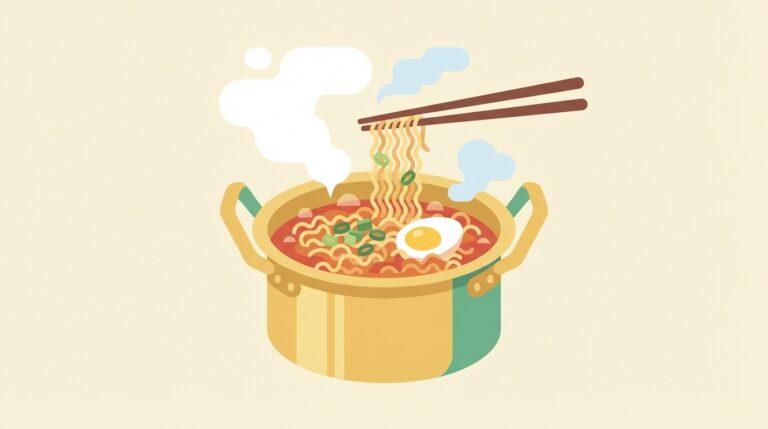
Picture this: It’s 11 PM in a K-Drama. The lead character has just had a terrible day. They open a cupboard, grab a crinkly package, and pull out a dented, gold-colored aluminum pot (양은냄비). The water boils, the red powder goes in, and then—the magic moment. They crack an egg, drop some chopped green onions, and lift the noodles into the air to cool them down.
They take a sip of the soup and make a sound that translates to “Ah, refreshing,” even though the soup is scalding hot.
Today, we aren’t just talking about “instant noodles.” We are diving into the soul of Korean comfort food. If you only know how to boil water and dump the packet in, you’re missing out on 50% of the flavor—and the culture. Let’s learn the hacks and the words that turn a simple snack into a gourmet experience.
Phase 2: Deep Dive into Key Expressions
1. 꼬들꼬들하다 (Kkodeul-kkodeul-hada)
- Pronunciation: [Kko-deul-kko-deul-ha-da] + Sounds like the rhythmic tapping of hard shoes.
- Meaning: Literal: Firm / Real Nuance: Al dente (perfectly chewy)
- K-Culture Moment: In reality shows like I Live Alone, you’ll often hear celebrities debating: “Are you ‘Team Soggy’ (퍼진 면) or ‘Team Chewy’ (꼬들한 면)?” Most Koreans prefer their noodles slightly undercooked so they remain bouncy until the last bite.
- Editor’s Insight: This is the highest compliment for a ramen chef. If you cook noodles for a Korean friend, turn off the heat 30 seconds early. When they chew and say, “Wow, it’s totally kkodeul-kkodeul,” you’ve won.
- Situation Spectrum:
[🚫 Formal Presentation] ———— [⚠️ Semi-formal] ———— [✅ Casual Dining] - 🤔 Think About It: Why do Koreans value “chewiness” (texture) so much in food (like tteokbokki and ramen), sometimes even more than the flavor itself?
2. 국물이 끝내줘요 (Gungmuri kkeunnae-jwoyo)
- Pronunciation: [Gung-mu-ri kkeun-nae-jwo-yo] + Imagine a satisfied sigh after finishing a marathon.
- Meaning: Literal: The soup finishes it off. / Real Nuance: The broth is to die for / The soup is amazing.
- K-Culture Moment: This phrase became legendary due to an old commercial. Now, whenever someone takes a sip of really deep, savory soup, this reaction is almost automatic.
- Editor’s Insight: The verb 끝내다 means “to finish,” but in slang, it means something is so good it “ends” the competition. You can use this for any liquid dish, from kimchi stew to udon.
- Situation Spectrum:
[🚫 Very Formal] ———— [⚠️ Polite Company] ———— [✅ Friends/Family] - 🤔 Think About It: In Western culture, soup is often an appetizer. In Korea, gukmul (broth) is the soul of the main meal. What does this say about the Korean dining structure?
3. 파 송송 계란 탁 (Pa song-song gyeran tak)
- Pronunciation: [Pa song-song gye-ran tak] + Sounds like a rhythmic chant.
- Meaning: Literal: Green onions chopped song-song, egg cracked tak.
- K-Culture Moment: This is the “magic spell” for delicious ramen. It refers to the two essential toppings: green onions (for freshness) and an egg (for richness). It was even the title of a Korean movie!
- Editor’s Insight: Use this when you want to describe adding the finishing touches to something. It implies doing something quickly but perfectly.
- Situation Spectrum:
[🚫 Business Meeting] ———— [⚠️ Casual Chat] ———— [✅ Cooking Context] - 🤔 Think About It: Korean cuisine relies heavily on onomatopoeia (mimetic words) like song-song and tak. How does sound shape the way we perceive food?
Phase 3: Textbook vs. Real Life
| Situation | 📖 Textbook Korean | 🗣️ Real Korean (Inssa Style) | 💡 Why the difference? |
|---|---|---|---|
| Tasting the soup | 국물이 맛있어요. (The soup is delicious.) | 국물이 진국이네! (This broth is the “real deal”/essence.) | Jin-guk implies depth and time spent cooking, not just “tasty.” |
| Adding rice after noodles | 밥을 말아 먹을까요? (Shall we mix rice?) | 밥 말아 먹는 건 국룰이지. (Mixing rice is a national rule.) | Gung-nul (National Rule) refers to unwritten social laws everyone follows. |
| Noodles are perfect | 면이 잘 익었어요. (Noodles are cooked well.) | 면발이 살아있네. (The noodle strands are alive!) | Personifying food adds emphasis to its freshness and texture. |
Bottom Note: Use “국룰 (Gung-nul)” when you want to emphasize that a certain combination (like Ramen + Kimchi) is undeniable. It makes you sound very culturally aware!
Phase 4: Cultural Deep Dive
4-1. The Art of “Myeonchigi” (면치기 – Noodle Slurping)
In many Western cultures, slurping is rude. In Korea, 면치기 (Myeonchigi)—slurping noodles loudly without cutting them—is often seen (especially on TV) as a sign that the food is delicious. However, be careful! Not everyone likes it. In a quiet setting or with elders, silent eating is still safer. But with close friends? A little slurp shows you’re enjoying the meal.
4-2. The “Lid” Plate (뚜껑 접시)
Have you seen K-Drama characters eating ramen straight from the pot lid?
Why?
1. Efficiency: Fewer dishes to wash.
2. Cooling: The metal lid cools the hot noodles instantly.
3. Vibe: It just tastes better. It’s the flavor of “home” and “unpretentiousness.”
Phase 5: Immersive Roleplay
Setting: It’s 2 AM at a Han River convenience store. You are trying the famous “automatic ramen cooking machine.” A friendly Korean student is waiting behind you.
Characters:
– YOU: A hungry traveler trying to figure out the machine.
– Jimin (24): A helpful local student, holding a triangle kimbap.
Dialogue:
Jimin: (Seeing you hesitate) 저기요, 도와드릴까요? 물 조절이 좀 어렵거든요.
(Jeogiyo, dowadeurilkkayo? Mul jojeori jom eoryeopgeodeunyo.)
(Excuse me, need help? Controlling the water is a bit tricky.)
YOU: 아, 네! 감사합니다. [Decision Point]
🔀 Your Turn! How do you describe your noodle preference?
– A) “저는 부드러운 면이 좋아요.” (I like soft noodles.)
– B) “저는 꼬들꼬들한 게 좋아요!” (I like them al dente/chewy!)
– C) “대충 해주세요.” (Just do it roughly.)✅ Best Choice: B — Why: Most Koreans prefer ramen kkodeul-kkodeul. Saying this shows you know exactly what you want. Jimin will nod in approval.
⚠️ Choice C Analysis: “대충 (Roughly)” sounds a bit rude or indifferent here. It puts the burden on Jimin to decide.
Jimin: (Pressing buttons) 오, 맛을 좀 아시네요! 꼬들꼬들하게 하려면 30초 빨리 꺼야 해요.
(O, maseul jom asineyo! Kkodeul-kkodeul-hage haryeomyeon 30-cho ppalli kkeoya haeyo.)
(Oh, you know the taste! To make it chewy, you have to turn it off 30 seconds early.)
Jimin: 계란은 지금 넣으세요! 파 송송 계란 탁! 아시죠?
(Gyeraneun jigeum neouseyo! Pa song-song gyeran tak! Asijyo?)
(Put the egg in now! Chopped green onions and crack the egg! You know, right?)
Phase 6: 10-Second Shadowing Drill
Let’s practice the ultimate compliment for a hot meal.
Drill:
😊 (Satisfied sigh): 와, / 국물이 / 아주 / 끝내주네요!
(Wa, / gungmuri / aju / kkeunnaejuneyo!)
Wow, / the broth / is / absolutely / to die for!
Phase 7: K-Culture Mini Glossary
| Korean | Romanization | Meaning | Context |
|---|---|---|---|
| 해장 | Haejang | Hangover Cure | Eating spicy ramen to “sweat out” a hangover. |
| 한강 라면 | Hangang Ramyeon | Han River Ramen | Ramen cooked in foil containers at the Han River parks. A must-do date course. |
| 1인 1냄비 | Irin-il-naembi | 1 Pot per Person | While stews are shared, ramen is often cooked in individual pots to respect noodle texture preference. |
| 뽀글이 | Ppogeuri | Bag Ramen | Cooking ramen directly in the bag by pouring hot water (military style). |
Phase 8: Traveler’s Survival Kit
Heading to a Korean Convenience Store (Pyeoneui-jeom)?
🆘 Survival Phrases
– 🇰🇷 “여기서 먹고 갈 수 있어요?” (Yeogiseo meokgo gal su isseoyo?)
– “Can I eat this here?”
– 📍 Use: At a convenience store.
– 🇰🇷 “나무 젓가락 주세요.” (Namu jeotgarak juseyo.)
– “Please give me wooden chopsticks.”
– 💡 Pro Tip: Often you grab them yourself, but sometimes they are behind the counter.📌 Editor’s Travel Note
Most Korean convenience stores have a microwave and hot water dispenser. Look for the “라면 조리기” (Ramen Cooker) machine at the Han River—it creates the perfect water-to-noodle ratio automatically!
Phase 9: Think Deeper — Food & Identity
Why is Korea the “Land of Instant Noodles”?
Korea has the highest per capita ramen consumption in the world. Why? It connects to the “Pali-pali” (Hurry-hurry) culture developed during Korea’s rapid economic growth. Ramen is quick, cheap, and hot—fuel for a hardworking nation. But interestingly, Koreans have turned this “fast food” into a “soul food” by adding their own touches (kimchi, egg, cheese, tuna). It reflects a culture that finds comfort and creativity even within the constraints of a busy life.
💬 Your Turn: Does your country have a “fast food” that implies more than just a quick meal? Share in the comments!
Phase 10: FAQ & Troubleshooting
Q: Is it rude to drink the soup from the bowl?
A: Not at all! In casual settings (like a ramen shop), lifting the bowl with both hands to drink the broth is a compliment to the chef. It means you enjoyed it to the last drop.
Q: Can I ask for a fork instead of chopsticks?
A: Yes, say “포크 좀 주시겠어요?” (Pokeu jom jusigesseoyo?). However, eating noodles with a fork might make it harder to do the “Myeonchigi” (slurping) technique!
❌ Common Mistake:
Don’t say “Ramen” (Japanese pronunciation) too strongly. Try to say “Ramyeon” (라면). And never leave your chopsticks sticking vertically into the noodles—it resembles a funeral ritual.
Phase 11: Wrap-up & Action Mission
Summary: Today we learned how to demand al dente noodles (꼬들꼬들), praise the broth (국물), and understand the soul of Korean ramen culture.
🚀 Action Missions:
– 🥉 Bronze: Say “꼬들꼬들하게 해주세요” (Please make it al dente) to yourself while cooking pasta or noodles.
– 🥈 Silver: Post a photo of your noodles on social media with the caption: “오늘 점심은 국룰! (Today’s lunch is the national rule!)”
– 🥇 Gold: Go to a Korean supermarket, buy a shiny gold pot (양은냄비), and cook ramen for a friend using the “Pa song-song gyeran tak” technique!
Phase 12: Quiz — Interactive Challenge
- Situation: Your friend cooked ramen, but the noodles are swollen and mushy. What is the OPPOSITE of this texture?
- A) 시원하다 (Siwon-hada)
- B) 꼬들꼬들하다 (Kkodeul-kkodeul-hada)
- C) 느끼하다 (Neukki-hada)
- Culture: Which behavior implies that the ramen is delicious (in a casual setting)?
- A) Eating silently with eyes closed.
- B) Myeonchigi (Slurping loudly).
- C) Leaving half the soup in the bowl.
- True or False: “Gung-nul” (National Rule) refers to a law written in the Korean constitution about how to eat food.
Answer Key:
1. B (A means refreshing/cool soup, C means greasy/oily)
2. B (Though be careful in formal settings!)
3. False (It’s a slang term for unwritten social norms/trends.)
Frequently Asked Questions (FAQ)
Q: What does "꼬들꼬들하다 (Kkodeul-kkodeul-hada)" mean in Korean and how do you pronounce it?
A: In Korean, "꼬들꼬들하다 (Kkodeul-kkodeul-hada)" is pronounced [Kko-deul-kko-deul-ha-da] and means: Literal: Firm / Real Nuance: Al dente (perfectly chewy)
Q: What does "국물이 끝내줘요 (Gungmuri kkeunnae-jwoyo)" mean in Korean and how do you pronounce it?
A: In Korean, "국물이 끝내줘요 (Gungmuri kkeunnae-jwoyo)" is pronounced [Gung-mu-ri kkeun-nae-jwo-yo] and means: Literal: The soup finishes it off. / Real Nuance: The broth is to die for / The soup is amazing.
Q: What does "파 송송 계란 탁 (Pa song-song gyeran tak)" mean in Korean and how do you pronounce it?
A: In Korean, "파 송송 계란 탁 (Pa song-song gyeran tak)" is pronounced [Pa song-song gye-ran tak] and means: Literal: Green onions chopped song-song, egg cracked tak.







