

Phase 1: The Immersive Hook
Hello, Daily Hangul readers! This is your Senior Editor.
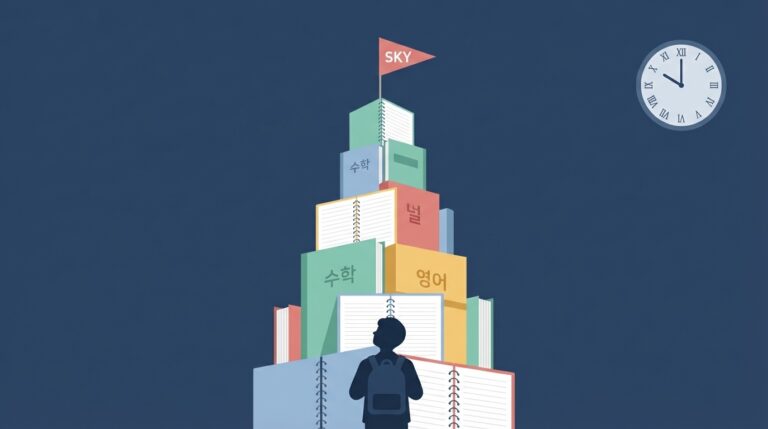
Imagine this scene: It’s 10:00 PM in Daechi-dong, the epicenter of Seoul’s education craze. Suddenly, the quiet streets are flooded with students pouring out of buildings, and traffic comes to a standstill as parents line up their cars to pick them up. It looks like a scene straight out of the K-Drama Sky Castle or Crash Course in Romance, doesn’t it?
But this isn’t just drama magic; it’s the reality of ‘The War on Private Education’.
Today, we are tackling a C2-level topic that dominates Korean news, politics, and dinner conversations: The Normalization of Public Education and the Regulation of Private Education (공교육 정상화와 사교육 규제).
If you can discuss this topic, you aren’t just ‘good at Korean’—you understand the anxiety, ambition, and social structure of modern Korea. Ready to dive into the deep end?
Phase 2: Deep Dive Expressions
Here are the heavy-hitters you need to sound like a sophisticated social commentator.
1. 공교육 정상화 (Gong-gyo-yuk Jeong-sang-hwa)
- Pronunciation: [Gong-gyo-yuk Jeong-sang-hwa] (Sounds like: Gong-as in gong, gyo-yuk, Jeong-sang-hwa)
- Meaning: Normalization of Public Education.
- Nuance: It’s a political buzzword implying that the current public school system is ‘abnormal’ or ‘broken’ because it relies too heavily on private tutoring.
- K-Culture Moment: Every time a new Minister of Education is appointed on the news, they promise this. It’s the ultimate goal that seems forever out of reach, like a perfect SAT score.
- Situation Spectrum:
[🚫 Casual Friends] ———— [✅ Debate/News/Formal]- 🤔 Think About It: Why is “normalization” the goal? Does this imply that the current state of relying on Hagwons (academies) is considered a “crisis” by the government, even if parents love it?
2. 사교육비 경감 (Sa-gyo-yuk-bi Gyeong-gam)
- Pronunciation: [Sa-gyo-yuk-bi Gyeong-gam]
- Meaning: Reduction of private education expenses.
- Nuance: This isn’t just about saving money; it’s about solving the low birth rate issue. Many Koreans cite sa-gyo-yuk-bi as the #1 reason they don’t have children.
- Editor’s Insight: If you use the word ‘줄이다’ (to reduce), you sound like a student. If you use ‘경감하다’ (to alleviate/mitigate), you sound like a policy maker.
- Situation Spectrum:
[⚠️ Casual] ———— [✅ Professional/Academic]- 🤔 Think About It: In your country, is education a public right or a paid privilege? How does the cost of education affect family planning there?
3. 선행 학습 (Seon-haeng Hak-seup)
- Pronunciation: [Seon-haeng Hak-seup]
- Meaning: Prior learning / Advance learning.
- Nuance: Learning curriculum (math, English) 1 to 3 years ahead of the actual school grade in private academies. It is technically banned in schools but rampant in Hagwons.
- K-Drama Context: Remember the kids in Sky Castle solving high school math problems while in middle school? That is Seon-haeng Hak-seup.
- Situation Spectrum:
[✅ All Situations]
Phase 3: Textbook vs. Real Life
Let’s see how a standard textbook discusses education vs. how Koreans actually talk about it over a beer.
| Situation | 📖 Textbook Korean | 🗣️ Real Korean (The Vibe) | 💡 Why the difference? |
|---|---|---|---|
| Describing intense study | 학생들이 밤늦게까지 공부해요. (Students study until late at night.) | 입시 지옥이 따로 없어요. (It’s literally entrance exam hell.) | ‘Hell’ (지옥) captures the emotional suffering better than just ‘studying’. |
| Going to academies | 학원에 다녀요. (I attend an academy.) | 학원 뺑뺑이 돌려요. (I’m spinning around the academy loop.) | ‘뺑뺑이’ implies a passive, endless cycle of being moved from one place to another. |
| Successful Kid | 공부를 아주 잘하는 학생이에요. (He is a very good student.) | 개천 용은 이제 옛말이죠. (Dragons rising from small streams is an old saying.) | Implies that success now requires money, not just effort. Use this to sound cynical and smart. |
💡 Editor’s Note: At C2 level, using idioms like “개천에서 용 난다” (Rags to riches) and negating them shows you understand the shift in social mobility.
Phase 4: Cultural Deep Dive
4-1. The “Nunchi” of Educational Background
In Korea, asking “Which university did you graduate from?” (어디 학교 나오셨어요?) is common but high-stakes.
* The Rule: If you graduated from a ‘SKY’ university (Seoul National, Korea, Yonsei), you answer proudly. If not, people often answer vaguely (“Just a school in Seoul…”).
* Non-verbal Tip: If someone answers vaguely, do not press for details. That is bad nunchi.
4-2. K-Drama Connection: The “Coordinator”
In dramas like Sky Castle, the “Coordinator” manages a student’s entire life. In reality, this is the “Ip-si Consulting” (Entrance Exam Consulting) industry. Regulation often targets these high-priced consultants. When discussing this, you can say:
* “드라마가 현실을 과장한 게 아니라, 현실이 더하다더라고요.” (They say the drama didn’t exaggerate reality; reality is actually worse.)
Phase 5: Immersive Roleplay
Scenario: You are at a dinner with Korean colleagues. The topic shifts to the government’s new policy to remove “Killer Questions” (super hard questions) from the Suneung (CSAT) to reduce reliance on private education.
Characters:
* YOU: An expat interested in Korean society.
* Department Head Kim (50s): Conservative, believes in hard work.
* Assistant Lee (30s): Cynical about policy changes.
(Dialogue Start)
Head Kim: 이번에 수능에서 킬러 문항 없앤다면서요? 공교육 정상화가 될지 모르겠네요.
(I heard they are removing ‘Killer Questions’ from the CSAT. I wonder if public education will actually be normalized.)
Assistant Lee: 에이, 부장님. 풍선 효과 아시잖아요. 여기 누르면 저기가 튀어나오는 거. 사교육이 그렇게 쉽게 잡히겠어요?
(Ay, Boss. You know the ‘Balloon Effect.’ You press here, it bulges there. Do you think private education can be caught that easily?)
🔀 Your Turn! How do you join this high-level debate?
Option A: “맞아요. 한국 교육은 너무 힘들어요.” (Too simple for C2)
Option B: “결국 평가 방식이 바뀌지 않으면, 사교육 풍선 효과는 계속될 것 같아요.”
(Ultimately, unless the evaluation method changes, the balloon effect of private education will likely continue.)
Option C: “킬러 문항이 없으면 변별력은 어떻게 확보하나요?”
(If there are no Killer Questions, how do they ensure discrimination [ability to distinguish top students]?)
✅ Best Choice: Option C. “변별력 (Byeon-byeol-lyeok)” is the Magic Word here. It shows you understand the core dilemma: easy exams mean everyone gets 100, making it impossible to rank students for top universities.
(Continuing with Option C)
Head Kim: 오! OO씨, ‘변별력’이라는 말도 알아요? 정확해요. 물수능이 되면 그건 그거대로 문제죠.
(Oh! You know the word ‘discrimination power’? Exactly. If it becomes a ‘Water Suneung’ [too easy], that’s a problem in itself.)
Phase 6: 10-Second Shadowing Drill
Let’s practice a sentence that summarizes the irony of the situation.
Emotion: 🤔 Thoughtful and slightly critical
Sentence:
사교육을 잡으려고 / 입시 제도를 바꿀 때마다 / 오히려 불안감이 커져서 / 학원을 더 찾게 되는 역설이 발생해요.
Romanization:
Sa-gyo-yu-geul ja-beu-ryeo-go / ip-si je-do-reul ba-kkul ttae-ma-da / o-hi-ryeo bul-an-ga-mi keo-jyeo-seo / ha-gwo-neul deo chat-ge doe-neun yeok-seol-i bal-saeng-hae-yo.
Translation:
Every time they change the entrance exam system / to catch [regulate] private education, / the anxiety actually grows, / leading to the paradox of people seeking out academies even more.
Phase 7: K-Culture Glossary (Education Edition)
| Korean | Rom. | Meaning | Context |
|---|---|---|---|
| 일타 강사 | Ilta Gangsa | Star Instructor | “1-deung Star”. Instructors who earn millions like K-Pop stars. (Ref: Crash Course in Romance) |
| 야자 (야간자율학습) | Yaja | Night Self-Study | Students staying at school until 10 PM to study. Becoming less common but still iconic. |
| 학군지 | Hak-gun-ji | School District Area | Areas like Daechi-dong or Mok-dong with high concentrations of academies. Real estate is expensive here. |
| N수생 | N-su-saeng | Repeat Test Taker | Students who take the CSAT 2, 3, or N times to get into a better university. |
Phase 8: Traveler’s Survival Kit (The “Observer” Edition)
Even if you aren’t a student, you will see this culture on the streets.
👀 Survival Observation: The Yellow Buses
– What: If you see a fleet of yellow mini-buses in Gangnam/Seocho at 10 PM, do not try to catch a taxi there. It is chaos.
– Why: 10 PM is the legal curfew for Hagwons in Seoul. It’s rush hour part 2.🗣️ Survival Expression: When asking directions
– “이 근처에 입시 학원이 많아서 길이 좀 막히네요.”
– (Traffic is a bit jammed because there are many entrance exam academies nearby.)
– Use this: To start small talk with a taxi driver in Gangnam. They will have a LOT to say about it.
Phase 9: Think Deeper — “The Ladder of Success”
Topic: Social Mobility vs. Education
Historically, Koreans believed in “Education as a Ladder”—that studying hard could lift you out of poverty. However, the current debate on normalizing public education is deeply tied to the belief that this ladder is broken. Private education (Hagwons) is expensive, meaning the wealthy have a distinct advantage.
When you hear news about “regulating private education,” it’s not just about school; it’s a battle over fairness (공정성) in society. Can a student relying solely on public education still compete with a “Daechi-dong kid”?
💬 Your Turn: Does your country have a “private education fever”? Is it seen as a tool for success or a source of inequality? Tell us in the comments using the word ‘양극화’ (polarization)!
Phase 10: FAQ & Troubleshooting
Q: Can I ask a Korean parent “Why do you send your kid to so many Hagwons?”
Answer: Careful (⚠️). If you ask with a tone of “That looks crazy/abusive,” it’s rude. Most parents feel they have to do it so their child isn’t left behind.
Better phrasing: “한국은 교육 열기가 정말 대단한 것 같아요. 부모님들이 참 고생이 많으시겠어요.” (Korea’s passion for education seems intense. Parents must go through a lot of trouble.) -> Empathy works best.
❌ Common Mistake: Confusing 대학원 (Graduate School) and 학원 (Academy).
“저는 밤마다 대학원에 가요” (I go to grad school every night) vs “저는 밤마다 학원에 가요” (I go to a cram school every night). Very different vibes!
Phase 11: Wrap-up & Mission
Summary: Today we learned that ‘Public Education Normalization’ is a complex ideal fighting against the reality of ‘Entrance Exam Hell’ and the ‘Balloon Effect’ of regulations.
Action Missions:
* 🥉 Bronze: Read a Korean news headline containing ‘사교육’ or ‘수능’.
* 🥈 Silver: Search for “Korean Star Instructor” on YouTube and watch 1 minute of their lecture. Feel the energy.
* 🥇 Gold: Ask a Korean friend, “한국에서 개천에서 용 난다는 말이 아직 유효하다고 생각해?” (Do you think ‘rags to riches’ is still valid in Korea?) and listen to their rant.
K-Culture Mission: Watch the first episode of “Crash Course in Romance” (일타 스캔들). Look for the scene where moms line up to reserve a seat for a class. That is the ‘War’ we discussed today.
See you in the next class!
Stay curious, study hard (but not too hard)!
Phase 12: Interactive Quiz
- Situation: A news anchor is criticizing the fact that students learn materials 3 years in advance. What term would they use?
- a) 야간자율학습
- b) 선행 학습
- c) 킬러 문항
- True or False: In Korea, it is considered very polite and good ‘nunchi’ to ask someone specifically why they didn’t get into a SKY university.
- ( True / False )
- Fill in the blank: “Government regulations often fail because of the
_____ effect, where suppressing one problem causes it to pop up elsewhere.”- (Hint: 🎈)
(Scroll down for answers)
…
Answers: 1. (b), 2. False (Very rude!), 3. Balloon (풍선 효과)
Frequently Asked Questions (FAQ)
Q: What does "공교육 정상화 (Gong-gyo-yuk Jeong-sang-hwa)" mean in Korean and how do you pronounce it?
A: In Korean, "공교육 정상화 (Gong-gyo-yuk Jeong-sang-hwa)" is pronounced [Gong-gyo-yuk Jeong-sang-hwa] and means: Normalization of Public Education.
Q: What does "사교육비 경감 (Sa-gyo-yuk-bi Gyeong-gam)" mean in Korean and how do you pronounce it?
A: In Korean, "사교육비 경감 (Sa-gyo-yuk-bi Gyeong-gam)" is pronounced [Sa-gyo-yuk-bi Gyeong-gam] and means: Reduction of private education expenses.
Q: What does "선행 학습 (Seon-haeng Hak-seup)" mean in Korean and how do you pronounce it?
A: In Korean, "선행 학습 (Seon-haeng Hak-seup)" is pronounced [Seon-haeng Hak-seup] and means: Prior learning / Advance learning.







