

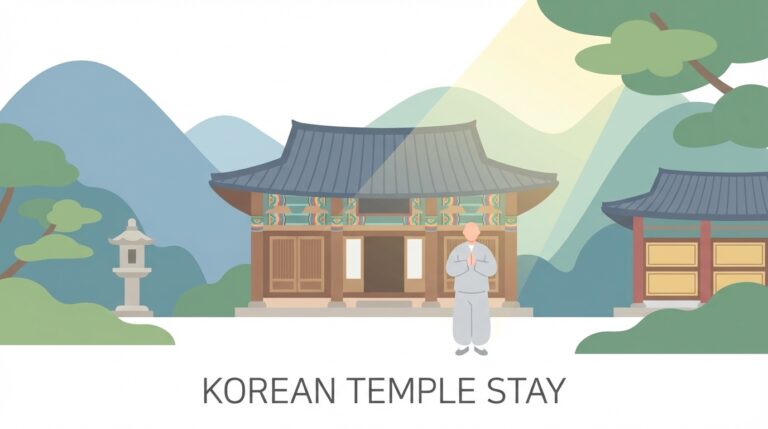
Phase 1: The Immersive Hook
🧘♂️ Finding Your “Inner Peace” K-Drama Style
Hello, Daily Hangul family! It’s your editor, the one who visits temples not just for prayer, but to find that cinematic “healing” moment.
Picture this: You’ve seen it in countless K-Dramas like My Mister or variety shows like I Live Alone. The celebrity, exhausted from city life, escapes to a quiet mountain temple. They wear comfortable grey uniforms, drink tea with a monk, and suddenly—the world seems peaceful. You might have even seen BTS’s RM posting photos from a temple visit, looking incredibly zen.
But wait. You arrive at a beautiful temple in Gyeongju or Seoul, and you freeze. A monk is walking toward you. Do you wave? Do you bow? Do you shake hands? And why is everyone walking so quietly?
If you treat a Korean temple (절, Jeol) like a noisy tourist spot, you might get some stern looks. But master a few key phrases and gestures, and you’ll be treated with the warmth reserved for a true Gu-do-ja (seeker of truth). Let’s unlock the secrets of Korean temple etiquette together.
Phase 2: Deep Dive into Key Expressions
Here are the top 3 expressions you need to survive a Temple Stay or a casual visit.
1. 성불하세요 (Seongbul-haseyo)
- Pronunciation: [Seong-bul-ha-se-yo] (Sounds like “Song-bull-ha-say-yo” but softer)
- Meaning:
- Literal: Please become a Buddha.
- Real Nuance: “May you be blessed” or “I wish you enlightenment/happiness.” It is the standard greeting between Buddhists or when parting ways with a monk.
- K-Culture Moment: In historical dramas, you often hear this when a character leaves a temple after praying for their family’s health.
- Editor’s Insight: This is the “God bless you” of Korean Buddhism. It’s a very high-level, sophisticated greeting. If you say this to a monk or a devout believer, their eyes will widen in surprise at your cultural depth.
- Situation Spectrum:
[🚫 To Friends] ———— [⚠️ Elders] ———— [✅ Monks/Believers] - 🤔 Think About It: Why do Koreans wish for you to “become a Buddha” rather than just have a good day? It reflects the core Buddhist belief that everyone has the potential for enlightenment inside them.
2. 합장 (Hapjang)
- Pronunciation: [Hap-jang] (Hap like ‘Hop’, Jang like ‘Jang’ in ‘Django’)
- Meaning:
- Literal: Joining palms.
- Real Nuance: The act of putting hands together in prayer/greeting.
- K-Culture Moment: You see this everywhere. Not just in temples, but when someone is apologizing profusely or asking for a huge favor in a rom-com (“Please, just this once!” while rubbing hands together).
- Editor’s Insight: In a temple, you don’t wave. You do Hapjang. You stop, put your hands together at chest level, and bow slightly. It’s the universal pass key.
- Situation Spectrum:
[✅ Temple Greeting] ———— [✅ Asking a Favor] ———— [✅ Apologizing]
3. 공양 (Gongyang)
- Pronunciation: [Gong-yang]
- Meaning:
- Literal: Offering.
- Real Nuance: A meal eaten at a temple.
- K-Culture Moment: Temple food (Temple Cuisine) is huge right now thanks to Chef Jeong Kwan on Netflix’s Chef’s Table. When you eat at a temple, it’s not just “Bab” (rice), it’s “Gongyang.”
- Editor’s Insight: If a monk asks, “Did you have lunch?” they might use the word Gongyang. It implies eating with gratitude and zero waste. You must clean your bowl with water and drink it (yes, really) to finish the ritual!
- Situation Spectrum:
[🚫 Fancy Restaurant] ———— [⚠️ Religious friends] ———— [✅ Temple]
Phase 3: Textbook vs. Real Life
| Situation | 📖 Textbook Korean | 🗣️ Real Korean (Temple Ver.) | 💡 Why the difference? |
|---|---|---|---|
| Greeting a Monk | 안녕하세요 (Annyeong-haseyo) | 합장 (Just Bow) or 성불하세요 | In temples, silence is often better than words. A bow is sufficient. |
| “Be Quiet” | 조용히 해 주세요 (Please be quiet) | 묵언 (Mugeon) / 정숙 (Jeongsuk) | Mugeon is a spiritual practice of silence, not just a rule. |
| Mealtime | 밥 먹읍시다 (Let’s eat) | 공양하시죠 (Shall we do Gongyang?) | Temple language elevates daily acts to spiritual rituals. |
Bottom Note: While “Annyeong-haseyo” is never wrong, using the specific temple vocabulary shows you respect the sanctity of the space.
Phase 4: Cultural Deep Dive
4-1. Non-verbal: The Art of “Nunchi” in Temples
In a temple, where you walk matters.
* The Center Door: Never enter the main hall through the center door. That is for the Buddha and the monks. Use the side doors.
* The Threshold: Never step on the raised wooden threshold (munji-bang). Step over it. Stepping on it is considered bad luck and disrespectful to the structure.
4-2. K-Culture Connection: The “Temple Stay” Variety Show Trope
In Korean variety shows (like 2 Days & 1 Night or I Live Alone), the “Temple Stay” episode is a classic trope.
1. The Suffering: The cast members struggle with the 108 Bows (108-bae). This is a physical prostration ritual to cleanse 108 worldly anxieties. It’s legitimate cardio!
2. The Food: They marvel at how delicious the vegan food is, despite no meat or garlic (the “Five Pungent Spices” are forbidden).
3. The Realization: They usually end up crying or having a deep talk during tea time with the monk.
🤔 Critical Thinking: Why is “suffering” (like 108 bows) seen as a path to healing in Korean culture? Is it about punishing the body, or emptying the mind through repetition?
Phase 5: Immersive Roleplay Scenario
Scenario A: Tea Time with a Monk (Cha-dam)
Setting: It’s a rainy afternoon at a temple in the mountains. You are doing a Temple Stay. You are sitting on the floor across from a Monk (Sunim), drinking lotus tea.
Characters:
* YOU: A foreign visitor seeking peace of mind.
* Sunim (Monk): A gentle, wise monk with a soft voice.
Dialogue:
Sunim: (Pouring tea) 차 맛이 어떻습니까?
(Cha masi eotteoseumnikka?)
(How is the taste of the tea?)
YOU: (Following the etiquette, holding the cup with two hands)
[Your Choice Needed!]
🔀 Your Turn! How do you answer?
- A) “맛이 없어요. 설탕 있어요?” (It tastes bad. Do you have sugar?)
- B) “향이 참 좋습니다. 마음이 편해지네요.” (The scent is very good. My mind feels at ease.)
- C) “이거 얼마예요?” (How much is this?)
✅ Best Choice: B
* Why: Even if the tea is bitter, commenting on the scent (hyang) and the atmosphere is the polite, “high-nunchi” response. “Majeum” (peace of mind) is the goal here.
* ⚠️ Choice A Analysis: NEVER ask for sugar in a traditional tea ceremony! It ruins the natural flavor.
Sunim: 허허, 그렇습니까. 성불하세요.
(Heo-heo, geureoseumnikka. Seongbul-haseyo.)
(Haha, is that so? May you be enlightened.)
YOU: 감사합니다, 스님. 합장하겠습니다.
(Gamsahamnida, Sunim. Hapjang-hagesseumnida.)
(Thank you, Sunim. I will do Hapjang [bow].)
Phase 6: 10-Second Shadowing Drill
Let’s practice the vibe. Don’t sound too excited. Keep it calm and low.
- Greeting a Monk (Respectful & Calm):
🙏 스님, / 좋은 말씀 / 감사합니다.
(Sunim, / joeun malsseum / gamsahamnida.)
(Monk, thank you for your good words.) -
Leaving the Temple (Polite):
🌿 안녕히 계세요, / 성불하세요!
(Annyeong-hi gyeseyo, / Seongbul-haseyo!)
(Goodbye, stay well, and achieve enlightenment!)
Phase 7: K-Culture Mini Glossary
| Korean | Romanization | Meaning | Context |
|---|---|---|---|
| 스님 | Sunim | Monk | The respectful title used to address a monk. Never just use “Hey!” |
| 템플스테이 | Temple Stay | Temple Stay | A cultural program where you live at a temple for 1-2 days. |
| 발우공양 | Balwu-gongyang | Monastic Meal | A formal meal ritual where you use 4 bowls and waste nothing. |
| 108배 | Baekpal-bae | 108 Bows | Physical prostrations to clear the mind of 108 torments. |
Phase 8: Traveler’s Survival Kit
Visiting a temple (like Jogyesa in Seoul or Bulguksa in Gyeongju)? Keep this handy.
🆘 Survival Top 3
1. “사진 찍어도 돼요?” (Sajin jjigeodo dwaeyo?)
* Can I take a photo? (Always ask inside buildings! Buddha statues are often sacred and restricted.)
2. “신발 벗어야 해요?” (Sinbal beoseoya haeyo?)
* Do I have to take off my shoes? (99% Yes if you are entering a hall.)
3. “화장실 어디예요?” (Hwajangsil eodiyeyo?)
* Where is the restroom? (Usually called ‘Haewooso’ in temples, but Hwajangsil works.)📌 Editor’s Pro Tip:
Avoid wearing tank tops or very short shorts. Many temples offer “training pants” to cover up if you are dressed too revealingly. It’s about respect!
Phase 9: Think Deeper — “Silence Speaks”
Language & Silence:
In Western culture, silence is often awkward. We feel the need to fill it with small talk. In Korean temple culture, silence (묵언, Mugeon) is a form of communication. It signifies respect, self-reflection, and discipline.
When you visit a Korean temple, try not to speak for 10 minutes. Notice how your body language and eyes start to communicate more than your mouth ever could. This “high-context” communication is the root of Korean Nunchi.
💬 Your Turn: Does your culture value silence, or is it seen as awkward? How do you show respect in religious places in your country?
Phase 10: FAQ & Troubleshooting
- Q: Can I visit a temple if I’m Christian or Muslim?
- A: Absolutely! Korean temples are open cultural sites. You don’t have to bow to the Buddha if it conflicts with your faith. Just standing quietly is enough respect.
- Q: Can I hold hands with my partner?
- A: It’s not forbidden, but excessive PDA (Public Display of Affection) is frowned upon in sacred areas. Keep it low-key.
- ❌ Common Mistake: Sitting with the bottoms of your feet facing the Buddha statue.
- ✅ Fix: Sit cross-legged (Yangban-dari) or kneel. Pointing feet at someone is rude in Korea generally, but especially at a deity.
Phase 11: Wrap-up & Mission
One-Liner: To visit a Korean temple is to master the art of silence and the “Hapjang” bow.
🎯 Action Mission:
* 🥉 Bronze: Stand in front of a mirror and practice the Hapjang bow. Hands at chest, elbows slightly out, gentle bow.
* 🥈 Silver: Watch a YouTube video of a “Temple Stay ASMR” or “Temple Food” and comment using the word “공양” or “힐링” (Healing).
* 🥇 Gold: Visit a local temple (or a quiet park) and try walking for 10 minutes in total silence (묵언).
K-Culture Mission: Watch the “Temple” episode of the K-Drama The Glory (or similar) and spot the lanterns. What colors are they?
Phase 12: Interactive Quiz
- Situation: You meet a monk on the path. What is the BEST greeting?
- A) High-five and say “What’s up!”
- B) Stop, do Hapjang, and bow slightly.
- C) Shake hands firmly.
- True or False: It is okay to step on the wooden threshold when entering the temple hall.
- ( ) True / ( ) False
- Vocab: What is the specific word for a temple meal?
- A) 밥 (Bap)
- B) 식사 (Siksa)
- C) 공양 (Gongyang)
(Answers: 1-B, 2-False, 3-C)
Frequently Asked Questions (FAQ)
Q: What does "성불하세요 (Seongbul-haseyo)" mean in Korean and how do you pronounce it?
A: In Korean, "성불하세요 (Seongbul-haseyo)" is pronounced [Seong-bul-ha-se-yo] and means: Literal: Please become a Buddha.
Q: What does "합장 (Hapjang)" mean in Korean and how do you pronounce it?
A: In Korean, "합장 (Hapjang)" is pronounced [Hap-jang] and means: Literal: Joining palms.
Q: What does "공양 (Gongyang)" mean in Korean and how do you pronounce it?
A: In Korean, "공양 (Gongyang)" is pronounced [Gong-yang] and means: Literal: Offering.







