

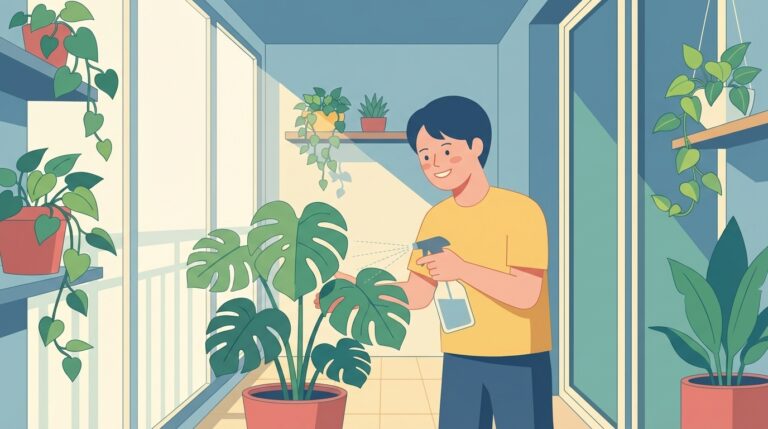
Hello, Plant Lovers! Welcome to Daily Hangul.
I’m your Senior Editor, and today we’re trading the neon lights of Seoul for the green sanctuary of a veranda. You know that scene in Crash Landing on You where Captain Ri talks to his tomato plant? Or that intense moment in a thriller where a villain meticulously wipes the leaves of an orchid while plotting revenge? That isn’t just a prop choice; it reflects Korea’s deep emotional connection with nature, even indoors.
Today, we aren’t just learning how to say “flower.” We are diving into the high-level, nuanced world of the ‘Sik-jipsa’ (Plant Butler) community. If you want to understand why Koreans treat their Monsteras like royalty and how to navigate the delicate art of ‘Nanum’ (sharing) without making a cultural faux pas, you are in the right place.
This isn’t beginner Korean. This is for those who want to speak with the sophistication of a true insider. Ready to get your hands dirty? 🌱
Phase 2: Deep Dive into Core Expressions
1. [식집사 (Sik-jipsa)]
- Pronunciation: [Sik-jip-sa] (Sounds like ‘Sick’ + ‘Jip’ (Jeep) + ‘Sa’ (Saw))
- Meaning: Plant Butler (Portmanteau of Singmul (Plant) + Jipsa (Butler))
- Context: In standard Korean, you might say “gardener” (jeong-won-sa). But in modern Korea, especially online, you are a butler. This implies the plant is the master and you exist to serve its humidity and light needs.
- K-Culture Moment: Just like K-Pop fans call themselves ‘fan managers’ or ‘supporters,’ plant owners adopt a humble position. It’s self-deprecating humor meets genuine devotion.
- Situation Spectrum:
[🚫 Formal Biz] ———— [⚠️ Semi-Formal] ———— [✅ Casual/Online] - 🤔 Think About It: Why does Korean internet culture love the ‘Butler’ metaphor (also used for cat owners: Nyang-jipsa)? It reflects a shift from “owning” nature to “coexisting” with it, acknowledging the capriciousness of living things.
2. [반려 식물 (Banryeo singmul)]
- Pronunciation: [Ban-ryeo-sing-mul]
- Meaning: Companion Plant (Literal: Companion + Plant)
- Context: ‘Banryeo’ is usually reserved for spouses or pets (Banryeo-dog). Using this for plants elevates them to family status. It’s not decoration; it’s a roommate.
- Editor’s Insight: If you say “I grow flowers” (kkot kiwoyo), it sounds like a hobby. If you say “I live with a companion plant” (banryeo singmul), it sounds like a lifestyle. Use this to sound deep and C2-level sophisticated.
- Situation Spectrum:
[🚫 Military] ———— [⚠️ Biz Meeting] ———— [✅ Everywhere Else]
3. [분양하다 / 입양하다 (Bunyang-hada / Ibyang-hada)]
- Pronunciation: [Bun-yang-ha-da / Ib-yang-ha-da]
- Meaning: To distribute (send away) / To adopt (receive)
- Context: These verbs are typically used for babies or puppies. Using them for plant cuttings (clones) personifies the plant. You don’t “sell” a cutting; you “send it to a good home.”
- Editor’s Insight: This carries an emotional weight. If you sell a plant, you just want money. If you ‘Bunyang’ a plant, you care about where it goes.
Phase 3: Textbook vs. Real Life
| Situation | 📖 Textbook Korean | 🗣️ Real ‘Sik-jipsa’ Korean | 💡 Why the difference? |
|---|---|---|---|
| Showing off a new leaf | 새 잎이 났어요. (A new leaf came out.) | 신엽이 펴졌어요! 눈물 나요 ㅠㅠ (The new leaf unfurled! I’m crying.) | ‘Sin-yeop’ (Sino-Korean for new leaf) sounds more professional/obsessive. |
| Giving a plant away | 이 식물 드릴게요. (I will give you this plant.) | 제 ‘초록이’ 좋은 분께 분양 보냅니다. (Sending my ‘greenie’ to a good person.) | Using ‘Greenie’ (Chorogi) adds affection; ‘Bunyang’ implies adoption. |
| Asking for advice | 식물이 죽어가요. (The plant is dying.) | 애가 시들시들한데, ‘무름병’인가요? (The kid is withering, is it ‘soft rot’?) | Calling the plant ‘kid’ (ae) and using specific disease names shows expertise. |
💡 Editor’s Note: At the C2 level, specificity is key. Don’t just say “sick.” Say “root rot” (ppuri-pareum) or “pest” (chung-ae).
Phase 4: Cultural Context — The ‘Jeong’ (Affection) of Sharing
4-1. Non-verbal: The “Certification Shot” (Injeung-shot)
In the Korean plant community, if someone sends you a cutting (often for free or just shipping cost), the transaction isn’t over when you receive it. You must post an ‘Injeung-shot’ (proof photo) on the community board. It’s not just proof of receipt; it’s a public “Thank You” letter. Ignoring this is a major breach of Nunchi.
4-2. K-Culture Connection: The ‘Danggeun’ Phenomenon
Most plant trading happens on Danggeun Market (Karrot), a hyperlocal second-hand app. It’s distinct from eBay because you meet face-to-face in the neighborhood.
* K-Drama Trope: The characters meet to trade an item, realize they have a connection, and romance/friendship blooms. In reality, plant people meet, exchange care tips for 20 minutes on the street, and become ‘plant friends’ (Sik-chin).
Phase 5: Immersive Roleplay — The ‘Danggeun’ Deal
Setting: It is Saturday afternoon. You are chatting on the Danggeun Market app with a neighbor (‘MintChoco’) who is offering a rare Monstera cutting.
Characters:
– YOU: An expat ‘Sik-jipsa’ looking for a Monstera Albo.
– MintChoco: A veteran Korean plant owner, very protective of her plants.
(Dialogue)
MintChoco: 알보 몬스테라 탑삽수(Top cutting) 분양합니다. 뿌리는 아직 안 났어요.
(Albo Monstera top-sapsu bunyang-hamnida. Ppurineun ajik an nasseoyo.)
(Trans: Adopting out an Albo Monstera top cutting. Roots haven’t come out yet.)
YOU: 안녕하세요! 사진 보니 무늬가 정말 예쁘네요. 혹시 수태(sphagnum moss)에 감겨 있나요?
(Annyeonghaseyo! Sajin boni munyiga jeongmal yeppeuneyo. Hoksi sutae-e gamgyeo innayo?)
(Trans: Hello! The variegation is beautiful in the photo. Is it wrapped in sphagnum moss?)
MintChoco: 네, 수태봉으로 유도해서 기근(aerial root)은 튼실해요.
(Ne, sutaebong-euro yudo-haeseo gigeun-eun teunsilhaeyo.)
(Trans: Yes, I guided it with a moss pole, so the aerial root is robust.)
YOU: 다행이네요. 제가 물꽂이(water propagation)로 뿌리 내릴 자신 있습니다.
(Dahaeng-ineyo. Jega mulkkoji-ro ppuri naeril jasin itsseumnida.)
(Trans: That’s a relief. I am confident I can root it via water propagation.)
MintChoco: 오, 식집사님이시군요! 그럼 믿고 분양 보낼게요. 🌿
(Oh, Sik-jipsa-nim-isi-gunyo! Geureom mitgo bunyang bonael-geyo.)
(Trans: Oh, you are a Plant Butler! Then I trust you and will send it for adoption.)
🔀 Decision Point: How do you close the deal?
– A) “네, 계좌 주세요.” (Okay, give me your account number.)
– B) “소중하게 잘 키우겠습니다. 시간 되실 때 뵈어요!” (I will raise it preciously. See you when you have time!)
– C) “깎아주세요.” (Give me a discount.)✅ Best Choice: B — In the plant community, emotional reassurance (“I will raise it well”) is often more important than money. It shows respect for her effort.
🚫 Avoid C: Unlike general second-hand goods, haggling over “living things” (unless they are in bad shape) is often considered rude in the hobbyist community.
Phase 6: 10-Second Shadowing Drill
Let’s practice the emotion of a proud Plant Butler.
Context: Showing a photo of your plant’s new leaf to a friend.
Sentence:
😊 드디어 / 신엽이 / 펴졌는데, / 무늬가 / 예술이야!
(Deudieo / sinyeobi / pyeojyeon-neunde, / munyiga / yesuriya!)
Translation: Finally / the new leaf / unfurled, / and the pattern / is art!
Key Point: Elongate ‘Ye~~~suriya’ to emphasize your amazement.
Phase 7: K-Culture Mini Glossary
| Korean | Romanization | Meaning | Context |
|---|---|---|---|
| 삽수 | Sapsu | Cutting (Plant part) | A piece of a plant used for propagation. Not ‘branch’ (gaji), use ‘sapsu’. |
| 물꽂이 | Mulkkoji | Water propagation | Rooting a cutting in water. Literal: “Sticking in water.” |
| 식멍 | Sik-meong | Plant spacing-out | Staring blankly at plants to relax. akin to ‘Bul-meong’ (fire staring). |
| 무천이 | Mucheon-i | Variegation Genius | Slang for a plant with perfect variegated patterns (Pattern + Genius). |
| 초록별 | Chorok-byeol | Green Star | Plant heaven. When a plant dies, we say “It went to the Green Star.” |
Phase 8: Traveler’s Survival Kit (Plant Edition)
Even if you are traveling, you might visit a famous botanical cafe or flower market (like Yangjae Flower Market).
🆘 Survival Expression
– 🇰🇷 “이거 검역 통과 되나요?” (Igeo geomyeok tonggwa doenayo?)
– 🗣️ Pronunciation: [I-geo geo-myeok tong-gwa dwe-na-yo?]
– 📍 Meaning: “Does this pass quarantine?”
– 💡 Why: As a traveler, you usually cannot take soil or live plants back to your country. Always ask before buying seeds or processed dried flowers.📌 Editor’s Travel Note:
Visit “Sikmul-gwan PH” (Botanical House PH) in Seoul. It’s a gallery/cafe hybrid. You don’t need to buy plants; just enjoy the ‘Sik-meong’ (plant spacing-out) vibe with an iced americano.
Phase 9: Think Deeper — “Jeong” in the Digital Age
The Gift Economy of ‘Nanum’:
Why do Koreans often give away expensive plant cuttings for free (Nanum) to strangers on the internet? This connects to the traditional concept of Jeong (정)—a deep feeling of attachment and community. Even in the hyper-modern, digital age, the act of sharing a piece of a living thing creates a bond that money cannot buy. It validates one’s identity as a ‘good grower’ and strengthens the community. In your culture, is there a hobby where giving things away is more common than selling them?
Phase 10: FAQ & Troubleshooting
Q: Can I use the honorific particle ‘-nim’ for plants?
A: Ironically, yes! People often jokingly say “Monstera-nim” or “Albo-nim” to show how expensive or precious the plant is. It’s playful personification.
Q: Can I touch the plants in a Korean cafe?
A: Absolutely No. Koreans are very visual. Touching, pinching, or checking leaves is considered rude unless you are buying it at a market. Treat it like a museum piece.
❌ Common Mistake: Saying “It died” (Jugeosseoyo) to a serious plant owner.
✅ Better: Use “It went to the Green Star” (Chorok-byeol-ro gatseoyo). It sounds softer and empathetic.
Phase 11: Wrap-up & Mission
One-Liner: Being a ‘Sik-jipsa’ in Korea is about serving the plant, sharing the growth, and respecting the life in the leaves.
🚀 Action Mission:
– 🥉 Bronze: Look at a plant near you and say “Jal jara-ra” (Grow well) with feeling.
– 🥈 Silver: Search #식집사 (Sik-jipsa) on Instagram and see the layout of Korean verandas.
– 🥇 Gold: If you have a plant, post a photo on social media with the caption: “My 반려식물 (Companion plant) makes me happy! #DailyHangul”
💬 Your Turn: Do you name your plants? Tell me the funniest name you’ve given a plant in the comments below!
Frequently Asked Questions (FAQ)
Q: What does "[식집사 (Sik-jipsa)]" mean in Korean and how do you pronounce it?
A: In Korean, "[식집사 (Sik-jipsa)]" is pronounced [Sik-jip-sa] and means: Plant Butler (Portmanteau of Singmul (Plant) + Jipsa (Butler))
Q: What does "[반려 식물 (Banryeo singmul)]" mean in Korean and how do you pronounce it?
A: In Korean, "[반려 식물 (Banryeo singmul)]" is pronounced [Ban-ryeo-sing-mul] and means: Companion Plant (Literal: Companion + Plant)
Q: What does "[분양하다 / 입양하다 (Bunyang-hada / Ibyang-hada)]" mean in Korean and how do you pronounce it?
A: In Korean, "[분양하다 / 입양하다 (Bunyang-hada / Ibyang-hada)]" is pronounced [Bun-yang-ha-da / Ib-yang-ha-da] and means: To distribute (send away) / To adopt (receive)







