

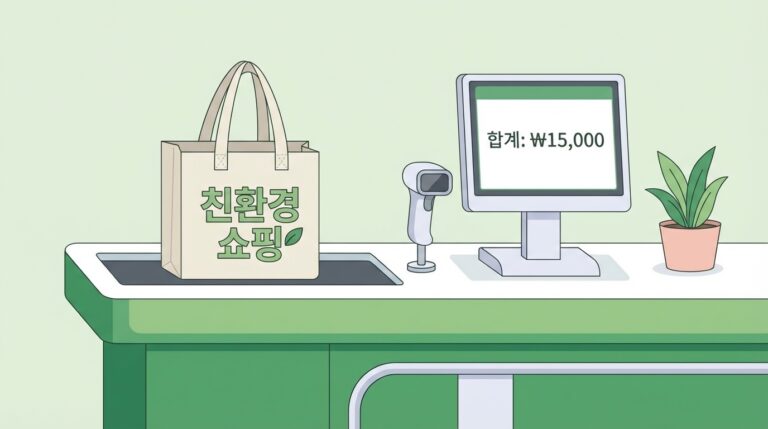
Phase 1: The “Checkout Panic” Moment 🛒
Hello! This is your Daily Hangul Chief Editor.
Imagine this: You are at a busy supermarket in Seoul like Lotte Mart or EMART. The cashier is scanning your items at lightning speed—beep, beep, beep. Behind you, a queue of impatient shoppers is forming. Suddenly, the cashier looks at you and fires off a rapid-fire question that ends in “…yo?”
You freeze. Is she asking for your membership card? Your phone number? Or is she scolding you for putting onions on the wrong side?
In 90% of cases, she’s asking: “Do you need a plastic bag?”
In Korea, plastic bags are rarely free due to strict environmental regulations. Knowing how to navigate this moment smoothly separates the tourists from the Seoulites. Today, let’s master the art of eco-friendly shopping in Korea, K-Style.
Phase 2: Deep Dive into Eco-Expressions 🧐
Here are the top 3 expressions to survive the checkout line with confidence.
1. 장바구니 가져왔어요 (I brought my shopping bag)
- Pronunciation: [Jang-ba-gu-ni ga-jyeo-wa-sseo-yo]
- Sound Analogy: ‘Jang’ like ‘Django’, ‘ba-gu-ni’ sounds like ‘bag-o-knee’.
- Meaning: “I brought a shopping basket/bag.” (Real nuance: “I’m prepared, so don’t charge me for plastic.”)
- K-Culture Moment: You’ll see this in reality shows like I Live Alone (Na Honja Sanda). Celebrities trying to be eco-friendly often whip out a stylish canvas bag with pride.
- Editor’s Insight: This sentence stops the cashier from reaching for the plastic bag. It signals you are a pro.
- Situation Spectrum:
[🚫 Formal Boss] ———— [✅ Cashier/Clerk] ———— [✅ Friend]- 🤔 Think About It: In many Western countries, baggers pack your groceries. In Korea, you pack while the cashier scans. Why do you think this division of labor exists? (Hint: Pali-pali culture!)
2. 담아 주시겠어요? (Could you put it in [for me]?)
- Pronunciation: [Da-ma ju-si-ge-sseo-yo?]
- Meaning: “Could you put/pack it?”
- K-Culture Moment: In K-Dramas, when a chaebol (rich heir) shops, they never pack their own bags. But for us regular folks, we usually ask this only at convenience stores (CU, GS25) where the counter space is small.
- Editor’s Insight: At big supermarkets, do not use this. You must pack your own bags at the designated packing table. Use this only at small convenience stores or bakeries.
- Situation Spectrum:
[⚠️ Supermarkets] ———— [✅ Convenience Stores] ———— [✅ Bakeries]3. 종량제 봉투로 주세요 (Please give me a standard garbage bag)
- Pronunciation: [Jong-nyang-je bong-tu-ro ju-se-yo]
- Meaning: Literal: “Give me the volume-rate bag.” / Real: “I want the reusable shopping bag that doubles as a trash bag later.”
- Editor’s Insight: This is the ultimate hack. In Seoul, instead of buying a useless plastic bag, you can buy a specific bag that you can later use to throw away your house trash. It saves money and the environment. Using this phrase instantly upgrades your level to “Local Resident.”
- 🤔 Think About It: Korea has one of the strictest recycling systems in the world. Why did they monetize trash bags (Jongnyangje)?
Phase 3: Textbook vs. Real Life 🥊
| Situation | 📖 Textbook Korean | 🗣️ Real Korean | 💡 Why the difference? |
|---|---|---|---|
| Refusing a bag | 비닐봉투는 필요 없습니다. (Binil bongtuneun piryo eopseumnida) | 아, 됐어요. (Ah, dwaesseoyo) | The textbook version is too stiff. “Dwaesseoyo” (Done/No thanks) is faster and more common, though slightly blunt. |
| Carrying by hand | 손으로 들고 가겠습니다. (Soneuro deulgo gagesseumnida) | 그냥 들고 갈게요. (Geunyang deulgo galkkeyo) | “Geunyang” (Just) implies “Don’t worry about wrapping it.” |
| Asking for a bag | 봉투 하나 주십시오. (Bongtu hana jusipsio) | 봉투 하나만요. (Bongtu hanamanyo) | Adding “-yo” to the noun is the most efficient way to speak in a busy line. |
💡 Editor’s Note: “됐어요” (Dwaesseoyo) depends heavily on your tone. Say it with a smile and a hand wave 👋, otherwise, it sounds like “Leave me alone.”
Phase 4: Cultural Context — The “Eco-Bag” Fashion 🌿
4-1. Non-verbal Communication: The “Ready Stance”
When you approach the counter, if you have your own bag, place it on the counter or hold it up visibly before the cashier starts scanning. This is the non-verbal signal for “No plastic needed.” It saves the cashier from asking the question.
4-2. K-Culture Connection: K-Pop & The Eco-Bag Trend
In K-Pop airport fashion photos or university K-Dramas (like Cheese in the Trap), you often see characters carrying canvas tote bags called “Eco-bags” (에코백).
In Korea, carrying a reusable bag isn’t just about groceries; it’s a fashion statement representing a minimalist and youthful lifestyle. Even if you are just buying snacks, pulling out a cute character eco-bag makes you look trendy, not cheap.
Phase 5: Roleplay Scenario 🎬
Setting: A Friday evening at a bustling Olive Young (drugstore). Loud K-Pop is playing. You are buying a lot of sheet masks and snacks.
Characters:
* YOU: An eco-conscious shopper.
* Staff: A busy part-timer (Albasaeng) speaking very fast.
Dialogue:
Staff: (Scanning rapidly) CJ 포인트 적립하세요?
(CJ point jeokrip-haseyo? / Do you collect CJ points?)
YOU: 아뇨, 없어요.
(Anyo, eopseoyo. / No, I don’t.)
Staff: 봉투 필요하세요? 100원 추가됩니다.
(Bongtu piryohaseyo? Baek-won chuga-doemnida. / Do you need a bag? It’s 100 won extra.)
🔀 Decision Point: What do you say?
- A) “네, 주세요.” (Yes, please.)
- B) “아뇨, 장바구니 있어요.” (No, I have a shopping bag.)
- C) “그냥 갈게요.” (I’ll just go / carry it as is.)
If you chose B:
YOU: 아뇨, 장바구니 있어요. 여기 담아 갈게요.
(Anyo, jangbaguni isseoyo. Yeogi dama galkkeyo.)
Staff: (Visibly relieved) 네, 결제 도와드리겠습니다.
(Ne, gyeolje dowadeurigesseumnida. / Okay, I’ll help you with payment.)
✅ Analysis: Choice B is the best. Olive Young staff are trained to ask quickly. Stating you have a bag clearly helps them move to the payment step immediately.
Phase 6: 10-Second Shadowing Drill 🎤
Practice this sentence until it comes out automatically when you hear “Bongtu…?”
- Emotion: 😊 Proudly & Clearly
- Sentence: 아뇨, / 저는 / 장바구니 / 가져왔어요!
- Romanization: Anyo, / jeo-neun / jang-ba-gu-ni / ga-jyeo-wa-sseo-yo!
Tip: Put stress on “Jang” and “Ga” to sound natural.
Phase 7: K-Culture Mini Glossary 📘
| Korean | Romanization | English | Context |
|---|---|---|---|
| 종량제 봉투 | Jongnyangje bongtu | Standard Trash Bag | The legal trash bag you must use to throw away waste. Can be bought at supermarkets as a shopping bag. |
| 에코백 | Ekobaek | Eco-bag | Canvas tote bags. A fashion item as much as a utility item. |
| 담다 | Damda | To put in/pack | Essential verb for shopping. “Bag-e dama juseyo” (Put it in the bag). |
| 1+1 | One-plus-one | Buy 1 Get 1 Free | The magic words every shopper loves. Pronounced “Won-ppeul-won”. |
| 분리수거 | Bullisugeo | Recycling | The act of separating trash. A major part of Korean daily life. |
Phase 8: Traveler’s Survival Kit 🧳
Even if you aren’t living in Korea, you will visit convenience stores (pyeoneijeom). Here is your survival card.
🆘 Survival Expressions
1. 🇰🇷 “봉투 주세요.” (Bongtu juseyo)
* Use when you forgot your bag. It costs 20~100 won.
2. 🇰🇷 “영수증 버려 주세요.” (Yeongsujeung beoryeo juseyo)
* “Please throw away the receipt.” (If you don’t need it).
3. 🇰🇷 “이거 1+1이에요?” (Igeo won-ppeul-won ieyo?)
* “Is this buy one get one free?” (Always check the label!)📌 Editor’s Travel Note:
In Korea, you cannot throw away trash just anywhere. Public trash cans are rare to encourage people to reduce waste. Carry a small plastic bag in your backpack to hold your trash until you return to your hotel!
Phase 9: Think Deeper — “Inconvenience for the Planet” 🧠
Why is buying a trash bag (Jongnyangje) complicated?
In Korea, trash bags are district-specific. You cannot use a “Gangnam-gu” trash bag in “Mapo-gu.” This system forces residents to be accountable for their own waste within their local community.
It might feel inconvenient compared to countries where you can toss anything in a black bin. But this “inconvenience” has made Korea one of the top recycling nations in the world.
💬 Your Turn: Does your country charge for plastic bags? Or is it still free? How do you feel about Korea’s strict system? Share in the comments!
Phase 10: FAQ & Troubleshooting 🛠️
Q: Is it rude to start packing my bag before I pay?
A: Not at all! In fact, it’s polite. It speeds up the line. At big marts like Homeplus, start packing as soon as the cashier scans the first item.
Q: Can I use a “Jongnyangje” bag (trash bag) to carry food?
A: Yes! They are clean, new bags sold at the counter. It’s perfectly normal to carry your milk and bread in them. Just don’t confuse it with a used one!
❌ Common Mistake: Asking “Plastic bag?” in English.
✅ Fix: Just say “Bongtu?” with a rising intonation. Even without the full sentence, they will understand.
Phase 11: Wrap-up & Action Items 🎁
Summary: Today we learned how to refuse plastic bags (“Jangbaguni isseoyo”) and the smartest way to shop (“Jongnyangje bongtu”).
🚀 Your Mission:
* 🥉 Bronze: Say “Jangbaguni ga-jyeo-wa-sseo-yo” 3 times in front of a mirror.
* 🥈 Silver: Next time you go to a store in your country, bring your own bag and imagine saying the Korean phrase as you pack.
* 🥇 Gold: Go to a Korean mart (or H-Mart) and when they ask about a bag, answer in Korean!
K-Culture Mission: Watch a scene from the variety show Seojin’s (Jinny’s Kitchen). Watch how they pack takeout orders and look for the word “Bongtu”!
Phase 12: Interactive Quiz 🧩
1. Situation: You are at a convenience store buying only one small chocolate bar. The clerk reaches for a plastic bag. What is the most natural thing to say?
* a) 비닐봉투를 절대 주지 마십시오. (Please never give me a plastic bag.)
* b) 그냥 가져갈게요. (I’ll just take it as is.)
* c) 종량제 봉투 주세요. (Give me a standard trash bag.)
2. True or False (K-Culture):
* In Seoul, you can throw away your household trash in any plastic bag you find. (T/F)
3. Fill in the Blank:
* Cashier: 봉투 필요하세요?
* You: 아뇨, ________ 가져왔어요. (No, I brought a shopping bag.)
Click to see answers
- b) For a small item, “Geunyang gajeogalkkeyo” (I’ll just take it) is most natural. Buying a trash bag (c) for one chocolate bar is weird!
- False. You must use the official “Jongnyangje” bags specific to your district.
- 장바구니 (Jangbaguni)
Frequently Asked Questions (FAQ)
Q: What does "장바구니 가져왔어요 (I brought my shopping bag)" mean in Korean and how do you pronounce it?
A: In Korean, "장바구니 가져왔어요 (I brought my shopping bag)" is pronounced [Jang-ba-gu-ni ga-jyeo-wa-sseo-yo] and means: a key conversational Korean expression covered in this lesson.
Q: What does "담아 주시겠어요? (Could you put it in [for me]?)" mean in Korean and how do you pronounce it?
A: In Korean, "담아 주시겠어요? (Could you put it in [for me]?)" is pronounced [Da-ma ju-si-ge-sseo-yo?] and means: "Could you put/pack it?"
Q: What does "종량제 봉투로 주세요 (Please give me a standard garbage bag)" mean in Korean and how do you pronounce it?
A: In Korean, "종량제 봉투로 주세요 (Please give me a standard garbage bag)" is pronounced [Jong-nyang-je bong-tu-ro ju-se-yo] and means: Literal: "Give me the volume-rate bag." / Real: "I want the reusable shopping bag that doubles as a trash bag later."







