

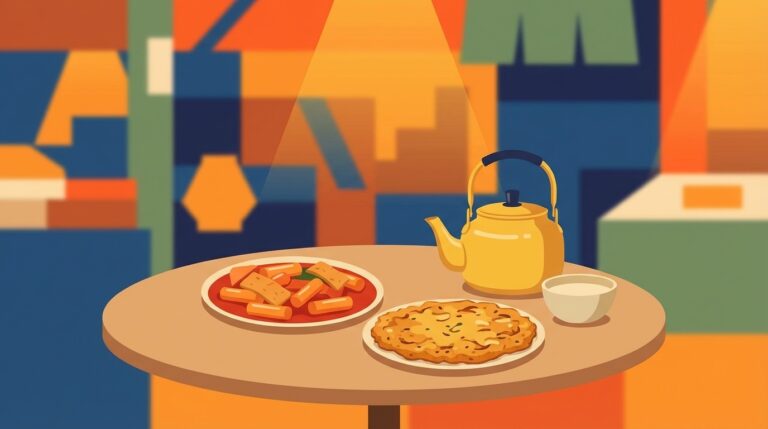
Phase 1: The Immersive Hook
Greeting: 안녕하세요! This is your Daily Hangul Chief Editor.
Imagine this: You are standing in the middle of Gwangjang Market. The steam from the giant iron griddles fogs up your glasses, the smell of sesame oil and spicy gochujang fills the air, and the noise is deafening—a chaotic symphony of shouting vendors and sizzling oil. You’ve seen this scene a hundred times in K-Dramas and on Netflix’s Street Food.
But here’s the reality check: The Ajumma (auntie) is shouting something at you, people are pushing past you, and you need to order before you lose your spot on the bench. You want that crispy Bindaetteok (mung bean pancake) and spicy Tteokbokki, but saying “I want this” feels… weak.
At a C1 (Advanced) level, we don’t just order food; we engage with the culture. We discuss textures, we negotiate the ‘service’ (freebies), and we understand the unwritten rules of the communal table. Today, we go beyond survival Korean to “Market Insider” Korean.
Phase 2: Deep Dive into Core Expressions
1. [국물에 찍어 먹게/범벅으로 해 주세요]
- Pronunciation: [Gung-mul-e jjig-eo meok-ge / beom-beog-eu-ro hae ju-se-yo] + Imagine saying “bum-bug” like a drum beat.
- Meaning:
- Literal: Please make it so I can dip it in broth / Please mix it all up.
- Real Nuance: When ordering Twigim (fried food) or Sundae (blood sausage) with Tteokbokki, you have two choices: keep them separate to dip yourself (찍먹 style) or have the vendor smother them in the spicy sauce (bum-beok style). Using “Beom-beok” makes you sound like a total pro who knows exactly how they like their flavor profile.
- K-Culture Moment: Think of the variety shows like Running Man or I Live Alone. When the cast visits a market, they don’t eat politely. They want the sauce everywhere. It represents a lack of pretension—getting messy is part of the joy.
- Editor’s Insight: Using specific culinary terms like 범벅 (beom-beok) elevates you from a tourist pointing at things to a local with preferences. It implies you know the synergy of flavors.
- Situation Spectrum:
[🚫 Formal Biz Meeting] ———— [⚠️ First Date] ———— [✅ Market/Casual] - 🤔 Think About It: Why does Korean street food culture often favor mixing textures (crispy fried food + soggy spicy sauce)? How does this reflect the concept of “harmony” (johwa) in Korean cuisine?
2. [겉바속촉 vs. 눅눅해지다]
- Pronunciation: [Geot-ba-sok-chok vs. Nung-nuk-hae-ji-da]
- Meaning:
- Geot-ba-sok-chok: Crispy outside, moist inside (An acronym for Geot-eun Basak, Sok-eun Chokchok).
- Nung-nuk-hae-ji-da: To become soggy/soggy.
- K-Culture Moment: You are eating Bindaetteok. If it’s soggy, it’s a tragedy. Food reviewers and YouTubers (Mukbang) obsess over “ASMR” crunch. Being able to complain or praise the texture using these words shows high proficiency.
- Editor’s Insight: Describing food simply as “delicious” (mashisseoyo) is A1 level. At C1, we critique texture. “사장님, 이거 진짜 겉바속촉이네요!” (Boss, this is perfectly crispy outside and moist inside!) is the highest compliment.
- Situation Spectrum:
[🚫 Funeral] ———— [⚠️ Biz Lunch] ———— [✅ Foodie Friends]
3. [현금영수증 필요 없어요 / 계좌이체 할게요]
- Pronunciation: [Hyeon-geum-yeong-su-jeung piryo eop-seo-yo / Gye-jwa-i-che hal-ge-yo]
- Meaning:
- Literal: I don’t need a cash receipt / I will do a bank transfer.
- Real Nuance: Many traditional markets prefer cash. If you don’t have cash, offering Gye-jwa-i-che (instant bank transfer) is the standard local workaround. Saying you don’t need a receipt speeds up the process and often earns you a warmer smile from the busy vendor.
- Editor’s Insight: This isn’t about food; it’s about transactional etiquette. Fumbling with a credit card at a tiny stall can be awkward. Offering a transfer immediately signals, “I know how things work here.”
- 🤔 Think About It: Why is cash (or direct transfer) still king in traditional markets in a super-digital society like Korea? Is it just tax avoidance, or is there a cultural preference for immediate, tangible exchange?
Phase 3: Textbook vs. Real Life
| Situation | 📖 Textbook Korean | 🗣️ Real Market Korean | 💡 Why the difference? |
|---|---|---|---|
| Asking for price | 이거 얼마입니까? (How much is this?) | 사장님, 이거 어떻게 해요? (Boss, how do you “do” this?) | “How do you do this?” implies “How do you sell this?” (by weight, by piece, by serving). It’s more natural for bulk items. |
| Ordering | 떡볶이 일 인분 주세요. (Give me 1 serving of Tteokbokki.) | 떡튀순 일 인분 같은 이 인분 주세요! (Give me Tteok-Twi-Sun, 2 servings that look like 1… wait, other way around!) Joke -> “사장님, 골고루 섞어서 만 원어치 주세요.” (Give me 10,000 won worth mixed evenly.) | Markets often sell by budget (amount) rather than strict servings. Asking for “10,000 won worth” is very common. |
| Refills | 양파 좀 더 주세요. (Give me more onions.) | 이모~ 여기 양파 좀 넉넉히! (Auntie, onions “plentifully” please!) | 넉넉히 (Neong-neok-hi) appeals to the vendor’s generosity (Jeong). It sounds less demanding and more affectionate. |
Phase 4: Cultural Deep Dive
4-1. Non-verbal: The Art of “Seo-seo meok-gi” (Standing & Eating)
In high-end restaurants, standing while eating is rude. In the market, it’s the norm. The key is spatial awareness. You must tuck your elbows in. When you eat a skewer (eomuk), point the sharp end down immediately after finishing so you don’t stab a passerby. Also, locking eyes with a stranger eating next to you? totally fine to nod and smile, acknowledging the shared struggle of spicy heat.
4-2. K-Food Connection: The “Service” (서비스) Culture
In K-Dramas, you often see a vendor throwing in an extra dumpling or a cup of broth for free. This is Service. At a C1 level, you don’t beg for it, but you can playfully nudge for it if you order a lot.
* The Move: If you buy bulk Bindaetteok and Tteokbokki, saying “사장님, 국물은 서비스죠?” (The broth is on the house, right?) with a cheeky smile usually works. It’s not about the cost; it’s about the Jeong (connection) established between regular and owner.
Phase 5: Immersive Roleplay
Setting: Gwangjang Market, Friday 8 PM. It’s packed. You finally found two seats at a popular Bindaetteok stall for you and your friend. The Imo-nim (auntie) is frying pancakes at lightning speed.
Characters:
* YOU: A savvy expat who knows their street food.
* Imo-nim: A veteran vendor, loud, fast, but warm-hearted.
Dialogue:
(The noise is loud. You need to project your voice!)
YOU: (Raising hand slightly) 사장님! 여기 고기 빈대떡 하나랑 마약김밥 하나 주세요!
(Sajangnim! Yeogi gogi bindaetteok hanarang mayak-gimbap hana juseyo!)
(Boss! One meat mung bean pancake and one drug kimbap [mini kimbap], please!)
Imo-nim: (Barely looking up, flipping a pancake) 막걸리는 안 해? 빈대떡엔 막걸린데.
(Makgeollineun an hae? Bindaetteogen makgeollinde.)
(No Makgeolli? You need Makgeolli with pancakes.)
YOU: 당연히 해야죠! 지평 생막걸리로 한 병 주세요. 아, 그리고…
(Dangyeonhi haeyajyo! Jipyeong saeng-makgeolliro han byeong juseyo. Ah, geurigo…)
(Of course we do! Give us a bottle of Jipyeong Draft Makgeolli. Ah, and…)
🔀 Decision Point: The onions in soy sauce are essential. How do you ask for a lot?
- A) “양파 많이 주세요.” (Give me a lot of onions.)
- B) “양파장 좀 넉넉히 챙겨주세요, 저희 양파 킬러거든요!” (Please take care of us with plenty of onion sauce, we are onion killers!)
- C) “양파 리필 되나요?” (Is onion refill possible?)
✅ Best Choice: B
Reasoning: Option A is fine but dry. Option C is too formal/restaurant-style. Option B uses “Nung-neok-hi” (generously) and adds a humorous reason (“Onion Killers”), which builds rapport.
Imo-nim: (Laughing) 알았어, 많이 줄게. 남기면 벌금이야!
(Arasseo, mani julge. Namgimyeon beolgeumiya!)
(Okay, I’ll give you lots. If you leave any leftovers, it’s a fine!)
Phase 6: 10-Second Shadowing Drill
Let’s practice the “Market Rhythm.” Speak clearly and slightly faster than usual.
Emotion: 😊 Friendly but assertive (to cut through the noise)
사장님! / 저, 이거 / 떡볶이 국물에 / 버무려 주실 수 있으세요?
(Sajangnim! / jeo, igeo / tteokbokki gung-mure / beo-mu-ryeo jusil su isseu-seyo?)
“Boss! / Uh, this / in the tteokbokki broth / could you mix it up for me?”
- Key Point: Focus on the “Sajangnim!” (Pitch goes up at the end) and “Beo-mu-ryeo” (smooth pronunciation).
Phase 7: K-Culture Glossary
| Korean | Romanization | Meaning & Context |
|---|---|---|
| 이모 / 사장님 | Imo / Sajangnim | “Auntie” / “Boss”. Use Sajangnim generally, but Imo if the vibe is friendly and she is an older woman. Never use “Ahjumma” directly to their face (it can be rude). |
| 밀떡 vs. 쌀떡 | Mill-tteok vs. Ssal-tteok | Wheat cake vs. Rice cake. Mill-tteok is chewier and absorbs sauce better; Ssal-tteok is softer and thicker. Knowing your preference is key! |
| 안주 | Anju | Food eaten with alcohol. Bindaetteok is the ultimate Anju for Makgeolli. |
| 불맛 | Bul-mat | “Fire taste” (Wok hei / Smoky flavor). Highly prized in street food. |
| 단짠단짠 | Dan-jjan-dan-jjan | Sweet and Salty. The holy grail of Korean flavor combinations. |
Phase 8: Traveler’s Survival Kit (Market Edition)
🆘 Survival Phrases
* 🇰🇷 “혹시 계좌이체 되나요?” (Hoksi gye-jwa-i-che doenayo?)
* Can I do a bank transfer? (Essential if you ran out of cash)
* 🇰🇷 “포장해 주세요.” (Po-jang-hae ju-se-yo.)
* Please pack it to go. (If the seats are full)
* 🇰🇷 “화장실 어디예요?” (Hwa-jang-sil eodi-yeyo?)
* Where is the bathroom? (Crucial in markets where bathrooms are hidden)📌 Editor’s Pro Tip
Bring wet wipes (Mul-ti-syu). Market stalls provide napkins, but they are thin. If you’re eating messy Tteokbokki or greasy Bindaetteok with your hands/toothpicks, your own wet wipes are a lifesaver. Also, don’t linger too long after eating if there is a line. It’s ‘Etiquette’ to free up the seat quickly.
Phase 9: Think Deeper — “Communal Eating”
Topic: Food and Identity (Sharing the Pot)
In Western cultures, double-dipping or sharing a soup bowl is often a hygiene taboo. In a Korean market, you might see friends eating from the same Tteokbokki plate or tearing pieces of Bindaetteok with their chopsticks from a shared basket. This stems from the concept of “Sikgu” (식구), meaning “family,” but literally translating to “mouths that eat together.” Sharing food from one vessel reinforces the bond of the group, dissolving boundaries between “mine” and “yours.”
🧠 Think Deeper: As Korea modernizes and hygiene awareness grows (especially post-pandemic), this culture is changing slightly (more individual plates). However, the sentiment remains. In your culture, does sharing food signify intimacy, or is it seen as an invasion of personal space?
Phase 10: FAQ & Troubleshooting
- Q: Can I drink alcohol (Makgeolli/Soju) at the market during the day?
- A: YES! In places like Gwangjang or Tongin Market, “Day Drinking” (낮술 – Nat-sul) is culturally accepted and part of the charm. Just don’t get rowdy.
- Q: Is it rude to leave food on the plate?
- A: Generally, yes, especially if the vendor gave you extra “Service.” It implies it wasn’t tasty. If you are full, say “너무 맛있는데 배가 불러서요” (It’s so tasty but I’m too full).
- ❌ Common Mistake: Calling the server “Agassi” (Miss) or “Ahjumma” (Auntie – blunt tone).
- ✅ Fix: Always use “Sajangnim” (Boss) or “Imo-nim” (Auntie – respectful tone). It guarantees better service.
Phase 11: Wrap-up & Action Mission
One-Liner: To eat like a local, you must master the art of texture (Geot-ba-sok-chok) and the warmth of connection (Jeong).
🎬 Your Mission:
* 🥉 Bronze: Stand in front of a mirror and practice saying “Sajangnim!” loudly and confidently.
* 🥈 Silver: Watch the Gwangjang Market episode of Netflix’s Street Food: Asia and identify the moment they mention ‘family’ or ‘struggle’ connected to food.
* 🥇 Gold: Go to a Korean restaurant (or a market in Korea) and ask, “Is this Ssal-tteok or Mill-tteok?” (Ige ssal-tteok ieyo, mill-tteok ieyo?) to the server.
K-Culture Mission: Watch a Mukbang of Gwangjang Market on YouTube. Notice how they describe the sound of the Bindaetteok crunching. Try to catch the word “Basak” (Crispy)!
Phase 12: Interactive Quiz
1. Which phrase will likely get you a bigger portion or better service?
* A) “Give me exactly 300g.”
* B) “Make it delicious, please.”
* C) “Imo-nim, please give it to me generously (Nung-neok-hi)!”
2. True or False?
* In a Korean market, it is strictly forbidden to drink alcohol before 6 PM.
3. Fill in the blank:
* You want your fried food covered in spicy sauce. You say: “Tteokbokki gung-mul-e ______ hae juseyo!”
Answers:
1. C (Appeals to Jeong)
2. False (Nat-sul or Day drinking is common)
3. Beom-beok (or Beo-mu-ryeo)
Frequently Asked Questions (FAQ)
Q: What does "[국물에 찍어 먹게/범벅으로 해 주세요]" mean in Korean and how do you pronounce it?
A: In Korean, "[국물에 찍어 먹게/범벅으로 해 주세요]" is pronounced [Gung-mul-e jjig-eo meok-ge / beom-beog-eu-ro hae ju-se-yo] and means: Literal: Please make it so I can dip it in broth / Please mix it all up.
Q: What does "[겉바속촉 vs. 눅눅해지다]" mean in Korean and how do you pronounce it?
A: In Korean, "[겉바속촉 vs. 눅눅해지다]" is pronounced [Geot-ba-sok-chok vs. Nung-nuk-hae-ji-da] and means: Geot-ba-sok-chok: Crispy outside, moist inside (An acronym for Geot-eun Basak, Sok-eun Chokchok).
Q: What does "[현금영수증 필요 없어요 / 계좌이체 할게요]" mean in Korean and how do you pronounce it?
A: In Korean, "[현금영수증 필요 없어요 / 계좌이체 할게요]" is pronounced [Hyeon-geum-yeong-su-jeung piryo eop-seo-yo / Gye-jwa-i-che hal-ge-yo] and means: Literal: I don't need a cash receipt / I will do a bank transfer.







