

Broken Phone in Korea? How to Handle ‘Wait for Parts’ like a Local 📱
Phase 1: Immersive Hook
Greeting: 안녕하세요! This is your Daily Hangul Senior Editor.
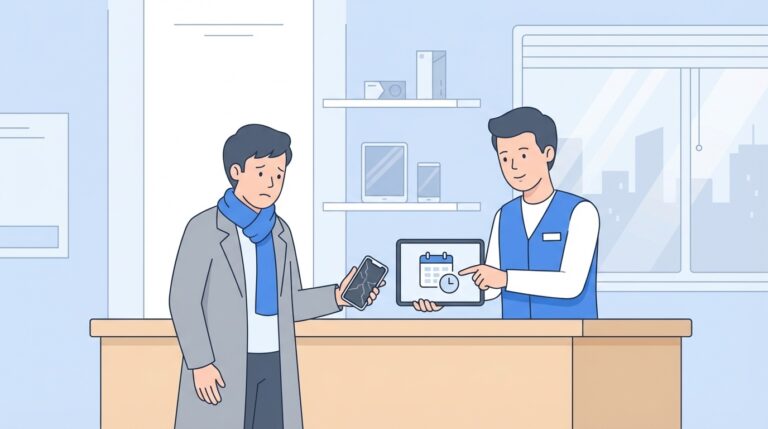
Picture this: You are in Seoul, the tech capital of the world. You accidentally drop your laptop at a hip cafe in Seongsu-dong. Crash. The screen goes black. You rush to the service center, expecting the famous Korean “Pali-pali” (Hurry-hurry) speed. You imagine a technician fixing it in 10 minutes like in a movie.
But then, the staff looks at your device, sighs, and says the dreaded sentence: “We don’t have the parts, so it will take a long time.”
Panic sets in. How long? Days? Weeks? What about your K-Drama streaming schedule? Today, we will learn how to navigate this frustration, understand exactly what is going on, and maybe even get a rental phone like a pro.
This isn’t just about repairs; it’s about surviving the unexpected pauses in a fast-paced country.
Phase 2: Deep Dive into Key Expressions
1. 부품이 없어서 (Because there are no parts)
- Pronunciation: [Bupum-i eopseo-seo] (Sounds like: Boo-poom-ee op-suh-suh)
- Meaning:
- Literal: Parts do not exist, so…
- Real Nuance: “We are out of stock right now, so we can’t start working.”
- K-Culture Moment: Think of a K-Pop concert where the light sticks are sold out. “Ya, bupum-i eopseo!” (Hey, there are no parts/stocks!). It implies a helpless situation due to supply chains.
- Editor’s Insight: The grammar
-어서/아서is crucial here. It connects the reason (no parts) with the result (delay). It’s softer and more natural than strictly logical connectors. - Situation Spectrum:
[🚫 Formal Report] ———— [⚠️ Service Center] ———— [✅ Friends]- This phrase is standard polite (with ‘yo’ at the end) and perfect for service centers (⚠️).
- 🤔 Think About It: Why does Korean put the reason (no parts) before the result (delay)? English often says “It will be late because…” but Korean logic is “Because X exists, Y happens.”
2. 수리가 오래 걸려요 (The repair takes a long time)
- Pronunciation: [Suri-ga orae geol-lyeo-yo]
- Meaning:
- Literal: Repair takes long.
- Real Nuance: “Don’t expect this to be done today. You need to wait.”
- K-Culture Moment: In K-Dramas, when a character undergoes surgery, the doctor comes out and says, “Suri… no, Susul (surgery) might take a long time.” The tension is the same!
- Editor’s Insight:
걸려요comes from걸리다(to take time/to get caught). It’s the most common way to discuss duration. - Situation Spectrum:
[🚫 King/President] ———— [⚠️ Stranger/Staff] ———— [✅ Family]- Casual: 오래 걸려 (Orae geol-lyeo)
- Polite: 오래 걸려요 (Orae geol-lyeo-yo)
3. 맡기고 가세요 (Please leave it with us)
- Pronunciation: [Mat-gi-go ga-se-yo]
- Meaning: Drop it off and go.
- Editor’s Insight: This requires trust. You are entrusting (
맡기다) your precious device to them. In Korea, theft is rare, so people comfortably leave laptops and phones at service centers for days.
Phase 3: Textbook vs. Real Life
| Situation | 📖 Textbook Korean | 🗣️ Real Korean (Survival) | 💡 Why the difference? |
|---|---|---|---|
| Explaining delay | 부품이 재고가 없습니다. (Parts are out of inventory.) | 자재가 지금 없어서요. (We don’t have the ‘materials’ now.) | Technicians often use industry terms like ‘자재’ (materials) instead of just ‘부품’ (parts). |
| Asking time | 시간이 얼마나 걸립니까? (How much time does it take?) | 언제쯤 될까요? (Around when will it be done?) | ‘언제쯤’ (About when) is less pressuring and more natural than asking for exact hours. |
| Checking availability | 부품이 언제 옵니까? (When do parts come?) | 입고되면 연락 주나요? (Will you call me when it ‘enters the warehouse’?) | Uses passive verbs (입고되다) to sound professional and objective. |
Phase 4: Cultural Deep Dive — The “AS” Culture
4-1. What is “AS”?
If you say “Customer Service” or “Warranty Repair,” Koreans might understand, but the magic word is AS (pronounced Ay-Ess). It stands for After Service.
– “AS 센터” = Repair Shop/Service Center.
– “AS 기간” = Warranty Period.
4-2. The “Ppali-Ppali” Paradox
Korea is famous for speed. Same-day delivery, fast internet. So, when an AS center says “Wait a week,” the frustration level is higher here than in other countries.
– Non-verbal tip: If the staff looks apologetic (bowing slightly, hands together), they genuinely feel bad about breaking the “speed” social contract. Don’t get angry at them; they are victims of logistics too!
Phase 5: Immersive Roleplay
Setting: A bright, clean Electronics Service Center in Gangnam. Number ticket #402. Tuesday, 2:00 PM.
Characters:
– YOU: An exchange student whose laptop won’t turn on.
– Technician: Wearing a blue vest, polite but looks tired.
(Dialogue Start)
Technician: 402번 고객님, 오세요. 어디가 불편하세요? (Customer 402, please come. What seems to be the problem?)
YOU: 노트북 전원이 안 켜져요. (The laptop power won’t turn on.)
Technician: (Inspects device) 아… 메인보드 문제네요. 근데 지금 부품이 없어서 수리가 좀 걸려요.
(Ah… it’s a motherboard issue. But we don’t have parts, so repair will take a while.)
YOU: 아, 정말요? 얼마나 걸릴까요?
(Ah, really? How long will it take?)
Technician: 부품 신청하면… 일주일 정도 걸립니다.
(If we order parts… it takes about a week.)
🔀 Decision Point: Your Turn!
* A) “네, 알겠습니다. 맡기고 갈게요.” (Okay, I understand. I’ll leave it here.)
* B) “헉, 일주일이나요? 혹시 임대폰 있나요?” (A week?! Do you happen to have a rental phone?)
* C) “더 빨리 안 돼요?” (Can’t you do it faster?)
✅ Best Choice: B
– Why: If it’s a phone, asking for a “rental phone” (Imdae-pon) is a pro move. For laptops, it’s rare, but asking shows you know the system. Option C won’t help because the parts are physically missing.
(Roleplay continues with Choice B)
Technician: 죄송하지만 노트북 대여는 없습니다. 연락처 남겨주시면 입고되는 대로 연락드릴게요.
(Sorry, no rental laptops. If you leave your contact, I’ll call you as soon as it arrives.)
Phase 6: 10-Second Shadowing Drill
Repeat after me to master the rhythm of a frustrated but polite customer.
- Sentences:
- 😟 부품이 / 없어서 / 오래 걸려요. (Bu-pum-i / eop-seo-seo / o-rae geol-lyeo-yo.)
- 🤔 수리는 / 언제쯤 / 끝나요? (Su-ri-neun / eon-je-jjeum / kkeut-na-yo?)
- 🥺 연락 / 꼭 / 주세요! (Yeon-lak / kkok / ju-se-yo!)
Phase 7: K-Culture Mini Glossary
| Korean | Romanization | Meaning | Context |
|---|---|---|---|
| AS | Ei-Esu | After Service / Warranty Repair | The universal term for repairs in Korea. |
| 접수 | Jeop-su | Registration / Reception | Taking a number and registering your issue. |
| 무상 / 유상 | Musang / Yusang | Free / Paid | Crucial to know if your warranty covers the cost. |
| 리퍼 | Ripeo | Refurbished | Getting a refurbished device instead of a repair. |
| 택배 수리 | Taekbae Suri | Parcel Repair | Sending your device via mail for repair (very common). |
Phase 8: Traveler’s Survival Kit
Even if you aren’t fixing a laptop, you might need to fix a suitcase or glasses.
🆘 Survival Phrase #1
– 🇰🇷 “이거 고칠 수 있어요?” (Igeo gochil su isseoyo?)
– 🗣️ Meaning: Can you fix this?
– 📍 Use at: Bag repair shops, shoe cobblers, glasses stores.📌 Editor’s Travel Note: The “Shoe Hospital”
You will see tiny stalls on the streets of Seoul labeled “구두 / 수선” (Shoes / Repair). They can fix broken heels, zippers on bags, and even belts very cheaply and quickly. Don’t throw away your broken travel gear; bring it to the street master!
Phase 9: Think Deeper — “AS” as a National Standard
Topic: Why is Korea obsessed with “AS”?
In many Western countries, if a cheap toaster breaks, you throw it away. In Korea, even small appliances often come with an expectation of AS. This reflects a high density of population (easy access to centers) and a consumer culture that demands post-purchase responsibility from companies. Samsung and LG became global giants partly because they mastered this “Service Trust” in their home market. When you ask for AS, you aren’t just asking for a repair; you are exercising your right as a consumer in a society that values the “relationship” between buyer and seller even after the transaction.
💬 Your Turn: In your country, is it easier to repair electronics or buy new ones? Share in the comments!
Phase 10: FAQ & Troubleshooting
Q: Can I negotiate the repair price (AS cost)?
* Answer: No. Official service centers (Samsung, LG, Apple) have fixed prices. However, at private repair shops (Sa-seol – 사설 업체) in places like Techno Mart, you might be able to negotiate slightly if you pay cash, but it’s risky for warranty.
Q: What if I don’t understand the technical Korean terms?
* Tip: Just ask: “비용이 얼마예요?” (How much is the cost?) and “언제 찾을 수 있어요?” (When can I pick it up?). These are the only two facts that really matter!
❌ Common Mistake:
* Don’t say “Why is it so slow?” aggressively. In Korea, supply chain issues are seen as unavoidable acts of nature. Complaining won’t make the part fly faster from the factory.
Phase 11: Wrap-up & Mission
Summary: Today we learned how to handle repair delays: “부품이 없어서” (No parts), “오래 걸려요” (Takes long), and the magic word “AS”.
🚀 Action Mission:
* 🥉 Bronze: Look at your phone and say, “Suri-ga pil-yo-hae” (It needs repair) three times.
* 🥈 Silver: Find a “Samsung Service Center” or “LG Best Shop” on Naver Maps in Seoul.
* 🥇 Gold: If you have a slightly broken item, take it to a repair shop and ask, “Igeo gochil su isseoyo?”
K-Culture Mission: Watch a scene in a K-Drama where a character breaks their phone (it happens in almost every series!). Do they go to a repair center, or do they just magically get the latest model in the next scene? (Spoiler: It’s usually product placement!)
See you next time, and hope your devices stay safe! 👋
Frequently Asked Questions (FAQ)
Q: What does "부품이 없어서 (Because there are no parts)" mean in Korean and how do you pronounce it?
A: In Korean, "부품이 없어서 (Because there are no parts)" is pronounced [Bupum-i eopseo-seo] and means: Literal: Parts do not exist, so...
Q: What does "수리가 오래 걸려요 (The repair takes a long time)" mean in Korean and how do you pronounce it?
A: In Korean, "수리가 오래 걸려요 (The repair takes a long time)" is pronounced [Suri-ga orae geol-lyeo-yo] and means: Literal: Repair takes long.
Q: What does "맡기고 가세요 (Please leave it with us)" mean in Korean and how do you pronounce it?
A: In Korean, "맡기고 가세요 (Please leave it with us)" is pronounced [Mat-gi-go ga-se-yo] and means: Drop it off and go.







