

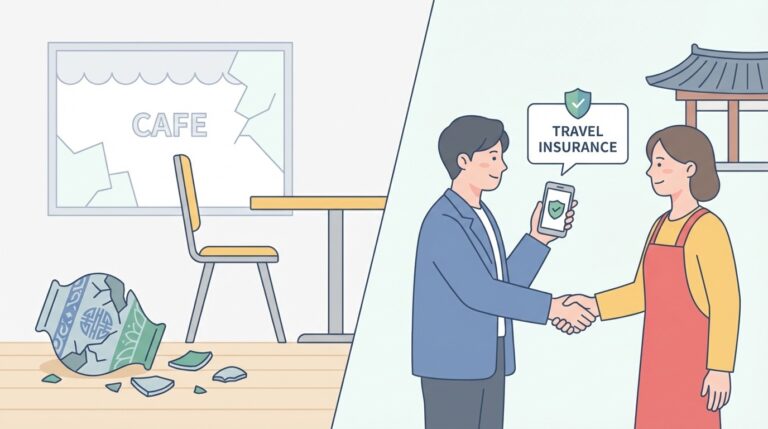
Broken Items, Broken Heart? Mastering the Art of “Liability” in Korean
Phase 1: The Immersive Hook
Greeting: Hello, Daily Hangul readers! This is your Senior Editor, back with the advanced survival tactics you won’t find in standard textbooks.
The Scene: Imagine this. You are in a high-end simplistic café in Seongsu-dong (the Brooklyn of Seoul). The interior is minimal, the vibe is immaculate. You turn around to grab your iced Americano, and your bag hits a shelf. CRASH. A limited-edition ceramic vase lies in pieces.
In a K-Drama, this is the moment the protagonist freezes, the camera zooms in on their trembling eyes, and the handsome CEO owner walks out saying, “That was worth 10 million won.” Usually, the protagonist promises to work part-time there for the next 50 years to pay it off.
The Reality: But you? You are a savvy traveler. You have travel insurance. The problem is, how do you communicate this legally and politely to a panicked shop owner without looking like a cold-hearted bureaucrat?
Today, we are moving beyond simple apologies. We are diving into the C2-level vocabulary of liability, compensation, and insurance claims.
Phase 2: Deep Dive — Critical Vocabulary
At the C2 level, we distinguish between “paying back” (money) and “compensating” (legal/formal).
1. 변상하다 (Byeonsanghada)
- Pronunciation:
[byeon-sang-ha-da](Sounds like ‘Beyond’ + ‘Sang’ + ‘Ha-da’) - Meaning: To compensate / To reimburse (specifically for damages caused)
- Nuance: Unlike
갚다(gapda – to repay a loan) or내다(naeda – to pay), 변상하다 carries a legal or formal weight. It implies restoring the loss incurred by another party. - K-Culture Moment: In legal dramas like Extraordinary Attorney Woo, when settlement discussions happen, this word is the anchor of the conversation.
- Situation Spectrum:
[🚫 Casual Friends] ———— [⚠️ Acquaintances] ———— [✅ Business/Formal]
(Use this with shop owners, hotel staff, or in insurance reports. Do not use this when you spill coffee on a close friend’s shirt; just say “내가 사줄게” (I’ll buy you a new one).) - 🤔 Think About It: Why does Korean distinguish so sharply between personal repayment and formal compensation? It reflects the society’s strong emphasis on public face (Chemyon) and formal responsibility versus private relationships.
2. 파손되다 (Pasondoeda)
- Pronunciation:
[pa-son-doe-da] - Meaning: To be damaged / To undergo breakage
- Nuance: This is a Sino-Korean term (Hanja: 破損). It is the passive form. In insurance claims, you rarely say “I broke it” (내가 깼어). You say “The item was damaged” (물품이 파손되었습니다) to maintain objective distance for documentation.
- Editor’s Insight: Using
파손instead of고장(breakdown/out of order) or깨짐(shattering) makes you sound educated and serious. It elevates the conversation from a “mistake” to an “incident.”
3. 자기부담금 (Jagi-budamgeum)
- Pronunciation:
[ja-gi-bu-dam-geum] - Meaning: Deductible / Co-pay
- Structure:
자기(Self) +부담(Burden/Bearing) +금(Money). - Editor’s Insight: This is the magic word when checking your policy. If you lose your phone or break a rental Wi-Fi egg, the first thing the staff will ask (or you should ask the insurer) is about the jagi-budamgeum.
Phase 3: Textbook vs. Real Life
| Situation | 📖 Textbook Korean | 🗣️ Real (C2) Korean | 💡 Why the difference? |
|---|---|---|---|
| Breaking an item | 물건을 깼어요. 미안해요. (I broke the item. Sorry.) | 실수로 기물이 파손되었습니다. 배상 책임 보험이 있어서요. (The property was damaged by mistake. I have liability insurance.) | “Breaking” sounds clumsy. “Damage” and “Liability” sound responsible and prepared. |
| Asking about cost | 이거 얼마예요? 제가 낼게요. (How much is this? I will pay.) | 견적서를 받을 수 있을까요? 보험사에 제출해야 해서요. (Could I get an estimate? I need to submit it to the insurer.) | You need paper trails. Asking for an ‘estimate’ signals you know the procedure. |
Phase 4: Cultural Context — The Art of Apology & Paperwork
4-1. The “Sorry” Sandwich
Even if you have insurance that covers 100% of the damage, do not start with “I have insurance.” In Korea, damaging someone’s property is a breach of peace.
- Emotional Apology: “정말 죄송합니다. 제가 부주의했습니다.” (I am terribly sorry. I was careless.)
- The Solution (Insurance): “다행히 여행자 보험에 가입되어 있어서 변상이 가능할 것 같습니다.” (Fortunately, I have travel insurance, so compensation should be possible.)
- Reassurance: “최대한 번거롭지 않게 처리해 드리겠습니다.” (I will handle this so it minimizes inconvenience for you.)
Why? If you skip step 1, you look like a rich snob who thinks money solves everything (the villain in K-Dramas). If you do step 1 well, the owner might even waive the cost if it’s minor.
4-2. K-Culture Connection: The “Gye” (Community) Mindset
In Korea, historically, communities had mutual aid societies called Gye. While modern insurance is Westernized, the concept of collective risk management is deep-rooted. However, bureaucracy in Korea is extremely fast. If you ask for a receipt or police report, expect it to be handled efficiently, but you must ask using the correct terminology (사고 경위서 – Accident Report, not just “paper”).
Phase 5: Immersive Roleplay
Setting: You are at a boutique hotel in Gangnam. You accidentally knocked over a tablet PC used for check-in, cracking the screen.
Characters:
* YOU: A prepared traveler with high-level Korean skills.
* Manager Kim: Stressed but professional hotel manager.
Dialogue:
YOU: (Looking shocked) 아, 어떡하죠? 체크인하다가 태블릿을 떨어뜨렸습니다. 액정이 파손된 것 같아요.
(Ah, eotteokhajyo? Check-in hadaga tablet-eul tteoreotteuryeotseumnida. Aekjeong-i pasondoen geot gatayo.)
(Oh no. I dropped the tablet while checking in. It seems the screen is damaged.)
Manager Kim: (Sighs) 아… 이거 수리비가 꽤 나올 텐데요. 고객님 과실이라 비용을 청구해야 할 것 같습니다.
(Ah… igeo suribi-ga kkwae naol tendeyo. Gogaeknim gwasil-ira biyong-eul cheongguhaeya hal geot gatseumnida.)
(Ah… the repair cost will be quite high. Since it is your negligence, we will have to bill you.)
🔀 Decision Point: How do you respond?
* A) “얼마예요? 지금 현금으로 드릴게요.” (Casual/Rich vibe)
* B) “제가 여행자 보험의 배상 책임 담보에 가입되어 있습니다. 필요한 서류를 주시면 접수하겠습니다.” (Professional/Smart)
* C) “제 잘못이 아니에요! 테이블이 미끄러웠어요!” (Defensive/Rude)
✅ Best Choice: B
* Analysis: Option A is fine if you are wealthy, but you lose money. Option C creates conflict. Option B uses the specific term 배상 책임 담보 (Liability Coverage). This instantly calms the manager because they know they will get paid officially.
YOU (Option B): 제가 여행자 보험의 배상 책임 담보에 가입되어 있습니다. 필요한 서류를 주시면 바로 보험사에 접수하겠습니다.
(Jega yeohaengja boheom-ui baesang chaegim dambo-e gaipdoeeo itseumnida. Piryohan seoryu-reul jusimyeon baro boheomsa-e jeopsuhagetseumnida.)
(I am covered under liability insurance. If you provide the necessary documents, I will file the claim immediately.)
Manager Kim: 아, 그러시군요. 그럼 수리 견적서와 파손 확인서를 준비해 드리겠습니다.
(I see. Then I will prepare the repair estimate and damage confirmation form.)
Phase 6: 10-Second Shadowing Drill
Let’s practice the sentence that saves your wallet. Say this with a tone of calm assurance (😟 -> 😌).
“Please issue a receipt and a damage confirmation form for insurance submission.”
🇰🇷 보험사 제출용으로 / 영수증과 파손 확인서를 / 발급해 주세요.
🔉 Boheomsa jechul-yong-euro / yeongsujeung-gwa pason hwaginseo-reul / balgeup-hae juseyo.
- Point: Pause after ‘yong-euro’ (for the purpose of) and ‘hwaginseo-reul’ (the document). Emphasize Balgeup (issue).
Phase 7: K-Culture Mini Glossary
| Korean | Romanization | Meaning | Context |
|---|---|---|---|
| 합의 | Hap-ui | Settlement | Agreeing on an amount privately without involving insurance/police. |
| 대물 배상 | Daemul Baesang | Property Liability | Legal term often seen in car rentals or insurance policies covering damage to things. |
| 경위서 | Gyeongwiseo | Written Explanation | A formal report explaining “how” an accident happened. Required for claims. |
| 본인 부담금 | Bonin Budamgeum | Deductible | The amount you pay before insurance kicks in. |
Phase 8: Traveler’s Survival Kit (Insurance Edition)
If you break something or get robbed, you need paperwork. Words vanish, documents stay.
🆘 Survival Expression #1: Asking for a Police Report (Theft)
* 🇰🇷 “도난 신고 증명서(Police Report)를 떼고 싶은데요.”
* (Donan singo jeungmyeongseo-reul ttego sipeundeyo)
* Note: In Korea, you go to a지구대(Jigudae – local police center), not just a big police station.🆘 Survival Expression #2: Asking for Repair Estimates
* 🇰🇷 “보험 청구하게 견적서(Estimate) 좀 끊어주세요.”
* (Boheom cheonggu-hage gyeonjeokseo jom kkeunneo-juseyo)
* Note:끊어주세요is a very native, idiomatic way to say “issue/print out” for tickets or receipts.
Phase 9: Think Deeper — Language & Bureaucracy
The Power of Sino-Korean Words (Hanja)
Notice how the vocabulary shifted from pure Korean (깨다 – to break) to Sino-Korean (파손 – damage, 변상 – compensation) when money and law became involved? In Korea, Sino-Korean words act as a shield of professionalism.
Using pure Korean in these situations can sound too emotional or childish. Using Sino-Korean vocabulary creates a necessary distance, signaling, “I am handling this rationally, not emotionally.” It transforms a personal mistake into an administrative process. As a C2 learner, mastering this shift allows you to command respect in stressful situations.
Phase 10: FAQ & Troubleshooting
- Q: Can I just offer cash to settle it quickly?
- A: In minor cases (e.g., breaking a $20 glass), yes. This is called instant
합의(settlement). But for expensive items or rental car scratches, always use insurance. Offering cash can lead to being overcharged if you don’t know the market price.
- A: In minor cases (e.g., breaking a $20 glass), yes. This is called instant
- Q: What if I don’t have the receipt for my own broken item?
- A: You will need to prove the value. Search for the same item on a Korean shopping site (Coupang, Naver Shopping) and show the current price to the insurer as a reference.
❌ Common Mistake: Saying “물어줄게” (I’ll pay for it) to a stranger/business.
✅ Correction: This sounds a bit aggressive or too casual (like a gangster movie). Use “변상해 드리겠습니다” (I will compensate you).
Phase 11: Wrap-up
One-Liner: Accidents happen, but your Korean doesn’t have to crash; use “변상” and “파손” to turn a crisis into a processed claim.
Action Mission:
* 🥉 Bronze: Look at your actual travel insurance policy and find the “Personal Liability” section. Translate the limit amount into Korean Won.
* 🥈 Silver: Practice the “Sorry Sandwich” (Apology + Insurance Solution + Reassurance) in front of a mirror.
* 🥇 Gold: Next time you buy something fragile or rent equipment in Korea, ask: “만약 파손되면 자기부담금이 얼마인가요?” (If this gets damaged, how much is the deductible?)
💬 Your Turn: Have you ever broken something while traveling? How did you handle it? Tell us in the comments!
Phase 12: Quiz — Interactive Challenge
Situation: You dropped a rental Wi-Fi egg and it won’t turn on. The clerk looks annoyed.
1. Which sentence is the most appropriate C2-level response?
* A) 이거 왜 안 돼요? (Why doesn’t this work?)
* B) 미안해요. 제가 고장 냈어요. (Sorry. I broke it.)
* C) 사용 중 실수로 기기가 파손된 것 같습니다. 배상 절차를 알려주시겠어요? (The device seems to have been damaged by mistake during use. Could you inform me of the compensation procedure?)
* D) 돈 줄게요. 얼마예요? (I’ll give you money. How much?)
Answer: [Toggle for Answer] -> C. (A is rude, B is too simple/childish for a legal context, D is aggressive. C is professional and cooperative.)
Frequently Asked Questions (FAQ)
Q: What does "변상하다 (Byeonsanghada)" mean in Korean and how do you pronounce it?
A: In Korean, "변상하다 (Byeonsanghada)" is pronounced [byeon-sang-ha-da] and means: To compensate / To reimburse (specifically for damages caused)
Q: What does "파손되다 (Pasondoeda)" mean in Korean and how do you pronounce it?
A: In Korean, "파손되다 (Pasondoeda)" is pronounced [pa-son-doe-da] and means: To be damaged / To undergo breakage
Q: What does "자기부담금 (Jagi-budamgeum)" mean in Korean and how do you pronounce it?
A: In Korean, "자기부담금 (Jagi-budamgeum)" is pronounced [ja-gi-bu-dam-geum] and means: Deductible / Co-pay







