

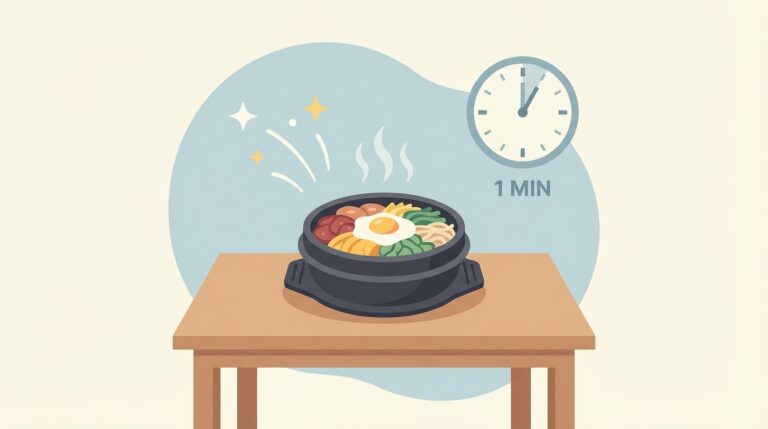
Phase 1: Immersive Hook
Greeting: 안녕하세요! (Hello!) This is your Daily Hangul Senior Editor.
Picture this: You are watching a K-Drama. The main character sits down at a bustling lunch spot, looking stressed about time. They order a stew. Cut to the very next second—the steaming clay pot is already on the table! 🍲✨
You might think, “That’s just TV editing!” But then you visit Seoul, order your own Kimchi-jjigae, look at your phone for five seconds, and… Bam! The food is there.
This is the magic of ‘Pballi-Pballi’ (빨리빨리 – Hurry-Hurry) culture. While in some countries, fast food means “unhealthy,” in Korea, fast service is a sign of respect for your precious time. Today, we’re not complaining about the rush; we are learning how to praise this lightning speed like a true local!
If you don’t know these phrases, the server might just think you are quietly eating. But if you use them, you become the “foreigner who gets it.” Let’s dive in!
Phase 2: Deep Dive into Key Expressions
Here are the top 3 phrases to react when your food arrives faster than a K-Pop rap verse.
1. 우와, 벌써 나왔어요? (Uwa, beolsseo nawasseoyo?)
- Pronunciation: [U-wa, beol-sseo na-wa-sseo-yo?]
- ‘Beol’ sounds like ‘Bird’ without the ‘d’.
- ‘Sseo’ sounds like ‘Saw’.
- Meaning:
- Literal: Wow, did it come out already?
- Real Nuance: “I can’t believe how fast this is! Thank you!”
- K-Culture Moment: Imagine a mukbang YouTuber getting their delivery food. They open the door and exclaim, “Beolsseo nawasseoyo?” to the camera.
- Editor’s Insight: This is the ultimate compliment. It tells the owner, “You are incredibly efficient.”
- Situation Spectrum:
[🚫 Boss/Elders] ———— [⚠️ Colleagues] ———— [✅ Restaurant Staff]
(Note: You use this TO the staff, so polite ‘yo’ ending is perfect.)- 🤔 Think About It: In many Western cultures, super-fast food might make you suspicious (“Is this pre-made?”). Why do you think Koreans equate speed with quality service?
2. 진짜 빠르다! (Jinjja ppareuda!)
- Pronunciation: [Jin-jja ppa-reu-da!]
- ‘Jinjja’ means “Really.”
- ‘Ppa’ sounds like ‘Pa’ in ‘Papa’ but with more explosive energy 💥.
- Meaning: It’s really fast!
- K-Culture Moment: In a variety show like Running Man, when a member completes a mission in record time, the captions flash: “Jinjja Ppareuda!”
- Editor’s Insight: This is usually said to your friends while looking at the food. If you want to say it to the staff, change it to “Jinjja ppareusineyo!” (You are really fast!).
- Situation Spectrum:
[🚫 Formal Speech] ———— [⚠️ To Staff (Modify)] ———— [✅ To Friends]3. 감사합니다, 잘 먹겠습니다! (Gamsahamnida, jal meokgesseumnida!)
- Pronunciation: [Gam-sa-ham-ni-da, jal meok-ge-sseum-ni-da]
- Meaning: Thank you, I will eat well!
- K-Culture Moment: Every single meal scene in a K-Drama. It’s the ritual starter.
- Editor’s Insight: While not explicitly about speed, saying this energetically right after the food drops implies gratitude for the quick service.
- 🤔 Think About It: “I will eat well” puts the focus on your future action of enjoying the food. It’s a promise to the cook.
Phase 3: Textbook vs. Real Life
| Situation | 📖 Textbook Korean | 🗣️ Real Korean (Insa Style) | 💡 Why the difference? |
|---|---|---|---|
| Food arrives fast | 음식이 빨리 나왔습니다. (The food came out fast.) | 대박, 스피드 무엇? (Daebak, what is this speed?) | Used mostly by younger generations on social media/chat. |
| Praising the chef | 요리사가 손이 빠르네요. (The cook has fast hands.) | 여기 LTE급이네요! (This place is LTE-level!) | Koreans love comparing speed to internet data speeds (LTE/5G). |
💡 Bottom Note: As an A2 learner, stick to “Uwa, beolsseo nawasseoyo?” It’s safer and universally understood!
Phase 4: Cultural Context — The “Service” Culture
4-1. Non-verbal: The “Happy Shock” Face 😲
When saying “Beolsseo nawasseoyo?”, don’t just say it robotically.
– Eyes: Open wide.
– Hands: Clap once softly or put hands together.
– Vibe: In Korea, showing a reaction (Reaction – 리액션) is part of good manners. A stony face might make the server think you are unhappy.
4-2. K-Food Connection: Why so fast?
Have you noticed K-Food menus? Many dishes like Gukbap (Soup with rice) or Jjigae (Stew) are constantly boiling in the kitchen. They are designed to be served instantly. It’s the “Korean Fast Food” that is actually slow-cooked but fast-served.
Phase 5: Immersive Roleplay Scenario
Setting: It is 12:10 PM on a weekday in Gangnam. The restaurant is packed with office workers. You have only 40 minutes left for lunch. You are with your Korean coworker, Minji.
Characters:
– YOU: Hungry foreign employee.
– Minji: Korean coworker (28, expert at quick lunches).
Dialogue:
YOU: (Looking worried) People are everywhere. Can we eat in time?
Minji: 걱정 마세요. 여기 진짜 빨라요. (Geokjeong maseyo. Yeogi jinjja ppallayo.)
(Don’t worry. This place is really fast.)
(You order Kimchi-stew. 3 minutes later, the server puts the boiling pot down.)
Server: 김치찌개 나왔습니다~ (Kimchi-jjigae nawasseumnida~)
(Here is the Kimchi stew.)
🔀 YOUR TURN! How do you react?
- A) (Say nothing and pick up chopsticks)
- B) “우와, 벌써 나왔어요? 감사합니다!” (Wow, already? Thank you!)
- C) “왜 이렇게 빨라요?” (Why is it this fast?)
✅ Best Choice: B
Reason: It expresses surprise and gratitude perfectly.
⚠️ Analysis of C: “Why is it so fast?” might sound suspicious or like a complaint to a native speaker’s ear!
Phase 6: 10-Second Shadowing Drill
Repeat this after me. Focus on the rising intonation of surprise!
😲 우와 / 벌써 / 나왔어요? (U-wa / beol-sseo / na-wa-sseo-yo?)
Phase 7: K-Culture Mini Glossary
| Korean | Romanization | English | Context |
|---|---|---|---|
| 빨리빨리 | Pballi-Pballi | Hurry-Hurry | The national mindset of efficiency and speed. |
| 회전율 | Hoejeonyul | Turnover rate | Restaurants pride themselves on high table turnover. |
| 총알 배송 | Chong-al Baesong | Bullet Delivery | Usually for online shopping, but used to describe fast food too. |
Phase 8: Traveler’s Survival Kit
Situation: You are in a busy Myeongdong noodle shop.
🆘 Survival Phrases TOP 3
1. 🇰🇷 “저기요!” (Jeogiyo!)
– Use this to call the server if they are moving too fast to see you.
2. 🇰🇷 “이거 제일 빨리 되는 메뉴예요?” (Igeo jeil pballi doeneun menyuyeyo?)
– Meaning: “Is this the menu item that comes out the fastest?”
– 💡 Pro Tip: Ask this if you are in a rush!
3. 🇰🇷 “잘 먹었습니다!” (Jal meogeosseumnida!)
– Meaning: “I ate well.” Shout this to the owner as you leave to show appreciation.📌 Editor’s Travel Note
Many Korean restaurants have a Call Button (Ding-dong bell) on the table. Don’t be shy to press it! It is not rude; it is part of the Pballi-Pballi efficiency system. Press it once, and wait. The server will come running!
Phase 9: Think Deeper — “Why the Rush?”
Food & Identity:
Why is speed so important in Korean dining? Historically, Korea went through rapid modernization (the “Miracle on the Han River”). Time became money. Also, Korean dining is communal. We sit, eat quickly, and move to a cafe to talk. The restaurant is for eating, the cafe is for chatting.
💬 Your Turn: In your country, is a long wait at a restaurant a sign of a good chef, or bad service? Let me know in the comments!
Phase 10: FAQ & Troubleshooting
- Q: Can I say “Pballi juseyo” (Give it to me quickly) when ordering?
- A: ⚠️ Caution! While you will hear older men say this in dramas, as a foreigner or a younger person, it can sound rude/demanding. It’s better to ask, “How long does it take?” (Olama geollyeoyo?).
- Q: Is fast food bad quality?
- A: Not in Korea! A “Gukbap” place that serves food in 2 minutes usually has the broth boiling for 24 hours. Speed here means preparation, not shortcuts.
Phase 11: Wrap-up & Mission
One-Liner: Korean fast service is not about rushing you out; it’s about respecting your hungry stomach!
Action Mission:
– 🥉 Bronze: Say “Uwa, beolsseo nawasseoyo?” to your microwave dinner tonight.
– 🥈 Silver: Watch a scene in a K-Drama where characters eat lunch. Check if they talk about time or speed!
– 🥇 Gold: Visit a Korean restaurant in your city. When the food comes, try the phrase on the staff!
See you in the next lesson! 안녕! 👋
Frequently Asked Questions (FAQ)
Q: What does "우와, 벌써 나왔어요? (Uwa, beolsseo nawasseoyo?)" mean in Korean and how do you pronounce it?
A: In Korean, "우와, 벌써 나왔어요? (Uwa, beolsseo nawasseoyo?)" is pronounced [U-wa, beol-sseo na-wa-sseo-yo?] and means: a key conversational Korean expression covered in this lesson.
Q: What does "진짜 빠르다! (Jinjja ppareuda!)" mean in Korean and how do you pronounce it?
A: In Korean, "진짜 빠르다! (Jinjja ppareuda!)" is pronounced [Jin-jja ppa-reu-da!] and means: a key conversational Korean expression covered in this lesson.
Q: What does "감사합니다, 잘 먹겠습니다! (Gamsahamnida, jal meokgesseumnida!)" mean in Korean and how do you pronounce it?
A: In Korean, "감사합니다, 잘 먹겠습니다! (Gamsahamnida, jal meokgesseumnida!)" is pronounced [Gam-sa-ham-ni-da, jal meok-ge-sseum-ni-da] and means: Thank you, I will eat well!







