

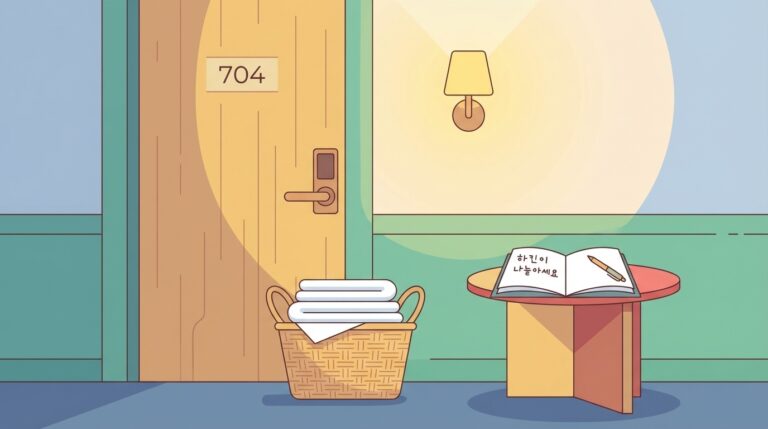
Phase 1: Immersive Hook — The “Shower Panic” Moment
Greeting: 안녕하세요! Welcome back to Daily Hangul. I’m your editor and cultural navigator.
Picture this: You’ve just checked into a sleek hotel in Gangnam after a long flight. You’ve watched enough K-Dramas to know that a brooding CEO might be staying in the penthouse, but right now, your reality is a bit different. You step out of the shower, reaching out blindly, and grab… nothing but air. 😱
There are no towels. Or maybe there’s just one tiny hand towel for two people.
In a K-Drama, this is the moment the lead character calls the front desk and demands service with charisma. But in real life? Your heart races. calling the front desk in a foreign language is terrifying. Do you say “Give me towel”? (Too rude!) do you stay silent and air-dry?
Don’t worry. Today, we’re going to learn how to solve this crisis with the elegance of a K-Drama heroine and the politeness of a true local. Let’s get you that fluffy towel.
Phase 2: Deep Dive — The Magic Sentences
Here are the three most natural ways to handle this situation, ranked by nuance.
1. 수건 좀 가져다주시겠어요?
(Su-geon jom ga-jyeo-da ju-si-ges-seo-yo?)
- Pronunciation: [Soo-geon] + [Jom] (sounds like ‘John’ with an M) + [Ga-jyeo-da] + [Ju-si-ges-seo-yo?]
- Meaning: Could you please bring me some towels?
- Breakdown:
수건(Towel) +좀(Please/A little) +가져다주다(To bring) +~시겠어요?(Would you politely?)- Editor’s Insight: This is your Golden Key. It’s polite, clear, and uses the magic word 좀 (Jom). In Korean, adding “Jom” softens a request instantly. Without it, you might sound like a robot command.
- Situation Spectrum:
[🚫 Casual Friend] ———— [✅ Hotel Staff] ———— [✅ Stranger]- 🤔 Think About It: Why do Koreans use “Give me a little” (Jom) to mean “Please”? It minimizes the burden on the listener. It’s a linguistic way of being humble.
2. 방에 수건이 부족해요.
(Bang-e su-geon-i bu-jok-hae-yo.)
- Pronunciation: [Bang-eh] + [Su-geon-ee] + [Bu-jok-hae-yo]
- Meaning: The room lacks towels / We are short on towels.
- K-Culture Moment: Think of a reality travel show like Youth Over Flowers. When the cast arrives at a hostel and things are missing, they don’t demand; they explain the situation first. “Excuse me, we are short on beds…”
- Editor’s Insight: This is an indirect request. You are stating a fact, and the listener (the staff) will naturally offer to solve it. It’s very sophisticated!
3. 수건 두 장만 더 주세요.
(Su-geon du jang-man deo ju-se-yo.)
- Pronunciation: [Su-geon] + [Du-jang-man] + [Deo] + [Ju-se-yo]
- Meaning: Please give me just two more towels.
- Grammar Note: Koreans count flat objects (tickets, paper, towels) using the counter 장 (jang).
- Situation Spectrum:
[⚠️ Elders] ———— [✅ Service Staff] ———— [✅ Restaurant]
Phase 3: Textbook vs. Real Life
| Situation | 📖 Textbook Korean | 🗣️ Real Korean (Daily Hangul Style) | 💡 Why the difference? |
|---|---|---|---|
| Calling Front Desk | 수건을 원합니다. (I want a towel.) |
여기 501혼데요, 수건 좀 부탁드려요. (This is room 501, I’d like to ask for towels.) |
Starting with your location saves time and sets a context immediately. |
| Asking for quantity | 수건 두 개 주세요. (Give me two towels.) |
두 장만 더 챙겨주시겠어요? (Could you take care of two more sheets for me?) |
“챙겨주다” (to take care of/pack) sounds much more caring and grateful than just “give.” |
Bottom Note: Never say “I want…” (나는 …을 원해요) to staff. It sounds like a translated movie subtitle from the 1990s!
Phase 4: Cultural Deep Dive — The “Service” Context
4-1. Non-verbal: The “Apologetic” Tone
Even though you are the guest and they forgot the towels, a polite Korean guest often speaks with a slightly apologetic tone. It’s not admitting fault; it’s just smoothing the social friction of making a request. Keep your voice calm and slightly soft.
4-2. K-Culture Connection: “Palli-Palli” (Hurry-Hurry) Culture
In Korean hotels, “Room Service” or housekeeping requests are often handled with lightning speed. This connects to Korea’s “Palli-Palli” culture.
– In Dramas: Notice how when a character orders food or asks for something, it arrives in the very next scene?
– In Reality: If you call for towels, they might be at your door in 3 minutes. Be dressed and ready!
Phase 5: Immersive Roleplay — The Phone Call
Setting: Seoul, 10:00 PM. You are in Room 704. You just realized you need an extra towel for your hair. You pick up the landline.
Characters:
– YOU: A tired but polite traveler.
– Staff: A professional hotelier.
Dialogue:
Staff: 프런트 데스크입니다. 무엇을 도와드릴까요?
(Peu-reon-teu de-seu-keu-im-ni-da. Mu-eo-seul do-wa-deu-ril-kka-yo?)
(Front desk. How may I help you?)
YOU: 안녕하세요. 여기 704호인데요.
(An-nyeong-ha-se-yo. Yeo-gi 704-ho-in-de-yo.)
(Hello. This is room 704.)
Staff: 네, 고객님. 무슨 일이신가요?
(Ne, go-gaeng-nim. Mu-seun il-i-sin-ga-yo?)
(Yes, guest. What is the matter?)
🔀 Decision Point: What do you say?
A) 수건 줘! (Su-geon jwo!) – “Give towel!”
B) 방에 수건이 좀 부족해서요. (Bang-e su-geon-i jom bu-jok-hae-seo-yo.) – “We are a little short on towels…”
C) 수건이 없습니다. (Su-geon-i eop-seum-ni-da.) – “There are no towels.”
✅ Best Choice: B
Reason: It explains the situation indirectly and uses “jom” to soften it. It implies a request without demanding it.
Staff: 아, 죄송합니다. 몇 장 가져다드릴까요?
(Ah, joe-song-ham-ni-da. Myeot jang ga-jyeo-da-deu-ril-kka-yo?)
(Ah, I apologize. How many sheets should I bring?)
YOU: 두 장만 부탁드려요. 감사합니다.
(Du jang-man bu-tak-deu-ryeo-yo. Gam-sa-ham-ni-da.)
(Just two, please. Thank you.)
Phase 6: 10-Second Shadowing Drill
Let’s practice the most useful phrase. Focus on the intonation—it should go up slightly at the end to sound polite.
😊 Soft & Polite:
수건 좀 / 더 주실 수 / 있나요?
(Su-geon jom / deo ju-sil su / innayo?)
Phase 7: K-Culture Mini Glossary
| Korean | Romanization | Meaning | Context |
|---|---|---|---|
| 어메니티 | Eo-me-ni-ti | Amenities | Used for shampoo, soap, etc. Identical to English! |
| 룸서비스 | Rum-seo-bi-seu | Room Service | Ordering food/drinks to the room. |
| 청소해 주세요 | Cheong-so-hae ju-se-yo | Please clean | Used when leaving the room for the day. |
| 1회용품 | Il-hoe-yong-pum | Disposables | Toothbrushes/razors (Note: Many KR hotels now charge for these due to environmental laws!) |
Phase 8: Traveler’s Survival Kit
Since you are likely staying at a hotel, here are 3 Survival Phrases you’ll need at the Front Desk.
🆘 Survival Expression #1: Asking for Wi-Fi
– 🇰🇷 “와이파이 비밀번호가 뭐예요?” (Wa-i-pa-i bi-mil-beon-ho-ga mwo-ye-yo?)
– 💡 Pro Tip: Usually, it’s on the key card holder, but asking this is a great ice-breaker.🆘 Survival Expression #2: Late Checkout
– 🇰🇷 “체크아웃 시간 좀 늦출 수 있나요?” (Che-keu-a-ut si-gan jom neut-chul su innayo?)
– 💡 Pro Tip: Most Korean hotels are strict about time (11:00 AM usually), but asking politely helps!🆘 Survival Expression #3: Leaving Luggage
– 🇰🇷 “짐 좀 맡겨도 될까요?” (Jim jom mat-gyeo-do doel-kka-yo?)
– 💡 Pro Tip: Essential for your last day when your flight is late at night.
Phase 9: Think Deeper — “Wait, no toothbrush?”
Topic: Sustainability vs. Convenience
Did you know that recently, many premium hotels in Korea stopped providing free toothbrushes, razors, and toothpaste? This is due to strict government environmental regulations to reduce plastic waste.
🧠 Think Deeper:
In your country, is a hotel obligated to provide everything? In Korea, the “Service” culture is huge, but the “Eco-friendly” law is stronger. How does this reflect the rapid way Korean society adapts to new rules? If you get annoyed, remember: it’s not the hotel being stingy; it’s a national movement for the planet.
Phase 10: FAQ & Troubleshooting
Q: Do I need to tip the staff who brings the towels?
A: NO. This is a common worry for Western tourists. Korea is a no-tipping culture. If you try to give money, the staff might feel awkward or refuse it. A warm “Gam-sa-ham-ni-da” (Thank you) and a slight bow of the head is the best payment.
Q: Can I take the hotel slippers or towels home?
A: Slippers (if disposable/paper): Yes. Towels/Gowns: Absolutely Not. It is considered theft. There was a time when this was a social issue in Korea, so hotels check inventory carefully!
❌ Common Mistake: Saying “Hey!” or whistling to get attention.
✅ Correct Way: Raise your hand slightly and say “Jeo-gi-yo” (Excuse me) if in person, or simply “Yeo-bo-se-yo” (Hello) on the phone.
Phase 11: Wrap-up & Action Mission
Summary: Today we learned how to ask for amenities politely using the magic word “Jom” and stating the room number first.
🚀 Action Missions:
– 🥉 Bronze: Say “Su-geon jom ju-se-yo” 3 times while looking at your bathroom mirror.
– 🥈 Silver: Next time you are at a restaurant (even a Korean one in your country), ask for extra napkins using “Napkin jom ju-se-yo.”
– 🥇 Gold: On your next trip to Korea, call the front desk and ask for extra water or towels in perfect Korean!
K-Culture Mission: Watch a scene in a K-Drama where someone stays at a hotel (or a ‘Motel/Pension’). Observe how they talk to the staff. Is it formal or rude? Tell us in the comments!
Phase 12: Quiz — Cultural Sense Check
Scenario: The housekeeping staff brought you the towels. You are very grateful because you were dripping wet.
Q: What is the most culturally appropriate reaction?
- Try to hand them a 5,000 KRW bill as a tip.
- Take the towels with one hand and slam the door.
- Receive the towels with two hands (or support your right arm with your left hand) and say “Gamsa-hamnida.”
- Hug them.
Answer: 3.
Explanation: Tipping (#1) is awkward. One hand (#2) can be seen as dismissive. Hugging (#4) is too intimate. Two hands show respect, even to service staff!
Frequently Asked Questions (FAQ)
Q: What does "좀" mean in Korean and how do you pronounce it?
A: In Korean, "좀" is pronounced [Jom] and means: . In Korean, adding "Jom" softens a request instantly. Without it, you might sound like a robot command.







