

Phase 1: Immersive Hook
Welcome to Daily Hangul! 👋
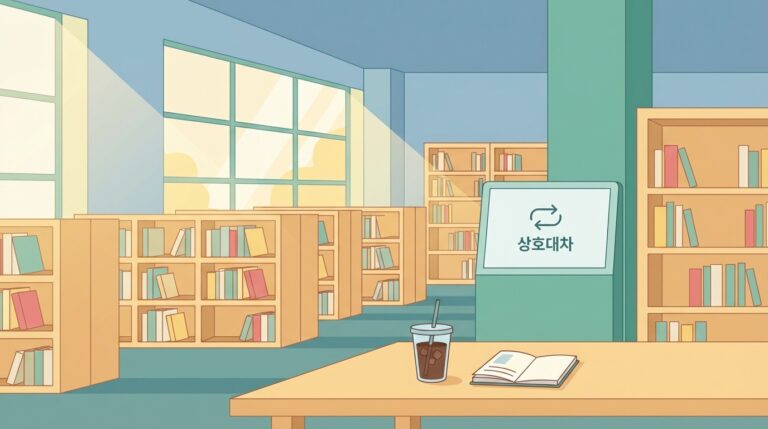
Picture this: You are the main character in a K-Drama like Romance is a Bonus Book or Our Beloved Summer. You are sitting in a sun-drenched, aesthetic library in Seoul, determined to find that one specific novel that holds the key to your research (or your heart). You search the database… and Bam! It says “대출 중” (Checked out).
In a typical Western drama, you might sigh and leave. But this is Korea, the land of Ppalli-Ppalli (hurry-hurry) and hyper-connectivity. You don’t give up. You use the magic spell called “Sangho Daecha” (Inter-library Loan).
If you are living in Korea or planning a long-term stay, mastering the library system is the ultimate “I’m a local” flex. Today, we are going beyond “Where is the bathroom?” and diving into the C1-level administrative Korean that will get that book delivered to your hands within 24 hours.
Ready to hack the Korean library system? Let’s go.
Phase 2: Deep Dive into Core Expressions
Since we are targeting C1 (Advanced), we are skipping the basics. These are the terms you see on the screen or say to a librarian when you need results.
1. 상호대차 (Sangho Daecha)
- Pronunciation: [Sang-ho Dae-cha] + Sounds like ‘Sang’ (song) + ‘Ho’ (Santa’s Ho) + ‘Dae’ (day) + ‘Cha’ (cha-cha).
- Meaning: Inter-library Loan (Literal: Mutual Loan/Borrowing)
- K-Culture Moment: Imagine a scene in a university drama where the senior (Sunbae) impresses the junior (Hoobae) by magically getting a rare book from a library across town. “I requested it via Sangho Daecha.”
- Editor’s Insight: This isn’t just a service; it’s a lifeline. Seoul’s libraries are networked. If Library A doesn’t have it, Library B will send it to Library A for you. It implies you know how the system works.
- Situation Spectrum:
[🚫 Casual/Slang] ———— [⚠️ Standard] ———— [✅ Professional/Admin]
- Used with friends: ⚠️ (A bit formal, but okay if discussing the system)
- Used with Librarian: ✅ (Perfect)
- 🤔 Think About It: Why does Korea use the word “Mutual (Sangho)” instead of just “Transfer”? It reflects the cooperative relationship between institutions, a microcosm of the collective society.
2. 타관 대출 (Tagwan Daechul)
- Pronunciation: [Ta-gwan Dae-chul]
- Meaning: Loan from another library (Literal: Other-building lending)
- Editor’s Insight: You will see this button on the kiosk or website. Tagwan means “other building/institution.” It feels very administrative. Using this word makes you sound like an academic or a serious reader.
- Situation Spectrum:
[🚫 Spoken Casual] ———— [✅ Written/Formal Spoken]
- “Can I do Tagwan Daechul?” sounds very educated.
3. 반납 기한 (Bannap Gihan)
- Pronunciation: [Ban-nap Gi-han]
- Meaning: Return Deadline / Due Date
- K-Culture Moment: The dramatic climax when a student runs to the Unmanned Return Machine at 11:59 PM to avoid suspension penalties.
- Editor’s Insight: In Korea, fines aren’t usually monetary; they suspend your borrowing privileges (e.g., late 3 days = banned for 3 days). Knowing your Gihan is crucial for survival.
Phase 3: Textbook vs. Real Life
| Situation | 📖 Textbook Korean | 🗣️ Real Interaction | 💡 Why the difference? |
|---|---|---|---|
| Asking if a transfer is possible | 이 책을 다른 도서관에서 빌릴 수 있습니까? (Can I borrow this book from another library?) | 이거 상호대차 신청 되나요? (Is inter-library loan request possible for this?) | ‘빌리다’ is too basic for this context. Using the specific terminology (상호대차) speeds up the process. |
| Asking when it arrives | 언제 책이 도착합니까? (When does the book arrive?) | 타관 신청하면 며칠 걸려요? (How many days does it take if I request from another branch?) | Koreans value efficiency. asking “How many days” sets a specific expectation. |
| Checking availability | 이 책이 도서관에 있습니까? (Is this book in the library?) | 지금 대출 가능 상태인가요? (Is the status ‘Available for Loan’ right now?) | You are asking about the system status, not just the physical location. |
Bottom Note: At C1 level, you stop describing the action (“borrow”) and start naming the process (“loan request”). This precision earns you respect.
Phase 4: Cultural Deep Dive
4-1. Non-verbal Cues: The Art of Silence 🤫
Korean libraries are quiet. I mean, pin-drop quiet. When you approach the information desk (안내 데스크), do not boom your voice.
– The Approach: Walk up, bow slightly (15 degrees), and speak in a hushed tone (ASMR volume).
– The Handover: When giving your membership card (usually a mobile app barcode these days), present your phone with two hands or at least support your right arm with your left hand.
4-2. K-Culture Connection: The “Smart City” Infrastructure 🌐
Have you seen those small, locker-looking booths at subway stations in Seoul? Those are Smart Libraries (스마트 도서관).
In K-Dramas like Start-Up, you see characters utilizing seamless tech. The Sangho Daecha service is part of this. You can request a book online and pick it up at a subway station locker on your way home from work. It perfectly illustrates the Korean “Ppal-li Ppal-li” (hurry hurry) culture combined with high-tech convenience. Using this service proves you have integrated into the lifestyle, not just the language.
Phase 5: Immersive Roleplay Scenario
Setting: Mapo Central Library, Seoul. A sleek, modern building. It’s Tuesday afternoon. You found a book on the computer, but it’s not on the shelf.
Characters:
– YOU: An expat researcher living in Seoul for 2 years.
– Librarian (사서): A polite woman in her 30s, wearing a headset, clicking away at a computer.
Dialogue:
YOU: (Approaching quietly) 저기요, 죄송한데 검색대에서는 ‘대출 가능’이라고 나오는데 서가에 없어서요.
(Jeogiyo, joesonghande geomsaekdae-eseoneun ‘daechul ganeung’-irago naoneunde seoga-e eopseoseoyo.)
(Excuse me, the search terminal says ‘Available’, but it’s not on the shelf.)
Librarian: 아, 그래요? 잠시만요. 등록번호 좀 알려주시겠어요?
(Ah, geuraeyo? Jamsimanyo. Deungnokbeonho jom allyeojusigesseoyo?)
(Ah, really? One moment. Could you give me the call number?)
YOU: 네, 811.35-김-2023 입니다.
(Ne, 811.35-Kim-2023 imnida.)
Librarian: (Typing rapidly) 아… 이거 지금 분관에 잘못 꽂혀있거나 ‘소재 불명’ 상태인 것 같네요. 죄송합니다.
(Ah… igeo jigeum bunggwan-e jalmot kkochyeoitgeona ‘sojae bulmyeong’ sangtaein geot ganneyo. Joesonghamnida.)
(Ah… it seems it’s either shelved wrong in the annex or ‘location unknown’. I apologize.)
🔀 Decision Point: What is your move?
– Option A: “그럼 못 빌리는 건가요?” (So I can’t borrow it?) -> A bit passive.
– Option B: “혹시 근처 다른 도서관에서 상호대차로 받아볼 수 있을까요?” (Could I receive it via inter-library loan from a nearby library?) -> Pro Move! Active & Knowledgeable.
– Option C: “찾아주세요.” (Please find it.) -> Too demanding/Direct.
✅ Best Choice: Option B. It shows you understand the system and offer a solution.
(Continuing with Option B)
Librarian: 네, 확인해볼게요. (Clicks mouse) 네, 서강 도서관에 재고가 있네요. 신청해 드릴까요? 도착하면 카톡으로 알림 갈 거예요.
(Ne, hwaginhaebolgeyo… Ne, Seogang doseogwan-e jaegoga inneyo. Sincheonghae deurilkkayo? Dochakamyeon Katok-euro allim gal geoyeyo.)
(Yes, let me check. Yes, Seogang Library has stock. Shall I request it? You’ll get a KakaoTalk notification when it arrives.)
YOU: 네, 부탁드립니다. 감사합니다!
(Ne, butakdeurimnida. Gamsahamnida!)
(Yes, please do. Thank you!)
Phase 6: 10-Second Shadowing Drill
Let’s practice the “Pro Move” sentence. Focus on the polite hesitation at the start and the clear terminology.
😊 Polite & Inquiring Tone:
혹시 / 근처 다른 도서관에서 / 상호대차로 / 받아볼 수 있을까요?
(Hoksi / geuncheo dareun doseogwan-eseo / sangho-daecha-ro / badabol su isseulkkayo?)
By any chance / from another nearby library / via inter-library loan / could I receive it?
Phase 7: K-Culture Mini Glossary
| Korean | Romanization | Meaning | Context |
|---|---|---|---|
| 열람실 | Yeollamsil | Reading Room | The quiet study area (often separated from book stacks) where students study for exams. |
| 소장하다 | Sojanghada | To possess/own | Used by libraries to say they “own” a copy. “우리 도서관 소장 자료입니다.” |
| 연체 | Yeonche | Overdue | The enemy. “연체료” is the overdue fee (though usually, it’s a suspension penalty). |
| 무인 반납기 | Muin Bannapgi | Unmanned Return Machine | The kiosk where you return books after hours. Essential for busy Seoulites. |
Phase 8: Traveler’s Survival Kit (Library Edition)
Even if you are just traveling, Seoul’s libraries (like the famous Starfield Library in COEX or Namsan Public Library) are tourist hotspots.
🆘 Survival Expressions
– 🇰🇷 “여기 와이파이 비밀번호가 뭐예요?” (Yeogi waipai bimilbeonhoga mwoyeyo?)
– 🗣️ Meaning: What is the Wi-Fi password here?
– 🇰🇷 “외부인도 들어갈 수 있나요?” (Oebuin-do deureogal su innayo?)
– 🗣️ Meaning: Can outsiders (non-members) enter?
– 💡 Pro Tip: Most public libraries in Korea allow anyone to enter and read books inside the library without a card. You only need a card to borrow them out.📌 Editor’s Note: The “Alien Registration Card” Hurdle
To get a library card and use Sangho Daecha, you usually need an Alien Registration Card (ARC). If you are a short-term traveler, enjoy the space and the AC, but don’t expect to take books home!
Phase 9: Think Deeper — “Public Trust”
🧠 The Culture of ‘Chaekkwan’ (Book Return)
In Korea, the inter-library loan system relies heavily on trust and logistics. Books travel miles across the city to reach you. Interestingly, Korea has a very high return rate for public goods. This reflects a society where “public property” is respected, but also where the “system” is watching (via your phone number and ID linked to everything).
💬 Your Turn: Does your country have a system where libraries talk to each other? Or do you have to travel to the specific library that has the book?
Phase 10: FAQ & Troubleshooting
- Q: Can I use Sangho Daecha for comic books (Manhwa)?
- A: Usually, yes! Unless they are reference-only (saved for inside reading). Korean libraries have huge comic sections.
- Q: Can I return a ‘Sangho Daecha’ book to any library?
- A: Generally, yes. This is called U-Library (Ubiquitous Library) service in many districts. But always double-check with the librarian: “아무 데나 반납해도 되나요?” (Can I return it anywhere?)
- ❌ Common Mistake:
- Don’t say “책 사고 싶어요” (I want to buy a book). Libraries aren’t bookstores (Seojeom). Use “빌리다” (borrow) or “대출하다” (loan).
Phase 11: Wrap-up & Action Mission
One-Liner: Knowing “Sangho Daecha” transforms the entire city of Seoul into your personal bookshelf.
🚀 Action Missions:
– 🥉 Bronze: Go to a Korean library website (e.g., Kyobo or a public library site) and find the button that says “상호대차 신청” or “소장 자료 검색”.
– 🥈 Silver: Visit a local library in Korea, find the “Search Kiosk,” and print out a location slip.
– 🥇 Gold: Actually request a book from another branch and pick it up when the KakaoTalk alert comes!
🎥 K-Culture Mission: Watch a scene from Romance is a Bonus Book (set in a publishing house/library context) and spot how they treat books with respect.
Phase 12: Interactive Quiz
- True or False? In Korea, if you return a book late, you usually have to pay a large cash fine immediately.
- (False! Usually, your borrowing privileges are suspended for a set period corresponding to the delay.)
- Situation: You are at the desk. The librarian says the book is at another branch. What is the most natural way to ask for it to be sent here?
- A) 택배로 보내주세요. (Send it via parcel service.)
- B) 상호대차 신청해 주세요. (Please request inter-library loan.)
- C) 책을 옮겨라. (Move the book.)
- (Answer: B. ‘A’ is for shopping, ‘C’ is rude command.)
Did you enjoy this deep dive? Leave a comment if you’ve ever discovered a hidden gem of a book in a Korean library!
Frequently Asked Questions (FAQ)
Q: What does "상호대차 (Sangho Daecha)" mean in Korean and how do you pronounce it?
A: In Korean, "상호대차 (Sangho Daecha)" is pronounced [Sang-ho Dae-cha] and means: Inter-library Loan (Literal: Mutual Loan/Borrowing)
Q: What does "타관 대출 (Tagwan Daechul)" mean in Korean and how do you pronounce it?
A: In Korean, "타관 대출 (Tagwan Daechul)" is pronounced [Ta-gwan Dae-chul] and means: Loan from another library (Literal: Other-building lending)
Q: What does "반납 기한 (Bannap Gihan)" mean in Korean and how do you pronounce it?
A: In Korean, "반납 기한 (Bannap Gihan)" is pronounced [Ban-nap Gi-han] and means: Return Deadline / Due Date







