

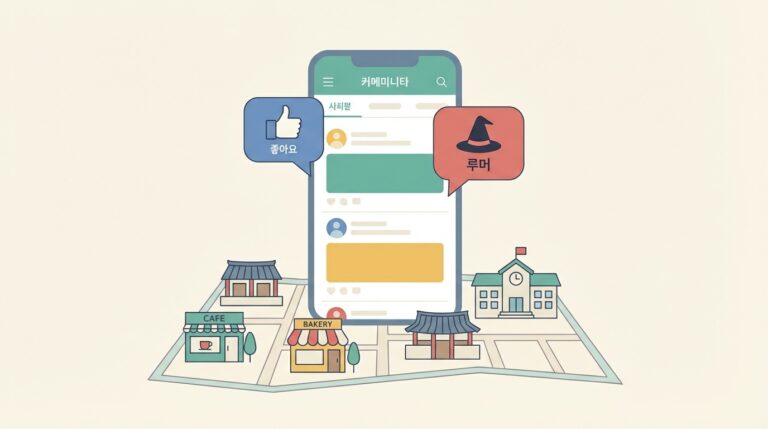
The Digital Village: Navigating the Double-Edged Sword of Korean “Mom Cafes”
Phase 1: Immersive Hook
안녕하세요! This is your Senior Editor at Daily Hangul.
Picture this scene from the K-Drama Green Mothers’ Club or Sky Castle. A group of mothers sits in an elegant brunch cafe, their phones face down on the table. The air is tense. One mother whispers, “Did you see the post about the English academy on the cafe this morning?” Immediately, the atmosphere shifts. That single post could mean the bankruptcy of a business or the rise of a new star tutor.
Welcome to the world of 맘카페 (Mam-ka-pe)—Korea’s hyper-local online communities for mothers.
For a foreigner living in Korea, these cafes are the ultimate intelligence agency. They are where you find the pediatrician who speaks English, the hidden matjib (tasty restaurant), and the truth about local schools. This is the 순기능 (positive function): collective intelligence.
But there is a dark side. A misinterpreted service at a restaurant can lead to a 마녀사냥 (witch hunt), where a mob of users attacks a business based on one-sided emotions.
Today, we are going to learn the advanced vocabulary needed to navigate this complex digital society—how to extract the 꿀팁 (honey tips) while avoiding the crossfire of 여론몰이 (swaying public opinion).
Let’s decode the power of the Korean mother.
Phase 2: Deep Dive into Core Expressions
Here are three high-level expressions that define the dynamics of Korean online communities.
1. 등업 (Deung-eop)
- Pronunciation: [Deung-eop] (Sounds like Dung-up)
- Meaning: Short for 등급 업그레이드 (Level Upgrade).
- Context: In Korean cafes (Naver/Daum), you cannot view premium information (like exam dumps or real estate secrets) just by joining. You must prove your loyalty by posting comments and visiting daily to get a “Level Up.”
- K-Culture Moment: Imagine a K-pop fan struggling to access the “From BTS” board because they haven’t done their ‘Deung-eop’ yet. It’s the gatekeeping mechanism of Korean digital society.
- Editor’s Insight: It’s not just a technical term; it implies earning trust. “Did you get Deung-eop yet?” means “Are you part of the inner circle now?”
- Situation Spectrum:
[🚫 Formal Reports] ———— [✅ Online/Casual] ———— [✅ Hobby Groups]- 🤔 Think About It: Why does Korean internet culture rely so heavily on these strict hierarchies even in hobbies? Does this mirror the age/rank hierarchy in offline society?
2. 좌표 찍다 (Jwapyo jjikda)
- Pronunciation: [Jwa-pyo jjik-da]
- Meaning: Literally “to mark coordinates.” Metaphorically, it means posting a link to a specific person or business to direct a collective attack or support.
- Context: “Let’s mark the coordinates on that bakery.” This is the start of a Cyber Witch Hunt. It can be positive (sending support) or devastating (mass negative reviews).
- K-Culture Moment: In political thrillers or crime dramas, when a character wants to ruin an opponent using public opinion, they say, “Just give me the coordinates.”
- Editor’s Insight: This is a scary C2-level phrase. It shows the weaponization of solidarity. If you hear this, things are about to get intense.
- Situation Spectrum:
[🚫 To Elders] ———— [⚠️ Serious Discussions] ———— [✅ Describing News]- 🤔 Think About It: Is “vigilante justice” via social media a necessary evil when the law is slow, or is it purely destructive?
3. 팩트 체크 (Paekteu chekeu)
- Pronunciation: [Paek-teu che-keu]
- Meaning: Fact Check.
- Context: Borrowed from English but used aggressively in Korea to counter rumors. In Mom Cafes, when a witch hunt begins, a rational user might step in and say, “Let’s do a fact check before we criticize.”
- Editor’s Insight: Using this word positions you as a rational, objective intellectual. It cuts through the emotional noise of 감성팔이 (appealing to emotion).
- Situation Spectrum:
[✅ Debates] ———— [✅ Business] ———— [✅ Daily Life]- 🤔 Think About It: Korean society moves incredibly fast (Pali-pali). Does this speed make “fact-checking” harder or more necessary compared to your culture?
Phase 3: Textbook vs. Real Life
| Situation | 📖 Textbook Korean | 🗣️ Real Korean (In the Mom Cafe) | 💡 Why the difference? |
|---|---|---|---|
| Sharing Info | 정보를 공유합니다. (I am sharing information.) |
꿀팁 공유해요~ / 좌표 공유합니다. (Sharing honey tips / Sharing coordinates.) |
“Honey tip” implies high value and exclusivity. |
| Complaining | 서비스가 불만족스러웠어요. (The service was unsatisfactory.) |
여기 비추예요. 사장님 마인드가 별로네요. (I strictly don’t recommend this. The owner’s mindset is bad.) |
“Mindset” (attitude) is judged as heavily as the product itself in Korea. |
| Asking | 이게 진짜인가요? (Is this real?) |
이거 광고 아닌가요? / 내돈내산 맞나요? (Isn’t this an ad? / Did you buy it with your own money?) |
Distrust of viral marketing led to the term “Nae-don-nae-san” (My money, my purchase). |
💡 Editor’s Note: Using 내돈내산 (Nae-don-nae-san) is the C2 level key to credibility. If you write a review without this tag, people will assume it’s a paid promotion.
Phase 4: Cultural Deep Dive — The Power of “Nunchi”
4-1. The Digital Nunchi (눈치)
In a Mom Cafe, you cannot just barge in and ask, “Where is a good hospital?” You will be labeled a 핑프 (Ping-pe – Finger Princess), someone who wants answers without lifting a finger to search previous posts.
* The Rule: Search first, ask later.
* The Tone: Always be overly polite and appreciative. Use clear honorifics. If you break the Nunchi, you might be “ghosted” (no replies).
4-2. K-Drama Connection: The Sky Castle Trope
The “Mom Cafe” is the modern, digital version of the neighborhood well or the laundry stream. In dramas like Sky Castle, information is power. Moms share exam tips only with their inner circle. In reality, Mom Cafes act as this gatekeeper. If you are excluded, your child might miss out on critical local opportunities. The fear of 왕따 (Wang-tta – outcast) applies to mothers as much as students.
Phase 5: Immersive Roleplay
Scenario: You are a foreign parent living in Bundang (a wealthy suburb). You joined a local Mom Cafe to find a swimming instructor. You see a post attacking a local bakery you actually like, claiming the owner was rude to a child.
Characters:
* YOU: A foreign resident who wants to be helpful but fair.
* Min-hee Mom (User ID): An influential, emotional poster leading the attack.
The Dialogue:
Min-hee Mom: (Post) 와, 저 여기 빵집 두 번 다시 안 가요. 애가 빵 좀 만졌다고 소리를 지르네요? 🤬
(Wa, jeo yeogi ppang-jip du beon dasi an gayo. Aega ppang jom manjyeotdago sorireul jireuneyo?)
(Wow, I’m never going to this bakery again. The owner yelled just because my kid touched the bread?)
Commenter A: 헐, 대박. 좌표 찍어주세요. 절대 안 감.
(Heol, daebak. Jwapyo jjik-eo-juseyo. Jeoldae an gam.)
(OMG. Give us the coordinates [location]. Never going there.)
🔀 Your Turn! How do you respond?
Option A: “Are you sure? I like that place.” (A bit confrontational)
Option B: “That’s terrible! I won’t go either.” (Blindly following—Dangerous!)
Option C: “Really? I go there often and he was kind… Maybe there was a misunderstanding? We should be careful with the facts.”
Select Option C (The C2 Level Mediator):
YOU: 어머, 속상하셨겠어요. 😢 근데 저는 거기 단골인데 항상 친절하셨거든요… 혹시 오해가 있었던 건 아닐까요? 우리 팩트 체크가 필요할 것 같아요.
(Eomeo, soksang-ha-syeot-ge-sseo-yo. Geunde jeoneun geogi dangol-inde hangsang chinjeol-ha-syeot-geo-deun-yo… Hoksi ohaega isseot-deon geon anil-kkayo? Uri paekteu chekeu-ga piryo-hal geot gatayo.)
Min-hee Mom: 아, 외국인 분이시라 잘 모르시나 본데, 사장님 눈빛이 장난 아니었어요!
(Ah, you might not know because you’re a foreigner, but his eyes were scary!)
YOU: 네, 분위기는 알죠. 하지만 사장님 생계가 달린 문제니까 마녀사냥이 되지 않게 조심하는 게 좋지 않을까요?
(Ne, bunwigineun aljyo. Hajiman sajangnim saenggye-ga dallin munjenikka manyeo-sanyang-i doeji anke josim-haneun ge jochi aneulkkayo?)
(Yes, I get the vibe. But since the owner’s livelihood is at stake, shouldn’t we be careful not to turn this into a witch hunt?)
✅ Analysis: Option C acknowledges her feelings (“You must be upset”) but uses high-level logic (“Livelihood,” “Witch hunt”) to de-escalate without being rude.
Phase 6: 10-Second Shadowing Drill
Practice this sentence to sound like a rational, thoughtful community member.
“We need to be careful so that fair criticism doesn’t turn into a witch hunt.”
정당한 비판이 / 마녀사냥으로 번지지 않게 / 주의해야 해요.
(Jeongdang-han bipan-i / manyeo-sanyang-euro beonjiji anke / ju-ui-haeya haeyo.)
- Emotional Tag: 😤 Firm but Polite (Serious face, slight nod)
- Key Intonation: Raise pitch slightly on “비판이” and “않게”. Pause after “않게”.
Phase 7: K-Culture Glossary (Mom Cafe Edition)
| Korean | Romanization | Meaning | Context |
|---|---|---|---|
| 공구 | Gong-gu | Group Purchase | Short for 공동구매. Moms buy in bulk (diapers, toys) to get discounts. “Let’s do a Gong-gu!” |
| 완판 | Wan-pan | Sold Out | When an item is completely sold out due to viral popularity. “The BTS coffee is Wan-pan.” |
| 지역화폐 | Jiyeok-hwapye | Local Currency | Prepaid cards issued by local govts offering discounts. A hot topic in Mom Cafes to save money. |
| 갑질 | Gap-jil | Power Trip | Abuse of power. Customers bullying owners, or bosses bullying staff. A major trigger for witch hunts. |
| 인증 | In-jeung | Verification | Posting a photo to prove you actually possess the item or visited the place. |
Phase 8: Traveler’s Survival Kit (Local Insights)
Even if you aren’t raising a child in Korea, the “Mom Cafe” logic applies to finding authentic restaurants and avoiding “No Kids Zones.”
**🆘 Survival Expression: Checking
Frequently Asked Questions (FAQ)
Q: What does "등업 (Deung-eop)" mean in Korean and how do you pronounce it?
A: In Korean, "등업 (Deung-eop)" is pronounced [Deung-eop] and means: Short for 등급 업그레이드 (Level Upgrade).
Q: What does "좌표 찍다 (Jwapyo jjikda)" mean in Korean and how do you pronounce it?
A: In Korean, "좌표 찍다 (Jwapyo jjikda)" is pronounced [Jwa-pyo jjik-da] and means: Literally "to mark coordinates." Metaphorically, it means posting a link to a specific person or business to direct a collective attack or support.
Q: What does "팩트 체크 (Paekteu chekeu)" mean in Korean and how do you pronounce it?
A: In Korean, "팩트 체크 (Paekteu chekeu)" is pronounced [Paek-teu che-keu] and means: Fact Check.







