

Phase 1: The “K-Drama Office” Reality Check 🎬
Greeting: Hello, Daily Hangul family! It’s your editor here.
Imagine this scene: You are the new intern in a glossy Gangnam office, just like in the drama Start-Up or Misaeng. You see your senior colleague, who looks friendly. You smile and shout, “Hey, Min-su!”
Suddenly, the office goes silent. The background music stops. Everyone gasps. 😱
Why? Because in Korea, a name is rarely just a name. It’s a GPS coordinate of power, age, and respect. Calling a colleague just by their name (or even the wrong title) can be a major social accident.
But don’t panic! Today, we are decoding the secret language of Korean Job Titles. Whether you are working in Seoul or just watching Business Proposal, this guide will save you from that awkward silence.
Let’s get you promoted to “Communication King”! 👑
Phase 2: Deep Dive — The “Title” Trinity 🔍
Here are the three most critical ways to address people in a Korean workplace.
1. [Name] + 씨 (ssi)
- Pronunciation: [Ssi] Sounds like the sharp ‘s’ in ‘sea’, but with more tension.
- Meaning: Mr./Ms. (Polite, but neutral)
- K-Culture Moment: In dramas, you often hear lovers distancing themselves during a fight: “Ya, Kim Tan-ssi!” It creates a wall.
- Editor’s Insight: This is the trickiest one. Textbooks say it’s polite. Reality? Using it for your boss is a death sentence. Using it for someone younger or same-level is okay, but it can feel a bit cold or distant.
- Situation Spectrum:
[🚫 Boss] ———— [⚠️ Senior] ———— [✅ Equal/Junior]- 🤔 Think About It: Why does a word meant to be polite (“-ssi”) feel offensive to a superior? What does this say about the need to acknowledge status over individuality?
2. [Job Title] + 님 (nim)
- Pronunciation: [Nim] Rhymes with ‘him’.
- Meaning: Honorable [Title]
- K-Culture Moment: Listen closely to K-Pop groups talking to their staff. They never say “Hey Manager.” It’s always “Manager-nim” (Maenijeo-nim).
- Editor’s Insight: This is your Magic Shield. If you don’t know their name, just use their title + nim. It shows you respect their hard-earned position.
Examples: 과장님 (Manager-nim), 대리님 (Assistant Manager-nim).- Situation Spectrum:
[✅ Boss] ———— [✅ Senior] ———— [✅ Formal Setting]- 🤔 Think About It: In English, we might say “Boss.” But in Korean, we add “-nim” even to the title. Why is the extra suffix necessary?
3. [English Name/Nickname] + 님 (nim)
- Pronunciation: [Name] + [Nim]
- Meaning: Respected [Name]
- K-Culture Moment: Think of modern tech companies like Kakao or startups in dramas like Start-Up. They try to break hierarchy by using English names.
- Editor’s Insight: Many Korean companies (called “K-Tech” style) are adopting this to force equality. You might call your CEO “Brian-nim” instead of “CEO-nim.”
- Situation Spectrum:
[✅ Startups] ———— [✅ Tech Companies] ———— [🚫 Traditional Companies]
Phase 3: Textbook vs. Real Life 🔥
| Situation | 📖 Textbook Korean | 🗣️ Real Korean (In the Office) | 💡 Why is it different? |
|---|---|---|---|
| Calling a manager | 김철수 과장님 (Kim Cheol-su Gwajang-nim) | 과장님 (Gwajang-nim) | Full names feel too formal/stiff. Context is king! |
| Asking for a senior | 선배님 (Sunbae-nim) | 선배님 (Sunbae-nim) / “OO” 써 (Ssem) | “Ssem” (Teacher) is slang for mentor/senior. |
| Calling a junior | 김영희 씨 (Kim Young-hee ssi) | 영희 씨 / 영희 님 (Young-hee nim) | Younger generations prefer ‘-nim’ over ‘-ssi’ for respect. |
💡 Bottom Note: If you are unsure, [Title] + 님 is 100% safer than [Name] + 씨.
Phase 4: Cultural Deep Dive — The Art of “Nunchi” 👀
4-1. Non-verbal: The “Bow-Voice” Sync
When addressing someone with a title like “부장님” (General Manager), your body must agree with your mouth. A slight nod or bow while saying the title is crucial. Saying a high title while leaning back in your chair? That’s a mixed signal that screams “I have no manners.”
4-2. K-Drama Connection: The “Promotion Dinner” Trope
You know that scene in every office drama where the team goes for Hoesik (company dinner) and they are grilling pork belly? Someone gets promoted, and suddenly the way people address them changes instantly.
- Yesterday: 김 대리 (Assistant Manager Kim)
- Today: 김 과장님 (Manager Kim!)
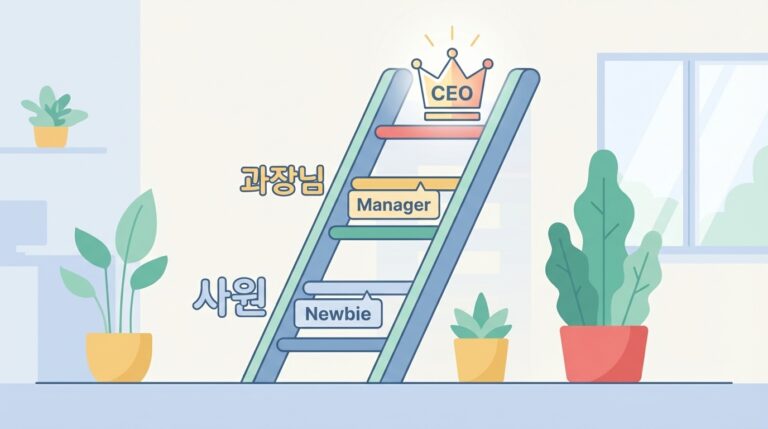
Using the new title immediately is the best congratulatory gift you can give. It acknowledges their rise in the social ladder. In K-Dramas, you’ll see characters correcting each other: “Eh? It’s not Daeri anymore, it’s Gwajang-nim!”
Phase 5: Roleplay Scenario 🎭
Setting: It’s your first week at a Korean company. 11:50 AM. The air smells of coffee and anticipation for lunch. You need to ask your superior, Min-su (who is a ‘Daeri’ – Assistant Manager), about lunch plans.
Characters:
* YOU: New foreign intern (nervous but eager).
* Min-su (NPC): Your direct supervisor. Friendly, but strict about work.
Dialogue:
YOU: (Approaching his desk carefully)
저… 민수 대리님?
(Jeo… Minsu Daeri-nim?)
(Um… Assistant Manager Minsu?)
Min-su: 어, 왜요? 무슨 일 있어요? 📄
(Eo, waeyo? Museun il isseoyo?)
(Oh, why? Is something wrong?)
🔀 DECISION POINT: How do you ask about lunch?
- Option A: 민수 얘, 밥 먹자! (Minsu-ya, bap meokja!) – “Hey Minsu, let’s eat!”
- Option B: 대리님, 점심 시간인데 같이 가실까요? (Daeri-nim, jeomsim siganinde gachi gasilkkayo?) – “Manager, it’s lunch time, shall we go together?”
- Option C: 아저씨, 밥 주세요. (Ajusshi, bap juseyo.) – “Mister, give me rice.”
✅ Best Choice: Option B.
* Analysis: You used the correct title (대리님) and the polite suggestion form (ㄹ까요?). Perfect workplace etiquette.
* Why A fails: You just used Banmal (casual speech) to your boss. Start packing your box.
* Why C fails: You treated your boss like a restaurant server. Also, “Ahjussi” is rude in the office.
Phase 6: 10-Second Shadowing 🎙️
Practice this sentence to sound like a pro when asking for help.
🙂 과장님, / 이것 좀 / 확인펴 주시겠어요?
(Gwajang-nim, / igeot jom / hwagin-hae jusigesseoyo?)
Manager, could you please check this for me?
- Tone: Polite and soft (😊). Don’t drop your voice at the end; keep it slightly rising.
- Key: Emphasize “Gwajang-nim” to grab attention politely.
Phase 7: K-Culture Mini Dictionary 📚
| Korean | Romanization | Meaning | Context |
|---|---|---|---|
| 사장님 | Sajang-nim | Boss / CEO | Used for the owner of a company OR any shop owner (restaurant, cafe). |
| 대리(님) | Daeri(-nim) | Assistant Manager | The “worker ant” of the office. Usually 3-5 years of experience. |
| 과장(님) | Gwajang(-nim) | Manager | The middle manager. Often the villain or the mentor in K-Dramas. |
| 선배(님) | Sunbae(-nim) | Senior | Someone with more experience than you, regardless of age. |
| 라때는 말이야 | Latteneun mariya | “Latte is horse” | A pun on “Na-tteneun” (Back in my day). Used to mock old bosses who preach about the past. |
Phase 8: Traveler’s Survival Kit 🌍
You might not work in Korea, but you will definitely enter a shop or restaurant. Here is how to call people when you are a customer.
🆘 Survival Expression #1: The Universal “Boss”
– 🇰🇷 “사장님!” (Sajang-nim!)
– 🗣️ Pronunciation: [Sah-jang-nim]
– 📍 Where to use: Restaurants, Cafes, Taxis, Convenience Stores.
– 💡 Pro Tip: Even if they are just an employee, calling them “Boss” (Sajang-nim) makes them feel good and might get you better service (Service = free stuff!).🆘 Survival Expression #2: The Polite “Excuse Me”
– 🇰🇷 “저기요!” (Jeogiyo!)
– 🗣️ Pronunciation: [Juh-gi-yo]
– 📍 Where to use: Everywhere when you need attention.
Phase 9: Think Deeper — Language & Power 🧠
Why does Korean act like a military hierarchy?
In Western cultures, hiding your title (e.g., “Call me Bob”) is often seen as being cool and approachable. In Korea, hiding your title can be confusing. The title (“Manager”, “Director”) isn’t just a job description; it tells everyone else how to speak to you (which verb endings to use, how low to bow).
Without the title, the “social GPS” is broken. However, young Koreans are pushing back. The rise of “-nim” for everyone (just calling people “Name-nim”) is an attempt to flatten this steep pyramid.
💬 Your Turn: Does your language change depending on who you are talking to? Or is it “You” for everyone? Share in the comments!
Phase 10: FAQ & Troubleshooting 🛠️
Q: Can I call my handsome male colleague “Oppa” at work?
A: 🚫 ABSOLUTELY NOT.
Unless you want to be the subject of office gossip for the next 3 years. “Oppa” (older brother/boyfriend) is too intimate for the workplace. Stick to [Name/Title] + Nim.
Q: What if I forget their job title?
A: It happens! The safest bet is to use “선배님” (Sunbae-nim) if they seem senior to you, or simply ask politely: “졠함이 어떻게 되시죠?” (What is your name? – Honorific form).
❌ Common Mistake Alert:
Don’t use “Mr. Kim” (미스터 김). It sounds like a bad translation from a 1950s movie or implies you are looking down on them.
Phase 11: Wrap-up & Mission 🎯
Summary: In a Korean office, titles are everything. Use [Title] + Nim to survive, avoid [Name] + Ssi for superiors, and use Sajang-nim for shop owners.
Action Missions:
* 🥉 Bronze: Say “Gwajang-nim” (Manager-nim) out loud 3 times with a polite nod.
* 🥈 Silver: Watch a K-Drama scene set in an office and count how many times they say “-nim.”
* 🥇 Gold: Go to a Korean restaurant and confidently call the server “Sajang-nim!” to ask for water.
Phase 12: Interactive Quiz 🧩
1. Situation: You are meeting the CEO of your company for the first time. How do you call him?
* A) 김철수 씨! (Kim Cheol-su ssi!)
* B) 대표님! (Daepyo-nim!)
* C) 헬로, 철수! (Hello, Cheol-su!)
2. True or False (K-Culture):
* If you don’t know a waiter’s name in a restaurant, it is rude to call them “Sajang-nim” (Boss).
🔑 Answers:
1. B (Daepyo-nim) – ‘Daepyo’ means Representative/CEO. ‘A’ is suicidal, ‘C’ is only for Hollywood movies.
2. False – Calling them “Sajang-nim” is a compliment! It implies they look like the owner.
Frequently Asked Questions (FAQ)
Q: What does "[Name] + 씨 (ssi)" mean in Korean and how do you pronounce it?
A: In Korean, "[Name] + 씨 (ssi)" is pronounced [Ssi] and means: Mr./Ms. (Polite, but neutral)
Q: What does "[Job Title] + 님 (nim)" mean in Korean and how do you pronounce it?
A: In Korean, "[Job Title] + 님 (nim)" is pronounced [Nim] and means: Honorable [Title]
Q: What does "[English Name/Nickname] + 님 (nim)" mean in Korean and how do you pronounce it?
A: In Korean, "[English Name/Nickname] + 님 (nim)" is pronounced [Name] and means: Respected [Name]







