

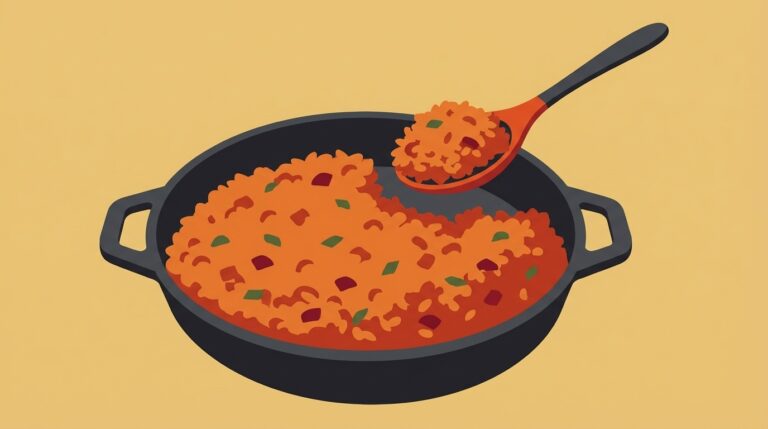
The Ultimate K-Food Finale: Why “Adding Rice” is Essential
Phase 1: The “K-Dessert” You Didn’t Know About
Hello! This is your Daily Hangul editor.
Imagine this scene from a K-Drama: The main characters have just finished a delicious meal of spicy stir-fried chicken (Dakgalbi) or grilled pork belly (Samgyeopsal). They look full, happy, and ready to leave, right?
Wrong.
Suddenly, the leader of the group raises a hand and shouts to the owner. A moment later, white rice hits the sizzling pan, mixing with the leftover spicy sauce. The characters’ eyes light up again.
In Korea, we joke that Fried Rice (Bokkeumbap) is our dessert. Even if you are 100% full, there is always room for rice. Today, we will learn the magic phrase to unlock this delicious level of Korean dining: “Adding Rice.”
If you don’t know this phrase, you might leave a Korean restaurant missing the best part of the meal. Let’s fix that right now!
Phase 2: Deep Dive — The Magic Words
Here are the top 3 expressions you need when adding rice to your cooking or order.
1. 밥 볶아 주세요 (Bap bokka juseyo)
- Pronunciation: [Bap bok-ka ju-se-yo]
- Bap sounds like “Bop” in “Bebop”.
- Bokka sounds like “Boca” in “Boca Raton”.
- Meaning: Please fry the rice (for me).
- K-Culture Moment: This is the “ending credit” of a Korean meal. In variety shows like Running Man, members often fight over the crispy rice stuck to the bottom of the pan after saying this phrase.
- Editor’s Insight: This isn’t just ordering food; it’s a ritual. Use this when you have some sauce left in the pan.
- Situation Spectrum:
[🚫 Formal Boss] ———— [⚠️ Colleagues] ———— [✅ Friends/Restaurant Staff]
- Actually, this is ✅ Safe to use with restaurant staff anytime!
- 🤔 Think About It: Why do Koreans eat rice after the main meat dish, while many Western cultures eat sides with the main dish?
2. 밥 넣어 (Bap neoeo)
- Pronunciation: [Bap neo-eo]
- Neo-eo sounds a bit like “No-uh” but softer.
- Meaning: Put rice in / Add rice.
- K-Culture Moment: Picture a cooking YouTuber or a mom in a K-Drama instructing someone while cooking Kimchi Stew: “Now, put the rice in!” (Ja, bap neoeo!)
- Editor’s Insight: This is the raw verb form. Use it when you are cooking with a Korean friend.
- Situation Spectrum:
[🚫 Elders/Strangers] ———— [⚠️ Close Colleagues] ———— [✅ Friends]
- This is casual speech (Banmal).
3. 공기밥 하나요 (Gonggibap hanayo)
- Pronunciation: [Gong-gi-bap ha-na-yo]
- Meaning: One bowl of rice, please.
- Editor’s Insight: Use this if you just want plain white rice to eat with your soup or meat, not to fry it.
Phase 3: Textbook vs. Real Life
| Situation | 📖 Textbook Korean | 🗣️ Real Korean | 💡 Why is it different? |
|---|---|---|---|
| Ordering Fried Rice | 볶음밥을 주문하고 싶습니다. (I would like to order fried rice.) | 사장님, 여기 밥 2개 볶아 주세요! (Boss, fry 2 rice here please!) | Real life is about speed and getting the owner’s attention! |
| Asking to add rice to soup | 밥을 국에 넣으세요. (Put rice into the soup.) | 밥 말아! (Mix/roll the rice in!) | “Mal-a” is a specific verb for mixing rice into soup. |
Bottom Note: Textbook Korean is polite but sounds like a robot in a noisy restaurant. The “Real Korean” connects you with the locals!
Phase 4: Cultural Deep Dive — The “K-Dessert” Theory
4-1. Non-verbal Communication: The “Spoon Rest”
When you are done with the main dish and waiting for the rice to be added (fried), do not hold your spoon. Put it down. It signals to the server, “We are ready for the rice ritual.” Also, when the server is frying the rice at your table, it is an unspoken rule to stay silent and watch the spoon movements. We call this “Bokkeumbap meong” (spacing out while watching fried rice).
4-2. K-Food Connection: The “Nurungji” Battle
When making fried rice or adding rice to a hot stone pot (Dolsot), the rice at the bottom gets crispy and brown. This is called Nurungji.
– Critical View: In many cultures, burnt food is bad. In Korea, slightly burnt rice is a delicacy. Why? Historically, when food was scarce, wasting even burnt rice wasn’t an option. Now, it’s a beloved flavor of savory nuttiness.
Phase 5: Immersive Roleplay Scenario
Setting: Friday night. A Dakgalbi (spicy chicken) restaurant in Hongdae. The pan is sizzling. You are with your Korean friend, Min-ji.
Characters:
– YOU: Hungry traveler.
– Min-ji: 25, Korean student, loves food.
Dialogue:
Min-ji: 와, 배부르다! 고기 다 먹었어? (Wa, baebureuda! Gogi da meogeosseo?)
(Wow, I’m full! Did you eat all the meat?)
YOU: 응, 너무 맛있었어. (Eung, neomu masisseosseo.)
(Yeah, it was so delicious.)
Min-ji: 잠깐! 아직 끝난 거 아니야. (Jamkkan! Ajik kkeunnan geo aniya.)
(Wait! It’s not over yet.)
Min-ji: (Raises hand) 사장님! 밥 볶아 주세요! (Sajangnim! Bap bokka juseyo!)
(Boss! Please fry some rice!)
🔀 Your Turn! The owner asks: “치즈 추가해 드릴까요?” (Should I add cheese?)
- A) “아니요.” (No.)
- B) “네! 치즈 많이 주세요!” (Yes! Please give me lots of cheese!)
- C) “What is cheese?”
✅ Best Choice: B — Korean spicy food + Cheese is a legendary combination. Saying “Mani juseyo” (Give me lots) makes you sound like a local!
Phase 6: 10-Second Shadowing Drill
Let’s practice ordering the finale of your meal. Say this with excitement!
😊 사장님 / 여기 / 밥 하나 / 볶아 주세요!
(Sajangnim / yeogi / bap hana / bokka juseyo!)
“Boss / here / one rice / please fry!”
Phase 7: K-Culture Glossary
| Korean | Romanization | English | Context |
|---|---|---|---|
| 볶음밥 | Bokkeumbap | Fried Rice | The “dessert” eaten after the main dish. |
| 공기밥 | Gonggibap | Bowl of Rice | Plain white rice in a steel bowl. |
| 누룽지 | Nurungji | Scorched Rice | The crispy rice at the bottom of the pot. |
| 이모님 | Imonim | Auntie | A friendly title for female restaurant staff (use with care/affection). |
Phase 8: Traveler’s Survival Kit
Ordering rice seems simple, but details matter!
🆘 Survival Expression #1
– 🇰🇷 “밥 몇 개 볶을까요?” (Bap myeot gae bokkeulkkayo?)
– 🗣️ Meaning: “How many rice portions should we fry?” (Waiters will ask you this!)
– 📍 Answer: “Hana” (1), “Dul” (2). Usually, order 1 portion less than the number of people because you are already full.📌 Editor’s Travel Note
– Leftovers: Don’t eat all the sauce! Leave about 10-20% of the meat and sauce in the pan. The staff needs it to flavor the rice.
Phase 9: Think Deeper — “Food and Communal Culture”
Why do Koreans eat from one big pan?
In many Western cultures, “adding rice” to a shared pot might seem unhygienic. Everyone has their own plate. But in Korea, eating from the same pot represents Jeong (정) — a deep feeling of connection and bonding. When you put your spoon into the shared fried rice, you are not just eating carbs; you are becoming part of the group.
💬 Your Turn: Does your culture have a dish that everyone shares from the same bowl? Tell us in the comments!
Phase 10: FAQ & Troubleshooting
- Q: Can I add rice to any Korean dish?
- A: Almost! If there is a spicy sauce left in a pan (Dakgalbi, Bulgogi, Tteokbokki), the answer is Yes. If it’s a clear soup, we usually add plain rice (Gonggibap) instead of frying it.
- Q: Is it rude to scrape the pan for Nurungji (crispy rice)?
- A: No! It’s a compliment to the chef. It means the food was delicious. Just don’t scratch the pan too hard if it’s non-stick!
❌ Common Mistake: Ordering fried rice before finishing the meat.
✅ Fix: Wait until you are mostly done with the main protein. Fried rice is the finale, not the side dish.
Phase 11: Wrap-up & Action Items
Summary: Today we learned that in Korea, rice is the perfect ending to a meal, and we practiced saying “Bap bokka juseyo” (Please fry rice).
Action Mission:
– 🥉 Bronze: Look in the mirror and say “Bap bokka juseyo” 3 times with a smile.
– 🥈 Silver: Search “Korean Fried Rice Ending” on YouTube and watch a Mukbang video.
– 🥇 Gold: Go to a Korean restaurant, order a spicy dish, and actually say this phrase to the server!
K-Culture Mission: Watch the drama Let’s Eat. Count how many times they mix rice at the end of a meal!
Phase 12: Quiz — Interactive Challenge
1. Situation Judgment:
You have just finished eating Tteokbokki (spicy rice cakes) and have sauce left. What do you say?
– A) I’m full, let’s go.
– B) Bap bokka juseyo! (Please fry rice!)
– C) Give me bread.
2. True or False:
In Korea, it is polite to eat all the sauce completely before ordering fried rice.
– (True / False)
(Scroll down for answers)
.
.
.
Answers:
1. B) Don’t waste that delicious sauce! Make it into K-Dessert.
2. False! You must leave some sauce for the staff to mix with the rice.
See you in the next lesson! 맛있는 하루 보내세요 (Have a delicious day)!
Frequently Asked Questions (FAQ)
Q: What does "밥 볶아 주세요 (Bap bokka juseyo)" mean in Korean and how do you pronounce it?
A: In Korean, "밥 볶아 주세요 (Bap bokka juseyo)" is pronounced [Bap bok-ka ju-se-yo] and means: a key conversational Korean expression covered in this lesson.
Q: What does "밥 넣어 (Bap neoeo)" mean in Korean and how do you pronounce it?
A: In Korean, "밥 넣어 (Bap neoeo)" is pronounced [Bap neo-eo] and means: a key conversational Korean expression covered in this lesson.
Q: What does "공기밥 하나요 (Gonggibap hanayo)" mean in Korean and how do you pronounce it?
A: In Korean, "공기밥 하나요 (Gonggibap hanayo)" is pronounced [Gong-gi-bap ha-na-yo] and means: One bowl of rice, please.







