

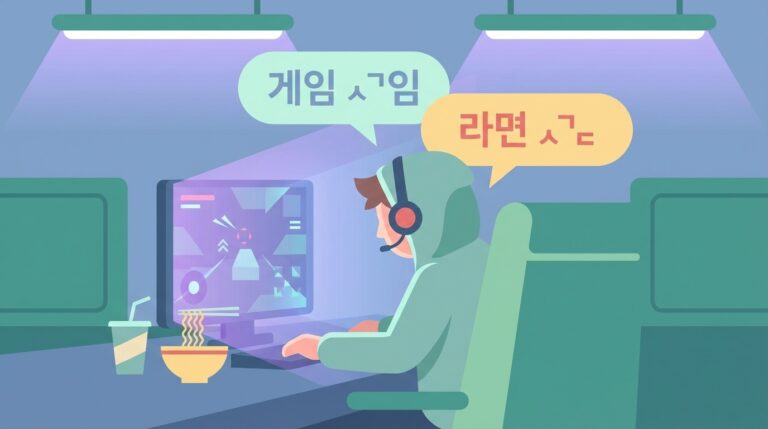
Unit: Surviving the Team Voice Chat in a Korean PC Bang 🎧
Phase 1: The Immersive Hook
Greeting: 안녕하세요! This is your Daily Hangul editor, live from a neon-lit alley in Hongdae.
Imagine this: You are sitting in a comfortable leather chair. To your left, someone is slurping spicy Ramyun (라면). To your right, the sound of mechanical keyboards clicking at light speed fills the air like heavy rain. You put on your headset. You are not just in a room; you are on the digital battlefield with your Korean friends.
Suddenly, your friend screams, “야! 궁 써! 궁!” (Ya! Gung sseo! Gung!).
Panic sets in. Are they talking about a palace (Gung)? Why are we talking about royalty in the middle of a gunfight? If you hesitate, your team loses, and you become the “Troll” of the group. But don’t worry. Today, we’re going to upgrade your Korean from “Textbook Politeness” to “Battle-Hardened Gamer Mode.”
This isn’t just about games. The slang you learn here is the secret code of the younger Korean generation (MZ Generation). Let’s log in.
Phase 2: Deep Dive into Core Expressions
1. 개피 / 딸피 (Gae-pi / Ttal-pi)
- Pronunciation: [Gae-pi] Sounds like ‘Gap’ + ‘Pea’ / [Ttal-pi] Sounds like ‘Tal’ + ‘Pea’
- Meaning:
- Literal: Dog Blood / Daughter’s Blood (Note: The etymology is messy, but in gaming context, it’s harmless).
- Real Nuance: Low HP (Health Points) / “He’s one shot!”
- K-Culture Moment: You know those K-Drama scenes where the hero is beaten up, stumbling, barely walking but still fighting? In gaming terms, that hero is “Gae-pi.”
- Editor’s Insight: The prefix “개(Gae-)” literally means “dog,” but in Korean slang, it acts as an intensifier (like “freaking” or “super”). While Gae-pi is standard, Gen Z has started using “딸피 (Ttal-pi)” more frequently recently. It implies the enemy has so little health, a single touch would eliminate them.
- Situation Spectrum:
[🚫 Boss/Elders] ———— [⚠️ Close Colleagues] ———— [✅ Gamers/Friends] - 🤔 Think About It: Why does Korean slang often use “Dog” (Gae) to intensify things (e.g., Gae-kkul / Honey-funny/Great)? Is there an animal in your language that does the same work?
2. 버스 타다 (Beo-seu Ta-da)
- Pronunciation: [Beo-seu Ta-da] Just like the English ‘Bus’ + ‘Ta-da’
- Meaning:
- Literal: To ride a bus.
- Real Nuance: To get carried. (To win easily because a teammate is extremely good, while you do nothing).
- K-Culture Moment: Think of a K-Pop group where the main vocal hits all the high notes while the visual member just winks at the camera. The winking member is “riding the bus.”
- Editor’s Insight: This is a humble brag or a self-deprecating joke. If you win, you say, “I rode the bus thanks to Min-su.” If you are the one carrying, you are the “Bus Driver” (버스 기사 – Beo-seu Gi-sa).
- Situation Spectrum:
[🚫 Formal Business] ———— [⚠️ Casual Office Chat] ———— [✅ Friends/Gaming]
(Note: You can actually use this in a casual office setting: “Thanks to Manager Kim, I rode the bus on this project.”)
3. 궁 (Gung)
- Pronunciation: [Gung] Sounds like ‘Kung’ in Kung-fu
- Meaning:
- Literal: Palace.
- Real Nuance: Ultimate Ability (Ult). Short for Gung-geuk-gi (궁극기).
- K-Culture Moment: In fantasy K-Dramas, when the protagonist’s eyes turn blue and the CGI budget triples for 10 seconds? That is their Gung.
- Editor’s Insight: Speed is life in Korea (Ppalli-ppalli culture). Nobody has time to say “Ultimate Ability.” Just scream “Gung!”
- Situation Spectrum:
[🚫 Everywhere else] ———— [✅ Gaming/Metaphorical Joking]
Phase 3: Textbook vs. Real Life
| Situation | 📖 Textbook Korean | 🗣️ Real Gamer Korean | 💡 Why the difference? |
|---|---|---|---|
| Asking for help | 도와주세요! (Do-wa-ju-se-yo!) | 백업 좀! / 헬프! (Back-up jom! / Help!) | “Do-wa-ju-se-yo” sounds like you’re drowning in a river. Gamers use Konglish for efficiency. |
| Enemy is missing | 적이 안 보여요. (Jeok-i an bo-yeo-yo.) | 미아! (Mia!) | Derived from “Missing In Action.” It’s faster to say. |
| Apologizing for a mistake | 제 실수입니다. 죄송합니다. (Je sil-su-im-ni-da…) | 아, 까비… / ㅈㅅ (Ah, Kkabi… / J.S.) | “Kkabi” comes from Akkapda (It’s a shame/close). “J.S” is text slang for Joesong (Sorry). |
Bottom Note: If you say “제 실수입니다” in a game, people might think you are being sarcastic or you are an AI bot. Keep it short!
Phase 4: Cultural Deep Dive
4-1. The Art of “Clicking for Food” (PC Bang Gastronomy)
In a Korean PC Bang, you don’t just game; you dine. The computer has a menu button. You click, and 5 minutes later, a part-timer silently places a bowl of Jjapaguri (Ram-don) and an iced Americano next to your mouse. This is the peak of Korean “Untact” (Un-contact) service culture.
4-2. Connection to K-Society: “Carry” Culture
The term “Carry” (캐리하다) has transcended gaming. In Korean society, if one person pays for dinner, plans the whole trip, or does all the work in a group presentation, we say “He carried hard today” (오늘 하드 캐리했어). It reflects the collective nature of Korean society where roles are often strictly divided between leaders (Drivers) and followers (Passengers).
Phase 5: Immersive Roleplay
Setting: A smoky (vape only) PC Bang in Gangnam. Friday night. You are playing League of Legends with your Korean friend, Jun-ho.
Characters:
* YOU: The Support player (trying not to die).
* Jun-ho: The AD Carry (passionate, loud, clicks mouse furiously).
Start Dialogue:
Jun-ho: 야, 들어간다! 나 믿지? 궁 준비해!
(Ya, deureo-ganda! Na mit-ji? Gung jun-bi-hae!)
(Hey, I’m going in! You trust me, right? Get your Ult ready!)
YOU: 알았어! 언제 쓰면 돼?
(Arasseo! Eonje sseumyeon dwae?)
(Okay! When should I use it?)
Jun-ho: 지금! 지금!! 아, 뭐해!!
(Jigeum! Jigeum!! Ah, mwo-hae!!)
(Now! NOW!! Ah, what are you doing!!)
(🎭 Stage Direction: Jun-ho’s character dies on screen. Gray screen.)
🔀 Decision Point: How do you react?
- A) “미안해요, 제가 타이밍을 놓쳤어요.” (Polite apology)
- B) “아 까비! 렉 걸렸어.” (Casual excuse)
- C) “니가 너무 빨리 들어갔잖아!” (Counter-attack)
✅ Best Choice: B) “Ah Kkabi! Lag geol-lyeo-sseo.” (Ah, so close! I had lag.)
* Why: In Korean gaming culture, “Lag” is the universal excuse that preserves everyone’s dignity. It’s not your fault, it’s the internet’s fault.
⚠️ Choice A Analysis: Too formal. It kills the vibe.
⚠️ Choice C Analysis: Only say this if you are really close friends. Otherwise, it starts a real fight.
Phase 6: 10-Second Shadowing Drill
Practice these with the emotion indicated. Don’t be shy!
- 😤 Urgent/Desperate:
살려줘! / 나 / 개피야! / 백업 좀!!
(Sal-lyeo-jwo! / Na / Gae-pi-ya! / Baek-eop jom!!)
(Save me! I’m low HP! Backup please!!) -
😏 Confident/Swag:
걱정 마. / 이 판은 / 내가 / 캐리한다.
(Geok-jeong ma. / I pan-eun / nae-ga / cae-ri-han-da.)
(Don’t worry. This game, I will carry.)
Phase 7: K-Culture Mini Glossary
| Korean | Romanization | Meaning | Context |
|---|---|---|---|
| 현질 | Hyeon-jil | Pay-to-Win / Buying items | Literally “Using cash.” Used when someone buys expensive gear instead of earning it. |
| 막타 | Mak-ta | Last Hit | Taking the final blow to get the gold/credit. |
| 치킨 | Chi-kin | Chicken / Victory | Comes from PUBG “Winner Winner Chicken Dinner.” Used to mean “Let’s win!” |
| 트롤 | Teu-rol | Troll | Someone who intentionally plays badly to annoy the team. |
Phase 8: Traveler’s Survival Kit (PC Bang Edition)
Even if you don’t game, PC Bangs are great for printing documents or resting cheaply during travel.
🆘 Survival Expression #1: Ordering Food
* 🇰🇷 “여기 젓가락이 없어요.” (Yeogi jeot-ga-rak-i eop-seo-yo.)
* 🗣️ Pronunciation: [Yeo-gi jeot-ga-rak-ee op-so-yo]
* Meaning: “There are no chopsticks here.”
* 💡 Pro Tip: Usually, cutlery is in a drawer under your keyboard tray. Check there before asking!📌 Editor’s Travel Note
* Login: As a foreigner, you might not have a Korean phone number for verification. Look for the “Non-Member” (비회원) button on the login screen, or ask the staff: “Woegugin-inde, eotteoke haeyo?” (I’m a foreigner, how do I do this?)
Phase 9: Think Deeper — Language & Aggression
🧠 Think Deeper: Why is gaming language so aggressive?
Korean gaming terms often sound aggressive (kill, smash, dog-blood), but ironically, this aggression creates a tighter bond. In a high-context culture like Korea, where politeness is mandatory in daily life, the PC Bang serves as a “safe space for rebellion.” Here, you drop the honorifics (Jondaemal), scream at your Hyung (older brother), and release stress (Han). It’s not disrespect; it’s a temporary suspension of social hierarchy for the sake of victory.
💬 Your Turn: Does your culture have a space where social hierarchies disappear? Is it sports? Drinking? Tell us in the comments!
Phase 10: FAQ & Troubleshooting
Q: Can I use “Ya!” (Hey!) to an older friend in a game?
A: Maybe. If it’s a very intense moment, yes. But immediately after the game ends, switch back to polite language: “Ah, Hyung, that was a good game.” This “switch” is crucial for social survival.
❌ Common Mistake: Calling people “You” (Dangsin / Neo).
✅ Fix: In games, refer to people by their Champion Name or Colors. E.g., “Hey Ashe!” or “Hey Blue!” Using “Neo” (You) can sound aggressive if you aren’t close friends.
Phase 11: Wrap-up & Mission
One-Liner: To survive a Korean PC Bang, remember: Blame the lag, praise the carry, and order the Ramyun.
🎯 Action Mission:
* 🥉 Bronze: Say “Ah, Kkabi!” out loud next time you drop something or make a small mistake.
* 🥈 Silver: Watch a Korean streamer (like Faker) on Twitch/YouTube and count how many times they say “Gae-pi” or “Nice.”
* 🥇 Gold: Go to a PC Bang in Korea, order food via the system, and say “Gamsahamnida” (Thank you) to the staff when they bring it.
K-Culture Mission: Try listening to the song “Super Shy” by NewJeans. Wait, why? Because even in the cutest songs, you’ll hear distinct English pronunciations that match gaming Konglish. Train your ear to hear Korean-English hybrid sounds!
Frequently Asked Questions (FAQ)
Q: What does "개피 / 딸피 (Gae-pi / Ttal-pi)" mean in Korean and how do you pronounce it?
A: In Korean, "개피 / 딸피 (Gae-pi / Ttal-pi)" is pronounced [Gae-pi] and means: Literal: Dog Blood / Daughter's Blood (Note: The etymology is messy, but in gaming context, it's harmless).
Q: What does "버스 타다 (Beo-seu Ta-da)" mean in Korean and how do you pronounce it?
A: In Korean, "버스 타다 (Beo-seu Ta-da)" is pronounced [Beo-seu Ta-da] and means: Literal: To ride a bus.
Q: What does "궁 (Gung)" mean in Korean and how do you pronounce it?
A: In Korean, "궁 (Gung)" is pronounced [Gung] and means: Literal: Palace.







