

Phase 1: The Immersive Hook
👋 안녕하세요! It’s your Daily Hangul Editor.
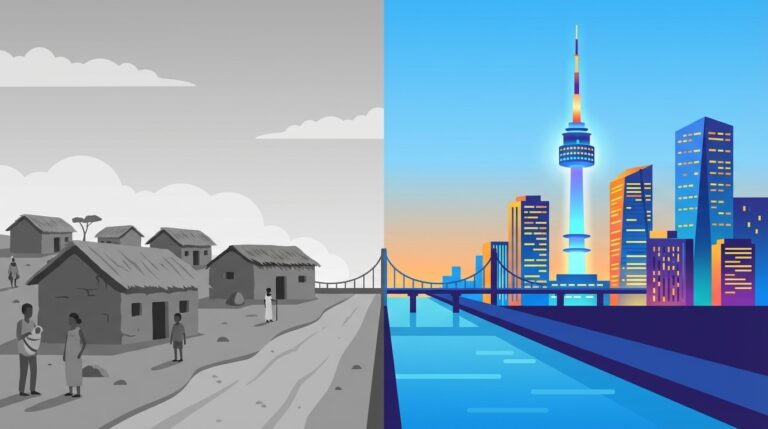
Picture this: You are standing by the Han River (한강) at night. The city lights of Seoul are dazzling, reflected on the water. You see the towering Lotte World Tower, endless bridges, and futuristic apartments. It feels like a scene straight out of a Cyberpunk movie or a glossy K-Drama ending.
Now, hit the rewind button. Go back just 60 or 70 years. What do you see?
Almost nothing. Ashes, makeshift tents, and a river that flooded every summer.
Foreign reporters in the 1950s said, “Expecting democracy (or economic recovery) in Korea is like expecting a rose to bloom in a garbage bin.” Well, look at us now! 🌹
This transformation is what the world calls “The Miracle on the Han River” (한강의 기적). But for us Koreans, it’s not just history; it’s the DNA that makes your delivery food arrive in 20 minutes and makes K-Pop idols practice for 15 hours a day.
Today, we aren’t just learning history dates. We are decoding the Korean mindset—the grit, the speed, and the passion that built modern Korea. Let’s dive into the language of the miracle.
Phase 2: Deep Dive into Key Expressions
1. 빨리빨리 (Pali-pali)
- Pronunciation: [Pali-pali] (Sounds like “Pah-lee Pah-lee”)
- Meaning:
- Literal: Quick, quick!
- Real Nuance: “Efficiency is life.” It’s the cultural heartbeat of modern Korea. It’s why internet speeds are blazing fast and why subway doors close immediately.
- K-Culture Moment: Think of any K-Drama restaurant scene. Customers don’t wait patiently. They raise their hand and shout, “Imo! (Auntie!) Soju, pali-pali please!”
- Editor’s Insight: This isn’t just about speed; it’s about enthusiasm. In the context of the “Miracle on the Han River,” this spirit is what allowed Korea to industrialize in decades instead of centuries.
- Situation Spectrum:
[🚫 Boss/Elders] ———— [⚠️ Service Workers] ———— [✅ Friends/Self]
(Note: Be careful using this to people serving you; it can sound rude if you are demanding. It’s often used to describe a situation or urge oneself.) - 🤔 Think About It: Does “fast” always mean “good”? How does this pali-pali culture affect the stress levels of modern Koreans?
2. 맨땅에 헤딩 (Maen-ttang-e he-ding)
- Pronunciation: [Maen-ttang-e he-ding] (Imagine heading a soccer ball… but into “bare ground”)
- Meaning:
- Literal: Heading (a soccer ball) into the bare ground.
- Real Nuance: Starting from scratch with zero resources but sheer guts. Trying something impossible and making it work.
- K-Culture Moment: Every K-Pop group from a small agency that made it big (like BTS in the early days) embodies this spirit. Also, the founders of companies like Hyundai or Samsung often use this phrase to describe their early days.
- Editor’s Insight: This is the perfect B2 idiom to describe Korean history. We had no natural resources, no money—just people. We did a “heading into the bare ground.”
- Situation Spectrum:
[🚫 Formal Report] ———— [⚠️ Colleagues] ———— [✅ Casual/Storytelling]
3. 격세지감 (Gyeok-se-ji-gam)
- Pronunciation: [Gyeok-se-ji-gam]
- Meaning:
- Literal: Feeling separated by a generation.
- Real Nuance: “How times have changed!” Used when the change is so drastic it feels like a different world.
- K-Culture Moment: In time-slip dramas like Tunnel or Signal, when a character from the past sees a smartphone, they feel Gyeok-se-ji-gam.
- Editor’s Insight: A very sophisticated B2/C1 idiom. Use this when you look at old photos of Gangnam (which was farmland in the 70s) versus today. Your Korean friends will be shocked you know this word!
- Situation Spectrum:
[🚫 Kids] ———— [⚠️ Friends] ———— [✅ Writing/Formal Speech]
Phase 3: Textbook vs. Real Life
| Situation | 📖 Textbook Korean | 🗣️ Real Korean (The “Vibe”) | 💡 Why different? |
|---|---|---|---|
| Describing hard work | 열심히 했습니다. (I worked hard.) | 피땀 눈물을 흘렸어. (I shed blood, sweat, and tears.) | Koreans love dramatic, emotional emphasis on effort. (Yes, like the BTS song!) |
| Expressing surprise at change | 많이 변했네요. (It changed a lot.) | 완전 딴세상이네! (It’s completely another world!) | “Changed a lot” is too mild for the explosive growth Korea experienced. |
| Doing something quickly | 서둘러 주세요. (Please hurry.) | 후딱 해치우자! (Let’s finish it whoosh!) | Huttak is an onomatopoeia for doing something in a flash. Very common in workplaces. |
Bottom Note: slang like “후딱” (Huttak) is great with friends or close colleagues, but stick to “서둘러 주세요” with your boss!
Phase 4: Cultural Deep Dive — The Cost of the Miracle
4-1. The “K-Office” Context (K-Drama Connection)
Have you seen the drama “Misaeng (Incomplete Life)”? It perfectly portrays the legacy of the Miracle on the Han River in the office.
– The Grind: The intense overtime culture (야근 – yageun) comes from the era where working long hours was a patriotic duty to rebuild the nation.
– The Hierarchy: The military-style top-down culture in companies is a remnant of the rapid industrialization period.
4-2. Non-verbal: The “Coffee Mix” Ritual
Instant coffee (Mix Coffee) is the fuel of the Korean economy. In the 80s and 90s, workers didn’t have time to brew espresso. They needed sugar and caffeine fast.
– Real Life Tip: If you visit a Korean office or even a construction site, you might be offered a small cup of super sweet instant coffee. Accepting it is a sign of sharing the “hustle.”
Phase 5: Immersive Roleplay Scenario
Setting: Friday night, inside a Taxi driving along the Han River. You are looking out the window.
Characters:
– YOU: A foreign student fascinated by the view.
– Driver (기사님): A man in his 60s who has lived in Seoul all his life.
Dialogue:
기사님: (Looking at the view) 학생, 저기 저 아파트들 보이죠? 옛날엔 저기 다 논밭이었어요.
(Hak-saeng, jeogi jeo apateu-deul boijyo? Yennal-en jeogi da nonbat-ieosseoyo.)
“Student, you see those apartments? In the old days, that was all rice paddies.”
YOU: (Using the idiom learned)
🔀 Your Turn! How do you respond?
- A) 네, 정말 많이 변했네요. (Yes, it changed a lot.)
- B) 와, 진짜 격세지감이 느껴지시겠어요! (Wow, you must really feel how times have changed!)
- C) 빨리빨리 만들었네요. (They built it pali-pali.)
✅ Best Choice: B
Why? Using 격세지감 (Gyeok-se-ji-gam) here shows deep empathy for his generation’s experience. He will likely treat you like a grandchild and tell you amazing stories.
⚠️ Choice C Analysis: While true, saying “they built it pali-pali” might sound like you are criticizing the construction quality.
기사님: 허허, 한국말 진짜 잘하네! 맞아요. 우리 때는 진짜 맨땅에 헤딩하면서 살았지.
(Heo-heo, you speak Korean well! Right. In our time, we really lived by heading into the bare ground.)
Phase 6: 10-Second Shadowing Drill
Let’s practice the sentence you would use while looking at the Seoul skyline.
Emotion: Awe & Respect (😯)
“이 아름다운 야경은 / 피땀 눈물로 / 만들어진 거예요.”
(I-areum-daun ya-gyeong-eun / pi-ttam nunmul-ro / mandeul-eo-jin geoyeyo.)
Meaning: This beautiful night view / was made with / blood, sweat, and tears.
Phase 7: K-Culture Mini Glossary
| Korean | Romanization | Context |
|---|---|---|
| 한강의 기적 | Hangang-ui Gijeok | The Miracle on the Han River. Refers to Korea’s economic growth from the 1950s to the 1990s. |
| 재벌 | Chaebol | Large family-owned business conglomerates (Samsung, Hyundai, etc.) that drove the economy. |
| IMF | I-em-epeu | Refers to the 1997 Asian Financial Crisis. A traumatic turning point that ended the high-growth era. |
| 야근 | Yageun | Overtime work. A byproduct of the rapid growth era’s work ethic. |
Phase 8: Traveler’s Survival Kit (The Fruit of Growth)
Because of this rapid growth, Seoul has one of the world’s best transportation systems. Don’t get lost in the “Miracle”!
🆘 Survival Phrases for Transport
1. “T-money 카드 어디서 사요?” (Where can I buy a T-money card?)
– Essential for subways, buses, and taxis.
2. “강남역으로 가주세요.” (Please go to Gangnam Station.)
– Used in Taxis.
3. “환승입니다!” (Transfer!)
– Not a phrase you say, but one you HEAR from the machine when transferring buses. It means you aren’t charged extra!📌 Editor’s Pro Tip:
The subway Wi-Fi in Seoul is faster than home Wi-Fi in many countries. This is the Pali-pali spirit in technology. Use the Naver Map or KakaoMap apps; Google Maps is often outdated here due to security laws!
Phase 9: Think Deeper — “Why so intense?”
🧠 The Cost of Speed
The “Miracle on the Han River” explains why modern Korea feels so intense and competitive. The generation that built the country from nothing believes in “Hard work = Success.”
However, the younger generation (Gen Z) often calls Korea “Hell Joseon” because the competition is too fierce. When you see Koreans studying until midnight or rushing in the subway, remember: it’s not just personality; it’s the lingering shadow of a desperate history to survive and thrive.
💬 Your Turn: In your country, is “doing things fast” considered a virtue, or is “taking it slow” preferred? Tell me in the comments!
Phase 10: FAQ & Troubleshooting
Q: Can I use “Pali-pali” to a waiter if my food is late?
A: NO! 🙅♂️ While Koreans love speed, saying “Pali-pali” to a server is considered very rude (gapjil). Instead, just raise your hand and say “저기요~ (Excuse me)” politely. They are already rushing!
Q: Is it okay to talk about the Korean War?
A: Generally, yes, but be respectful. For older people, it’s a real memory, not a history lesson. Listening is better than asking probing questions.
❌ Common Mistake: Thinking all old buildings in Seoul are “ancient.”
✅ Correction: Because of the war, most “old-looking” buildings are actually from the 70s or 80s. Real ancient architecture (Joseon Dynasty) is preserved in palaces.
Phase 11: Wrap-up & Action Mission
📝 One-Liner Summary:
Modern Korea’s speed and intensity come from the desperate, miraculous history of rebuilding a nation from ashes—remember “Pali-pali” and “Maen-ttang-e he-ding”!
🚀 Action Missions:
– 🥉 Bronze: Stand in front of a mirror and say “격세지감!” with a surprised face.
– 🥈 Silver: Search “Seoul 1960 vs Now” on Google Images. Post the link in a Korean learner group with the caption: “This is the real 한강의 기적!”
– 🥇 Gold: Next time you are in a rush, mentally tell yourself, “Okay, let’s do this Pali-pali!” (But don’t say it to others!)
Phase 12: Quiz — Do you have Nunchi?
1. Which reaction is best when an elder tells you about how poor Korea used to be?
– A) “That sounds boring.”
– B) “Wow, Gyeok-se-ji-gam! It must be amazing to see the change.”
– C) “So, do you like K-Pop?”
2. True or False?
– You should shout “Pali-pali!” at the restaurant owner to show you know Korean culture.
– (Answer: False! That’s rude!)
(Answer Key: 1-B, 2-False)
Frequently Asked Questions (FAQ)
Q: What does "빨리빨리 (Pali-pali)" mean in Korean and how do you pronounce it?
A: In Korean, "빨리빨리 (Pali-pali)" is pronounced [Pali-pali] and means: Literal: Quick, quick!
Q: What does "맨땅에 헤딩 (Maen-ttang-e he-ding)" mean in Korean and how do you pronounce it?
A: In Korean, "맨땅에 헤딩 (Maen-ttang-e he-ding)" is pronounced [Maen-ttang-e he-ding] and means: Literal: Heading (a soccer ball) into the bare ground.
Q: What does "격세지감 (Gyeok-se-ji-gam)" mean in Korean and how do you pronounce it?
A: In Korean, "격세지감 (Gyeok-se-ji-gam)" is pronounced [Gyeok-se-ji-gam] and means: Literal: Feeling separated by a generation.







