

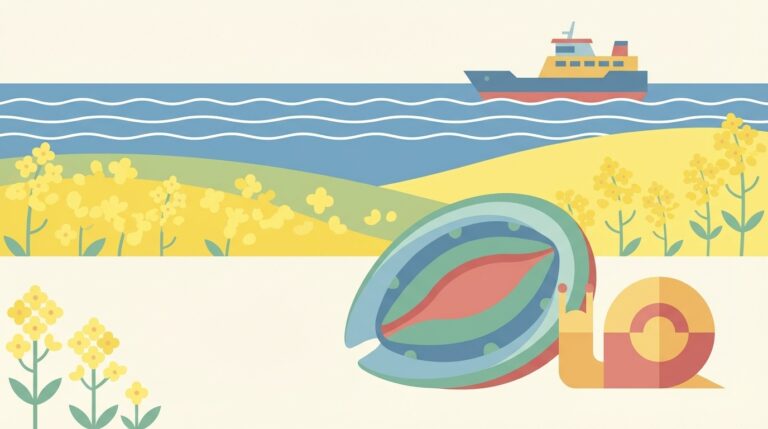
Escape the City Rush: Wando Abalone & The Art of “Slow” in Korea
Phase 1: Immersive Hook — The CEO’s Porridge
Greeting: 안녕하세요! This is your Daily Hangul Chief Editor.
Picture this: You’re watching a intense K-Drama. The main character, a chaebol CEO, collapses from overwork (a classic trope, right?). He wakes up in a hospital VIP room, and what does his concerned mother bring him? Not a burger, not a salad. It’s Jeonbok-juk (Abalone Porridge).
In the Korean psyche, Wando (완도) is synonymous with this “Emperor’s food.” But just a ferry ride away lies Cheongsando (청산도), the first designated “Slow City” in Asia. It is the absolute antithesis of Seoul’s ppalli-ppalli (hurry, hurry) culture.
Today, at a C1 Advanced Level, we aren’t just learning how to order food. We are going to explore the language of “Healing” (힐링) and “Vitality” (원기). If you can master these expressions, Koreans won’t just think you speak good Korean; they’ll think you understand the Korean soul.
Let’s slow down and dive in.
Phase 2: Deep Dive — Advanced Expressions
1. 몸보신하다 (Mombosin-hada)
- Pronunciation: [Mombosin-hada] Sounds like ‘Mom-bow-seen-hada’
- Meaning: To nourish the body / To eat restorative food for health.
- Context: Literally “body protection.” You don’t just eat Wando abalone; you do mombosin.
- K-Culture Moment: In variety shows like Running Man or I Live Alone, when the cast goes to a seaside town, the captions always scream “제대로 몸보신!” (Proper energy restoration!).
- Editor’s Insight: This is a step above “healthy food.” It implies restoring energy drained by society. Use this when you treat a Korean friend to something nutritious.
- Situation Spectrum:
[🚫 Formal Report] ———— [⚠️ Semi-Formal] ———— [✅ Casual/Social]
(Perfect for dining scenarios with colleagues or friends, less for boardroom presentations.)- 🤔 Think About It: Why does Korean culture obsess over “stamina” foods? Does this reflect the high-stress, high-fatigue nature of modern Korean society?
2. 여유를 만끽하다 (Yeoyu-reul mankkik-hada)
- Pronunciation: [Yeoyu-reul mankkik-hada]
- Meaning: To fully enjoy/savor the leisure/relaxed atmosphere.
- Context: Cheongsando is famous for its yellow canola flowers and stone walls. You don’t just “walk” there; you “savor the leisure.”
- K-Drama Note: Think of the ending scenes in healing dramas like Our Blues or Hometown Cha-Cha-Cha, where characters finally stop running and look at the sea.
- Editor’s Insight: Mankkik (만끽) is a high-level verb meaning to enjoy to the fullest limit. Combining it with Yeoyu (leisure/mental space) makes you sound incredibly sophisticated.
- Situation Spectrum:
[🚫 Slang] ———— [⚠️ Casual] ———— [✅ Literature/Descriptive]
(Great for travel journals, blogs, or describing your trip to a superior.)3. 탁 트이다 (Tak teu-ida)
- Pronunciation: [Tak teu-ida] ‘Tak’ is a popping sound
- Meaning: To be wide open / unobstructed (referring to a view or feeling).
- Context: Standing at the Wando Tower or walking the Cheongsando trails, looking at the horizon.
- Editor’s Insight: This isn’t just about eyesight; it’s about emotional release. When your stress is unblocked by a view, you say “가슴이 탁 트인다” (My chest feels wide open/unblocked).
Phase 3: Textbook vs. Real Life
| Situation | 📖 Textbook Korean | 🗣️ Real Korean (Insider) | 💡 Why the difference? |
|---|---|---|---|
| Looking at the sea | 경치가 아주 아름답습니다. (The scenery is very beautiful.) |
와, 물멍 때리기 딱이다. (Wow, perfect for spacing out at the water.) |
“Mul-meong” (Water-spacing out) is a massive trend. We value the act of doing nothing over just describing beauty. |
| Eating fresh abalone | 전복이 정말 신선해요. (The abalone is very fresh.) |
입에서 살살 녹네, 녹아! (It just melts in my mouth, seriously!) |
Koreans emphasize the texture and the physical reaction to the food. |
| Walking slowly | 천천히 걷고 싶어요. (I want to walk slowly.) |
유유자적하게 걷고 싶어. (I want to walk in a leisurely, carefree manner.) |
Yuyujajeok (유유자적) is a Hanja idiom that perfectly captures the “Slow City” vibe. |
Bottom Note: At C1 level, using idioms like “sal-sal nokne” (melts softly) makes you sound native. Avoid robotic adjectives like “delicious” or “fresh.”
Phase 4: Cultural Context — The “Ppalli-Ppalli” Paradox
4-1. Non-verbal: The Art of “Ssam” (Wrap)
When eating abalone (grilled) or sashimi in Wando, you might use lettuce or sesame leaves. The Golden Rule: If you make a wrap (ssam) for someone else, it signifies intimacy. But be careful—don’t make it too big, or they will struggle to eat it in one bite (which is the only polite way to eat a ssam). In a business setting? Stick to eating your own.
4-2. K-Culture Connection: The “Healing” Obsession
Why are islands like Cheongsando and Wando so popular in K-Travel shows?
– The “Healing” (힐링) Trend: Korea is one of the fastest societies on earth. The concept of a “Slow City” isn’t just a tourist slogan; it’s a desperate psychological need.
– K-Drama Trope: Notice how characters often “flee” to the countryside or islands to reset their lives (Welcome to Samdal-ri, Top Star U-back). Using words like “재충전” (recharging) adds depth to your travel description.
Phase 5: Immersive Roleplay — The Seafood Negotiation
Setting: A bustling seafood market near Wando Port. Tanks are full of giant abalones. You are with “Min-ji,” a Korean friend who loves bargaining.
Characters:
– YOU: An abalone enthusiast looking for the best quality.
– Min-ji: Your sharp-witted Korean friend.
– Ajumeoni (Owner): A friendly but tough market vendor.
(Dialogue Start)
Ajumeoni: 아이고, 서울에서 왔능가? 이 전복 좀 봐, 씨알이 굵어!
(Aigo, Seoul-eseo wat-neung-ga? I jeonbok jom bwa, ssial-i gul-geo!)
(Oh my, did you come from Seoul? Look at these abalones, the size is thick/huge!)
Min-ji: 이모님, 이거 양식이죠? 자연산 같은 양식 주세요~
(Imonim, igeo yangsig-ijyo? Jayeonsan gateun yangsik juseyo~)
(Auntie, this is farmed, right? Give us the farmed ones that taste like wild-caught~)
YOU: (Looking at the tank)
우와, 정말 싱싱해 보이네요. 이걸로 **몸보신 제대로 하겠는데요?**
(Uwa, jeongmal singsing-hae boineyo. Igeollo mombosin jedaero hagetneundeyo?)
(Wow, they look really fresh. I’m going to properly restore my energy with this!)
Ajumeoni: (Laughing) 말도 참 이쁘게 하네! 내가 서비스로 멍게 좀 더 줄게.
(Mal-do cham ippeuge hane! Naega service-ro meongge jom deo julge.)
(You speak so beautifully! I’ll give you some sea squirts as ‘service’ [freebie].)
🔀 Decision Point: Min-ji asks how you want to eat them.
Min-ji: 회로 먹을래, 아니면 구이로 할까? (Do you want them raw as sashimi, or grilled?)
- A) “다 좋아요. 알아서 시켜줘.” (I like everything. You order.)
- B) “전복 본연의 맛을 느끼려면 회가 좋지 않을까? 오독오독한 식감이 그립네.”
- C) “버터구이로 해달라고 하자. 초딩 입맛이라…”
✅ Best Choice: B — “Wouldn’t sashimi be best to taste the natural flavor (bon-yeon-ui mat)? I miss that crunchy texture (odok-odok).”
Why? This shows C1 level vocabulary (bon-yeon,odok-odok) and deep appreciation for the ingredient.
Phase 6: 10-Second Shadowing Drill
Context: Walking along the slow trails of Cheongsando, feeling the wind.
🥺 Emotional Tag: Sentimental & Relieved
서울에서는 / 상상도 못 할 / 여유네요.
(Seoul-eseoneun / sangsang-do mot hal / yeoyu-neyo.)“This is a sense of leisure / I couldn’t even imagine / in Seoul.”
Context: Eating the first bite of grilled abalone.
😤 Emotional Tag: Impressed & Energetic
와, 힘이 / 불끈불끈 / 솟는 기분이에요!
(Wa, him-i / bulkkeun-bulkkeun / sotneun gibun-ieyo!)“Wow, I feel like energy / is surging / up intensely!”
Phase 7: K-Culture Mini Dictionary (Wando Edition)
| Korean | Romanization | English | Context |
|---|---|---|---|
| 자연산 | Jayeonsan | Wild-caught | The premium standard. Much more expensive than farmed (양식). |
| 물멍 | Mul-meong | Water-spacing | Staring at water blankly to relax. A popular travel activity. |
| 슬로시티 | Seullo-siti | Slow City | Designated cities focused on traditional life and nature (Cheongsando). |
| 해녀 | Haenyeo | Female Diver | Cultural icons of Korean islands who harvest seafood without equipment. |
| 완도타워 | Wando-tower | Wando Tower | The landmark for the best “Tak teu-in” (open) view. |
Phase 8: Traveler’s Survival Kit (Wando & Cheongsando)
🆘 Survival Expression #1: Ferry Version
– 🇰🇷 “청산도 들어가는 배, 마지막이 몇 시예요?”
– (Cheongsando deureoganeun bae, majimagi myeot siyeyo?)
– Meaning: “What time is the last boat into Cheongsando?”
– ⚠️ Critical: Island ferries are subject to weather. Always check the “Last boat” (Mak-bae).🆘 Survival Expression #2: Motion Sickness
– 🇰🇷 “배 멀미 약 있나요?”
– (Bae meolmi yak innayo?)
– Meaning: “Do you have seasickness medicine?”
– 💡 Pro Tip: Buy this at the terminal pharmacy 30 minutes before boarding. Korean seasickness meds are liquid and very strong!📌 Editor’s Travel Note
– Booking: Ferries can sell out during festivals (April). App: ‘Ga Bogo Want’ (가보고 싶은 섬).
– Transport: Cheongsando has a tour bus, but walking the ‘Slow Road’ (Seulp-ro) is the real experience.
Phase 9: Critical Thinking — “Think Deeper”
Topic: The Commodification of “Slowness”
In a country famous for 5G internet and 24-hour deliveries, “Slow Cities” like Cheongsando have become a marketable product. Does paying for a “slow experience” defeat the purpose of slowness? Or is it the only way to preserve these traditional lifestyles in a capitalist economy?
🧠 Think Deeper:
Korean uses the word ‘힐링 (Healing)’ as a noun almost like a product you buy. “I need to go buy some healing.” How does this reflect the pressure of Korean urban life? In your culture, is resting considered ‘doing something’ or ‘doing nothing’?
Phase 10: FAQ & Troubleshooting
Q: Is it rude to not eat the abalone intestines (Geu-u)?
A: Not rude, but Koreans consider the intestines (green/dark part) the most nutritious part (“The essence of the abalone”). If you eat it, they will exclaim, “You really know how to eat!” If you can’t handle the bitterness, just say “초딩 입맛이라…” (I have a kid’s palate…).
Q: The locals speak with a strong accent. What if I don’t understand?
A: Jeolla-do dialect (Saturi) is warm but tricky. If an elder ends sentences with “~ing” or “~danggga?”, just smile. It’s okay to ask, “죄송하지만 다시 한 번 말씀해 주시겠어요?” (Could you please say that again?). They will appreciate your politeness.
❌ Common Mistake: Asking for “Soy Sauce” with Sashimi immediately.
✅ Fix: In the south, many locals eat sashimi with Chojang (Vinegar Chili Paste) or Makjang (Seasoned Soybean Paste). Try the local style first before asking for soy sauce!
Phase 11: Wrap-up & Action Mission
One-Liner: Wando is for Mombosin (Body repair), and Cheongsando is for Mankkik (Savoring leisure).
🚀 Action Missions:
– 🥉 Bronze: Stand in front of a mirror, take a deep breath, and say “아, 가슴이 탁 트인다!” with a relieved expression.
– 🥈 Silver: Post a photo of nature or healthy food on social media with the caption: “오늘은 여유를 만끽하는 중. 제대로 몸보신! #Healing”.
– 🥇 Gold: Go to a Korean seafood restaurant in your city. Ask if the seafood is “Jayeonsan” (wild) or “Yangsik” (farmed). Watch the owner’s surprised face!
💬 Your Turn: Have you ever traveled specifically to “heal”? Where did you go? Tell me in the comments!
Phase 12: Interactive Quiz
- Situation Judgment: You are walking on a beautiful trail in Cheongsando. Your Korean friend asks how it is. Which response is awkward?
- A) “경치가 탁 트여서 정말 시원해.”
- B) “여유를 만끽하기 딱 좋은 곳이야.”
- C) “사람이 너무 없어서 심심해. 빨리 가자.”
- Answer: C. Cheongsando is a Slow City. complaining about boredom misses the cultural point of the location.
- True or False: When eating a ‘Ssam’ (Wrap) given by a friend, you should bite it in half.
- Answer: False! Breaking a Ssam is considered bad luck (breaking the luck wrapped inside) and messy. Eat it in one bite!
Frequently Asked Questions (FAQ)
Q: What does "몸보신하다 (Mombosin-hada)" mean in Korean and how do you pronounce it?
A: In Korean, "몸보신하다 (Mombosin-hada)" is pronounced [Mombosin-hada] and means: To nourish the body / To eat restorative food for health.
Q: What does "여유를 만끽하다 (Yeoyu-reul mankkik-hada)" mean in Korean and how do you pronounce it?
A: In Korean, "여유를 만끽하다 (Yeoyu-reul mankkik-hada)" is pronounced [Yeoyu-reul mankkik-hada] and means: To fully enjoy/savor the leisure/relaxed atmosphere.
Q: What does "탁 트이다 (Tak teu-ida)" mean in Korean and how do you pronounce it?
A: In Korean, "탁 트이다 (Tak teu-ida)" is pronounced [Tak teu-ida] and means: To be wide open / unobstructed (referring to a view or feeling).







