

Phase 1: Immersive Hook
Hello! This is your Daily Hangul Editor.
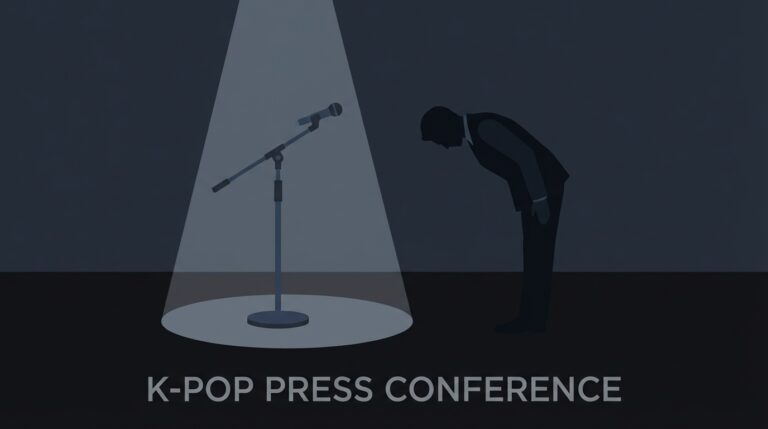
Picture this scenario, one you’ve likely seen in the news or a K-Drama: A celebrity, once the darling of the nation, stands in front of a wall of flashing cameras. They are wearing a somber black suit, no makeup, and their hair is tied back neatly. The room is silent. They slowly lower their head into a deep, 90-degree bow that lasts just a few seconds too long.
They aren’t just saying “sorry.” They are performing a ritual of social redemption.
In the world of K-Entertainment, the “School Violence Me Too” (학폭 미투) movement has been a seismic shifter. It ends careers overnight and demands a very specific, culturally coded path to forgiveness. But when is it okay for them to come back? How do Koreans decide if an apology is “real”?
Today, we aren’t just learning words; we are dissecting the language of accountability in Korea. To understand this is to understand the incredibly high moral standards—and the severe scrutiny—placed on public figures in Korean society.
Phase 2: Deep Dive — The Vocabulary of Controversy
1. 자숙하다 (Jasuk-hada)
- Pronunciation: [Ja-suk-ha-da] (Think of ‘Ja’ as in ‘Jar’, ‘suk’ like ‘soook’ but shorter)
- Meaning: To self-reflect; to stay low and live quietly in repentance.
- Nuance: This is distinct from ‘resting’ or ‘taking a break.’ It implies a self-imposed exile to reflect on one’s wrongdoings. In the entertainment industry, this is the mandatory period of silence after a scandal.
- K-Culture Moment: When an actor steps down from a drama mid-season due to a scandal, the agency releases a statement: “The actor will halt all activities and 자숙하다 (enter a period of self-reflection).”
- Situation Spectrum:
[🚫 Casual Chat] ———— [⚠️ Serious Discussion] ———— [✅ Formal/News]- Used when discussing serious errors, crimes, or moral failings.
- 🤔 Think About It: Why does Korean society demand “silence” and “invisibility” as the primary form of apology? How does this compare to Western celebrities who might go on a talk show to explain themselves immediately?
2. 물의를 빚다 (Muri-reul bitda)
- Pronunciation: [Mu-ui-reul bit-da] (The ‘ui’ is tricky; often pronounced like ‘ri’ in flow: ‘Murireul’)
- Meaning: To cause trouble; to give rise to public criticism.
- Nuance: A highly formal, journalistic phrase. ‘물의’ means public criticism or controversy, and ‘빚다’ means to brew or create (like making pottery or dumplings). It suggests the celebrity crafted this messy situation.
- K-Culture Moment: The opening line of every apology letter: “물의를 빚어 죄송합니다.” (I am sorry for causing this public disturbance.)
- Editor’s Insight: You will hear this on the 9 PM news constantly. It shifts the focus from the specific act (e.g., bullying) to the disturbance of social harmony caused by that act.
- Situation Spectrum:
[🚫 Slang] ———— [⚠️ Formal Writing] ———— [✅ News/Official Statements]
3. 진정성 (Jinjeongseong)
- Pronunciation: [Jin-jeong-seong]
- Meaning: Sincerity; authenticity.
- Nuance: This is the currency of forgiveness. The public doesn’t just want an apology; they analyze the 진정성 of it. Is it handwritten? Did they meet the victim? Was the timing calculated?
- K-Culture Moment: Netizens commenting on a return attempt: “사과에 진정성이 안 느껴져요.” (I don’t feel any sincerity in the apology.)
- 🤔 Think About It: Can sincerity truly be measured by the public? In Korea, ‘sincerity’ often follows a specific form (handwritten letters, deep bows). Does following a form prove sincerity, or does it perform it?
Phase 3: Textbook vs. Real Life
| Situation | 📖 Textbook Korean | 🗣️ Real Korean (Netizen/Colloquial) | 💡 Why the difference? |
|---|---|---|---|
| Criticizing a return | 복귀가 너무 빠르다고 생각해요. (I think the return is too fast.) | 아직 나올 때가 아닌 것 같은데? (It doesn’t seem like the time to come out yet?) | Koreans often use indirect questions (“~같은데?”) to express strong disapproval politely but firmly. |
| Doubtful apology | 그 사과는 진심이 아닌 것 같습니다. (That apology does not seem sincere.) | 이미지 세탁하네. (They are laundering their image.) | “Laundering” (세탁) is a cynical metaphor for trying to clean up a dirty reputation artificially. |
| Demanding removal | 그 연예인이 방송에 안 나왔으면 좋겠어요. (I wish that celebrity wouldn’t appear on TV.) | 손절각이다 / 나락 갔다. (It’s time to cut ties / They fell into the abyss.) | Slang like ‘Narak’ (Abyss/Hell) emphasizes the total collapse of a career. |
Phase 4: Cultural Deep Dive — The “Iljin” Trauma
4-1. Why is “School Violence” (Hakpok) unforgivable?
In many Western cultures, school bullying might be dismissed as “kids being kids.” In Korea, it is treated as a severe character flaw. Why? Because the Korean school system is an intense, high-pressure pressure cooker where students spend 12+ hours a day together. The Iljin (일진 – school bully gangs) hierarchy is a shared trauma for many Koreans. When a celebrity who represents “dreams and hopes” is revealed to have been an oppressor, the sense of betrayal is personal.
4-2. The Timing of the Return (Nunchi Game)
Returning from a scandal is the ultimate test of Nunchi. Come back too soon (e.g., within 6 months), and you are labeled “shameless” (뻔뻔하다). Wait too long, and you are forgotten. The public looks for specific signals:
1. Settlement: Has the victim been compensated or appeased?
2. Volunteering: Has the star been doing community service quietly?
3. Humble Role: Are they returning in a flashy role, or a humble, supporting one?
Phase 5: Immersive Roleplay
Setting: A Friday night at a Chicken & Beer (Chimaek) place in Hongdae. The TV is playing a variety show, and a celebrity who was cancelled for bullying 2 years ago suddenly appears as a guest.
Characters:
* YOU: An expat who enjoys K-Entertainment but thinks people deserve second chances.
* Minji (30): Your Korean friend. She is strict about moral standards for celebrities.
Dialogue:
Minji: 헐, 대박. 쟤가 벌써 방송에 나온다고? 진짜 뻔뻔하다.
(Heol, daebak. Jyaega beolsseo bangsong-e naondago? Jinjja ppeonppeonhada.)
(Wow, crazy. He’s appearing on TV already? He’s really shameless.)
YOU: (Looking at the screen) 벌써 2년이나 지났잖아. 자숙 기간은 충분하지 않았어?
(Beolsseo 2-nyeon-ina jinatjana. Jasuk giganeun chungbunhaji anasseo?)
(It’s already been 2 years. Wasn’t the reflection period enough?)
Minji: 시간 문제가 아니지. 피해자한테 제대로 사과도 안 했다던데? 진정성이 없잖아.
(Sigan munjega aniji. Pihaeja-hante jedaero sagwado an haetdadeonde? Jinjeongseong-i eopjana.)
(It’s not a matter of time. I heard he didn’t even apologize properly to the victim. There’s no sincerity.)
🔀 Decision Point! How do you respond?
- A) “그래도 사람은 누구나 실수하잖아.” (But everyone makes mistakes.)
- B) “한국 대중들은 도덕적 기준이 정말 높은 것 같아.” (It seems the Korean public has really high moral standards.)
- C) “재미만 있으면 되는 거 아니야?” (Isn’t it fine as long as they are funny?)
✅ Best Choice: B — This acknowledges the cultural context without dismissing the victim’s pain. It opens a deeper discussion about society.
⚠️ Choice A Analysis: While logical, in the context of Hakpok, calling it a “mistake” can be offensive to Koreans who view it as intentional violence.
🚫 Choice C Analysis: This is a quick way to seem insensitive. In Korea, a celebrity’s character is as important as their talent.
Phase 6: 10-Second Shadowing Drill
Let’s practice a sentence you can use when debating these topics. Focus on the skeptical tone.
“Apologizing only after the controversy broke out… isn’t that just for show?”
🇰🇷 논란이 터지고 나서야 / 사과하는 건 / 보여주기식 아니에요?
(Nollani teojigo naseoya / sagwahaneun geon / boyeojugisik anieyo?)
- Emotion: 🤨 Skeptical & Sharp
- Key Pronunciation: ‘터지고 나서야’ (Stress the ‘ya’ to emphasize “only after”). ‘보여주기식’ (Show-off style/Performative).
Phase 7: K-Culture Mini Glossary
| Korean | Romanization | English | Context |
|---|---|---|---|
| 학폭 (학교폭력) | Hakpok | School Violence | The specific term for bullying/violence in schools. A career-ender. |
| 일진 | Iljin | School Gang/Bully | The term for the “cool kids” who bully others. Being labeled an ‘Iljin’ is a permanent stain. |
| 하차하다 | Hacha-hada | To step down | To leave a TV program or drama due to a scandal. |
| 복귀 | Bokgui | Return/Comeback | Returning to the industry after a hiatus/scandal. |
| 마녀사냥 | Manyeo-sanyang | Witch Hunt | When public criticism becomes excessive and mob-like without facts. |
Phase 8: Traveler’s Survival Kit (The “Apology” Edition)
While you aren’t a celebrity, understanding how to handle mistakes in Korea is crucial for travel. If you make a social blunder (e.g., wearing shoes inside, sitting in the elderly seat):
🆘 Survival Expressions
1. “잘 몰라서 실수를 했습니다. 죄송합니다.” (I made a mistake because I didn’t know better. I am sorry.)
* Why it works: Admitting ignorance (“I didn’t know”) is a valid plea for foreigners, but you must pair it with “mistake” (실수).
2. “제가 주의하겠습니다.” (I will be careful/pay attention.)
* Why it works: Koreans value the promise of future correction more than the feeling of guilt.
📌 Editor’s Note: If you see a protest truck (trucks with LED screens blasting complaints) near entertainment agencies in Gangnam or Mapo-gu, you are witnessing K-Pop fan activism in real-time. This is how fans demand “feedback” or “apologies” from companies!
Phase 9: Think Deeper — Media vs. Reality
The Paradox of Moral Perfection
K-Pop idols and actors are often marketed as “products of perfection”—morally pure, polite, and innocent. This marketing strategy creates a dangerous double-edged sword. When a “perfect” idol is revealed to have a flawed past (like being a bully), the illusion shatters, and the public reaction is not just disappointment, but consumer rage. They feel they were sold a defective product.
🧠 Think Deeper: In your country, are celebrities expected to be moral role models? Or do you separate the art from the artist? How does this affect “Cancel Culture” in your region compared to Korea?
Phase 10: FAQ & Troubleshooting
Q: Can I ask my Korean friends about a specific celebrity’s scandal?
A: Yes, but read the room. Most Koreans love gossiping about entertainment news. However, avoid defending the celebrity too aggressively if your friend is critical. The sentiment is usually “Punish the wrongdoer,” and defending them might make you look like you support bullying.
Q: Why do they apologize for dating?
A: This is changing, but traditionally, idols selling the “boyfriend/girlfriend fantasy” are seen as breaking a business contract with fans when they date. It’s less about morality and more about “business ethics” in the idol industry context.
❌ Common Mistake: Using “미안해 (Mianhae)” to a superior or in a formal setting.
✅ Fix: Always use “죄송합니다 (Joesong-hamnida)”. “Mianhae” is strictly for friends/close peers. In a scandal context, a celebrity would NEVER say “Mianhae” to the public.
Phase 11: Wrap-up & Action Mission
Today’s Summary: We learned that in Korea, an apology requires time (자숙), formality (물의를 빚다), and authenticity (진정성) to be accepted.
Your Mission:
* 🥉 Bronze: Look in the mirror and practice the “Skeptical Shadowing” sentence.
* 🥈 Silver: Go to a K-Pop news site (like Soompi or Allkpop), find an article about an apology, and look for the Korean source words: “자숙,” “사과문 (Apology letter).”
* 🥇 Gold: Ask a Korean friend, “Do you think [Celebrity Name] should return to TV?” and listen to their reasoning using today’s keywords.
💬 Editor’s Question: Who is a celebrity in your country that made a successful comeback after a scandal? What did they do to earn forgiveness? Let me know in the comments!
Phase 12: Quiz — The “Nunchi” Test
1. Situational Judgment:
A celebrity was caught drunk driving yesterday. Today, they uploaded a selfie on Instagram smiling. What will the public say?
* A) “Wow, positive vibes!” (긍정적이네요!)
* B) “They are really reflecting hard.” (정말 자숙하고 있군요.)
* C) “They have no sincerity and are shameless.” (진정성이 없고 뻔뻔하네.)
2. True or False:
“자숙하다” means to go on a vacation to Hawaii to relax after a hard drama shoot.
3. Vocabulary Match:
Which word implies a “public disturbance” or “controversy”?
* [ ] 진정성
* [ ] 물의
* [ ] 복귀
(Answers: 1. C, 2. False – it means penitence/reflection, 3. 물의)
Frequently Asked Questions (FAQ)
Q: What does "자숙하다 (Jasuk-hada)" mean in Korean and how do you pronounce it?
A: In Korean, "자숙하다 (Jasuk-hada)" is pronounced [Ja-suk-ha-da] and means: To self-reflect; to stay low and live quietly in repentance.
Q: What does "물의를 빚다 (Muri-reul bitda)" mean in Korean and how do you pronounce it?
A: In Korean, "물의를 빚다 (Muri-reul bitda)" is pronounced [Mu-ui-reul bit-da] and means: To cause trouble; to give rise to public criticism.
Q: What does "진정성 (Jinjeongseong)" mean in Korean and how do you pronounce it?
A: In Korean, "진정성 (Jinjeongseong)" is pronounced [Jin-jeong-seong] and means: Sincerity; authenticity.






