

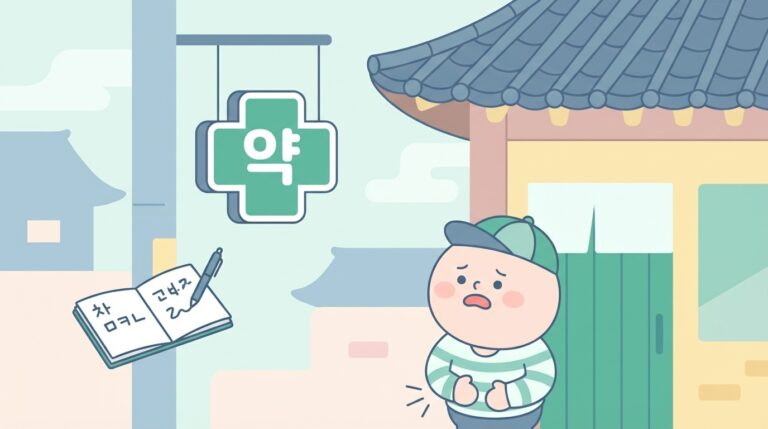
Phase 1: The “Fire Noodle” Aftermath — An Immersive Hook
Greeting:
안녕하세요! (Hello!) This is your Daily Hangul Editor, writing to you from a cafe in Seoul where I just saw a tourist running desperately for the bathroom.
The Scene:
Imagine this. You just arrived in Korea. You watched your favorite K-Pop idol eat that bright red Buldak (Fire Chicken) ramen, and you thought, “I can handle spice!” Fast forward 30 minutes. You are walking down the street in Myeongdong. Your forehead is sweating. Your stomach is making sounds like a dubstep remix.
In K-Dramas, when the lead character gets sick, a handsome doctor appears instantly. In reality? You need to find a pharmacy (Yakguk) or a bathroom, and you need to do it fast.
The ‘Why’:
If you can’t express pain, a small stomachache can turn into a nightmare trip. But if you know just three magic phrases, the pharmacist will become your savior, handing you a magical brown drink that fixes everything.
Transparency:
This guide is based on real panic moments from my students who underestimated the power of Korean chili paste (Gochujang)!
Phase 2: Deep Dive — Essential Survival Phrases
Here are the absolute essentials for when your tummy is in trouble.
1. 배가 아파요 (My stomach hurts)
- Pronunciation: [Bae-ga a-pa-yo]
- Bae sounds like ‘Bay’ area.
- a-pa sounds like ‘Upp-er’ without the ‘r’.
- Meaning:
- Literal: Stomach is painful.
- Real Nuance: I have a stomachache / I need medicine / I might need a bathroom.
- K-Culture Moment: In variety shows like Running Man, when members laugh too hard, they grab their bellies and shout “Ah, 배 아파!” (Ah, my stomach hurts from laughing!). But with a sad face, it means real pain.
- Editor’s Insight: This is the universal SOS signal. Use it for indigestion, diarrhea, or menstrual cramps.
- Situation Spectrum:
[🚫 Formal Speech] ———— [✅ Semi-formal (yo)] ———— [✅ Casual (no yo)]
- Use “-yo” with the pharmacist or strangers.
- 🤔 Think About It: Koreans use “Bae” (stomach) to describe many emotions. Why do you think the stomach is considered the center of feeling in Korean culture? (Hint: We even say “My stomach hurts” when we are jealous of someone!)
2. 약국 어디예요? (Where is the pharmacy?)
- Pronunciation: [Yak-guk eo-di-ye-yo?]
- Yak sounds like ‘Yak’ (the animal).
- Guk sounds like ‘Cook’ with a ‘G’.
- Meaning: Where is the pharmacy?
- K-Culture Moment: You will see signs with a big red “약” (Yak) everywhere in Korea. It’s iconic, appearing in almost every street scene in K-Dramas.
- Editor’s Insight: Korean pharmacies are amazing. You don’t always need a prescription for simple stomach meds. You walk in, describe the pain, and they give you a cocktail of pills and a drink.
- Situation Spectrum: Essential for asking passersby.
Phase 3: Textbook vs. Real Life — The K-Survival Edition
| Situation | 📖 Textbook Korean | 🗣️ Real Korean | 💡 Why is it different? |
|---|---|---|---|
| Describing Pain | 복통이 있습니다. (I have abdominal pain.) | 배가 너무 아파요. (My stomach hurts SO much.) | “Bogtong” is a medical term used by doctors. “Bae” is what you use in real life. |
| Asking for Meds | 소화제를 주시겠습니까? (Could you give me digestive medicine?) | 소화제 주세요. (Digestive medicine, please.) | Efficiency! “Juseyo” (Please give) is the magic word for shopping and ordering. |
| Urgency | 화장실은 어디에 있습니까? (Where is the toilet located?) | 화장실…! (Bathroom…!) | When you are about to explode, you don’t need grammar. You need speed. |
Phase 4: Cultural Deep Dive — The Magic of “Yak-guk”
4-1. Non-verbal: The Hand Rub
If you tell an older Korean person “Baega apayo,” they might offer to rub your stomach in a circular motion. This is called “Yak-son” (Medicinal Hand). It’s a childhood memory for every Korean—mom’s hand is medicine. Don’t be alarmed; it’s an act of care!
4-2. K-Food Connection: The “Hwalmyeongsu” Cult
If you go to a pharmacy for a stomachache, 90% of the time, they will give you a small glass bottle of brown liquid called Hwalmyeongsu (or similar brands).
– What is it? It’s a carbonated herbal digestive drink.
– Taste: Like minty, herbal cola without the sugar.
– K-Drama Trope: The protagonist overeats from stress -> The love interest buys them this bottle -> Romance blooms.
Phase 5: Immersive Roleplay — At the Pharmacy
Setting:
It’s 2:00 PM in Hongdae. You ate too much spicy Tteokbokki. You spot the “약” sign. You walk into the small, clean pharmacy. An Ajumma (middle-aged woman) pharmacist in a white coat looks at you.
Characters:
– YOU: A tourist holding your stomach.
– Pharmacist: Helpful, quick, professional.
The Dialogue:
Pharmacist: 어서 오세요. 어디가 아프세요?
(Eoseo oseyo. Eodiga apeuseyo?)
(Welcome. Where does it hurt?)
YOU: 😣 안녕하세요. 배가 아파요.
(Annyeonghaseyo. Baega apayo.)
(Hello. My stomach hurts.)
Pharmacist: 무엇을 드셨어요?
(Mueoseul deusyeosseoyo?)
(What did you eat?)
YOU: 매운 음식… 떡볶이요.
(Mae-un eumsik… Tteokbokki-yo.)
(Spicy food… Tteokbokki.)
Pharmacist: 아이고. 여기 약 있어요.
(Aigo. Yeogi yak isseoyo.)
(Oh dear. Here is medicine.)
🔀 Decision Point: The Pharmacist hands you a bottle.
Option A: “감사합니다.” (Take it and leave.)
Option B: “지금 마셔요?” (Drink it now?)✅ Best Choice: Option B!
Why? Often, pharmacists will open the bottle for you to drink right there. It saves trash and gives immediate relief.
Phrase: 지금 마셔요? (Ji-geum ma-shyeo-yo?)
Phase 6: 10-Second Shadowing Drill
Practice this before you eat that spicy noodle cup!
😢 Emotion: Painful, pleading, urgent.
배가 / 너~~~무 / 아파요!
(Bae-ga / neo~~~mu / a-pa-yo!)
My stomach / hurts / soooo much!
Phase 7: K-Culture Mini Glossary
| Korean | Romanization | English | Context |
|---|---|---|---|
| 약 | Yak | Medicine | Look for this character on signs! |
| 약국 | Yak-guk | Pharmacy | Where you buy meds. |
| 소화제 | So-hwa-je | Digestive Meds | The #1 seller for travelers. |
| 매워요 | Mae-wo-yo | It’s spicy | The cause of your stomachache. |
| 화장실 | Hwa-jang-sil | Bathroom | The most important room. |
Phase 8: Traveler’s Survival Kit — The “Emergency” Edition
When your stomach hurts, you need a toilet, not a history lesson. Here is your survival card.
🆘 SOS Survival Expression
– 🇰🇷 화장실 어디예요? (Hwa-jang-sil eo-di-ye-yo?)
– 🗣️ Sound like: Hwa-jang-shill, Uh-dee-yay-yo?
– 📍 Where to use: Restaurants, Cafes, Subway stations.
– 💡 Pro Tip: In Korea, subway station bathrooms are usually free and clean. Look for the subway logo if you are in a panic!📌 Editor’s Travel Note:
– Convenience Stores (CU, GS25): They sell basic digestive medicine (pills/drinks) 24/7. Look for the shelf marked 의약품 (Medical Supplies).
– Map Apps: Search “Pharmacy” or “Yakguk” on Naver Map/Kakao Map to find the nearest one.
Phase 9: Think Deeper — “Han” and the Stomach
Medical Accessibility & Speed
In many Western countries, you need a doctor’s appointment to get effective medicine. In Korea, the Yakguk (Pharmacy) is the first line of defense. Pharmacists act like mini-doctors (called “Yak-sa-nim”).
Why? Korea’s “Pali-Pali” (Hurry-Hurry) culture applies to healing too. We don’t want to wait to feel better; we want to take the liquid medicine and get back to work or play immediately. This accessibility makes healthcare feel very communal and fast-paced.
💬 Your Turn: In your country, can you buy strong medicine at a pharmacy without a prescription? Or must you see a doctor first?
Phase 10: FAQ & Troubleshooting
Q: Can I just go to a convenience store instead of a pharmacy?
A: Yes! For simple overeating or mild indigestion, CU, GS25, and 7-Eleven sell digestives. But for severe pain or food poisoning, go to a Yakguk (Pharmacy).
Q: Do I need to tip the pharmacist?
A: No! Never. Just say “Kamsahamnida” (Thank you).
❌ Common Mistake:
Don’t say “I am sick” (Joneun apayo). It sounds weird.
✅ Say: “My [body part] hurts” (Baega apayo).
Phase 11: Wrap-up & Action Mission
One-Liner: “Baega apayo” is your key to getting sympathy and medicine in Korea.
Action Missions:
– 🥉 Bronze: Say “Bae-ga A-pa-yo” out loud 3 times while rubbing your stomach.
– 🥈 Silver: Open Google Maps or Naver Map and search for “Yakguk” in Seoul. See how many there are!
– 🥇 Gold: Next time you eat spicy food, pretend you are in a K-Drama and dramatically say, “Ah… too spicy… baega apayo.”
K-Culture Mission:
Watch a ‘Muktbang’ (Eating show) on YouTube. When they eat something super spicy, watch their reaction. Can you hear them say “Ah, bae apa”?
Phase 12: Interactive Quiz
- Situation: You are at a pharmacy. You want digestive medicine. What do you say?
- A) Kimchi juseyo.
- B) Sohwaje juseyo.
- C) Hwajangsil juseyo.
- Culture: True or False? You can buy basic stomach medicine at a convenience store in Korea.
- (True / False)
- Survival: Which sign should you look for if you are sick?
- A) 빵 (Bread)
- B) 약 (Medicine)
- C) 술 (Alcohol)
(Scroll down for answers)
🔑 Click to see Answers
- B) Sohwaje juseyo. (Please give me digestive medicine.)
- True. Basic meds are available 24/7.
- B) 약 (Yak). This means medicine/pharmacy.
Frequently Asked Questions (FAQ)
Q: What does "배가 아파요 (My stomach hurts)" mean in Korean and how do you pronounce it?
A: In Korean, "배가 아파요 (My stomach hurts)" is pronounced [Bae-ga a-pa-yo] and means: a key conversational Korean expression covered in this lesson.
Q: What does "약국 어디예요? (Where is the pharmacy?)" mean in Korean and how do you pronounce it?
A: In Korean, "약국 어디예요? (Where is the pharmacy?)" is pronounced [Yak-guk eo-di-ye-yo?] and means: a key conversational Korean expression covered in this lesson.






