

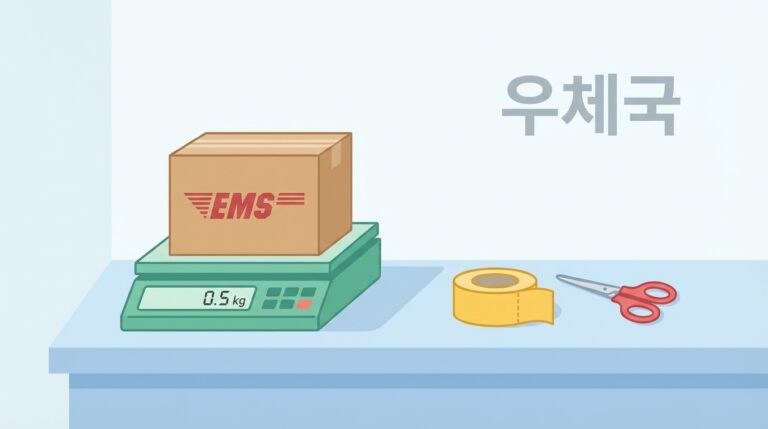
Phase 1: Immersive Hook
Hello! This is your Daily Hangul Editor.
Imagine this: You’ve spent the last week in Seoul raiding Myeongdong for skincare products, sweeping through Hongdae for vintage clothes, and—let’s be honest—buying way too many K-Pop albums to get that one specific photocard. Now, your suitcase won’t close. You’re sitting on it, but the zipper refuses to budge. 🤯
In a K-Drama, a handsome lead might appear to help you carry your bags. In reality? You need the Korean Post Office (우체국, Ucheguk).
But walking into a local post office can be intimidating. The forms are in Korean, everyone is moving at the speed of light (palli-palli!), and you’re terrified you might accidentally send your precious package to North Korea instead of New York.
Don’t worry. As a tutor who has helped countless students ship 20kg boxes of snacks and albums back home, I’ve got you covered. This guide is real, practical, and survival-tested. Let’s get that box shipped!
Phase 2: Deep Dive into Key Expressions
Here are the top 3 expressions you need to survive the counter interaction.
1. 미국으로 소포를 보내고 싶은데요.
- Pronunciation: [Miguk-euro sopo-reul bonaego sipeundeyo]
- Sounds like: “Me-gook-euro so-po-reul bo-neh-go ship-eun-de-yo”
- Meaning: I would like to send a parcel to the USA.
- Literal: To America / parcel / want to send.
- K-Culture Moment: Think of those “unboxing” videos on YouTube. Before the unboxing joy happens, someone had to say this sentence at a counter in Seoul!
- Editor’s Insight: You can replace ‘미국’ (USA) with your country. The ending ~는데요 is crucial here. It’s not just a statement; it’s a soft way of saying, “I want to do this… (so please guide me on what to do next).” It invites cooperation.
- Situation Spectrum:
[🚫 Formal Boss] ———— [✅ Post Office Clerk] ———— [✅ Friend]- 🤔 Think About It: Why do Koreans prefer endings like ~는데요 (leaving room for response) over direct commands? It reflects a high-context culture where “reading the room” (Nunchi) is shared between speaker and listener.
2. 제일 빠른 걸로 해주세요.
- Pronunciation: [Jeil ppareun geollo haejuseyo]
- Sounds like: “Jay-il pa-reun girl-lo heh-ju-se-yo”
- Meaning: Please do it with the fastest one.
- Nuance: I don’t care about the price, just get it there ASAP.
- K-Culture Moment: This is the spirit of Korean delivery! Whether it’s fried chicken arriving in 20 minutes or a document to Busan, speed is a virtue. In K-Pop fandoms, speed = first to post the unboxing.
- Editor’s Insight: Usually, this means EMS (Express Mail Service). It’s expensive but tracks everything. If you want the cheapest, say: “제일 싼 걸로 해주세요” (Jeil ssan geollo…).
- Situation Spectrum:
[✅ Universal]3. 내용물이 뭐예요?
- Pronunciation: [Naeyongmuri mwoyeyo?]
- Sounds like: “Nay-yong-mool-ee mwo-yay-yo?”
- Meaning: What are the contents?
- K-Culture Moment: The moment of truth. Like a strict homeroom teacher in a school K-Drama asking what’s in your bag. The clerk needs to know for customs.
- Editor’s Insight: You don’t need full sentences here. Just list the items. “옷 (Clothes), 책 (Books), 화장품 (Cosmetics).” Warning: Be careful with batteries (lithium) and liquids!
- Situation Spectrum:
[✅ Service Encounter]- 🤔 Think About It: Korean addresses start big (Country > City > District) and end small (Room number). Western addresses start small and end big. How does this reflect the Asian value of “Group/Society first, Individual second”?
Phase 3: Textbook vs. Real Life
| Situation | 📖 Textbook Korean | 🗣️ Real Korean (Survival Mode) | 💡 Why different? |
|---|---|---|---|
| Stating Purpose | 소포를 부치러 왔습니다. (I came to mail a parcel.) | 이거 [Country]로 보내려고요. (I’m sending this to [Country].) | “부치다” is a bit formal/old-fashioned. “보내다” is used 99% of the time now. |
| Checking Time | 도착까지 얼마나 걸립니까? (How long does it take to arrive?) | 이거 언제 도착해요? (When does this arrive?) | Directness is preferred in busy service counters to save time. |
| Contents | 내용물은 의류와 서적입니다. (The contents are clothing and books.) | 그냥 옷이랑 책이에요. (It’s just clothes and books.) | “그냥” (Just) softens the tone, implying “nothing dangerous inside.” |
Phase 4: Cultural Context — K-Culture Deep Dive
4-1. The “Self-Packing” Zone (자율 포장대)
In Western post offices, you often bring a sealed box. In Korea? No. You bring your stuff in a shopping bag and head to the “Self-Packing Zone” inside the post office.
– Why? It has boxes of all sizes (1-ho to 6-ho), free tape, scissors, and bubble wrap.
– Non-verbal Tip: Do not cut the line at the packing table. It’s a battlefield of people packing kimchi and herbal medicine. Wait for your spot, pack quickly (palli-palli), and tape it securely.
4-2. The “Kimchi” Crisis
If you are trying to send food (ramen, snacks, kimchi), the clerk might look stressed.
– K-Food Connection: Kimchi ferments and releases gas. If you pack it in a regular jar, it will explode on the plane. Post offices sell special “Kimchi Cans” or require double wrapping.
– Reality Check: Many countries prohibit meat products (even in Ramen soup packets). If the clerk asks “Is there meat?” (고기 있어요?), be honest. If caught, your package gets destroyed.
Phase 5: Immersive Roleplay Scenario
Setting: A bustling Post Office in Mapo-gu, Seoul. 2:00 PM. The sound of tape being ripped echoes loudly. You are holding a box filled with K-Pop albums and seaweed snacks.
Characters:
– YOU: A student returning home after a semester abroad.
– Clerk: A middle-aged lady (Im-o-nim), efficient but slightly tired.
Dialogue:
Clerk: (Without looking up) 다음 분 오세요! (Next person, please!)
[Daeum bun oseyo!]
YOU: 안녕하세요. 이거 호주로 보내고 싶은데요. (Hello. I want to send this to Australia.)
[Annyeonghaseyo. Igeo Hojuro bonaego sipeundeyo.]
Clerk: (Weighing the box) 호주요? 내용물이 뭐예요? (Australia? What’s inside?)
[Hojuyo? Naeyongmuri mwoyeyo?]
YOU: 앨범이랑 과자예요. (Albums and snacks.)
[Albeom-irang gwajayeyo.]
Clerk: (Eyebrows raise) 배터리나 액체는 없죠? (No batteries or liquids, right?)
[Baeteri-na aekcheneun eopjyo?]
🔀 Decision Point! You realize there is a ‘light stick’ (needs batteries) deep in the box.
- A) “네, 없어요.” (Lie and pray)
- B) “아! 잠시만요, 뺄게요!” (Oops, wait, I’ll take it out!)
- C) “배터리 있어도 괜찮지 않나요?” (Is it okay even with batteries?)
✅ Best Choice: B
– Reason: Lithium batteries are strictly regulated in airmail (EMS). If X-rayed and found, your package returns to you weeks later, and no refund! Just take them out now. Choice C will get a firm “No” (Andwaeyo).
(Scenario Continues after Choice B)
YOU: (Removing batteries) 이제 됐어요. 얼마나 걸려요? (Done. How long will it take?)
[Ije dwaesseoyo. Eolmana geollyeoyo?]
Clerk: EMS는 보통 일주일 정도 걸려요. (EMS usually takes about a week.)
[EMS-neun botong iljuil jeongdo geollyeoyo.]
Phase 6: 10-Second Shadowing Drill
Let’s practice the magic sentence to get the fastest shipping.
😊 Imagine you are eager to get these gifts to your family!
“가장 / 빠른 걸로 / 해주세요!”
(Gajang / ppareun geollo / haejuseyo!)
“Please do it / with the fastest one!”
Phase 7: K-Culture Glossary (Post Office Edition)
| Korean | Romanization | English | Context |
|---|---|---|---|
| 택배 | Taekbae | Parcel Service | The lifeblood of Korean commerce. Fast, cheap, reliable. |
| 등기 | Deunggi | Registered Mail | Used for important documents. Requires a signature upon delivery. |
| 포장 | Pojan | Packing | Often used in food delivery too (“Pojang please” = Takeout). |
| 송장 | Songjang | Invoice/Label | The sticker paper you write the address on. |
| 착불 | Chakbul | Cash on Delivery | Receiver pays for the shipping fee (don’t use for international!). |
Phase 8: Traveler’s Survival Kit
Whether you are moving or just sending a souvenir, you need these.
🆘 Survival Vocabulary
– 🇰🇷 “박스 주세요.” (Bakseu juseyo)
– Meaning: Please give me a box.
– Note: Boxes cost money (usually 1,000~2,500 KRW). You buy them at the counter first.
– 🇰🇷 “테이프 어디 있어요?” (Teipeu eodi isseoyo?)
– Meaning: Where is the tape?
– Answer: Look for the table with people aggressively packing things.
– 🇰🇷 “깨지는 거예요.” (Kkaejineun geoyeyo)
– Meaning: It’s fragile (breakable).
– Action: They will give you a red “Fragile” (취급주의) sticker.📌 Editor’s Travel Note:
Post Office Hours: Usually 9:00 AM – 6:00 PM (Mon-Fri). No weekends! If you need weekend shipping, go to a convenience store (GS25, CU) and look for the “Postbox” machine. It’s domestic focused but some offer international shipping.
Phase 9: Think Deeper — “The Speed of Trust”
Culture & Infrastructure:
Have you noticed that in Korea, you can leave your laptop on a cafe table, and no one steals it? But if you leave a bicycle, it vanishes? Interestingly, the Korean postal system relies heavily on this high-trust but high-speed culture. Parcels are often left in front of apartment doors if you aren’t home, simply because “Speed” (efficiency) outweighs “Security protocol” in the consumer’s mind.
🧠 Think Deeper: In your country, is a package left at the door considered “good service” or “negligence”? How does the Korean ‘delivery culture’ reflect the safety of the society?
Phase 10: FAQ & Troubleshooting
Q: Can I write the address in English?
A: Yes! For international mail, English is preferred for the destination. However, write your Korean return address in Hangul if possible, so if it returns, the local mailman knows where to find you.
Q: I don’t know my Korean address!
A: Search your hotel or Airbnb on Naver Map. Copy the address starting with “Seoul…” or “Busan…”.
❌ Common Mistake: Sealing the box before showing the clerk.
✅ Fix: Sometimes they ask to see inside. Keep the tape loose or tape it at the counter if you are sending tricky items (electronics, food).
Phase 11: Wrap-up & Mission
One-Liner: To send a parcel, remember: Destination + (으)로 보내고 싶은데요 and check your batteries!
🚀 Action Missions:
– 🥉 Bronze: Look up the word for your country in Korean (e.g., 미국, 영국, 프랑스, 필리핀).
– 🥈 Silver: Practice saying “가장 빠른 걸로 해주세요” while pretending to hand over a box.
– 🥇 Gold: Go to a Korean Post Office, buy a ‘Number 1’ box (1호 박스 – the smallest one), and mail a postcard or small souvenir to your family!
💬 K-Culture Mission: Next time you watch a K-Drama, look for a scene where a character receives a ‘homeland package’ (often kimchi or side dishes from mom). Note how they treat the box!
Phase 12: Interactive Quiz
1. Which item is usually FORBIDDEN in airmail (EMS)?
– A) Clothes
– B) Books
– C) Lithium Batteries (in light sticks)
– D) Dried Seaweed
2. You want to ask for a box. What do you say?
– A) 박스 있어요? (Do you have a box?)
– B) 박스 주세요. (Please give me a box.)
– C) 박스 싫어요. (I hate boxes.)
3. True or False?
– “You must bring your own scissors and tape to the Korean Post Office.”
Answers:
1. C (Batteries are dangerous goods for planes!)
2. B (A is okay, but B is the standard way to buy one.)
3. False (Korean hospitality! They provide packing stations with free tape and tools.)
Frequently Asked Questions (FAQ)
Q: What does "미국으로 소포를 보내고 싶은데요." mean in Korean and how do you pronounce it?
A: In Korean, "미국으로 소포를 보내고 싶은데요." is pronounced [Miguk-euro sopo-reul bonaego sipeundeyo] and means: a key conversational Korean expression covered in this lesson.
Q: What does "제일 빠른 걸로 해주세요." mean in Korean and how do you pronounce it?
A: In Korean, "제일 빠른 걸로 해주세요." is pronounced [Jeil ppareun geollo haejuseyo] and means: a key conversational Korean expression covered in this lesson.
Q: What does "내용물이 뭐예요?" mean in Korean and how do you pronounce it?
A: In Korean, "내용물이 뭐예요?" is pronounced [Naeyongmuri mwoyeyo?] and means: a key conversational Korean expression covered in this lesson.







