

Phase 1: The Immersive Hook
Greeting: 안녕하세요! Welcome back to Daily Hangul. I’m your editor and local navigator.
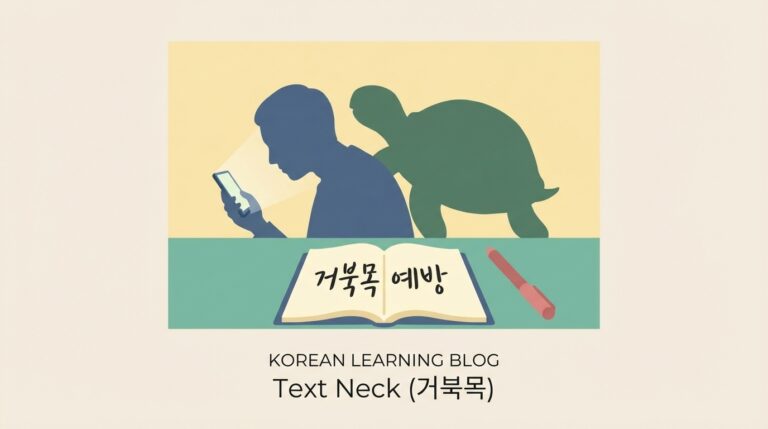
The Scene: Picture this. You are on the Seoul Metro Line 2 during rush hour. It’s quiet, except for the hum of the train. You look around, and what do you see? Everyone—literally everyone—is looking down at their smartphones. Their heads are tilted forward, necks bent at a 45-degree angle.
In Korea, we have a name for this modern alignment hazard. It’s not just “bad posture.” We call it “Geobukmok” (Turtle Neck).
Even in K-Dramas, have you noticed how the lead actor suddenly grabs the back of their neck after a long day of working (or plotting revenge)? That’s the universal Korean sign for stress and stiffness.
The ‘Why’: If you visit Korea, you will walk a lot, and you will use your phone for navigation constantly. Knowing how to express pain, ask for posture advice, or buy a pain patch at a pharmacy is essential survival K-Korean. Plus, using the specific word “Geobukmok” will instantly make Koreans laugh and nod in agreement. You’re not just a foreigner; you’re a fellow sufferer of modern life!
Phase 2: Deep Dive into Core Expressions
Here are the top 3 expressions you need to survive the digital age in Korea.
1. 거북목 (Geobukmok)
- Pronunciation: [Geobung-mok] Tip: The ‘k’ at the end of Geobuk blends into the ‘m’ of mok, making an ‘ng’ sound. Think of the word “Gong.”
- Meaning: Turtle Neck (Forward Head Posture)
- K-Culture Moment: You’ll often see ads for “Geobukmok pillows” (거북목 베개) on Korean home shopping channels. It’s a national obsession.
- Editor’s Insight: This is a very visual word. ‘거북’ is turtle, ‘목’ is neck. It literally means you look like a turtle poking its head out of its shell. It’s slightly self-deprecating but very common.
- Situation Spectrum:
[🚫 Formal(Boss)] ———— [⚠️ Semi-formal(Colleagues)] ———— [✅ Casual(Friends)]
(Note: You can use it with colleagues to complain about your own neck, but don’t tell your boss they have a turtle neck!)- 🤔 Think About It: Why do you think Korea uses an animal metaphor for a medical condition? Does it make the condition seem less serious or more relatable?
2. 허리(를) 펴다 (Heori-reul pyeoda)
- Pronunciation: [Heo-ri-reul pyeo-da] Tip: ‘Pyeo’ sounds like the start of ‘Pure’.
- Meaning: To straighten one’s back / To stand tall.
- K-Culture Moment: In K-Pop survival shows (like Produce 101), dance trainers constantly yell “허리 펴!” (Straighten your back!) because posture equals confidence and stage presence.
- Editor’s Insight: ‘허리’ usually translates to ‘waist,’ but in this context, it refers to your lower back or spine. ‘펴다’ means to unfold or straighten (like ironing a shirt).
- Situation Spectrum:
[🚫 Formal] ———— [⚠️ Semi-formal] ———— [✅ Casual]
(Use ‘허리 좀 펴세요’ for polite advice, ‘허리 펴!’ for close friends.)3. 뻐근하다 (Ppeogeunhada)
- Pronunciation: [Ppeo-geun-ha-da] Tip: The double ‘Pp’ is a tense sound. Imagine spitting out a seed forcefully.
- Meaning: To be stiff / achy / heavy (muscles).
- K-Drama Trope: The main character wakes up on a uncomfortable sofa after a drunk night and says, “아, 목이 뻐근해…” (Ah, my neck is stiff…).
- Editor’s Insight: This is distinct from sharp pain (아프다). It’s that dull, heavy feeling you get after sitting at a desk for 8 hours. Using this specific adjective shows high-level proficiency.
- 🤔 Think About It: Korean has many “sound-symbolic” words for pain (uksin-uksin, ssuk-ssuk). ‘Ppeogeun’ feels heavy, doesn’t it?
Phase 3: Textbook vs. Real Life
Let’s see how a textbook robot speaks versus a Seoul local.
| Situation | 📖 Textbook Korean | 🗣️ Real Korean | 💡 Why the difference? |
|---|---|---|---|
| Complaining about pain | 목이 아픕니다. (My neck hurts.) | 목이 나갈 것 같아. (It feels like my neck is going to fly away/break.) | Koreans love dramatic exaggeration to emphasize stress. |
| Suggesting a break | 휴식을 취합시다. (Let’s take a rest.) | 좀 풀고 하자. (Let’s loosen up/stretch a bit before continuing.) | Focuses on the physical action of releasing tension rather than just ‘resting’. |
| Warning a friend | 자세를 교정하세요. (Please correct your posture.) | 그러다 목 디스크 온다. (You’re gonna get a slipped disc like that.) | Using medical threats (Disk) is a common way to show care! |
Bottom Note: “목 디스크” (Neck Disc) is practically a slang term in Korea because it’s so common. Don’t be afraid to use it!
Phase 4: Cultural Deep Dive — The K-Health Obsession
4-1. Non-verbal Communication: The “Polite” Slouch?
Wait, didn’t we say posture is important? Yes, but… paradoxically, sitting too straight and staring directly at an elder or superior can sometimes be seen as challenging them (stiff/arrogant). However, generally, good posture is a sign of Barun Saenghwal (Righteous Living).
4-2. K-Culture Connection: The “Hanuiwon” (Oriental Clinic) Experience
In Western countries, you might see a chiropractor for bad posture. In Korea, we go to the Hanuiwon (한의원).
If you watch variety shows like Home Alone (I Live Alone), you often see celebrities getting acupuncture.
- The Trope: The doctor presses a spot on their neck, and the celeb screams. The doctor calmly says, “This is because of your stress and bad posture.”
- Critical View: Why is Health often linked to Hard Work in Korea? Complaining about a stiff neck can sometimes be a humble brag: “I worked so hard today that my body is breaking down.”
Phase 5: Immersive Roleplay — The Office Survivor
Setting: A shared workspace (Study Cafe) in Gangnam. It’s 9:00 PM. You and your Korean friend, Min-ji, have been staring at laptops for 4 hours.
Characters:
* YOU: An international student/worker, neck feeling like a rock.
* Min-ji (28): Your posture-obsessed friend who does yoga.
(Dialogue Start)
YOU: (Rubbing your neck dramatically) 아, 진짜 죽겠다… 목이 너무 뻐근해.
(Ah, jinjja jukgetda… mogi neomu ppeogeunhae.)
(Ah, I’m dying… My neck is so stiff.)
Min-ji: (Looking at you with pity) 야, 너 자세가 완전 거북이야! 목 좀 집어넣어. 🐢
(Ya, neo jasega wanjeon geobugiya! Mok jom jibeonoeo.)
(Hey, your posture is totally a turtle! Tuck your neck in.)
YOU: 나도 아는데, 집중하다 보니까 자꾸 앞으로 나가네.
(Nado aneunde, jipjunghada bonikka jakku apeuro nagane.)
(I know, but since I’m focusing, it keeps moving forward.)
Min-ji: 그러다 디스크 터진다? 잠깐 스트레칭 좀 해.
(Geureoda diseukeu teojinda? Jamkkan seuteureching jom hae.)
(You’ll rupture a disc like that! Do some stretching for a second.)
🔀 Decision Point: How do you respond?
- A) “그래, 우리 편의점 가서 뭐 좀 마실까?” (Suggest a break)
- B) “아니야, 이거만 끝내고.” (The Hardworking Hero)
- C) “내 목은 이미 틀렸어…” (Self-deprecating joke)
✅ Best Choice: A. Koreans love “refresh” breaks. Going to a convenience store (Pyeon-ui-jeom) is the perfect excuse to walk and fix your posture.
⚠️ Choice B Analysis: Very Korean spirit, but Min-ji will likely nag you more!
Phase 6: 10-Second Shadowing Drill
Let’s practice the intonation. Don’t sound like a robot; sound like you are in pain!
- Complaining (😩 Painful/Whiny):
아~ / 목이 / 너~무 / 뻐근해요.
(Ah~ / mogi / neo~mu / ppeogeunhaeyo.)
Ah~ / my neck / is so~ / stiff.
(Note: Stretch the ‘neo~mu’ to emphasize the pain.) -
Advising (😤 Firm/Bossy):
허리 좀 / 펴고 / 앉으세요!
(Heori jom / pyeogo / anjeuseyo!)
Waist (a bit) / straighten / and sit!
Phase 7: K-Culture Mini Glossary
| Korean | Romanization | English | Context |
|---|---|---|---|
| 거북목 | Geobukmok | Turtle Neck | Forward head posture syndrome from phones/PC. |
| 목 디스크 | Mok-diseukeu | Neck Disc | Herniated disc. Often used loosely for “serious neck pain.” |
| 도수치료 | Dosu-chiryo | Manual Therapy | Physical therapy often covered by insurance; very popular for office workers. |
| 파스 | Paseu | Pain Patch | The magical sticky patch Koreans put everywhere for muscle pain. |
Phase 8: Traveler’s Survival Kit — The Pharmacy Run
Your neck hurts after a 12-hour flight to Incheon? Here is how to survive.
🆘 Survival Expression: At the Pharmacy (Yak-guk)
* 🇰🇷 “목이 뻐근한데, 파스 주세요.”
(Mogi ppeogeunhande, paseu juseyo.)
* 🗣️ Sounds like: “Mog-ee ppug-un-han-day, Pass joo-se-yo.”
* Meaning: “My neck is stiff, please give me a pain patch.”
* 💡 Pro Tip: There are two types of ‘Pas’: Cool (쿨) for sudden pain/swelling, and Hot (핫) for chronic aches. If you have Geobukmok, ask for “Hot Pas.”📌 Editor’s Travel Note
* Clinics: If it really hurts, you can walk into a Jeong-hyeong-oe-gwa (Orthopedics) or Han-ui-won (Oriental Clinic). Walk-ins are usually accepted!
* Cost: Korean physical therapy is surprisingly affordable compared to the US or Europe (often $10-$30 with insurance, slightly more without).
Phase 9: Think Deeper — “Why so stiff?”
Topic: The Weight of Social Pressure
Have you noticed that “Geobukmok” is almost treated like a badge of honor in Korean offices or schools? It signifies that you spend long hours at a desk, studying or working towards a goal. In a society that values diligence (Seongsil-ham) above almost everything, physical ailments like stiff necks or dry eyes are physical proofs of your effort.
🧠 Think Deeper:
Does your culture view physical exhaustion as a sign of hard work, or as a sign of poor self-management? In Korea, it’s shifting towards the latter with the “Well-being” trend, but the “Hard work” glory still remains.💬 Your Turn: How do you say “stand up straight” in your language? Is it rude or caring?
Phase 10: FAQ & Troubleshooting
- Q: Can I tell an older person “허리 펴세요” (Straighten your back)?
- A: NO! 🚫 Even if you use polite language (-seyo), pointing out a physical flaw or correcting an elder’s behavior is considered rude. Unless you are their doctor or yoga instructor, keep it to yourself!
- Q: What if I don’t want to go to a doctor?
- A: Visit a Jjimjilbang (Korean Sauna). Soaking in hot water is the traditional Korean cure for Ppeogeun muscles. You will see many locals stretching in the tubs.
- ❌ Common Mistake: Saying “Neck is sick” (목이 아파요) when you mean “Sore throat” vs “Muscle pain.”
- Inside throat (cold/flu) = 목이 따가워요 / 목감기예요.
- Muscle pain (posture) = 목이 뻐근해요 / 결려요.
Phase 11: Wrap-up & Missions
Summary: Today we learned how to complain about “Turtle Neck” (Geobukmok), tell friends to “Straighten their back” (Heori pyeo), and realized that Korean pharmacies have magical patches called “Pas.”
🚀 Action Missions:
* 🥉 Bronze: Look in the mirror. If your head is forward, pull it back and say “거북목 노!” (No Turtle Neck!).
* 🥈 Silver: Go to a Korean pharmacy (or an Asian market in your country) and buy a pack of “Pas” (파스). Post a photo of it!
* 🥇 Gold: Next time you see a friend slouching, gently say, “허리 좀 펴! 그러다 거북이 된다?” (Straighten your back! You’ll become a turtle!).
K-Culture Mission: Search for “Idol Posture Correction” on YouTube. You will see compilation videos of K-Pop idols suddenly straightening up when they realize they are on camera. It’s hilarious and educational!
Phase 12: Quiz — Are you a Posture Master?
- Situation: Your boss is slouching at his desk. What do you say?
- A) 사장님, 허리 좀 펴세요. (Boss, straighten your back.)
- B) 사장님, 거북목이시네요. (Boss, you have a turtle neck.)
- C) Nothing. (Bring him a coffee silently.)
- True or False?
- “목이 뻐근하다” is used when you have a sore throat from a cold.
- Missing Word:
- “Ah, my neck is so stiff. I need to buy a ______ at the pharmacy.”
- (Hint: It rhymes with ‘Bus’ but starts with P)
Answers:
1. C. Never correct the boss’s posture! (Unless you want to get fired).
2. False. That is muscle stiffness. Sore throat is ‘Mok-gamgi’.
3. Pas (파스).
Frequently Asked Questions (FAQ)
Q: What does "거북목 (Geobukmok)" mean in Korean and how do you pronounce it?
A: In Korean, "거북목 (Geobukmok)" is pronounced [Geobung-mok] and means: Turtle Neck (Forward Head Posture)
Q: What does "허리(를) 펴다 (Heori-reul pyeoda)" mean in Korean and how do you pronounce it?
A: In Korean, "허리(를) 펴다 (Heori-reul pyeoda)" is pronounced [Heo-ri-reul pyeo-da] and means: To straighten one's back / To stand tall.
Q: What does "뻐근하다 (Ppeogeunhada)" mean in Korean and how do you pronounce it?
A: In Korean, "뻐근하다 (Ppeogeunhada)" is pronounced [Ppeo-geun-ha-da] and means: To be stiff / achy / heavy (muscles).







