

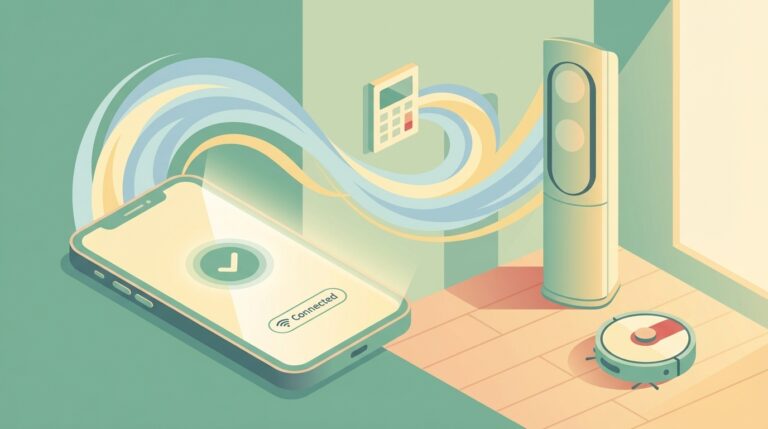
Phase 1: Immersive Hook
Hello! This is your Senior Editor at Daily Hangul.
Picture this: You are watching a sleek K-Drama. The handsome CEO protagonist walks into his penthouse overlooking the Han River. He doesn’t flip a switch. He just says, “Turn on the lights,” and effortlessly, the room glows. Or maybe you’ve seen a scene where a character checks who is ringing the doorbell just by looking at their smartphone while at a café.
Now, cut to reality. You are standing in your modern Seoul apartment (officetel), shouting at a small speaker that refuses to listen, or staring at an app that keeps saying “연결 실패” (Connection Failed).
At the C1 level, you can discuss politics and emotions, but can you tell your smart refrigerator to lower the temperature? Today, we are bridging the gap between “textbook fluency” and “digital survival” in Korea’s hyper-connected society. Let’s master the language of the Internet of Things (IoT).
Phase 2: Deep Dive into Key Expressions
Here are the three critical terms you need to navigate the Korean smart home ecosystem.
1. 연동하다 (Yeondong-hada)
- Pronunciation: [Yeon-dong-ha-da] (Think of ‘Yeon’ as in yawn but shorter + ‘dong’ like a bell sound)
- Meaning: To interlock / To link / To sync (data or systems)
- Context: While
연결하다means a simple connection (like plugging in a cord),연동하다implies a system integration. You 연동 your bank account to KakaoPay, or your smartphone to your wall pad.- K-Culture Moment: You’ll see this in tech reviews or when a character in a drama tries to sync their black box (dashcam) to their phone to catch the culprit. “폰이랑 연동이 안 돼서 확인을 못 했어!” (I couldn’t check because it wasn’t synced with my phone!)
- Situation Spectrum:
[🚫 Formal Only] ———— [⚠️ Semi-Formal] ———— [✅ Universal]
This is a technical term but widely used in daily life (Universal ✅).- 🤔 Think About It: Why does Korean distinguish between physical connection (연결) and systemic interlocking (연동)? It reflects a nuance in how systems cooperate versus just touch.
2. 음성 인식 (Eumseong Insik)
- Pronunciation: [Eum-seong In-sik]
- Meaning: Voice Recognition
- Context: This is the feature that makes your AI speaker (GiGA Genie, Clova, Bixby) work. If your pronunciation is off, the device fails to “recognize” (인식하다) your command.
- Editor’s Insight: If an automated machine fails to understand you, don’t say “It doesn’t hear me.” Say “음성 인식이 잘 안 돼요” (The voice recognition isn’t working well).
- Situation Spectrum: Universal ✅. Used in settings, manuals, and complaints.
3. 원격 제어 (Wongyeok Jeeo)
- Pronunciation: [Won-gyeok Je-eo]
- Meaning: Remote Control (literally: Distant Control)
- Context: Used when controlling appliances from outside the house.
- K-Culture Moment: A thriller movie trope: The villain hacks the smart home system and uses 원격 제어 to lock the doors or turn off the heat.
- Situation Spectrum: Technical/Formal ✅. In casual speech, people might just say “밖에서 폰으로 켜다” (turn it on with the phone from outside).
Phase 3: Textbook vs. Real Life
| Situation | 📖 Textbook Korean | 🗣️ Real Korean (In the Wild) | 💡 Why the difference? |
|---|---|---|---|
| Pairing a device | “기기를 연결해 주십시오.” (Please connect the device.) | “이거 블루투스 페어링이 자꾸 끊겨.” (The Bluetooth pairing keeps cutting off.) | Koreans love borrowing tech terms directly from English (Pairing). |
| Voice command failure | “제 말을 이해하지 못했습니다.” (It did not understand my words.) | “아, 얘가 내 말을 못 알아먹네.” (Ah, this thing isn’t ‘eating/understanding’ my words.) | treating the machine like a stubborn person/animal. |
| Setting up automatic routines | “자동화 설정을 하세요.” (Set up the automation.) | “그냥 루틴 맞춰 놔.” (Just set up the routine.) | ‘Routine’ is the trendy UI term used in apps like SmartThings. |
Phase 4: Cultural Context — The “Smart Apartment” Life
4-1. The “Wall Pad” (월패드) Phenomenon
In most modern Korean apartments built after 2010, there is a central hub on the living room wall called a Wall Pad. It controls the boiler (heating), gas valve, lights, and even lets you see who is in the parking lot.
* Non-verbal Tip: When the Wall Pad malfunctions, Korean adults often tap it firmly with a knuckle, assuming it’s a hardware contact issue. It’s a culturally ingrained reaction to “fix” electronics!
4-2. K-Drama Trope: The High-Tech Door Lock
Have you noticed in dramas (like My Love from the Star) that door locks are distinct characters? The beep-beep-beep-beep-clack sound is iconic.
* Critical Perspective: Korea’s obsession with smart locks (digitizing security) represents a shift towards convenience over the traditional “key” culture. However, it also introduces the modern fear of digital hacking, a common plot point in Korean thrillers.
Phase 5: Immersive Roleplay Scenario
Setting: A Friday evening at your newly rented officetel in Gangnam. You bought a second-hand AI speaker, and your Korean friend, Min-ji (29, tech-savvy, fast talker), is helping you set it up.
Characters:
* YOU: An expat trying to make your home “smart.”
* Min-ji: Your friend who thinks everything should be “smart.”
Dialogue:
Min-ji: 야, 이거 모델이 좀 구형인데? 앱이랑 연동부터 시켜 봐. 📱
(Ya, igeo modeli jom guhyeong-inde? Aeb-irang yeondong-buteo sikyeo bwa.)
(Hey, this model is a bit old? Try syncing it with the app first.)
YOU: (Looking confused at the phone) 어떻게 하는지 모르겠어. 자꾸 ‘기기를 찾을 수 없습니다’라고 나와.
(Eotteoke haneunji moreugesseo. Jakku ‘gigireul chajeul su eopseumnida’-rago nawa.)
(I don’t know how. It keeps saying ‘Device not found’.)
Min-ji: 와이파이는 2.4GHz로 잡았어? 5G로 하면 인식 못 할 수도 있어.
(Waipai-neun 2.4GHz-ro jabasseo? 5G-ro hamyeon insik mot hal sudo isseo.)
(Did you catch the 2.4GHz Wi-Fi? If you use 5G, it might not recognize it.)
YOU: 아, 진짜? 몰랐네. 잠깐만 바꿔볼게.
(Ah, jinjja? Mollanne. Jamkkanman bakkwobolge.)
(Ah, really? I didn’t know. Let me switch it for a second.)
(🎭 Stage Direction: The speaker suddenly lights up blue and makes a ‘Ding!’ sound)
Min-ji: 오! 됐다! 이제 음성 명령 테스트해 봐. “불 꺼달라고” 해봐.
(Oh! Dwaetda! Ije eumseong myeongnyeong teseuteu-hae bwa. “Bul kkeodallago” haebwa.)
(Oh! It worked! Now test the voice command. Ask it to turn off the lights.)
🔀 Decision Point: How do you command the AI?
- A) “저기요… 불 좀 꺼 주세요.” (Polite/Formal)
- B) “야! 불 꺼!” (Aggressive/Casual)
- C) “헤이 [Name], 불 꺼 줘.” (Standard Smart Home Command)
✅ Best Choice: C — AI speakers usually have a “Wake-up word” (H 호출어). Politeness (A) is unnecessary for robots, and (B) won’t work without the wake-up word.
⚠️ Note on A: It’s cute, but many foreigners mistakenly use high honorifics with AI. You can drop the formalities with machines!
Phase 6: 10-Second Shadowing Drill
Let’s practice complaining about technology, a very common conversation starter!
Sentence:
“업데이트를 하라는데 / 와이파이 연결이 / 자꾸 끊겨서 / 미치겠어!”
Pronunciation:
[Eop-de-i-teu-reul ha-ra-neun-de / wa-i-pa-i yeon-gyeo-ri / jak-ku kkeun-kyeo-seo / mi-chi-ge-sseo!]
Meaning:
“It’s telling me to update, but the Wi-Fi connection keeps dropping, so I’m going crazy!”
Emotion Guide:
😤 Frustrated (Stress the ‘Mi-chi-ge-sseo’ part!)
Phase 7: K-Culture Mini Glossary
| Korean | Romanization | English | Context |
|---|---|---|---|
| 사물 인터넷 | Samul Inteonet | IoT | The formal term for IoT in news/articles. |
| 인공지능 스피커 | Ingong-jineung Seupikeo | AI Speaker | Essential item in modern Korean homes (Kakao Mini, Naver Clova). |
| 스마트 플러그 | Seumateu Peulleogeu | Smart Plug | Used to make “dumb” appliances smart. |
| 난방비 | Nanbang-bi | Heating Cost | The #1 reason people use IoT control for boilers—to save money! |
Phase 8: Traveler’s Survival Kit (Airbnb Edition)
You’ve checked into a high-tech Airbnb in Seoul. The host isn’t there, and everything is digital.
🆘 Survival Expression #1: The Boiler Struggle
* 🇰🇷 “보일러 조절기는 어디에 있나요?” (Boilleo jojeolgi-neun eodie innayo?)
* 🗣️ Meaning: Where is the boiler control panel?
* 📍 Where: Airbnb, Guesthouse.
* 💡 Pro Tip: In Korea, floor heating (Ondol) is separate from hot water in some old systems. Look for buttons like ‘온수 전용’ (Hot Water Only) vs ‘난방’ (Heating).📌 Editor’s Travel Note
* App Fatigue: Many Korean smart appliances require specific Korean apps (Samsung SmartThings, LG ThinQ) that might be region-locked. If you are a short-term traveler, don’t try to pair them. Just look for the manual buttons (수동 조작).
Phase 9: Critical Thinking — “Think Deeper”
Topic: High-Tech vs. High-Touch in Korea
Korea is one of the most wired nations on earth. We have robot baristas and apartments that recognize our cars. But ask yourself: Does this convenience create isolation? In Korean, we have a concept called ‘Jeong’ (정 – deep connection). As we interact more with machines (kiosks, AI speakers) and less with humans, is the texture of ‘Jeong’ changing? Or is the ability to check on your elderly parents’ home temperature remotely a new form of digital Jeong?
💬 Your Turn: In your country, is smart home technology seen as a luxury or a necessity? Do you talk to your devices politely?
Phase 10: FAQ & Troubleshooting
- Q: My AI speaker only speaks Korean. Can I change it to English?
- A: Most domestic Korean devices (Kakao Mini, GiGA Genie, Naver Clova) are optimized for Korean services (Melon, KakaoTalk) and often do not support English or have very limited English capabilities. This is your chance to practice!
- Q: Can I say “수고했어” (Good job) to a machine?
- A: Ironically, yes! Many Koreans say “지니야, 고마워” (Thanks, Genie) or “수고했어” out of habit or for fun. The AI usually responds with a pre-programmed “You’re welcome.”
- ❌ Common Mistake: Confusing 켜다 (Turn on) with 열다 (Open).
- Don’t say: “보일러 열어 주세요.” (Please open the boiler.)
- Say: “보일러 켜 주세요.” (Please turn on the boiler.) — Electronics use ‘Turn on/off’.
Phase 11: Wrap-up & Action Mission
One-Liner Summary: To master the Korean smart home, remember the trinity: 연동하다 (Sync), 인식하다 (Recognize), and 원격 제어 (Remote Control).
🚀 Action Missions:
* 🥉 Bronze: Look at your phone settings and find the word ‘연결’ or ‘연동’ (Bluetooth/WiFi menu).
* 🥈 Silver: Change your phone’s language to Korean for 1 hour. Try to connect a Bluetooth device.
* 🥇 Gold: If you have Siri, Bixby, or Google Assistant, switch it to Korean and try to set an alarm: “오전 7시에 알람 맞춰 줘.”
K-Culture Mission: Watch a clip of a Korean tech review on YouTube (Search: “스마트홈 룸투어” – Smart Home Room Tour) and count how many times they say “연동.”
Phase 12: Quiz — Interactive Challenge
- Situational Judgment: You are cold in your Airbnb. You see the wall pad. Which button do you press?
- A) 외출 (Going Out)
- B) 난방 (Heating)
- C) 경비실 (Security Office)
- D) 문열림 (Door Open)
- Fill in the Blank:
“내 목소리를 기계가
____을/를 못 해서 자꾸 에러가 나.”
(The machine can’t [____] my voice, so it keeps erroring.) -
True or False (Culture):
Most modern Korean apartments allow you to call the elevator from inside your house before you leave the front door. (T/F)
Answers:
1. B) 난방 (A turns off heat to save energy, C calls the guard, D unlocks the door! Be careful!)
2. 인식 (Recognition)
3. True. It’s a very common feature in ‘Smart Apartments’ to save waiting time—the epitome of ‘Palli-Palli’ culture!
Frequently Asked Questions (FAQ)
Q: What does "연동하다 (Yeondong-hada)" mean in Korean and how do you pronounce it?
A: In Korean, "연동하다 (Yeondong-hada)" is pronounced [Yeon-dong-ha-da] and means: To interlock / To link / To sync (data or systems)
Q: What does "음성 인식 (Eumseong Insik)" mean in Korean and how do you pronounce it?
A: In Korean, "음성 인식 (Eumseong Insik)" is pronounced [Eum-seong In-sik] and means: Voice Recognition
Q: What does "원격 제어 (Wongyeok Jeeo)" mean in Korean and how do you pronounce it?
A: In Korean, "원격 제어 (Wongyeok Jeeo)" is pronounced [Won-gyeok Je-eo] and means: Remote Control (literally: Distant Control)







