

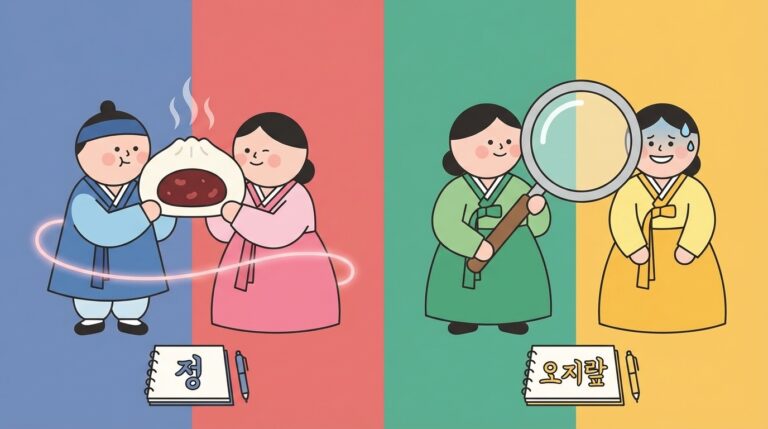
Phase 1: The Immersive Hook
Hello! This is your Senior Editor at Daily Hangul.
Picture this: You are watching a K-Drama. The protagonist has just returned home after a long, hard day. Their mom—or perhaps the friendly grandmother next door—looks them up and down and says, “Aigoo, why is your face so haggard? Have you even eaten? You should get married soon so someone can cook for you!”
The subtitles might translate this as concern, but you feel a mix of emotions. Is this love? Or is this just… too much information?
Welcome to the blurry, often confusing line between Jeong (情) and Ojirap (오지랖).
If you don’t understand this nuance, you might feel offended by a Korean friend’s personal question, or conversely, you might seem distant because you’re drawing boundaries too strictly. Today, we are going to master the art of distinguishing “warm affection” from “nosy interference”—and how to handle both like a local.
Phase 2: Deep Dive into Key Expressions
Here are the three expressions that define this cultural tug-of-war.
1. 정(이) 들다 / 정(이) 많다
- Pronunciation: [jeong-(i) deul-da] / [jeong-(i) man-ta]
- Sound Analogy: Jeong sounds like “Chung” in “Chung-king Express,” but with a soft ‘J’.
- Meaning: Literal: To enter affection / To have much affection. Real Nuance: To grow attached / To be warm-hearted.
- K-Culture Moment: Think of that K-Pop idol who cries at the final concert, thanking the staff and fans. That deep, invisible emotional bond is Jeong. It’s not just love; it’s a shared history and attachment.
- Editor’s Insight: Jeong is the fuel of Korean society. It’s why people share food and pay for each other’s coffee. It is the positive side of being involved in someone’s life.
- Situation Spectrum:
[🚫 Boss] ———— [⚠️ Colleague] ———— [✅ Friends/Family](Used to describe relationships) - 🤔 Think About It: Why is Jeong often described as something you can feel even for people you dislike? (e.g., Miun-jeong / Hateful affection)
2. 오지랖(이) 넓다
- Pronunciation: [ojirap-(i) neol-da]
- Sound Analogy: O-ji-rap sounds like “Oh, G-Lap.”
- Meaning: Literal: The front of one’s jacket is wide. Real Nuance: To be nosy; to meddle in affairs that aren’t yours.
- K-Culture Moment: The “ajumma” in a drama who asks a stranger on the bus, “Why aren’t you wearing socks? You’ll catch a cold!” That is wide Ojirap.
- Editor’s Insight: This comes from the idea that if your jacket is too wide, it covers (touches) everything. It implies someone who covers too much ground in other people’s business.
- Situation Spectrum:
[🚫 To Elders] ———— [⚠️ To Friends] ———— [✅ Self-deprecating](Best used to joke about yourself: “I’m being too nosy, right?”) - 🤔 Think About It: Is Ojirap always bad? Sometimes, this “nosiness” is what saves someone in trouble in a collective society.
3. 다 너 잘되라고 하는 소리야
- Pronunciation: [da neo jal-dwe-rago ha-neun sori-ya]
- Meaning: Literal: It is all sound for you to become well. Real Nuance: I’m saying this for your own good.
- K-Culture Moment: Every Korean parent in history, right before giving advice you didn’t ask for (about dieting, studying, or dating).
- Editor’s Insight: This is the Magic Shield used to justify Ojirap. If someone uses this sentence, they believe their interference is an act of Jeong.
- Situation Spectrum:
[🚫 To Superior] ———— [⚠️ To Junior] ———— [✅ Parents to Kids]
Phase 3: Textbook vs. Real Life
| Situation | 📖 Textbook Korean | 🗣️ Real Korean | 💡 Why the difference? |
|---|---|---|---|
| Expressing Concern | 관심이 있어요. (I have interest.) | 신경 끄셔도 돼요. (You can turn off your nerve/attention.) | “Interest” sounds too formal. “Turning off nerves” is the blunt, real way to say “Mind your business.” |
| Asking about marriage/dating | 결혼 계획이 있으십니까? (Do you have marriage plans?) | 국수 언제 먹여 줄 거야? (When will you let us eat noodles?) | Traditionally, noodles were served at weddings. It’s a culturally indirect way to pressure you! |
| Commenting on weight | 체중이 변한 것 같아요. (Your weight seems to have changed.) | 얼굴 좋아졌네! (Your face looks good!) | “Face looks good” is a code for “You gained a little weight (healthily).” Direct mention of fat is rude, but this is acceptable Jeong. |
💡 Bottom Note: Be careful with “국수 언제 먹여 줄 거야?” It’s a classic phrase, but younger generations (MZ gen) might find it annoying (Kkondae-ish).
Phase 4: Cultural Deep Dive
4-1. Nunchi (눈치) and The Art of Deflection
In Korea, straight-up rejecting Ojirap can be seen as rejecting Jeong. You need Nunchi (social intuition).
– Non-verbal: If someone asks a personal question, don’t frown. Smile awkwardly and scratch your head. This signals “This is uncomfortable” without being aggressive.
– The Rule: Never look them in the eye and say “It’s none of your business.” Instead, use a “soft shield” (see the Roleplay section).
4-2. K-Food Connection: The “Refill” Ojirap
You are at a K-BBQ place. You didn’t ask for more Kimchi, but the owner slams a fresh plate on your table and says, “Eat more! You look too skinny!”
– Is this rude? No.
– Is it Ojirap? Yes.
– Is it Jeong? Definitely.
This is affection served on a plate. The correct response is not “I didn’t order this,” but “Wow, Thank you! (Aigoo, gamsahamnida!)”
Phase 5: Immersive Roleplay
Setting: Lunchtime at a company cafeteria in Yeouido. You are eating with Minji (30s, female colleague) who is nice but talks a lot.
Minji: (Poking at her salad) 요즘 연애는 안 해? 주말에 뭐 했어?
(Yojeum yeonae-neun an hae? Jumal-e mwo haesseo?)
[Translation: Are you not dating these days? What did you do on the weekend?]
🔀 YOUR TURN! How do you respond?
A) “제 사생활입니다. 묻지 마세요.” (It’s my private life. Don’t ask.)
B) “아, 네… 그냥 집에서 쉬었어요. 민지 님은요?” (Ah, yes… I just rested at home. How about you, Minji?)
C) “좋은 사람 있으면 소개시켜 주세요!” (If you know someone good, introduce me!)
Analysis:
– Option A: 🛑 Hard Stop. You will be known as the “cold foreigner.” Use only if you really dislike her.
– Option B: ✅ The Soft Shield. You gave a vague answer and deflected the question back to her. This is high-level Nunchi.
– Option C: ⚠️ The Open Door. Only say this if you actually want a blind date. Minji will find you someone by next week. That is the power of Korean Ojirap.
Phase 6: 10-Second Shadowing Drill
Let’s practice the “Soft Shield” technique. Say this when someone asks a question you don’t want to answer.
😊 (Awkward Smile) 아, 네~ / 그냥 / 잘 지내고 있어요!
(Ah, ne~ / geunyang / jal jinaego isseoyo!)
“Ah, yes~ / I’m just / doing well!”
Phase 7: K-Culture Mini Glossary
| Korean | Romanization | Meaning | Context |
|---|---|---|---|
| 꼰대 | Kkondae | Boomer / Condescending person | Someone who uses Ojirap to lecture younger people. |
| 역마살 | Yeokmasal | Wanderlust (destined to move) | If you travel a lot, Koreans might say you have this spirit (Ojirap about your lifestyle). |
| 서비스 | Service | Freebie | When a restaurant gives you free food out of Jeong. |
| 답정너 | Dap-jeong-neo | “The answer is fixed, you just reply” | When someone asks for your opinion but only wants to hear compliments. |
Phase 8: Traveler’s Survival Kit
Since Ojirap often happens in taxis or markets, here is how to handle it.
🆘 Survival Expression #1: The Taxi Driver Interrogation
Situation: The driver asks, “How old are you? Are you married? From which country?”
– 🇰🇷 “한국말 아직 잘 못해요… ㅎㅎ” (Hangukmal ajik jal mot-haeyo… haha)
– Meaning: I can’t speak Korean well yet.
– 💡 Pro Tip: Even if you speak B2 level Korean, playing the “I don’t understand” card is the most polite way to end an exhausting conversation without hurting feelings.📌 Editor’s Travel Note
– Personal Space: In crowded places like subways, people might push you slightly. It’s not aggression; it’s just a lack of physical Ojirap boundaries in a dense city. Don’t take it personally!
Phase 9: Think Deeper — “Jeong” vs. Privacy
Why does Korean culture value ‘knowing your business’ over privacy?
Historically, Korea was an agrarian society deeply rooted in rice farming, which required communal labor. Survival depended on the collective, not the individual. Knowing that your neighbor was sick or starving wasn’t “nosy”—it was necessary for the village’s survival.
Today, this has evolved into modern Ojirap. While younger Koreans (MZ Generation) are pushing back and demanding privacy (Individualism), the older generation still equates “indifference” with “coldness.”
🧠 Think Deeper: In your culture, is asking “Have you eaten?” a greeting or a genuine question? Where do you draw the line between caring and prying?
💬 Your Turn: Share a moment in the comments where you experienced “Too much Jeong” or “Good Ojirap”!
Phase 10: FAQ & Troubleshooting
Q: A Korean coworker said my face looks “bloated” (부었다). Should I be offended?
A: Not necessarily. In English, this is an insult. In Korean, it’s often an observation of condition—maybe you ate salty food or look tired. It’s usually meant as Jeong (concern for your health), but you have every right to feel annoyed!
Q: Can I use “Ojirap” to my boss?
A: ABSOLUTELY NO. You cannot say “That is Ojirap” to a superior. That is a firing offense. Instead, just say “걱정해 주셔서 감사합니다” (Thank you for worrying).
❌ Common Mistake:
Thinking everyone who asks your age is rude.
✅ Fix: They often ask age to determine which politeness level (Honorifics) to use. It is a linguistic necessity, not just nosiness.
Phase 11: Wrap-up & Action Items
Summary: Jeong is the glue of Korean affection, but when it crosses the line into your privacy, it becomes Ojirap. The key is to accept the heart (intention) but gently deflect the intrusion.
🚀 Action Missions:
– 🥉 Bronze: Practice the “Awkward Smile & Head Scratch” in the mirror. It’s a valid communication skill!
– 🥈 Silver: Watch a K-Drama scene involving a mother and child. Identify one sentence that sounds like Ojirap but means Jeong.
– 🥇 Gold: Next time a Korean asks a personal question, use the Soft Shield technique (“Ah, I’m just doing well!”) instead of answering directly.
Phase 12: Interactive Quiz
Situation: You are wearing a T-shirt in winter. An older lady at the bus stop touches your arm and says, “Isn’t it cold? You should dress warmly!”
Q1. What is the most culturally appropriate interpretation?
1. She is crazy and rude.
2. She is expressing Jeong because she views you as a ‘grandchild’ figure.
3. She wants to sell you a jacket.
Q2. How should you respond?
1. “Don’t touch me.”
2. Ignore her completely.
3. Smile and say, “It’s okay, I’m hot-blooded!” (괜찮아요, 저 열이 많아서요!)
Answers:
Q1: 2. It is classic ‘Grandma Jeong.’
Q2: 3. Humor and politeness are the best ways to handle harmless Ojirap.
Frequently Asked Questions (FAQ)
Q: What does "정(이) 들다 / 정(이) 많다" mean in Korean and how do you pronounce it?
A: In Korean, "정(이) 들다 / 정(이) 많다" is pronounced [jeong-(i] and means: Literal: To enter affection / To have much affection. Real Nuance: To grow attached / To be warm-hearted.
Q: What does "오지랖(이) 넓다" mean in Korean and how do you pronounce it?
A: In Korean, "오지랖(이) 넓다" is pronounced [ojirap-(i] and means: Literal: The front of one's jacket is wide. Real Nuance: To be nosy; to meddle in affairs that aren't yours.
Q: What does "다 너 잘되라고 하는 소리야" mean in Korean and how do you pronounce it?
A: In Korean, "다 너 잘되라고 하는 소리야" is pronounced [da neo jal-dwe-rago ha-neun sori-ya] and means: Literal: It is all sound for you to become well. Real Nuance: I'm saying this for your own good.







