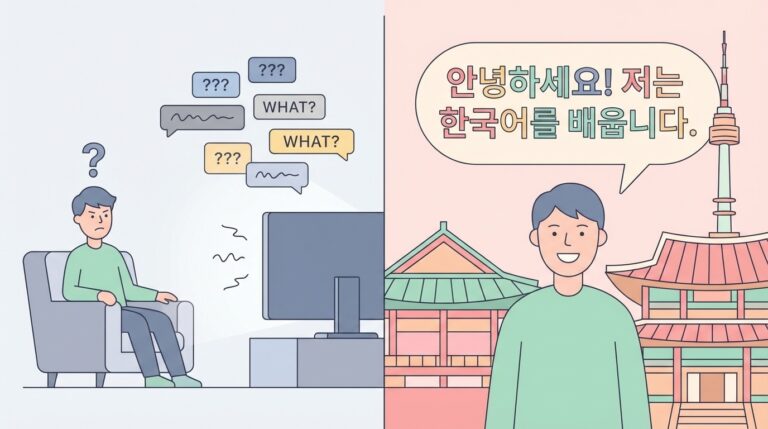
Phase 1: The “Subtitles Off” Dream (Immersive Hook)
Hello! This is your Daily Hangul Editor. 👋
Picture this: You are watching the latest episode of a trending K-Drama (maybe Queen of Tears or Squid Game season 2). The lead actor whispers something incredibly emotional, tears welling up in their eyes. You look down to read the subtitles, but for a split second, you miss the subtle twitch of their eyebrow that conveyed the real acting.
Or perhaps you’re at a fan meeting. Your bias is right there, asking you a question. You freeze. You know the words in your head, but your mouth feels like it’s glued shut. You end up just smiling and saying, “Ne… ne…” (Yes… yes…).
Frustrating, right? We’ve all been there. That burning desire isn’t just about passing a TOPIK exam; it’s about connection. Today, we are going to move beyond the textbook “I study Korean” and learn how to express your burning ambition: “I want to speak Korean fluently.”
Let’s turn those subtitles off in your brain.
Phase 2: Deep Dive into Core Expressions
1. 한국어를 유창하게 하고 싶어요
(I want to speak Korean fluently)
- Pronunciation: [Hangugeo-reul yuchang-hage hago sipeoyo]
- Sound tip: For 유 (yu), think of the “you” in “You need to practice.” For 창 (chang), imagine the sound of a window (chang-mun) opening swiftly.
- Meaning:
- Literal: I want to do Korean fluently.
- Real Nuance: “I want my words to flow like water without getting stuck.”
- K-Culture Moment: This is the standard interview answer when K-Pop idols are asked about their goals for learning English or Japanese. It shows professionalism and high ambition.
- Editor’s Insight: The word
유창하게comes from Hanja (Chinese characters) meaning “flowing smoothly.” It’s a B1+ word. Beginners say “잘하고 싶어요” (I want to do well), but Intermediate learners say “유창하게 하고 싶어요.” - Situation Spectrum:
[🚫 Formal Only] ———— [⚠️ Semi-Formal] ———— [✅ All-Rounder]
(Actually, this phrase is polite enough for almost any situation! ✅) - 🤔 Think About It: Why do we value “fluency” (speed/flow) over “accuracy” (grammar)? In Korean culture, keeping the conversation flowing (nunchi) is often more important than perfect grammar.
2. 자막 없이 드라마를 보고 싶어요
(I want to watch dramas without subtitles)
- Pronunciation: [Jamak eopsi deurama-reul bogo sipeoyo]
- Sound tip: 없 (eops) sounds like “oops” without the ‘s’, but with a sharp stop at the end.
- Meaning: A specific, relatable goal.
- K-Culture Moment: Every international fan’s ultimate dream. Using this phrase instantly bonds you with other learners or makes Koreans go, “Ooh, that’s a serious goal!”
- Editor’s Insight: This is a much more natural and conversational way to express your desire than saying “I want to reach TOPIK Level 6.”
- Situation Spectrum:
Friends/Casual: ✅
Teachers/Interviews: ✅
3. 한국 사람처럼 자연스럽게 말하고 싶어요
(I want to speak naturally like a Korean)
- Pronunciation: [Hanguk saram-cheoreom jayeon-seureop-ge malhago sipeoyo]
- Meaning:
- Literal: Like a Korean person, naturally, I want to speak.
- Real Nuance: “I don’t want to sound like a textbook robot. I want the vibe, the slang, and the rhythm.”
- Editor’s Insight: The key word here is 자연스럽게 (naturally). Koreans love it when things feel “natural” rather than “artificial” or “forced.”
- 🤔 Think About It: Is “sounding like a native” actually necessary? Or is having your own unique accent part of your charm? (More on this later!)
Phase 3: Textbook vs. Real Life
| Situation | 📖 Textbook Korean | 🗣️ Real Korean (Insa/Insider Style) | 💡 Why the difference? |
|---|---|---|---|
| Telling a friend your goal | 한국말을 잘하고 싶습니다. (I want to speak Korean well.) |
프리토킹이 되면 좋겠어. (I wish I could do “Free Talking.”) |
“Free Talking” (Konglish) is the specific term Koreans use for effortless conversation. |
| Expressing frustration | 한국어가 너무 어려워요. (Korean is too hard.) |
아, 입이 안 트여요. (Ah, my mouth won’t “open up”/unlock.) |
Koreans visualize speaking as a blocked channel that needs to “burst open” (트이다). |
| Wishing for improvement | 한국어 실력이 늘었으면 좋겠어요. (I wish my skills would improve.) |
한국어 패치가 시급해요. (I urgently need a Korean “patch”.) |
A metaphor from gaming/software updates. It’s funny and trendy. |
💡 Editor’s Note: Use “패치” (patch) only with close friends who are familiar with internet slang!
Phase 4: Cultural Deep Dive — The “Nunchi” of Learning
4-1. Non-verbal: The “Humble Brag” Head Scratch
When you say, “I want to be fluent,” usually a Korean listener will reply, “But you are already so good!” (Hangukmal jalhasineyo!).
* Do NOT say: “Yes, I know.” (Arrogant! 🚫)
* Do say: Scratch the back of your head slightly, wave your hand in denial, and say “아니에요, 아직 멀었어요” (No, I’m still far from it).
4-2. K-Culture Connection: The “Trainee” Mindset
In K-Pop, before idols debut, they are “trainees” (연습생). They practice for years not just to sing, but to embody the concept.
Think of yourself as a Korean Language Trainee.
* K-Drama Trope: The montage scene where the protagonist studies late at night with nosebleeds.
* Your Reality: You don’t need nosebleeds, but you do need that “fighting” spirit. When you tell a Korean “I want to be fluent,” you are declaring your debut date is coming soon. It shows you respect their culture enough to want to master it, not just dabble in it.
Phase 5: Immersive Roleplay
Setting: A trendy cafe in Yeonnam-dong. You are with your Korean language exchange partner, Ji-min (20s, enthusiastic, talks fast).
Start Roleplay:
Ji-min: 와, 너 한국어 발음 진짜 좋아졌다! 요즘 공부 열심히 해?
(Wa, neo hangugeo bareum jinjja joajyeotda! Yojeum gongbu yeolsimhi hae?)
(Wow, your pronunciation got really good! Studying hard these days?)
YOU:
(Select your response!)
🔀 Decision Point:
* A) 네, 열심히 해요. (Yes, I do hard.) – A bit dry.
* B) 아직 멀었어요. 더 유창하게 하고 싶어요. (Still far. I want to be more fluent.) – Perfect humility & ambition.
* C) 당연하지! 나 한국인 다 됐어. (Of course! I’m practically Korean.) – Risky joke.
✅ Best Choice: B
Ji-min: 오~ 욕심 있네! (Oh~ You have ambition!) 구체적으로 어떤 목표가 있어?
(O~ yoksim inne! Guchejeogeuro eotteon mokpyoga isseo?)
(Oh~ Ambitious! Do you have a specific goal?)
YOU: 음… 솔직히 말하면…
(Umm… honestly speaking…)
[Insert Phrase: 자막 없이 드라마를 보고 싶어요.]
Ji-min: 대박! 그거 진짜 어려운데. 나랑 같이 연습하면 금방 할 수 있을 거야! 화이팅!
(Daebak! That’s really hard. If you practice with me, you’ll do it soon! Fighting!)
Phase 6: 10-Second Shadowing Drill
Let’s train your mouth muscles! Repeat after me with the emotion tags.
- 😤 Determined:
저는 / 한국 사람처럼 / 자연스럽게 / 말하고 싶어요!
(Jeo-neun / Hanguk saram-cheoreom / jayeon-seureop-ge / malhago sipeoyo!) -
🥺 Earnest/Desperate:
제발… / 자막 없이 / 예능을 / 보고 싶어요…
(Jebal… / jamak eopsi / yeneung-eul / bogo sipeoyo…) -
😊 Confident:
내년에는 / 한국어로 / 프리토킹 / 할 거예요!
(Naenyeon-eneun / hangugeo-ro / peuri-toking / hal geoyeyo!)
Phase 7: K-Culture Mini Glossary
| Korean | Romanization | Meaning | Context |
|---|---|---|---|
| 프리토킹 | Peuri-toking | Free Talking | Ability to hold a conversation without a script or textbook topic. |
| 귀가 트이다 | Gwi-ga teu-ida | Ears open up | The magical moment you suddenly understand spoken Korean. |
| 자막 | Jamak | Subtitles | The barrier between you and your Oppa/Unnie. |
| 언어 교환 | Eoneo gyohwan | Language Exchange | A popular way to meet Koreans (and sometimes date 👀). |
| 울렁증 | Ulleong-jeung | Nausea/Anxiety | Used metaphorically for “nervousness when speaking a foreign language” (e.g., 영어 울렁증). |
Phase 8: Traveler’s Survival Kit
You are traveling, and you want to practice, but people keep switching to English. Stand your ground!
🆘 Survival Expression #1: The “Let Me Try” Shield
* 🇰🇷 “한국어로 연습하고 싶어요.” (Hangugeo-ro yeonseup-hago sipeoyo.)
* 🗣️ Meaning: I want to practice in Korean.
* 📍 Where: Cafes, Hotels, Convenience Stores.
* 💡 Pro Tip: Smile broadly when you say this. Most Koreans will be touched and switch back to Korean for you.🆘 Survival Expression #2: The “Slow Down” Request
* 🇰🇷 “조금만 천천히 말해 주세요.” (Jogeum-man cheoncheonhi malhae juseyo.)
* 🗣️ Meaning: Please speak a little slowly.📌 Editor’s Travel Note:
If you are in busy areas like Myeongdong, clerks might speak English for speed. Don’t take it personally! Try visiting quieter neighborhoods (like Seochon or Mangwon-dong) to find locals willing to chat.
Phase 9: Think Deeper — Language & Identity
🧠 The Trap of “Sounding Native”
We often say “I want to speak like a Korean.” But have you considered why? In Korea, there is a strong concept of “Danil Minjok” (One Ethnic Family). Speaking the language perfectly is seen as the only way to truly belong.
However, as Korea becomes more global, this is changing. You don’t need to erase your accent to be “fluent.” Your accent carries your history and your effort.
💬 Your Turn: Do you want to sound exactly like a native, or do you want to keep a bit of your own accent as a “cultural badge”? Why? Let me know in the comments!
Phase 10: FAQ & Troubleshooting
- Q: Can I say “…하고 싶어” (casual) to my teacher?
- A: 🚫 NO! Always end with “-yo” (요) or “-seumnida” (습니다) unless you have agreed to be casual friends. Ambition does not excuse rudeness!
- Q: People laugh when I try to speak. Are they mocking me?
- A: usually, No. In Korean culture, hearing a foreigner speak Korean is still a delightful “surprise.” The laughter is often out of awkwardness or endearment (Gwiyeowo!), not malice.
- ❌ Common Mistake: Saying “I speak well” (저는 한국말 잘해요) to a superior.
- ✅ Fix: Use “I am studying hard” (열심히 배우고 있습니다). Humility is the ultimate fluency hack.
Phase 11: Wrap-up & Mission
One-Liner Summary: To say you want to be fluent, use “유창하게 하고 싶어요” for professional vibes, and “자연스럽게 하고 싶어요” for social vibes.
🚀 Action Mission:
* 🥉 Bronze: Look in the mirror and say “나는 한국어를 유창하게 할 거야!” 3 times with confidence.
* 🥈 Silver: Find a Korean YouTube video, turn off the subtitles for 1 minute, and try to catch just ONE word.
* 🥇 Gold: Go to a Korean restaurant (or online forum) and tell someone: “I am studying Korean because I want to watch dramas without subtitles.”
🎬 K-Culture Mission: Watch a clip of a K-Pop idol speaking a foreign language (like Blackpink’s Lisa speaking Korean/Thai/English). Observe their confidence even when they make mistakes. That is your role model!
Phase 12: Interactive Quiz
- Situation: You are at a job interview for a Korean company. They ask about your Korean goals. What is the best answer?
- A) 프리토킹 하고 싶어요. (Too casual/slangy)
- B) 비즈니스 한국어를 유창하게 구사하고 싶습니다. (I want to command business Korean fluently.)
- C) 한국 드라마 자막 없이 보고 싶어요. (Too personal)
- True or False: If a Korean says “Your Korean is good!”, you should immediately agree and say “Thank you.”
- (True / False)
Answers:
1. B (Use formal vocabulary like ‘구사하다’ in interviews.)
2. False (Show ‘Humble Brag’ etiquette! Say “No, I still have a long way to go.”)
Frequently Asked Questions (FAQ)
Q: What does "유" mean in Korean and how do you pronounce it?
A: In Korean, "유" is pronounced [yu] and means: , think of the "you" in "You need to practice." For
Q: What does "창" mean in Korean and how do you pronounce it?
A: In Korean, "창" is pronounced [chang] and means: , imagine the sound of a window (
Q: What does "없" mean in Korean and how do you pronounce it?
A: In Korean, "없" is pronounced [eops] and means: sounds like "oops" without the 's', but with a sharp stop at the end.