

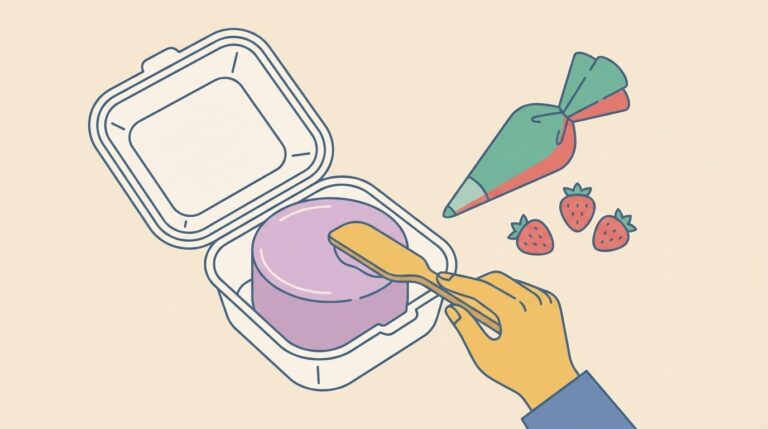
Mastering the Art of “K-Cake” Icing: More Than Just Sweetness 🎂
Phase 1: Welcome to the World of “Aesthetic” Sweets
안녕하세요! This is your Daily Hangul Editor.
Have you ever scrolled through Instagram and stopped at those perfectly minimalist, pastel-colored cakes from a cafe in Yeonnam-dong? Or maybe you’ve seen a K-Drama scene where the protagonist gifts a “Dosirak Cake” (lunchbox cake) with a clumsy but heartfelt message written in icing?
In Korea, a cake isn’t just a dessert; it’s a visual love letter. The trend of “Lettering Cakes” (레터링 케이크) has exploded, and the standard for icing (아이싱) has skyrocketed. If you take a one-day baking class in Seoul—a huge trend right now—you’ll realize that asking “Is this good?” isn’t enough.
You need the vocabulary to discuss texture, angles, and finesse. Today, we are stepping into the kitchen. Put on your apron; we’re going to learn the language of perfection.
Phase 2: Deep Dive into Icing Vocabulary
1. [각을 잡다 / 각을 살리다]
- Pronunciation: [gageul japda / gageul sallida] + Think of the sharp sound of a knife hitting a cutting board: ‘Gak!’
- Meaning: Literally “to catch/save the angle.” In baking, it means to create sharp, crisp edges on the cake.
- K-Culture Moment: You know those military dramas where soldiers fold their blankets perfectly? That’s also called “각을 잡다.” In baking, it’s the difference between a professional cake and a home-made one.
- Editor’s Insight: This is a C1-level phrase because “각” (angle) is used metaphorically in many situations (e.g., “sizing up a situation”). In baking, it’s about precision.
- Situation Spectrum:
[🚫 Boss] ———— [⚠️ Colleague] ———— [✅ Class/Friends]
(Use freely in baking contexts or casually with friends when talking about being prepared.) - 🤔 Think About It: Why does Korean culture value sharpness and neatness (각) so much, even in soft desserts? Is it related to the “Palli-Palli” culture of efficiency, or an aesthetic of discipline?
2. [매끄럽게 다듬다]
- Pronunciation: [maekkeureopge dadeumda] + ‘Mae’ sounds like ‘May’, ‘ddeum’ sounds like a soft drum beat.
- Meaning: To smooth out / to trim or refine neatly.
- K-Culture Moment: Watch a K-Pop idol getting their hair and makeup fixed before going on stage. The stylist is “다듬다”-ing their look. It implies adding the final, perfecting touch.
- Editor’s Insight: You don’t just “spread” (바르다) the cream. You refine it. This verb shows you care about the finish, not just the action.
- Situation Spectrum:
[✅ Universal] - 🤔 Think About It: The word ‘다듬다’ is also used for fixing relationships or emotions. How does this reflect the Korean value of harmony?
3. [농도를 맞추다]
- Pronunciation: [nongdoreul matchuda] + ‘Nong’ like the gong sound, ‘do’ like dough.
- Meaning: To adjust the consistency/density.
- K-Culture Moment: In cooking shows like Culinary Class Wars, chefs obsess over this. “The sauce consistency is off.” It’s the technical term that separates amateurs from pros.
- Editor’s Insight: If your icing is too runny, it’s a disaster. Use this when asking your instructor for help: “Is this thickness right?”
- Situation Spectrum:
[✅ Universal]
Phase 3: Textbook vs. Real Life Korean
| Situation | 📖 Textbook Korean | 🗣️ Real Korean | 💡 Why the difference? |
|---|---|---|---|
| Smoothing the cream | 크림을 평평하게 만드세요. (Make the cream flat.) |
아이싱 면을 정리해주세요. (Clean up the icing surface.) |
‘정리하다’ implies organizing chaos into order, which fits the mindset of icing better. |
| Asking about texture | 크림이 너무 딱딱해요. (The cream is too hard.) |
크림이 너무 뻑뻑해요. (The cream is too stiff/dry.) |
‘뻑뻑하다’ specifically describes texture resistance (like stiff shoulders or dry dough). |
| Messing up | 실수를 했어요. (I made a mistake.) |
아, 망했다… / 번졌어요. (Ah, I’m doomed… / It smudged.) |
Native speakers use specific verbs for the type of mistake (smudging vs. breaking). |
💡 Editor’s Note: “뻑뻑하다” is a great sensory word. You can even use it to describe “dry eyes” or a “stiff conversation”!
Phase 4: Cultural Deep Dive
4-1. The “Hand Taste” (손맛) Myth
In Korea, even in baking which requires scientific precision, people talk about 손맛 (Son-mat). It literally means “hand taste.” It implies that the unique touch, care, and temperature of the creator’s hands change the flavor. When you are icing, don’t just look at the cake—feel the spatula as an extension of your hand. A teacher might say, “손에 힘을 빼세요” (Relax your hand strength). It’s about flow, not force.
4-2. The Rise of the “Custom Cake” (Jumun-jjak Cake)
Why is icing vocabulary so specific? Because of the Fan Culture (Fandom). K-Pop fans order custom cakes for their idols’ birthdays to display in cafes. These cakes are often photographed thousands of times. If the lettering is “smudged” (번지다) or the “edges” (각) aren’t sharp, it’s considered a lack of sincerity (정성). The visual perfection is part of the tribute.
Phase 5: Immersive Roleplay
Setting: A trendy One-Day Baking Class in Seongsu-dong (the Brooklyn of Seoul). The room smells of vanilla and fresh strawberries. You are trying to finish a vintage-style lettering cake.
Characters:
– YOU: An advanced learner trying to impress with a handmade gift.
– Teacher (지수쌤): A kind but perfectionist instructor (30s).
Dialogue:
지수쌤: 자, 이제 스패출러를 45도로 세우고 돌려보세요. 손목 힘 빼시고요!
(Ja, ije sepaechulleoreul 45-doro seugo dollyeoboseyo. Sonmok him bbaesigoyo!)
(Okay, now hold the spatula at 45 degrees and spin it. Relax your wrist!)
YOU: 선생님, 옆면이 자꾸 거칠게 나와요. 농도가 안 맞는 걸까요?
(Seonsaengnim, yeommyeoni jakku geochilge nawayo. Nongdoga an manneun geolkkayo?)
(Teacher, the sides keep coming out rough. Is the consistency off?)
지수쌤: 어디 봐요… 아, 크림이 좀 오버 휘핑(over-whipping) 됐네요. 조금 더 부드럽게 풀어드릴게요.
(Eodi bwayo… Ah, keurimi jom obeo-hwiping dwaenneyo. Jogeum deo budeureopge pureodeurilgeyo.)
(Let me see… Ah, the cream is a bit over-whipped. I’ll loosen it up to make it softer.)
YOU: 다행이네요. 저는 제가 각을 못 잡아서 그런 줄 알았어요.
(Dahaengineyo. Jeoneun jega gageul mot jabaseo geureon jul arasseoyo.)
(That’s a relief. I thought it was because I couldn’t get the edges sharp.)
지수쌤: (웃으며) 각은 좋은데요? 아이싱 마무리만 매끈하게 하면 완벽하겠어요.
(Gageun joeundeyo? Aising mamuriman maekkeunhage hamyeon wanbyeokhagesseoyo.)
(Laughs) The edges are good though? If you just finish the icing sleekly, it will be perfect.)
🔀 Decision Point: The teacher compliments you. How do you respond?
– A) “아니에요, 아직 멀었어요.” (No, I still have a long way to go.)
– B) “제가 좀 소질이 있죠?” (I have some talent, right?)
– C) “선생님이 잘 가르쳐주셔서 그래요.” (It’s because you taught me well.)✅ Best Choice: C. In Korean culture, attributing your success to the teacher’s guidance is the ultimate humble-brag and shows high social intelligence (nunchi).
⚠️ Choice B Analysis: This might seem arrogant unless said jokingly between close friends.
Phase 6: 10-Second Shadowing Drill
Let’s practice the “frustrated but determined” artist tone.
“Please help me! The letters are smudging!”
😢 선생님! / 글씨가 / 자꾸 / 번져요…
(Seonsaengnim! / geulssiga / jakku / beonjyeoyo…)
- Focus: Elongate ‘자꾸’ (jakku~~) to emphasize your recurring frustration.
- Intonation: Drop the pitch at ‘번져요’ to sound sad about the cake.
Phase 7: K-Culture Mini Glossary
| Korean | Romanization | English | Context |
|---|---|---|---|
| 도시락 케이크 | Dosirak Cake | Bento Box Cake | Small, lunchbox-sized custom cakes. Very trendy for light gifts. |
| 레터링 | Reteoring | Lettering | Writing messages on cakes with icing. The core of K-Cake culture. |
| 짤주머니 | Jjaljumouni | Piping bag | Literally “squeezing pocket.” Essential tool. |
| 생크림 | Saeng-keurim | Fresh cream | Koreans prefer light, dairy cream over heavy American buttercream. |
| 아이싱 | Aising | Icing | Used as a verb: “아이싱하다” (to ice a cake). |
Phase 8: Traveler’s Survival Kit (Ordering a Custom Cake)
Even if you don’t bake, you might want to order a custom cake for a friend while traveling in Korea.
🆘 Survival Phrases for Ordering
– 🇰🇷 “문구는 이걸로 해주세요.” (Munguneun igeollo haejuseyo.)
– “Please use this for the text/message.”
– 🇰🇷 “픽업 시간 변경 가능할까요?” (Pigeop sigan byeongyeong ganeunghalkkayo?)
– “Is it possible to change the pickup time?”
– 🇰🇷 “고정 핀이 있나요?” (Gojeong pini innayo?)
– “Is there a fixing pin inside?” (Crucial! Korean custom cakes often lack pins inside, so they slide easily. Ask this to know how carefully you must carry it.)📌 Editor’s Travel Note
Most custom cake shops in Korea operate via KakaoTalk Channel or Instagram DM, not phone calls. You often need to fill out a specific form in Korean. Use Papago to translate the form fields!
Phase 9: Think Deeper — “The Aesthetics of Consumption”
The Visual Language of Korea
Why does a cake need to look like a piece of art? In Korea, visual presentation is a form of language. The concept of “보기 좋은 떡이 먹기도 좋다” (Rice cakes that look good taste good too) is deeply ingrained.
However, there’s a modern twist. The “Instagrammability” of a dessert sometimes outweighs its taste. This reflects a shift in Korean society where sharing the experience (posting a photo) is as important as the experience itself (eating). When you learn words like “각을 잡다” (sharpen the edges), you are learning the language of this visual-centric social etiquette.
💬 Your Turn: In your culture, does the look of the food matter more than the portion size? Let us know in the comments!
Phase 10: FAQ & Troubleshooting
Q: Can I dip my finger in the cream to taste it during class?
A: 🚫 NO. Korean hygiene standards are very high. Usually, tasting is done with a clean spoon, and never double-dipped. Wait for the teacher to offer.
Q: Is it rude to say the cake looks “messy”?
A: Yes. Instead of “지저분해요” (It’s messy/dirty), say “표면이 고르지 않아요” (The surface isn’t even) or “정리가 좀 덜 됐어요” (It’s not quite tidied up yet). It sounds much more professional and polite.
⚠️ Common Mistake:
❌ Using “바르다” (spread) for everything.
✅ Use “아이싱하다” (to ice) or “샌딩하다” (to sand/fill between layers) for specific steps. It shows you know what you are doing.
Phase 11: Wrap-up & Action Items
One-Liner: To master Korean baking terms, remember that visual perfection (각) and texture (농도) are your new best friends.
🚀 Your Mission:
– 🥉 Bronze: Say “각을 살려주세요” while pretending to smooth a blanket or a cake.
– 🥈 Silver: Search #레터링케이크 on Instagram and leave a comment in Korean: “아이싱이 정말 매끄러워요!” (The icing is really smooth!)
– 🥇 Gold: Go to a bakery in Korea (or a Korean bakery in your city) and ask, “이 케이크는 생크림인가요, 버터크림인가요?” (Is this fresh cream or buttercream?)
K-Culture Mission: Watch a “Home Cafe” (홈카페) video on YouTube. Listen for the sound of the tools and try to spot the word “아이싱” in the subtitles!
Phase 12: Interactive Quiz
- Situational Judgment: You are holding a piping bag, but the cream is too hard to squeeze out. What do you say?
- a) 크림이 너무 시끄러워요. (The cream is too noisy.)
- b) 크림이 너무 뻑뻑해요. (The cream is too stiff.)
- c) 크림이 너무 매끄러워요. (The cream is too smooth.)
- K-Culture True/False:
- “In Korea, it is common for custom cakes to have a ‘fixing pin’ inside to keep them safe.”
- (Hint: Check the Survival Kit again!)
- Fill in the Blank:
- “The icing is messy. Can you help me [_____] the edges?”
- (Tip: Think of the military blanket folding term!)
Answer Key:
1. (b) 뻑뻑하다 is the correct texture word.
2. False. Many Korean custom cakes (especially mousse or soft cream) do NOT have pins, so you must carry them like a newborn baby!
3. 각을 잡다 (or 각을 살리다)
Frequently Asked Questions (FAQ)
Q: What does "[각을 잡다 / 각을 살리다]" mean in Korean and how do you pronounce it?
A: In Korean, "[각을 잡다 / 각을 살리다]" is pronounced [gageul japda / gageul sallida] and means: Literally "to catch/save the angle." In baking, it means to create sharp, crisp edges on the cake.
Q: What does "[매끄럽게 다듬다]" mean in Korean and how do you pronounce it?
A: In Korean, "[매끄럽게 다듬다]" is pronounced [maekkeureopge dadeumda] and means: To smooth out / to trim or refine neatly.
Q: What does "[농도를 맞추다]" mean in Korean and how do you pronounce it?
A: In Korean, "[농도를 맞추다]" is pronounced [nongdoreul matchuda] and means: To adjust the consistency/density.







