

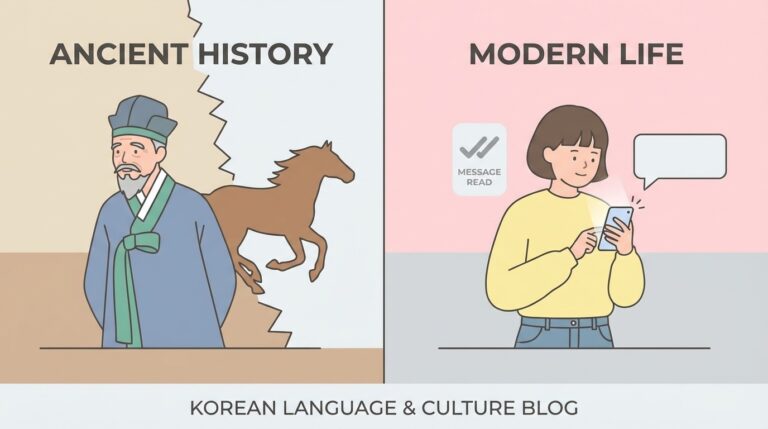
Phase 1: The ‘Aha!’ Moment — K-Drama Logic 🎬
Hello! This is your Daily Hangul Editor.
Picture this: You are watching the season finale of a hit K-Drama. The main character just lost their job, got dumped, and missed the bus. It feels like the end of the world. But suddenly, because they missed that bus, they meet a mysterious stranger who changes their life forever.
The camera zooms out, and a wise grandmother in the background clicks her tongue and says, “Insaeng… Saeongjima-ya (Life is… Saeongjima).”
The subtitles just say “Life is unpredictable,” but you know there’s more to it. Why do Koreans use these four-character codes (Sajeoseong-eo) to explain complex life situations? Today, we are cracking the code of Gosa-seong-eo (idioms derived from ancient history) that explain the Korean mindset perfectly.
Knowing these isn’t just about vocabulary; it’s about understanding why your Korean friend says “It’s a blessing in disguise” or why they get frustrated when a message goes unanswered. Let’s dive into the stories behind the words.
Phase 2: Deep Dive into the Code 🧐
Here are three idioms that will instantly upgrade your Korean from “Textbook Student” to “Cultured Insider.”
1. 새옹지마 (Saeongjima)
- Pronunciation: [Sae-ong-ji-ma] Sounds like: “Say-ong-jee-ma”
- Meaning:
- Literal: The old man of the border’s horse.
- Real Nuance: Life’s ups and downs are unpredictable; a blessing can be a curse, and a curse can be a blessing.
- The Origin Story: An old man lived near the border. One day his horse ran away (bad luck). People pitied him, but he said, “Who knows?” The horse returned with a wild mare (good luck). Then his son broke his leg riding the new horse (bad luck). But because of the broken leg, the son didn’t have to go to war (good luck).
- K-Culture Moment: Every time a K-Pop idol faces a scandal but bounces back even stronger, or when a drama character loses everything only to find true love. It represents the Korean resilience.
- Situation Spectrum:
[✅ Casual] — [✅ Semi-formal] — [✅ Formal] - 🤔 Think About It: Why is this fatalistic yet optimistic view so central to Korean history? Perhaps because Korea has faced many invasions and rapid changes, creating a mindset of “this too shall pass.”
2. 함흥차사 (Hamheungchasa)
- Pronunciation: [Ham-heung-cha-sa] Sounds like: “Ham-hung-cha-sa”
- Meaning:
- Literal: Messenger to Hamheung.
- Real Nuance: Someone who goes on an errand and never returns, or never gives an update/reply.
- The Origin Story: In the early Joseon Dynasty, King Taejong sent messengers to the city of Hamheung to persuade his angry father (the former King) to return. The father was so furious he allegedly killed or imprisoned every messenger. None came back.
- Editor’s Insight: Use this when your friend goes to the bathroom and doesn’t come back for 30 minutes, or when you order delivery (Baedal) and it’s an hour late. It implies frustration with a delay.
- Situation Spectrum:
[✅ Casual] — [✅ Semi-formal] — [🚫 Formal (Avoid with strict bosses)]
3. 이심전심 (Isimjeonsim)
- Pronunciation: [I-sim-jeon-sim] Sounds like: “Ee-shim-jun-shim”
- Meaning:
- Literal: From heart to heart.
- Real Nuance: Telepathy; understanding each other without words.
- The Origin Story: It comes from Buddhism. Buddha held up a flower during a sermon without saying a word. Only one disciple smiled, understanding the profound meaning instantly.
- K-Culture Moment: The “Slow Motion Stare” in romantic K-Dramas. They don’t speak, but their eyes say “I love you.” That is Isimjeonsim.
- Situation Spectrum:
[✅ Casual] — [✅ Semi-formal] — [✅ Formal]
Phase 3: Textbook vs. Real Life 🆚
| Situation | 📖 Textbook Korean | 🗣️ Real Korean (Slang/Idiom) | 💡 Why the difference? |
|---|---|---|---|
| Friend is late/No reply | 소식이 없어요. (There is no news.) | 완전 함흥차사네! (Totally Hamheungchasa!) | Idioms express the emotion of frustration better than plain facts. |
| Cheering up a friend | 인생은 알 수 없어요. (Life is unknowable.) | 인생 새옹지마야. (Life is Saeongjima.) | Provides philosophical comfort rather than just stating a fact. |
| Perfect teamwork | 우리는 마음이 잘 맞아요. (Our hearts match well.) | 우리는 이심전심이지 / 통했어! | Emphasizes a spiritual or deep connection typical of “Jeong” culture. |
💡 Editor’s Note: In casual chat (KakaoTalk), instead of the full 4-character idiom, young people might just say “안읽씹” (An-ilk-ssip: not reading and ignoring) instead of Hamheungchasa. But knowing the idiom makes you sound smart!
Phase 4: Cultural Context — The “High Context” Society 🇰🇷
4-1. Nunchi and Silence
In Western cultures, clear verbal communication is key. In Korea, silence speaks volumes. Isimjeonsim is closely related to Nunchi (the art of gauging the atmosphere). If you have to explain everything in words, the connection is considered weak. The goal of a close relationship in Korea is to reach a state of Isimjeonsim where words are unnecessary.
4-2. K-Food Connection: The “Service” Culture
Think of Saeongjima when you visit a restaurant. Maybe the restaurant you wanted to go to is closed (Bad luck). But the owner of the place next door sees you and offers you a free drink (“Service”) to come in, and the food turns out to be amazing (Good luck). Korean dining is full of these spontaneous turns of fortune!
Phase 5: Roleplay Scenario 🎭
Setting: A Friday night at a Han River Park. You and your Korean friend, Jisoo, ordered fried chicken 50 minutes ago. It still hasn’t arrived.
Jisoo: 아, 배달원 아저씨 왜 안 오시지? 벌써 50분 지났어.
(Ah, baedal-won ajeossi wae an osiji? Beolsseo 50-bun jinasseo.)
(Ah, why isn’t the delivery guy coming? It’s already been 50 minutes.)
YOU:
(Select your response)
📐 Your Turn! How do you respond?
- A) “Maybe he got lost?” (Logical, but plain)
- B) “Wow, he is totally Hamheungchasa!” (Witty & Contextually Perfect)
- C) “This is Saeongjima.” (A bit awkward context, unless the delay leads to finding $100 on the ground)
✅ Best Choice: B
* Jisoo’s Reaction: “그러니까! 진짜 함흥차사네. 전화 한번 해볼까?” (Exactly! Totally Hamheungchasa. Should I call him?)
* Why? You correctly identified the situation of “waiting with no news.”
(Suddenly, the delivery arrives, and the driver gives you extra cheese balls as an apology.)
YOU: “Look! Because he was late, we got free cheese balls!”
Jisoo: “Haha, I guess this is Saeongjima, right?”
Phase 6: 10-Second Shadowing Drill 🗣️
Let’s practice the rhythm. Korean idioms usually have a 2+2 beat.
- Consoling a friend: (Warmly 😊)
- 너무 / 걱정하지 마. / 인생은 / 새옹지마잖아.
- Neomu / geokjeong-haji ma. / Insaeng-eun / Sae-ong-ji-ma-jana.
- Complaining about a reply: (Annoyed 😤)
- 답장이 / 완전 / 함흥차사야!
- Dapjang-i / wanjeon / Ham-heung-cha-sa-ya!
Phase 7: K-Culture Mini Dictionary 📚
| Korean | Romanization | Meaning | Context |
|---|---|---|---|
| 고사성어 | Gosa-seong-eo | Idioms from history | Usually 4 characters, derived from Chinese classics or Korean history. |
| 운 | Un | Luck/Fortune | Used in “Un-i jota” (lucky) or “Un-i nappeuda” (unlucky). |
| 답장 | Dapjang | Reply/Answer | Essential word when waiting for a text (related to Hamheungchasa). |
| 텔레파시 | Telepasi | Telepathy | Modern Konglish equivalent of Isimjeonsim. |
Phase 8: Traveler’s Survival Kit 🎒
Even if you are just traveling, knowing “Saeongjima” helps you keep a positive attitude when things go wrong!
🆘 Survival Phrase #1: When plans change
* 🇰🇷 “어쩔 수 없죠, 뭐.” (Eojjeol su eop-jjo, mwo.)
* 🗣️ Meaning: “Can’t be helped.” / “It is what it is.”
* 📍 Usage: When you miss the bus or the museum is closed. It embodies the acceptance spirit of Saeongjima.📌 Editor’s Travel Note:
If your KakaoTaxi shows “Arriving in 3 min” for the last 10 minutes, you can mutter to your friend: “This taxi is Hamheungchasa…” It will make any nearby Korean driver laugh (or drive faster)!
Phase 9: Think Deeper — Language & Efficiency 🧠
Why do Koreans love 4-character idioms?
Korean culture values “high-density communication.” Instead of explaining a long story about a horse, a border, and a broken leg, saying just four syllables—Sae-ong-ji-ma—transmits the entire philosophy and emotional context instantly. It’s like a cultural zip file.
Also, historically, knowing these idioms (which often come from Chinese characters, Hanja) was a sign of the educated elite. Today, using them appropriately still gives off an intellectual vibe, showing you respect the history behind the language.
💬 Your Turn: Does your language have short idioms that tell a whole story? (Like “Sour Grapes” or “Trojan Horse”)? Share in the comments!
Phase 10: FAQ & Troubleshooting 🛠️
Q: Can I use these idioms with my boss?
A: Generally, yes! Saeongjima and Isimjeonsim are very safe and make you sound professional. However, be careful with Hamheungchasa directed at your boss (e.g., “Boss, why are you Hamheungchasa with my approval?”). That implies you are annoyed with them. Use it about a third party or a situation instead.
Q: Is it old-fashioned?
A: Not at all. While they are “old” phrases, they are used frequently in news headlines, variety shows (like Running Man), and daily conversation. They are timeless classics.
❌ Common Mistake: Don’t mix up the order of the characters. “Jima-Saeong” means nothing!
Phase 11: Wrap-up & Mission 🏁
Summary: Life is unpredictable (Saeongjima), waiting is frustrating (Hamheungchasa), but true friends understand this without words (Isimjeonsim).
🔥 Action Mission:
* 🥉 Bronze: Say “Insaeng… Saeongjima” next time you drop your toast (butter side up!).
* 🥈 Silver: Text a friend who hasn’t replied in a while: “Are you Hamheungchasa? 😭”
* 🥇 Gold: Watch a K-Drama episode and try to spot a moment of Isimjeonsim between the leads.
K-Culture Mission: Go to a Korean convenience store (or Asian market), look at the “1+1” or “2+1” deals. If your favorite snack isn’t on sale (Bad luck), but you find a new snack that is delicious (Good luck), tell yourself: “This is Saeongjima!”
Phase 12: Interactive Quiz 🧩
1. Situation: You and your friend both reach for the last piece of Pizza at the exact same time and laugh.
* Which idiom fits best?
* A) Hamheungchasa
* B) Isimjeonsim
* C) Saeongjima
2. True or False:
* “Hamheungchasa” comes from a happy story about a King and his son having a party. (T/F)
3. Application:
* Your flight was cancelled, but because of that, you met your favorite K-Pop idol at the airport lounge.
* You shout: “This is complete _________!”
(Scroll down for answers)
.
.
.
Answers:
1. B (Isimjeonsim) – Telepathy!
2. False – It’s a tragic story about messengers never returning.
3. Saeongjima – Bad luck turned into good luck.
Frequently Asked Questions (FAQ)
Q: What does "새옹지마 (Saeongjima)" mean in Korean and how do you pronounce it?
A: In Korean, "새옹지마 (Saeongjima)" is pronounced [Sae-ong-ji-ma] and means: Literal: The old man of the border's horse.
Q: What does "함흥차사 (Hamheungchasa)" mean in Korean and how do you pronounce it?
A: In Korean, "함흥차사 (Hamheungchasa)" is pronounced [Ham-heung-cha-sa] and means: Literal: Messenger to Hamheung.
Q: What does "이심전심 (Isimjeonsim)" mean in Korean and how do you pronounce it?
A: In Korean, "이심전심 (Isimjeonsim)" is pronounced [I-sim-jeon-sim] and means: Literal: From heart to heart.







