

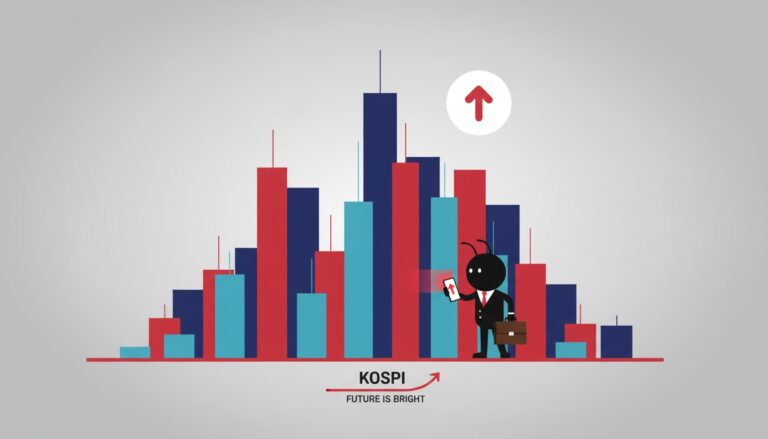
Phase 1: Immersive Hook — The Yeouido Pulse
Greeting: 안녕하세요! This is your Daily Hangul Senior Editor.
Picture this: It’s 11:30 AM on a weekday. You are in Yeouido (여의도), the Wall Street of Seoul. Office workers are pouring out for lunch, but everyone is glued to their smartphones. The Bank of Korea (한국은행) has just announced a ‘Big Step’ (빅스텝).
In a K-Drama like Reborn Rich or Misaeng, this is the moment the dramatic music swells. The protagonist looks at a graph plummeting in red (yes, in Korea, red means profit/up and blue means loss/down—opposite to the West!).
Your colleague sighs and says, “채권 금리가 치솟는데, 지금이라도 장기채 담아야 하나?”
If you only know textbook Korean, you might hear “interest rate” and “long term,” but the nuance of strategic timing and market psychology will fly right past you. Today, we are not just learning words; we are decoding the survival language of a high-interest era. Let’s master the art of bond investment strategy, C2 style.
Phase 2: Deep Dive — Critical Financial Vocabulary
To sound like a Yeouido insider, you need precision. Here are the heavy hitters.
1. 금리 인상 단행 (Geumri Insang Danhaeng)
- Pronunciation: [Geum-ni In-sang Dan-haeng] ‘Geum-ni’ sounds like ‘Gum-knee’.
- Meaning: Carrying out an interest rate hike (decisively).
- Nuance: You don’t just ‘do’ a rate hike in high-level Korean; you ‘carry it out’ (단행하다). This verb adds weight and official authority.
- K-Culture Moment: In news flashes, the anchor always says, “한국은행이 기준금리 인상을 단행했습니다.” It sounds inevitable and impactful.
- Editor’s Insight: Use this when discussing policy changes. It shows you understand the gravity of the decision.
- Situation Spectrum:
[🚫 Casual Friends] ———— [✅ Business/News] ———— [✅ Academic]- 🤔 Think About It: Why does Korean business language prefer militant or heavy verbs like ‘단행하다’ (carry out) or ‘공격적’ (aggressive) for economic policies? Does this reflect the rapid, driven nature of Korea’s economic development history?
2. 반비례 (Banbirye)
- Pronunciation: [Ban-bi-rye]
- Meaning: Inverse proportion / Inversely related.
- Nuance: Essential for explaining the bond market mechanic: “금리와 채권 가격은 반비례한다” (Interest rates and bond prices are inversely related).
- Editor’s Insight: Using ‘반대로 움직인다’ (move oppositely) is B1 level. Using ‘반비례 관계다’ is C2 level. It makes you sound analytical.
- Situation Spectrum:
[⚠️ Casual] ———— [✅ Professional] ———— [✅ Academic]3. 저가 매수 기회 (Jeoga Maesu Gihoe)
- Pronunciation: [Jeo-ga Mae-su Gi-hoe]
- Meaning: Opportunity to buy at a low price (Buying the dip).
- K-Culture Moment: This is the holy grail for the ‘Donghak Ants’ (동학개미)—the nickname for individual retail investors. In every YouTube investment comment section, you will see people debating if now is the time for 저가 매수.
- Editor’s Insight: Combined with ‘줍줍’ (Jup-jup – slang for picking up cheap items), this is the most exciting concept in Korean investing.
4. 관망세 (Gwanmangse)
- Pronunciation: [Gwan-mang-se]
- Meaning: A “wait-and-see” trend/sentiment.
- Nuance: It’s not just waiting; it’s observing the situation from a distance before making a move. It implies caution and strategy.
- Example: “지금은 적극적인 투자보다 관망세를 유지하는 게 좋습니다.” (Now is better to maintain a wait-and-see stance rather than aggressive investment.)
Phase 3: Textbook vs. Real Life (Yeouido Edition)
| Situation | 📖 Textbook Korean | 🗣️ Real Yeouido Korean | 💡 Why the difference? |
|---|---|---|---|
| Price Drop | 가격이 떨어졌어요. (Prices fell.) | 조정을 받고 있어요. (It’s undergoing a correction.) | ‘Falling’ sounds negative/permanent. ‘Correction’ (조정) sounds technical and temporary. |
| Buying | 채권을 샀어요. (I bought bonds.) | 채권을 담았어요 / 매집했어요. (I ‘put them in [my portfolio]’ / Accumulated.) | ‘Buying’ is too simple. Investors ‘fill their basket’ (담다) or systematically accumulate (매집). |
| Loss | 돈을 잃었어요. (I lost money.) | 물렸어요. (I got bitten/stuck.) | A vivid metaphor used by everyone. Like being bitten by a snake or trapped, meaning you can’t sell without a loss. |
Phase 4: Cultural Deep Dive — The “Ant” Mentalitly
4-1. The Color Psychology (Red vs. Blue)
In Western markets, red signals danger or loss. In Korea, Red (빨간색) is the color of fire, passion, and rising stock prices. Blue (파란색) signifies cooling down or falling prices.
* Tip: If your Korean boss is looking at a screen full of red numbers and smiling, do not ask, “Is something wrong?” He is making money.
4-2. Who are the “Ants” (개미)?
In Korean finance culture, individual investors are affectionately (and sometimes pitiably) called Gaemi (Ants).
* Donghak Ants (동학개미): Domestic stock investors (referencing a historical peasant revolution).
* Seohak Ants (서학개미): Investors trading US stocks (Westward ants).
* Chaegwon Ants (채권개미): The new breed of retail investors flocking to bonds as rates rise.
🤔 Think About It: Why animals? In English, you have Bulls and Bears. In Korea, the “Ant” represents the hardworking, numerous, but individually weak common people fighting against the giant institutions. It reflects a collective underdog identity.
Phase 5: Immersive Roleplay — The Strategy Meeting
Setting: A sleek Izakaya near Yeouido Station. 7:30 PM. You are having drinks with Director Choi (50s), a veteran investor who has survived the 1997 IMF crisis and the 2008 crash.
Characters:
* YOU: An expatriate finance manager.
* Director Choi: Experienced, cynical, but wise. Speaks in metaphors.
(Dialogue Start)
Director Choi: (Swirling his glass) 미국 국채 금리가 또 튀었어. 시장이 발작을 일으키는구먼.
(Miguk gukchae geumriga tto twieosseo. Sijang-i baljageul ireukineungumon.)
(US Treasury yields jumped again. The market is having a seizure.)
YOU: 🔀 Your Turn! How do you respond to show your insight?
- Option A: “네, 무서워요. 주식을 다 팔아야 할까요?” (Too simple/novice)
- Option B: “이럴 때일수록 단기채 위주로 방어적인 포트폴리오를 짜야 하지 않을까요?” (Professional & Strategic)
- Option C: “와, 금리 대박이네요!” (Too casual/childish)
✅ Best Choice: Option B
Translation: “In times like this, shouldn’t we build a defensive portfolio focused on short-term bonds (단기채)?”
Why: You acknowledged the volatility and proposed a C2-level strategy (defensive portfolio, short-term bonds).
Director Choi: 오, 제법인데? 하지만 나는 슬슬 장기채를 분할 매수할 생각이야. 금리 정점이 머지않았거든.
(Oh, not bad? But I’m thinking of split-buying long-term bonds. The rate peak isn’t far off.)
YOU: 아, 역시… ‘공포에 사라’는 말씀이시군요?
(Ah, as expected… you mean ‘Buy when there is blood in the streets’?)
Director Choi: (Laughing) 그렇지. 남들이 공포에 질려 던질 때가 진짜 기회니까.
(Exactly. When others throw things away in fear, that is the real opportunity.)
Phase 6: 10-Second Shadowing Drill
Let’s practice a sentence you can use in a meeting to sound prudent and smart.
Sentence: “Uncertainty is high, so we should take a conservative approach.”
😤 Serious & Professional Tone:
대외 불확실성이 / 여전히 높기 때문에 / 보수적인 관점에서 / 접근해야 합니다.
(Dae-oe bul-hwak-sil-seong-i / yeo-jeon-hi nop-gi ttae-mun-e / bo-su-jeok-in gwan-jeom-e-seo / jeop-geun-hae-ya ham-ni-da.)
Phase 7: K-Culture Mini Glossary (Finance Edition)
| Korean | Romanization | English | Context |
|---|---|---|---|
| 물타기 | Multagi | Averaging Down | Lit. “Adding water.” Buying more of a stock/bond as it drops to lower your average cost. |
| 상투 잡다 | Sangtu japda | Buying at the Top | Lit. “Grabbing the topknot.” Buying at the absolute peak price before a crash. |
| 존버 | Jonber | HODL | Slang. “Jonna Beotigi” (Enduring like hell). Holding an asset through massive losses hoping for a rebound. |
| 성투 | Seongtu | Successful Investment | Short for “성공 투자하세요” (Have a successful investment). Used to sign off on forums. |
Phase 8: Traveler’s Survival Kit — The Money Changer
Even if you aren’t trading bonds, interest rates affect exchange rates (환율). Here is how to handle currency exchange like a pro.
🆘 Survival Phrases for Currency Exchange
1. “환율 우대 되나요?” (Hwaryul udae doenayo?)
– Meaning: “Do I get a preferential exchange rate?” (Can I get a discount on the fee?)
– Context: Banks often give “coupons” or discounts on fees to foreigners or loyal customers.
2. “수수료 포함인가요?” (Susuryo pohamingayo?)
– Meaning: “Is the commission fee included?”📌 Editor’s Travel Note:
In Korea, WOW Exchange machines (unmanned kiosks) at subway stations often give better rates than airport banks. If you see news about “King Dollar” (킹달러 – strong dollar), expect everything in Korea to feel slightly cheaper for USD holders!
Phase 9: Critical Thinking — “Money Talk” in Korea
🧠 Think Deeper: The Openness of Financial Desire
Traditionally, Confucian culture looked down on commerce and profit-seeking. However, modern Korea has flipped this completely. K-Dramas like Squid Game or The Penthouse show an intense, almost desperate desire for wealth. In 2023, bookstores were dominated by titles like “How to Become a Fire Tribe (Financial Independence).”Question: In your culture, is it polite to ask a friend, “Did you make money on stocks?” or “How much is your house worth?” In Korea, among close friends (especially the younger generation), sharing investment losses and gains is a bonding activity—a shared struggle in a hyper-competitive capitalist society.
Phase 10: FAQ & Troubleshooting
Q: Can I use terms like ‘존버’ (Jonber – HODL) with my boss?
A: NO. 🚫 ‘Jonber’ contains a vulgar prefix. Use “장기 보유” (Long-term holding) or “버티기” (Enduring) instead. ‘Jonber’ is strictly for friends or anonymous internet forums.
Q: Is it okay to ask someone about their bond yields?
A: Maybe. ⚠️ If you are close colleagues discussing strategy, yes. But asking about total assets or exact profit amounts is still intrusive. Stick to percentages: “수익률 괜찮으세요?” (Is your yield okay?) is safe.
❌ Common Mistake: Saying “Price is expensive” for bonds.
✅ Correction: Bonds have prices, but we usually talk about yields (금리).
* Wrong: “채권이 비싸요.”
* Better: “채권 금리가 너무 낮아요.” (Bond yields are too low – implying high price).
Phase 11: Wrap-up & Action Mission
Summary: Today we learned that in a rate hike period (금리 인상기), we look for buying opportunities (저가 매수) while maintaining a watchful stance (관망세), and we never confuse red with loss!
🚀 Action Missions:
* 🥉 Bronze: Look at a Korean economic news site (like Hankyung or Maekyung). Find the word ‘금리’ (Rate) in a headline.
* 🥈 Silver: Post on a learning app: “요즘은 관망세가 답인 것 같아요.” (I think waiting and seeing is the answer these days.)
* 🥇 Gold: Ask a Korean friend or tutor: “요즘 예금 금리 많이 올랐나요?” (Have deposit rates gone up a lot lately?) and start a conversation about money!
K-Culture Mission: Watch a clip of the movie Default (국가부도의 날). It depicts the 1997 financial crisis. Listen for how they talk about ‘imminent crisis’ and ‘opportunity.’
Phase 12: Interactive Quiz
1. Situation Judgment:
The news says the Bank of Korea just raised rates significantly. Your friend asks what will happen to bond prices. What is the most C2-level response?
* A) 채권 가격이 비싸질 거야. (Bond prices will get expensive.)
* B) 금리와 채권 가격은 반비례하니까, 가격은 조정받을 거야. (Since rates and prices are inversely related, prices will undergo a correction.)
* C) 몰라, 그냥 존버해. (IDK, just HODL.)
Answer: B. It uses the correct technical terms (반비례, 조정) and logic. A is factually wrong. C is too slang-heavy and dismissive.
2. True or False:
In a Korean stock trading app, if your numbers are BLUE, you are making a profit.
* ( True / False )
Answer: False. Blue is bad (loss/cold). Red is good (profit/hot/passion). Don’t panic when you see Red!
Keep investing in your Korean skills—the yield is infinite! See you next time at Daily Hangul.
Frequently Asked Questions (FAQ)
Q: What does "금리 인상 단행 (Geumri Insang Danhaeng)" mean in Korean and how do you pronounce it?
A: In Korean, "금리 인상 단행 (Geumri Insang Danhaeng)" is pronounced [Geum-ni In-sang Dan-haeng] and means: Carrying out an interest rate hike (decisively).
Q: What does "반비례 (Banbirye)" mean in Korean and how do you pronounce it?
A: In Korean, "반비례 (Banbirye)" is pronounced [Ban-bi-rye] and means: Inverse proportion / Inversely related.
Q: What does "저가 매수 기회 (Jeoga Maesu Gihoe)" mean in Korean and how do you pronounce it?
A: In Korean, "저가 매수 기회 (Jeoga Maesu Gihoe)" is pronounced [Jeo-ga Mae-su Gi-hoe] and means: Opportunity to buy at a low price (Buying the dip).
Q: What does "관망세 (Gwanmangse)" mean in Korean and how do you pronounce it?
A: In Korean, "관망세 (Gwanmangse)" is pronounced [Gwan-mang-se] and means: A "wait-and-see" trend/sentiment.







