

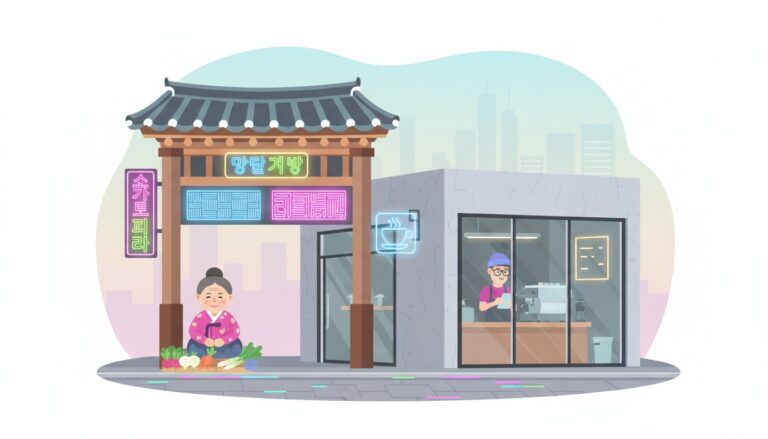
Phase 1: Immersive Hook
Greeting: 안녕하세요! Daily Hangul’s Senior Editor here.
Imagine walking through the narrow, twisting alleys of Euljiro at night. On your left, an old printing press is clanking away, smelling of ink and oil. On your right, a neon pink sign flickers, leading into a hidden wine bar packed with hip twenty-somethings listening to City Pop. This isn’t a movie set—it’s the reality of Seoul today.
You might have seen this in dramas like Vincenzo, where the Geumga Plaza fights against redevelopment, or seen your favorite idols doing photoshoots in gritty, retro industrial backgrounds. But when you visit these places, do you only see “cool aesthetics,” or do you read the complex story of urban regeneration (도시 재생) written on the walls?
Today, we are moving beyond “How much is this?” (이거 얼마예요?). We are diving into the C1-level discourse of how Korea balances tradition with hyper-modernity. Understanding this will turn you from a tourist into a cultural observer.
This guide is curated from real conversations with urban planners and local shop owners in Seoul’s hottest regeneration zones.
Phase 2: Deep Dive into Core Expressions
1. 젠트리피케이션 (Jenteuripikeisyeon)
- Pronunciation: [Jen-teu-ri-pi-kei-syeon]
- Meaning: Gentrification (Literal & Real nuance). While it’s a loanword, in Korea, it carries a heavy, almost inevitable connotation of “original artists and residents getting kicked out due to rising rent.”
- K-Culture Moment: Think of the storyline in Itaewon Class. The struggle of small pocha owners against big corporations (Jangga Co.) is essentially a battle against the forces that drive gentrification.
- Editor’s Insight: You will hear this on the news constantly. It’s not just an academic term; it’s a daily reality for cafe owners in areas like Seongsu-dong or Ikseon-dong. Using this word shows you understand the economics of the culture.
- Situation Spectrum:
[🚫 Absolute Formal] ———— [⚠️ Semi-Formal] ———— [✅ Casual/Discussion]- Friends/Debate: ✅ (Perfect for intellectual chats)
- Buying Vegetables: 🚫 (Don’t say this to a grandma selling radishes!)
- 🤔 Think About It: Why does Korea use the English loanword directly instead of a native Korean term? Does this suggest the phenomenon is viewed as an imported modern problem?
2. 상생 (Sangsaeng)
- Pronunciation: [Sang-saeng] (Sounds like ‘Sang’ as in ‘Song’ + ‘Saeng’ as in ‘Sang’wich)
- Meaning: Win-win / Coexistence / Mutual Survival. It refers to traditional markets and modern malls (or landlords and tenants) finding a way to survive together.
- K-Culture Moment: In variety shows like Baek Jong-won’s Alley Restaurant, the ultimate goal isn’t just one restaurant succeeding, but the whole alley reviving—that is 상생.
- Editor’s Insight: This is a keyword in Korean society. It captures the communal spirit (Jeong) applied to capitalism. If you use this in a business meeting or an academic essay, people will be impressed by your cultural depth.
- Situation Spectrum:
[🚫 Slang] ———— [⚠️ Casual] ———— [✅ Formal/Professional]- Business/News: ✅
- Daily Chat: ⚠️ (Can sound a bit too serious unless discussing social issues)
- 🤔 Think About It: Is “mutual survival” possible in a hyper-competitive society? How does the concept of ‘Sangsaeng’ contrast with Western capitalism?
3. 뉴트로 (Nyuteuro)
- Pronunciation: [Nyu-teu-ro]
- Meaning: New + Retro. It’s not just “vintage” (old things). It is “modern reinterpretations of vintage styles.”
- K-Culture Moment: K-Pop concepts like SHINee’s “1 of 1” or the aesthetic of the hit drama Reply 1988. It’s why young Koreans flock to dilapidated markets to drink coffee out of old-fashioned milk glasses.
- Editor’s Insight: Use this to describe places like Gwangjang Market’s youth section or cafes in renovated Hanoks. It explains why the old market is suddenly full of young people.
- Situation Spectrum:
[🚫 Formal Papers] ———— [⚠️ News/Marketing] ———— [✅ Daily/Trendy]- Marketing/Social Media: ✅
- Academic Paper: ⚠️ (Better to use ‘복고 열풍’ – Retro craze)
- 🤔 Think About It: Why is the younger generation, who never lived through the 70s and 80s, so obsessed with this era?
Phase 3: Textbook vs. Real Life
| Context | 📖 Textbook Korean | 🗣️ Real Korean (In the Streets) | 💡 Why the difference? |
|---|---|---|---|
| Describing a rising area | 이 지역은 요즘 인기가 많아요. (This area is popular these days.) | 여기가 완전 핫플(Hot Place)이에요. / 요즘 여기가 떠요. | ‘Hot Place’ (Konglish) is the de facto term for trendy spots. ‘뜨다’ (to float/rise) implies viral popularity. |
| renovation | 리모델링을 했습니다. (It was remodeled.) | 싹 갈아엎었어요. (They turned it all over/upside down.) | ‘갈아엎다’ is much more vivid and drastic, often used when the change is total. |
| Old atmosphere | 분위기가 고풍스럽네요. (The atmosphere is antique.) | 노포(Nopo) 감성 미쳤다. | ‘노포’ refers to long-standing shops with history. ‘감성’ (vibe/sensibility) is the #1 word for Instagram generation. |
Bottom Note: At C1 level, stop saying “popular” (인기 많다). Use “핫하다” (It’s hot) or “힙하다” (It’s hip) to sound natural.
Phase 4: Cultural Deep Dive — The “Hip” in History
4-1. The “Nopo” (노포) Phenomenon
In many countries, old, crumbling restaurants are avoided. In Korea, they are hunted down. Nopo (Old Shop) represents authenticity. When you enter a 50-year-old soup kitchen in a market, you don’t complain about the hygiene being less than sterile; you praise the “Sewol” (세월 – passage of time) stained on the walls. Use the phrase “이 집 내공이 장난 아니다” (This place’s inner force/mastery is no joke) to praise the depth of flavor that only time can create.
4-2. K-Architecture Connection
Korean Urban Regeneration is distinct. It rarely involves bulldozing everything (anymore). It’s about “upcycling” space.
– Drama Trope: Notice how in recent dramas, the protagonist often lives in a rooftop house (oktapbang) with a view of the city wall, or runs a cafe in a converted warehouse. This reflects the real estate trend where “unique imperfections” are more valuable than “perfect generic glass buildings.”
Phase 5: Immersive Roleplay
Setting: A Friday evening at a trendy cafe in Seongsu-dong. The cafe used to be a shoe factory. You are with your Korean friend, Ji-min (30, Architect, cynical but loves retro vibes).
Dialog:
Ji-min: 와, 여기 진짜 사람 많다. 예전엔 그냥 신발 공장이었는데, 완전히 힙해졌네.
(Wa, yeogi jinjja saram manda. Yejeonen geunyang sinbal gongjang-ieonneunde, wanjeonhi hip-haejyeonne.)
(English: Wow, so many people here. It used to be just a shoe factory, but now it’s totally hip.)
(🎭 Stage Direction: Ji-min looks at the exposed concrete ceiling and sips her latte.)
YOU:
(Choose your response below!)
🔀 Decision Point: How do you respond?
- A) “맞아요. 도시 재생의 좋은 예시인 것 같아요.” (Formal & Academic)
- B) “분위기는 좋은데, 임대료가 너무 올라서 원주민들은 힘들대요.” (Critical & Insightful – C1 Level)
- C) “진짜 힙하다! 인스타 각이다.” (Trendy & Simple)
✅ Best Choice: B
– Korean: “Bunwigineun joeunde, imdaeryoga neomu ollaseo wonjumindeureun himdeuldaeyo.”
– Why: This shows C1 proficiency. You aren’t just admiring the view; you are discussing the social consequence (rising rent/gentrification) using the grammar structure -nyunde, -daeyo (I heard that…).
Ji-min: 오, 너 한국 사회 문제까지 아네? 맞아, 그게 바로 젠트리피케이션이지. 씁쓸하네.
(Oh, you know about Korean social issues? Right, that’s exactly gentrification. It’s bittersweet.)
Phase 6: 10-Second Shadowing Drill
Let’s practice a sentence that makes you sound like an urban critic.
😡 With a tone of concern mixed with admiration:
“옛날 감성은 / 좋지만, / 젠트리피케이션은 / 걱정돼요.”
(Yennal gamseong-eun / jochiman, / jenteuripikeisyeon-eun / geokjeong-dwaeyo.)
Meaning: I like the old-school vibe, but I’m worried about gentrification.
Phase 7: K-Culture Glossary (Regeneration Edition)
| Korean | Romanization | Meaning | Context |
|---|---|---|---|
| 청년몰 | Cheongnyeon-mol | Youth Mall | Sections within traditional markets dedicated to young entrepreneurs to revitalize the area. |
| 도시 재생 | Dosi jaesaeng | Urban Regeneration | The official term for revitalizing a city without total destruction. |
| 골목 상권 | Golmok sanggwon | Alley Commercial Area | Small businesses located in alleyways, often threatened by franchises. |
| 핫플 | Hat-peul | Hot Place | The most popular, trendy spot at the moment. |
| 레트로 | Re-teu-ro | Retro | Nostalgia for the past style. |
Phase 8: Traveler’s Survival Kit — Exploring “Hip” Markets
Even if you are C1, finding these hidden spots is hard. Here is your survival kit for places like Mangwon Market or Gwangjang Market.
🆘 Survival Expression #1: Finding the “Real” Spot
* 🇰🇷 “여기 토박이들이 가는 맛집은 어디예요?” (Yeogi tobagi-deuri ganeun matjibeun eodiyeyo?)
* 🗣️ Meaning: Where is the restaurant that the locals/natives go to?
* 💡 Pro Tip: Don’t just follow the blog posts. ‘Tobagi’ (토박이) implies someone who has lived there for generations. This opens doors to hidden gems.📌 Editor’s Travel Note
* Navigation: In winding alleys of regeneration zones (like Euljiro), GPS often fails. Look for landmarks or ask “XX 건물이 어디예요?” (Where is XX building?).
* Payment: “Card is King” in Korea, but in very old traditional markets, holding cash (10,000 won bills) can sometimes get you more side dishes (Service/Seobisu).
Phase 9: Think Deeper — Critical Thinking
Topic: The Lifecycle of a “Hot Place”
In Korea, neighborhoods rise and fall with incredible speed. First, artists move to a cheap, run-down area (Old Town). Then, unique cafes open. The “Hip” crowd arrives. Rents explode (Gentrification). Franchises push out the artists. The area becomes boring. The crowd moves to the next run-down area.
🧠 Think Deeper:
Does this cycle destroy the “Soul” of Seoul, or is this constant reinvention the very essence of Seoul’s identity? In your country, do “hip” neighborhoods stay cool for decades, or do they burn out quickly like in Korea?
Phase 10: FAQ & Troubleshooting
Q: Can I use the word “낙후되다” (to be underdeveloped/backward) when talking to a local?
A: ⚠️ Caution! While it is a correct descriptive word for old areas, saying “This neighborhood is 낙후되었다” to a resident can be offensive. Instead, use “옛날 분위기가 남아있다” (It retains the old atmosphere) or “정겹다” (It feels affectionate/nostalgic).
Q: Are traditional markets only for old people?
A: No! Due to the “Newtro” trend, markets like Mangwon are dating hotspots. But be aware of the “age code.” The deep inside of the market is for elders; the edges with cafes are for youth. Adjust your politeness level accordingly.
❌ Common Mistake: Assuming all markets are cheap.
✅ Reality: Trendy markets (Hot places) often have “tourist prices” or “hipster taxes” (high prices for vibes). Use your judgment!
Phase 11: Wrap-up & Action Items
One-Liner: Urban regeneration in Korea is not just about buildings; it’s about Sangsaeng (Coexistence) and Newtro (Style) battling Gentrification.
🚀 Action Mission:
* 🥉 Bronze: Google “Euljiro Nogari Alley” and practice describing it using the word “Newtro.”
* 🥈 Silver: Watch a YouTube vlog of a Seoul market tour and identify 3 “Nopo” (Old Shops).
* 🥇 Gold: If you are in Korea, visit a market, find a shop that looks at least 30 years old, and tell the owner: “사장님, 가게 분위기가 너무 정겨워요.” (Boss, the shop’s vibe is so nostalgic/warm.)
Phase 12: Interactive Quiz
1. Situational Judgment:
You are discussing a neighborhood that has lost its charm because too many big franchises moved in. Which word best describes the cause?
* A) 상생 (Sangsaeng)
* B) 젠트리피케이션 (Gentrification)
* C) 뉴트로 (Newtro)
2. True or False (Culture):
“Tobagi” (토박이) refers to a tourist who visits a place frequently.
* (True / False)
3. Fill in the Blank:
“Wow, this restaurant has been here for 50 years? This place’s [_______] is no joke!”
* (Hint: Inner force/Mastery)
Answer Key:
1. B) Gentrification destroys local charm.
2. False. Tobagi refers to a native local who has lived there for a long time.
3. 내공 (Naegong).
Frequently Asked Questions (FAQ)
Q: What does "젠트리피케이션 (Jenteuripikeisyeon)" mean in Korean and how do you pronounce it?
A: In Korean, "젠트리피케이션 (Jenteuripikeisyeon)" is pronounced [Jen-teu-ri-pi-kei-syeon] and means: Gentrification (Literal & Real nuance). While it's a loanword, in Korea, it carries a heavy, almost inevitable connotation of "original artists and residents getting kicked out due to rising rent."
Q: What does "상생 (Sangsaeng)" mean in Korean and how do you pronounce it?
A: In Korean, "상생 (Sangsaeng)" is pronounced [Sang-saeng] and means: Win-win / Coexistence / Mutual Survival. It refers to traditional markets and modern malls (or landlords and tenants) finding a way to survive together.
Q: What does "뉴트로 (Nyuteuro)" mean in Korean and how do you pronounce it?
A: In Korean, "뉴트로 (Nyuteuro)" is pronounced [Nyu-teu-ro] and means: New + Retro. It’s not just "vintage" (old things). It is "modern reinterpretations of vintage styles."






