

Phase 1: The Immersive Hook
Hello! This is your Senior Editor at Daily Hangul.
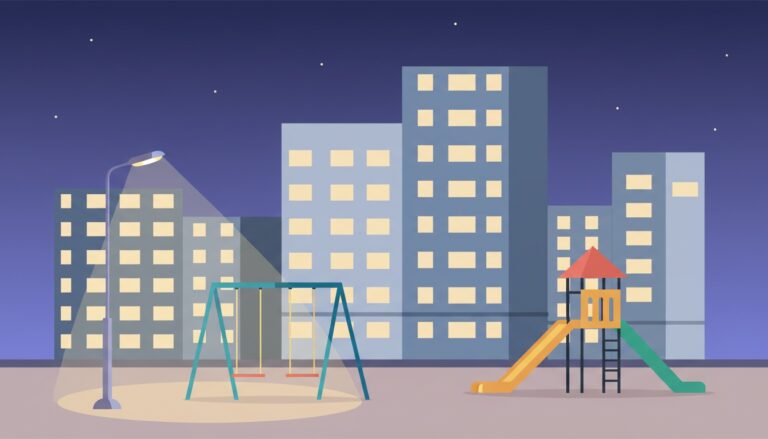
Picture this: It’s late at night in Seoul. You’re walking through a massive apartment complex (what we call “Apt”). You spot a lonely swing set under a streetlamp. Does this scene feel familiar?
If you’ve watched any K-Drama, you know the Playground (놀이터 – Noliteo) is not just for kids. It’s where the main characters have deep conversations while swinging back and forth. It’s where high schoolers secretly eat cup ramen (ramyun). It’s the unofficial “town square” of Korean life.
But here’s the catch: If a cute kid approaches you or an elderly lady sits next to you, what do you say? Do you freeze? Today, we’re going to learn the survival phrases for this surprisingly social space. Let’s turn you into a local insider.
Phase 2: Deep Dive into Key Expressions
1. 여기 앉아도 돼요? (Yeogi anjado dwaeyo?)
- Pronunciation: Yuh-gi an-jah-do dway-yo?
- (Think: Yuh as in ‘yuck’, gi as in ‘key’, an as in ‘on’, dway as in ‘way’ with a ‘d’ in front)
- Meaning:
- Literal: May I sit here?
- Real Nuance: “I see you are occupying this bench, but there is space. I don’t want to disturb your peace, but my legs hurt. Is it cool if I exist near you?”
- K-Culture Moment: The classic K-Drama scene. The male lead is brooding on a bench. The female lead approaches cautiously with two cans of soda. She asks this before sitting down.
- Editor’s Insight: Koreans value personal space in public. Asking this, even if the seat is obviously empty but near someone, shows you have excellent manners (K-Manners).
- Situation Spectrum:
[🚫 Boss] ———— [⚠️ Colleague] ———— [✅ Stranger/Neighbor] - 🤔 Think About It: Why do we ask for permission even when the bench is public property? What does this say about the Korean concept of “consideration” (baeryeo)?
2. 몇 살이에요? (Myeot sar-ieyo?)
- Pronunciation: Myut sar-ee-eh-yo?
- (Myut sounds like ‘mutt’ with a y)
- Meaning:
- Literal: How old are you?
- Real Nuance: “I need to know your age immediately so I can decide which level of polite language to use.”
- K-Culture Moment: Kids at the playground always ask this first. In variety shows like Running Man, when guests meet, age is the first thing established to sort out the hierarchy.
- Editor’s Insight: In the West, asking age is rude. In Korea, it’s a social GPS. If a child asks you this at the playground, they are trying to figure out if you are an Opp/Unnie (older sibling figure) or an Ahjumma/Ahjussi (older adult figure).
- Situation Spectrum:
[🚫 First Business Meeting] ———— [⚠️ Casual Adult Meeting] ———— [✅ Kids/Playground] - 🤔 Think About It: Is age just a number in Korea, or is it a rank? How does knowing someone’s age change your body language?
3. 귀엽다! (Gwi-yeop-da!)
- Pronunciation: Gwi-yup-da!
- (Make it sound like an exclamation!)
- Meaning:
- Literal: It is cute.
- Real Nuance: “OMG, that baby/puppy/toy is adorable!”
- K-Culture Moment: K-Pop idols at fan meetings when they see fans doing something silly, or every time a puppy appears on screen in a reality show.
- Editor’s Insight: This is the ultimate ice-breaker. If you see a neighbor walking a dog or a child playing, just saying this one word makes you instantly likeable. It lowers everyone’s guard.
- Situation Spectrum:
[🚫 Funeral] ———— [⚠️ Serious Meeting] ———— [✅ Anywhere else]
Phase 3: Textbook vs. Real Life
| Situation | 📖 Textbook Korean | 🗣️ Real Korean | 💡 Why different? |
|---|---|---|---|
| Asking to play | 우리 같이 놀까요? (Shall we play together?) | 같이 놀래? (Gachi nollae?) | Kids drop formalities immediately to build intimacy. |
| Leaving | 안녕히 계세요. (Stay in peace.) | 갈게! / 가볼게! (Gal-ge!) | “Goodbye” is too formal for friends. “I’m gonna go” fits the casual playground vibe. |
| Warning | 조심하십시오. (Please be careful.) | 조심해! (Jo-sim-hae!) | When a kid is about to fall off a slide, you don’t have time for grammar! |
Phase 4: Cultural Deep Dive
4-1. Non-verbal Communication: The “Bow”
Even at a playground, if you greet a neighbor or an older person, you don’t just wave. You do a slight head bow. If a child says hello to you, they will likely bow. If you bow back, they will think you are the coolest foreigner ever.
4-2. K-Culture Connection: The “Hagwon Bus” Stop
Korean apartment playgrounds are often the pick-up/drop-off zones for Hagwon (private academy) buses. around 2 PM to 6 PM, you will see yellow buses lining up.
* Drama Trope: This is often where the busy “Sky Castle” type moms gather to exchange gossip and information about tutors.
* Food Connection: You might see kids eating Cup Tteokbokki (spicy rice cakes in a cup) here before hopping on the bus. It’s the classic fuel for Korean students.
Phase 5: Immersive Roleplay
Setting: It’s a breezy autumn evening at your apartment playground. You are sitting on a bench, scrolling through your phone. A friendly Korean child (about 7 years old) approaches you with a soccer ball.
Characters:
* YOU: A friendly foreign resident.
* Kid (Min-jun): Curious, energetic, holding a ball.
(Dialogue)
Min-jun: (Staring at you) 외국인이다! 안녕하세요!
(Waeguk-in-ida! Annyeong-haseyo!)
(Translation: It’s a foreigner! Hello!)
YOU: (Smiling) 안녕?
(Annyeong?)
(Translation: Hi?)
Min-jun: 아저씨/누나, 여기서 뭐 해요?
(Ajussi/Noona, yeogiseo mwo haeyo?)
(Translation: Mister/Sister, what are you doing here?)
🔀 YOUR TURN! How do you respond?
- A) “그냥 쉬고 있어.” (Geunyang swigo isseo – Just resting.)
- B) “너 몇 살이니?” (Neo myeot sal-ini? – How old are you?)
- C) “가라.” (Gara. – Go away.)
✅ Best Choice: A – It’s natural and friendly.
⚠️ Choice B Analysis: You can ask this, but usually, you answer their question first. It might seem like you are interrogating them if you ask age immediately.
Min-jun: 심심해요… 축구 좋아해요?
(Simsimhaeyo… chukgu joahaeyo?)
(Translation: I’m bored… Do you like soccer?)
YOU: 응, 좋아해.
(Eung, joah-hae.)
(Translation: Yeah, I like it.)
Min-jun: 그럼 저랑 같이 차요!
(Geureom jeorang gachi chayo!)
(Translation: Then kick (the ball) with me!)
Phase 6: 10-Second Shadowing Drill
Let’s practice the magic word that makes you approachable.
- Emotion: 😊 Brightly and warmly
- Sentence: 강아지가 / 정말 / 귀엽네요!
- Romanization: Gang-aji-ga / jeong-mal / gwi-yeom-neyo!
- Meaning: The puppy / is really / cute!
Phase 7: K-Culture Glossary (Playground Edition)
| Korean | Romanization | Meaning | Context |
|---|---|---|---|
| 놀이터 | Noliteo | Playground | The social hub of the apartment complex. |
| 그네 | Geune | Swing | The spot for romance or deep thinking in dramas. |
| 학원 | Hagwon | Cram School | The yellow buses stop here. |
| 반상회 | Bansanghoe | Neighborhood Meeting | Often discussed casually by moms at the playground. |
| 미끄럼틀 | Mikkeureomteul | Slide | Kids play here; adults avoid getting stuck. |
Phase 8: Traveler’s Survival Kit
Even if you aren’t living in an apartment, you might walk through one or visit a public park.
🆘 Survival Expression #1
* 🇰🇷 “화장실 어디예요?” (Hwajangsil eodi-yeyo?)
* 🗣️ Sound-alike: Hwah-jang-shill uh-dee-yay-yo?
* Meaning: Where is the restroom?
* Note: Apartment playgrounds usually don’t have public restrooms. You might need to run to the nearest commercial building (Sang-ga).📌 Editor’s Travel Note
* Safety: Korean playgrounds are incredibly safe, even at night (CCTV is everywhere).
* No Smoking: It is illegal to smoke in playgrounds. You will be fined. Don’t do it!
Phase 9: Think Deeper – “Why Age Matters”
Language & Power: You noticed we learned “Myeot sal-ieyo?” (How old are you?). In Western culture, asking age is taboo. In Korea, it’s a tool for harmony. The Korean language has built-in hierarchy (Honorifics). Without knowing your age, the other person (even a child!) doesn’t know whether to use polite language or casual language. They aren’t being nosy; they are trying to be linguistically correct.
💬 Your Turn: In your culture, when is it okay to ask someone’s age? Tell us in the comments!
Phase 10: FAQ & Troubleshooting
- Q: Can I drink beer at the playground like in the dramas?
- A: Technically, many playgrounds are now “Alcohol-Free Zones.” While you see it in old dramas, nowadays, if you drink loudly or cause a scene, the security guard (Gyeongbi-ajussi) will come. It’s better to go to a proper “Pocha” or designated park area.
- Q: A grandma is staring at me. Is she angry?
- A: Probably not! Korean elderly people are often just curious about foreigners. If you smile and bow, she might even offer you a candy.
❌ Common Mistake: Wearing shoes on the playground equipment.
✅ Do this: If you climb up the slide structure to sit (like a teenager), make sure your shoes aren’t muddying the seat where kids sit.
Phase 11: Wrap-up & Action Mission
Summary: The playground is a mini-society where age matters, manners count, and “Cute!” (Gwiyeopda) is the magic password.
🚀 Action Missions:
* 🥉 Bronze: Look in the mirror and say “Yeogi anjado dwaeyo?” 3 times politely.
* 🥈 Silver: Watch a K-Drama scene set in a playground and try to hear if they use formal or casual speech.
* 🥇 Gold: Go to a park or playground. If you see a cute dog, say “Gwiyeopda!” to the owner.
Phase 12: Quiz – The Playground Logic
1. A 7-year-old kid asks you a question. You want to ask their age casually. What do you say?
* A) 연세가 어떻게 되세요? (Yeonse-ga eotteoke doeseyo?)
* B) 몇 살이야? (Myeot sal-iya?)
* C) 이름이 뭐예요? (Ireum-i mwoyeyo?)
2. True or False?
* It is culturally encouraged to smoke at the playground while thinking about life.
3. You want to sit on a bench where someone’s bag is nearby. You say:
* A) 비켜! (Bikyeo! – Move!)
* B) 여기 앉아도 돼요? (Yeogi anjado dwaeyo?)
(Scroll down for answers)
.
.
.
Answers:
1. B. (A is for elderly people! C is asking for a name.)
2. False. Highly illegal and rude.
3. B. Always be polite!
Frequently Asked Questions (FAQ)
Q: What does "여기 앉아도 돼요? (Yeogi anjado dwaeyo?)" mean in Korean and how do you pronounce it?
A: In Korean, "여기 앉아도 돼요? (Yeogi anjado dwaeyo?)" is pronounced [Yuh-gi an-jah-do dway-yo?] and means: a key conversational Korean expression covered in this lesson.
Q: What does "몇 살이에요? (Myeot sar-ieyo?)" mean in Korean and how do you pronounce it?
A: In Korean, "몇 살이에요? (Myeot sar-ieyo?)" is pronounced [Myut sar-ee-eh-yo?] and means: a key conversational Korean expression covered in this lesson.
Q: What does "귀엽다! (Gwi-yeop-da!)" mean in Korean and how do you pronounce it?
A: In Korean, "귀엽다! (Gwi-yeop-da!)" is pronounced [Gwi-yup-da!] and means: a key conversational Korean expression covered in this lesson.






