

Phase 1: The ‘Pork’ Dilemma — Immersive Hook
Greeting:
안녕하세요! Hello, Daily Hangul family! It’s your Chief Editor here.
K-Culture Cold Open:
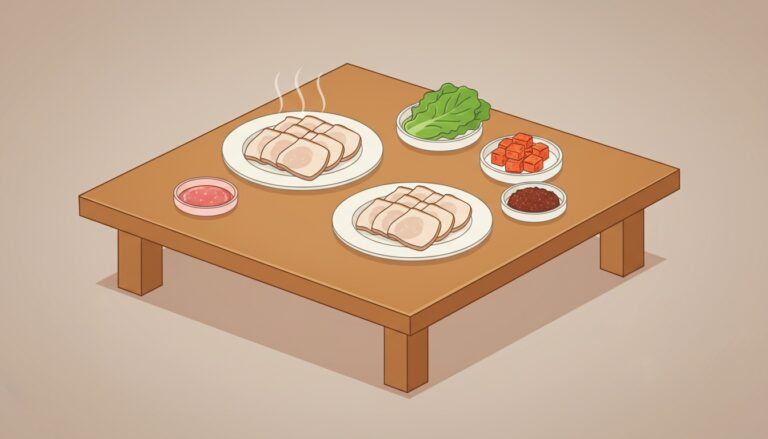
Picture this: It’s 11 PM on a Friday. You’re in your Airbnb in Seoul, watching a K-Drama where the main characters are sitting on the floor, struggling to wrap a huge piece of meat in a cabbage leaf. They stuff it into their mouths, cheeks bulging, looking absolutely euphoric. Your stomach growls. You open a delivery app (Baemin or Coupang Eats) and search for ‘pork.’
Suddenly, you hit a wall. Two options appear that look suspiciously similar:
- 수육 (Suyuk)
- 보쌈 (Bossam)
They are both boiled pork. They both look delicious. But if you order the wrong one, you might miss out on that crunchy, spicy radish kimchi you saw in the drama. Or worse, you might end up with a plate of meat when you wanted a full ‘wrap party.’
The ‘Why’:
Mixing these up is the most common rookie mistake in K-Food ordering. Knowing the difference doesn’t just get you the right dinner; it tells your Korean friends whether you are a ‘pure meat purist’ or a ‘flavor-stacking architect.’
Transparency:
Today, we break down this steamed pork puzzle using questions my intermediate students ask me every week. Let’s get hungry!
Phase 2: Deep Dive into Core Expressions
These terms are B2 level because they require cultural context to use correctly.
1. 수육 (Suyuk)
- Pronunciation: [Su-yuk]
- Sound Analogy: ‘Su’ sounds like ‘Su’ in ‘Soup’ + ‘yuk’ sounds like the first part of ‘Yuck’ (but without the disgusted face!).
- Meaning: Boiled meat slices (Pure meat focus).
- K-Culture Moment: In the variety show I Live Alone (나 혼자 산다), when a celebrity cooks a healthy meal, they often make Suyuk because it’s not fried or greasy.
- Editor’s Insight: Suyuk is the minimalist choice. It can be pork OR beef. It’s often served in or alongside soup (like Seolleongtang). The focus is entirely on the tenderness of the meat itself. It comes with simple dipping sauces like salted shrimp (saewujeot).
- Situation Spectrum:
[🚫 Formal Banquets] ——— [⚠️ Casual Lunch] ——— [✅ Drinking Snack (Anju)]- 🤔 Think About It: Why is boiled meat considered a high-end ‘health food’ in Korea, while fried chicken is a guilty pleasure? Think about the effort required to boil meat for hours to make it tender.
2. 보쌈 (Bossam)
- Pronunciation: [Bo-ssam]
- Sound Analogy: ‘Bo’ like ‘Bo’at + ‘ssam’ (tensed ‘s’) sounds like ‘Sam’ with a very sharp hiss.
- Meaning: Boiled pork wrapped in greens (The ‘Wrap’ experience).
- K-Culture Moment: Every winter, during Kimjang (Kimchi-making season), families gather to make hundreds of heads of Kimchi. The reward for this hard labor? Freshly made Kimchi wrapped around hot boiled pork. That is Bossam.
- Editor’s Insight: The word 쌈 (Ssam) literally means ‘wrap.’ If you order Bossam, the meat is important, but the Kimchi (specifically the sweet and spicy radish kind) and the vegetables are the real stars. It is almost exclusively pork.
- Situation Spectrum:
[🚫 Breakfast] ——— [⚠️ Solo Dining] ——— [✅ Late Night Delivery / Groups]- 🤔 Think About It: In Western cuisine, meat is usually the main character. In Bossam, the meat is a vehicle for the sauce and vegetables. How does this reflect the Korean philosophy of ‘harmony’ (eating things together)?
Phase 3: Textbook vs. Real Life
| Situation | 📖 Textbook Korean | 🗣️ Real Korean | 💡 Why the difference? |
|---|---|---|---|
| Ordering | “보쌈 주세요.” (Please give me Bossam.) | “사장님, 여기 보쌈 중(中)짜 같은 소(小)짜 주세요!” (Boss, give me a Small that looks like a Medium!) | This is a classic Korean ‘uncle’ joke/negotiation tactic to ask for a generous portion. |
| Asking for sauce | “새우젓 좀 더 주시겠어요?” (Could you give me more salted shrimp?) | “이모, 여기 새우젓 좀 넉넉히요!” (Auntie, plenty of salted shrimp here!) | Use 이모 (Auntie) in casual diners for better service. 넉넉히 sounds more generous than ‘more.’ |
| Eating method | “쌈을 싸서 드세요.” (Please wrap and eat it.) | “야, 한 입만!” (Hey, just one bite!) | 한 입만 is a famous phrase from the show Delicious Guys, challenging someone to fit a huge wrap in their mouth at once. |
💡 Editor’s Note: Using “짜” after sizes (Example: 소짜, 중짜, 대짜) is much more natural in spoken Korean than just saying 소 (Small), 중 (Medium), 대 (Large).
Phase 4: Cultural Deep Dive — The ‘Kimjang’ Connection
4-1. Non-verbal: The “Ssam” Etiquette
In Korea, making a wrap (Ssam) for someone else is a sign of affection. However, there is a Golden Rule:
* Don’t bite the wrap in half. A Ssam is engineered to be eaten in one bite. Biting it in half spills the sauce and is considered messy. If it’s too big, make a smaller wrap!
4-2. K-Drama Connection: The “Delivery” Trope
You’ve seen it in dramas like Crash Landing on You or Hospital Playlist. The team works late, everyone is tired, and someone shouts, “Let’s order Bossam!”
* Why Bossam? It’s the ultimate communal food. Unlike individual bowls of noodles, everyone picks from the same plate. It signifies bonding.
* Critical Perspective: While dramas show people drinking Soju endlessly with Bossam, in reality, Bossam is quite expensive (often $30~$40 USD). It’s a treat, not an everyday cheap meal.
Phase 5: Immersive Roleplay — The Friday Night Order
Setting: A bustling, old-school Bossam restaurant in Jongno, Seoul. Friday, 7:30 PM. The smell of boiled pork and spicy garlic fills the air.
Characters:
* YOU: A foreign exchange student who wants to impress your Korean friends.
* Imo-nim (NPC): The busy, loud, but kind restaurant owner.
Dialogue:
Imo-nim: (Wiping the table rapidly) 어서 오세요! 몇 분이세요?
(Eoseo oseyo! Myeot buniseyo?)
(Welcome! How many people?)
YOU: 세 명이요. 저희 보쌈 중(Medium) 하나 주세요.
(Se myeong-iyo. Jeohui Bossam Jung hana juseyo.)
(Three people. Please give us one Medium Bossam.)
Imo-nim: 아이고, 세 명이면 대(Large) 자는 먹어야지. 고기 안 모자라겠어?
(Aigo, se myeong-imyeon Dae-ja-neun meogeoyaji. Gogi an mojaragesseo?)
(Oh my, for three people you should eat a Large. Won’t you run out of meat?)
🔀 Decision Point: How do you respond to her upselling?
- A) “아, 그럼 대(Large)로 주세요.” (Accepting the upsell)
- B) “괜찮아요, 먹고 쟁반국수 시킬게요!” (Polite refusal + Smart alternative)
- C) “아니요, 중(Medium) 주세요.” (Direct refusal)
✅ Best Choice: B
Reason: This is the ‘Pro’ move. 쟁반국수 (Makguksu/Buckwheat noodles) is the classic partner for Bossam. Telling her you will order noodles later reassures her you will order enough food, and the combination tastes better!
YOU: 괜찮아요, 먹고 쟁반국수 추가할게요!
(Gwaenchannayo, meokgo Jaengban-guksu chugahal-geyo!)
(It’s okay, we’ll add the tray noodles later!)
Imo-nim: (Smiling) 알았어! 김치 많이 줄게~
(Arasseo! Kimchi mani julge~)
(Alright! I’ll give you lots of Kimchi~)
Phase 6: 10-Second Shadowing Drill
Practice this sentence to sound like a local when the meat runs out.
😊 (Politely but eagerly)
사장님, / 여기 고기 추가 / 반만 / 될까요?
(Sajang-nim, / yeogi gogi chuga / ban-man / doelkkayo?)
Boss, / can we add / just half a portion / of meat here?
- Note: You usually don’t have to order a full plate for seconds. “Gogi chuga” (Meat addition) is cheaper!
Phase 7: K-Culture Mini Glossary
| Korean | Romanization | English | Context |
|---|---|---|---|
| 쌈장 | Ssamjang | Seasoned Soybean Paste | The brown dipping sauce essential for Bossam. A mix of Doenjang and Gochujang. |
| 새우젓 | Saewujeot | Salted Fermented Shrimp | The salty pink sauce essential for Suyuk. Helps digestion of pork. |
| 무말랭이 | Mu-mallaengi | Dried Radish Kimchi | The crunchy, spicy red side dish that comes with Bossam. The texture king! |
| 쟁반국수 | Jaengban-guksu | Tray Buckwheat Noodles | Large platter of spicy cold noodles meant to be shared with Bossam. |
| 굴보쌈 | Gul-bossam | Oyster Bossam | A winter specialty where fresh raw oysters are added to the wrap. |
Phase 8: Traveler’s Survival Kit — Delivery App Edition
Since you are B2 level, you will likely use apps like Baemin (Baedal Minjok) or Yogiyo.
🆘 Survival Tips for Ordering Bossam/Suyuk
- Tip #1: The “Review Event” (리뷰 이벤트)
Check the shop banner. If it says “리뷰 이벤트,” promise to write a review and you might get free soda or extra meat!
- Phrase: “리뷰 약속! 콜라 주세요.” (Review promise! Please give me cola.)
- Tip #2: Disposing of Leftovers
Bossam delivery comes with A LOT of plastic containers. In Korea, you must rinse these and recycle. The leftover bones/food go in Food Waste (음식물 쓰레기), not general trash.- Tip #3: The Price Shock
Don’t be shocked. Bossam sets usually start at 30,000 KRW ($25). It is considered a premium delivery food.
Phase 9: Think Deeper — Food & Identity
The Philosophy of ‘Ssam’ (Wrapping)
Have you noticed that Korean food often involves mixing or wrapping? Bibimbap (mixing) and Ssam (wrapping). Some scholars say wrapping food symbolizes “wrapping luck” (Bok – 복). When you open your mouth wide to eat a huge lettuce wrap, you aren’t just eating pork; you are inviting good fortune into your body.
🧠 Think Deeper:
In many Western cultures, using hands to eat non-finger food (like wet meat) is considered impolite. In Korea, using your hands to construct a Ssam is intimate and natural. How does the ‘method’ of eating change the taste or the social atmosphere of a meal?💬 Your Turn: Does your culture have a food that requires ‘assembly’ at the table? Tell me in the comments!
Phase 10: FAQ & Troubleshooting
- Q: Can I refill the Kimchi for Bossam?
- Editor’s Warning: ⚠️ Usually, NO. Unlike normal restaurant Kimchi which is free, Bossam Kimchi takes a lot of effort and ingredients (oysters, pears, pine nuts). Most places charge extra for “Kimchi addition” (김치 추가). Check the menu first!
- Q: Is Suyuk always pork?
- A: Not always. If you go to a Gomtang (Beef bone soup) restaurant, Suyuk is often Beef. If you go to a Bossam or Noodle place, it is Pork. Always ask: “돼지예요, 소예요?” (Is it pig or cow?)
- ❌ Common Mistake:
- Trying to eat the Saewujeot (Salted Shrimp) like a side dish.
- Correction: It is EXTREMELY salty. Dip the tip of your meat in it, or put 1-2 tiny shrimps on your meat. Do not spoon it into your mouth!
Phase 11: Wrap-up & Missions
One-Liner: Suyuk is for the meat purist who loves dipping; Bossam is for the flavor architect who loves wrapping.
Action Missions:
* 🥉 Bronze: Say “보쌈 중짜 주세요” (Medium Bossam, please) aloud three times with a confident intonation.
* 🥈 Silver: Go to a Korean restaurant (or look at a menu online) and identify if they sell “Pork Suyuk” or “Beef Suyuk.”
* 🥇 Gold: Order Bossam, make a Ssam with garlic, kimchi, and meat, and eat it in one bite (Han-ip-man style)!
K-Culture Mission:
* Watch a clip of the show “Delicious Guys” (맛있는 녀석들) on YouTube searching for “Bossam Mukbang.” Observe how they stack their wraps!
Phase 12: Quiz — The ‘Real Korean’ Test
- Situation: You are at a funeral or a very formal traditional event. Boiled pork is served without lettuce wraps. What is this dish likely called?
- A) Bossam
- B) Suyuk
- True or False: At a Bossam restaurant, you can refill the spicy radish kimchi for free as many times as you want, just like regular kimchi.
-
Real Life: You ordered a “Medium” size but it looks small. How do you jokingly complain to the owner using the ‘Real Korean’ phrase we learned?
- “사장님, ……………!”
🔑 Answers:
1. B) Suyuk. (Suyuk is cleaner and served at formal events; Bossam is more casual/messy).
2. False. Bossam Kimchi is premium and usually costs extra.
3. “사장님, 대(Large)짜 같은 중(Medium)짜 주세요!” (Or complaining that the Medium looks like a Small!).
Frequently Asked Questions (FAQ)
Q: What does "수육 (Suyuk)" mean in Korean and how do you pronounce it?
A: In Korean, "수육 (Suyuk)" is pronounced [Su-yuk] and means: a key conversational Korean expression covered in this lesson.
Q: What does "보쌈 (Bossam)" mean in Korean and how do you pronounce it?
A: In Korean, "보쌈 (Bossam)" is pronounced [Bo-ssam] and means: a key conversational Korean expression covered in this lesson.







