

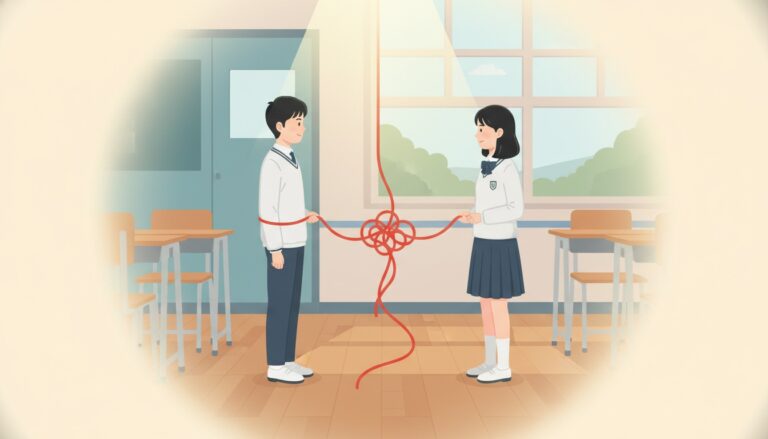
Phase 1: Immersive Hook
Greeting: 안녕하세요! This is your Daily Hangul Senior Editor. 👋
The Scene: Picture this. You’re watching a tense scene in a hit K-Drama like The Glory or School 2013. The background music stops. Two students stand in the empty classroom, the air thick with resentment. One student finally looks up, eyes red, and mutters something. The subtitles simply say, “I’m sorry.” But in Korean, the weight of the sentence depends entirely on how they said it. Did they use the dismissive “mian”? Or the heavy, restorative “jinsim-euro sagwahal-ge”?
The ‘Why’: At the C1 level, you aren’t just learning how to survive; you are learning how to connect and heal. In Korea, where group harmony (in-hwa) is paramount, conflict resolution isn’t just about stopping a fight—it’s about restoring the broken web of relationships. Whether you are teaching in a Korean school, working in a strict office hierarchy, or just navigating deep friendships, knowing how to mediate a conflict or offer a genuine apology is the ultimate “Insider” skill.
Transparency: This guide combines expressions from real mediation manuals used in Korean schools with the raw, emotional language you hear in daily life. Let’s learn how to untie the knots of conflict.
Phase 2: Deep Dive (Core Expressions)
1. 입장 바꿔서 한번 생각해 봐.
- Pronunciation: [ip-jang ba-kkwo-seo han-beon saeng-gak-hae bwa] (Sounds like: “Ip-jang” + “back-woah-saw” + …)
- Meaning:
- Literal: Change your stance/position and think about it once.
- Real Nuance: “Put yourself in their shoes.” / “Try to see it from their perspective.”
- K-Culture Moment: This is the golden sentence of mediation. You will hear this in variety shows like Hello Counselor whenever a guest is being too selfish, or in dramas when a teacher tries to make a bully understand the victim’s pain.
- Editor’s Insight: The word 입장 (Ipjang) is key here. It means ‘position’ or ‘stance.’ In a high-context culture like Korea, understanding someone’s ‘position’ is often more important than the logical facts of who did what.
- Situation Spectrum:
[🚫 To Elders] ———— [⚠️ Caution] ———— [✅ To Juniors/Peers]
(Use “입장 바꿔서 한번 생각해보세요” for polite situations, but never command an elder to do this unless you are a mediator.) - 🤔 Think About It: Why does Korean emphasize “position” (entrance/stance) rather than just “feelings”? How does this reflect the importance of social roles in Korea?
2. 진심으로 사과할게.
- Pronunciation: [jin-sim-eu-ro sa-gwa-hal-ge]
- Meaning:
- Literal: I will apologize with a true heart.
- Real Nuance: “I sincerely apologize.” (Signaling the end of excuses).
- K-Culture Moment: In K-Pop apology letters (often handwritten), the word 진심 (Jinsim – Sincerity/Truth) is the most scrutinized word. If the public doesn’t feel the ‘Jinsim,’ the apology is rejected.
- Editor’s Insight: Just saying “Mianhae” can sound like “Sorry (oops).” Adding 진심으로 adds gravity. It changes the tone from a social pleasantry to a moral confession.
- Situation Spectrum:
[🚫 Casual only] ———— [⚠️ Polite] ———— [✅ Serious/Formal]
(Use honorifics “사과드립니다” for higher-ups.) - 🤔 Think About It: Koreans often distinguish between “apples” (sagwa – homonym) and apologies. Why is the concept of “receiving” an apology so ritualistic in Korea?
3. 우리 서로 감정 풀자.
- Pronunciation: [u-ri seo-ro gam-jeong pul-ja]
- Meaning:
- Literal: Let’s untie our emotions together.
- Real Nuance: “Let’s bury the hatchet.” / “Let’s resolve this bad blood.”
- K-Culture Moment: After a fight scene in a drama, characters often go for a drink (Soju) specifically to “pul-da” (untie/dissolve) their stress or anger.
- Editor’s Insight: The verb 풀다 (pul-da) is fascinating. You ‘untie’ a knot, ‘solve’ a math problem, and ‘release’ stress. In Korea, conflict is seen as a ‘knot’ in the relationship that needs to be physically untied, not just ignored.
- Situation Spectrum:
[🚫 To Superiors] ———— [⚠️ Peers] ———— [✅ Juniors/Friends]
(To superiors: “오해를 풀고 싶습니다” – I want to untie the misunderstanding.) - 🤔 Think About It: Why is “untying” a better metaphor for reconciliation than “forgetting”?
Phase 3: Textbook vs. Real Life
| Situation | 📖 Textbook Korean | 🗣️ Real Korean (Insider) | 💡 Why the difference? |
|---|---|---|---|
| Starting Mediation | 왜 싸웠니? (Why did you fight?) | 무슨 일 있었어? 얘기 좀 해봐. (What happened? Talk to me.) | “Why” sounds accusatory. “What happened” invites a story. |
| Acknowledging Fault | 제 잘못입니다. (It is my fault.) | 내가 선 넘었어. (I crossed the line.) | Using idiomatic expressions like “crossing the line” sounds more genuine and aware of boundaries. |
| Reconciling | 우리 화해합시다. (Let’s reconcile.) | 없던 일로 하자! (Let’s pretend it never happened!) | Sometimes, wiping the slate clean is preferred over a formal declaration of peace. |
Bottom Note: At the C1 level, using “선 넘었다” (crossed the line) correctly shows you understand the intricate social boundaries of Korea.
Phase 4: Cultural Deep Dive — K-Drama Tropes & Reality
4-1. The “School Roof” Trope vs. Counseling Rooms
In K-Dramas like Weak Hero Class 1, conflicts are settled with violence on the roof. In reality, School Violence Committees (학폭위) are terrifying legal procedures. Using the language of mediation (Phase 2) is often a desperate attempt to avoid the legal “red line” that ruins college entrance prospects.
4-2. Non-Verbal: The “Eye Contact” Paradox
- The Glare: In the West, looking someone in the eye shows honesty. In a conflict with a Korean elder or teacher, staring straight into their eyes during a scolding is seen as “Daedeulda” (대들다 – acting defiantly).
- The Fix: Look at the chin or slightly downward when listening to a reprimand to show remorse, then make eye contact when delivering your sincere apology.
4-3. Nunchi (Eye-measure) in Conflict
Before intervening or apologizing, you must read the Bunwigi (Atmosphere). Is the other person ready to listen? Or are they still “fuming” (ssik-ssik)? Attempting to resolve a conflict too early can be seen as “ignoring their anger” rather than fixing it.
Phase 5: Immersive Roleplay
Scenario: You are a foreign English teacher at a Korean high school. Two students, Min-ho and Ji-hoon, have been giving each other the silent treatment for a week. The atmosphere in class is icy. You call Min-ho to the teachers’ lounge to mediate.
Characters:
– YOU: Empathetic Mediator (Teacher).
– Min-ho: Defiant but secretly guilty student.
Dialogue:
YOU: (Quietly) 민호야, 요즘 지훈이랑 분위기 안 좋던데. 무슨 일 있어?
(Min-ho-ya, yojeum Ji-hoon-irang bunwigi an joteonde. Museun il isseo?)
(Translation: Min-ho, things seem bad with Ji-hoon lately. Is something wrong?)
Min-ho: (Avoids eye contact) 그냥… 별일 아니에요. 신경 쓰지 마세요.
(Geunyang… byeoril anieyo. Singyeong sseuji maseyo.)
(Translation: Just… it’s nothing. Don’t worry about it.)
YOU: 별일 아닌 게 아닌 것 같은데? 선생님 눈에는 다 보여. 입장 바꿔서 한번 생각해 봐. 지훈이가 왜 저러는 것 같아?
(Byeoril anin ge anin geot gateunde? … Ip-jang ba-kkwo-seo han-beon saeng-gak-hae bwa…)
(Stage Direction: Lean in slightly, voice soft but firm.)
Min-ho: (Sighs deeply) 걔가 먼저 제 뒷담화 했단 말이에요.
(Gyaega meonjeo je dwit-dam-hwa haet-dan marieyo.)
(Translation: He badmouthed me behind my back first!)
🔀 Decision Point: How do you respond?
- A) “뒷담화는 나쁜 거야. 하지만 너도 잘못했잖아.” (Logical but preachy)
- B) “아, 정말? 그래서 많이 속상했구나.” (Empathy first)
- C) “둘 다 잘못했네. 빨리 화해해.” (The ‘Lazy Teacher’ approach)
✅ Best Choice: B
* Reason: In Korean conflict resolution, Gong-gam (Empathy) must precede correction. acknowledging his eok-ul-ham (feeling of unfairness) opens his heart.
⚠️ Choice A Analysis: Starting with “But you also…” triggers defensiveness instantly.
Phase 6: 10-Second Shadowing Drill
Emotion: 🥺 Empathetic & Gentle
친구 입장에서 / 생각해보니까 / 저라도 / 정말 속상했을 것 같아요.
(chin-gu ip-jang-e-seo / saeng-gak-hae-bo-ni-kka / jeo-ra-do / jeong-mal sok-sang-haes-seul geot ga-ta-yo.)Translation: Thinking about it from my friend’s position, I think I would have been really upset too.
- Key Point: Elongate “jeong~~~mal” slightly to emphasize sincerity.
Phase 7: K-Culture Glossary (School Conflict Edition)
| Korean | Romanization | Meaning | Context |
|---|---|---|---|
| 왕따 | Wang-tta | Outcast | The person intentionally excluded by the group. A severe social issue. |
| 뒷담화 | Dwit-dam-hwa | Gossip/Backbiting | Talking behind someone’s back. A common cause of school conflict. |
| 학폭 | Hak-pok | School Violence | Abbreviation for ‘Hak-gyo Pok-ryeok’. A heavy legal term now. |
| 선 넘다 | Seon neom-da | Cross the line | Going too far with a joke or action. |
| 눈치 보이다 | Nunchi boida | Walking on eggshells | Feeling uncomfortable because of the tension in the room. |
Phase 8: Traveler’s Survival Kit (Emergency Conflict)
Even if you aren’t in school, travel conflicts happen. Here is your C1 survival kit for when arguments escalate.
🆘 Survival Phrases for Conflict
1. “말씀이 너무 심하시네요.” (Mal-sseum-i neo-mu sim-ha-si-ne-yo)
* Meaning: “You are speaking too harshly.”
* Use: When a taxi driver or shopkeeper is being rude/aggressive. It’s a polite but firm warning.
2. “경찰 부르겠습니다.” (Gyeong-chal bu-reu-get-seum-ni-da)
* Meaning: “I will call the police.”
* Use: If you feel threatened. Dial 112.
3. “오해입니다. 제 말 좀 들어보세요.” (O-hae-im-ni-da. Je mal jom deu-reo-bo-se-yo)
* Meaning: “It’s a misunderstanding. Please listen to me.”
* Use: If you are falsely accused of something.📌 Editor’s Note: Korean police (K-Cops) are generally helpful to tourists, and translation services are available. Don’t be afraid to ask for help if a conflict gets physical.
Phase 9: Think Deeper — “One Step Further”
Topic: The Culture of ‘Han’ (Resentment) and ‘Jeong’ (Affection)
Why is reconciliation (Hwa-hae) in Korea often so dramatic, involving drinking or crying? It’s rooted in the concept of Han (한)—a deep-seated sorrow or resentment. If a conflict isn’t fully resolved, it builds up as Han. Conversely, once that knot is untied, the relationship is bound tighter by Jeong (정)—a deep, sticky attachment that includes both love and hate.
In Western culture, you might “agree to disagree” and walk away. In Korea, you must “untie” (pul-da) the resentment to restore the group harmony. If you don’t, the relationship is considered broken, not just paused.
💬 Your Turn: In your culture, do you prefer to confront conflicts head-on, or let time heal them? Does “agreeing to disagree” work in your friendships?
Phase 10: FAQ & Troubleshooting
Q: If I see students fighting in the street, should I intervene?
A: Be careful. In the past, adults would scold smoking or fighting students. Nowadays, with strict laws and fear of retaliation, many Koreans ignore it. As a foreigner, it’s safer to report it to the police (112) or a nearby shop owner rather than physically intervening, unless it’s an emergency.
Q: Can I use “Ip-jang ba-kkwo-seo” (Put yourself in my shoes) to my boss?
A: NO. 🚫 Telling a superior to “think from my perspective” is considered arrogant. Instead, say: “제 사정을 한번만 헤아려 주십시오” (Please consider my circumstances just once).
❌ Common Mistake #1: Forcing a handshake.
✅ The Fix: Koreans rarely shake hands to make up. A bow, a shared meal, or a small gift (a drink) is a more culturally appropriate sign of reconciliation.
Phase 11: Wrap-up & Action Items
Summary: Today we learned that Korean conflict resolution is about empathy (“Ipjang”), sincerity (“Jinsim”), and untying the emotional knots (“Pulda”).
🎬 Action Missions:
– 🥉 Bronze: Look in the mirror and practice the “sincere apology eye contact” (chin down, then eyes up).
– 🥈 Silver: Watch a scene from The Glory or Weak Hero Class 1 on YouTube and listen for the word “Sa-gwa” (Apology). Was it sincere?
– 🥇 Gold: If you have a Korean friend you’ve had a minor misunderstanding with, try saying, “우리 밥 한번 먹으면서 풀자” (Let’s eat and resolve this).
K-Culture Mission: Watch the drama Our Blues. It is a masterclass in how old neighbors and friends resolve decades-old Han and conflicts.
Phase 12: Interactive Quiz
1. Situational Judgment:
Your co-worker is angry because you missed a deadline. Which apology is best?
– A) “미안해.” (Mianhae)
– B) “진심으로 사과드립니다. 다시는 이런 일 없도록 하겠습니다.” (Formal & Commited)
– C) “입장 바꿔서 생각해 봐. 나도 바빴어.” (Defensive)
2. True or False:
To show you are listening to a scolding teacher, you should stare directly into their eyes without blinking. (T/F)
3. Vocab Match:
Connect the word to the meaning: “뒷담화”
– A) School Violence
– B) Talking behind someone’s back
– C) Best friend
Answers:
1. B (A is too casual, C is rude).
2. False (Look slightly down to show remorse).
3. B (Dwit-dam-hwa).
Frequently Asked Questions (FAQ)
Q: What does "입장 바꿔서 한번 생각해 봐." mean in Korean and how do you pronounce it?
A: In Korean, "입장 바꿔서 한번 생각해 봐." is pronounced [ip-jang ba-kkwo-seo han-beon saeng-gak-hae bwa] and means: Literal: Change your stance/position and think about it once.
Q: What does "진심으로 사과할게." mean in Korean and how do you pronounce it?
A: In Korean, "진심으로 사과할게." is pronounced [jin-sim-eu-ro sa-gwa-hal-ge] and means: Literal: I will apologize with a true heart.
Q: What does "우리 서로 감정 풀자." mean in Korean and how do you pronounce it?
A: In Korean, "우리 서로 감정 풀자." is pronounced [u-ri seo-ro gam-jeong pul-ja] and means: Literal: Let's untie our emotions together.






