

Can We Actually “Relax” in the Land of Pali-Pali? 🧘♀️
Phase 1: Immersive Hook — The “Pali-Pali” Paradox
Hello! This is your Daily Hangul Editor. 👋
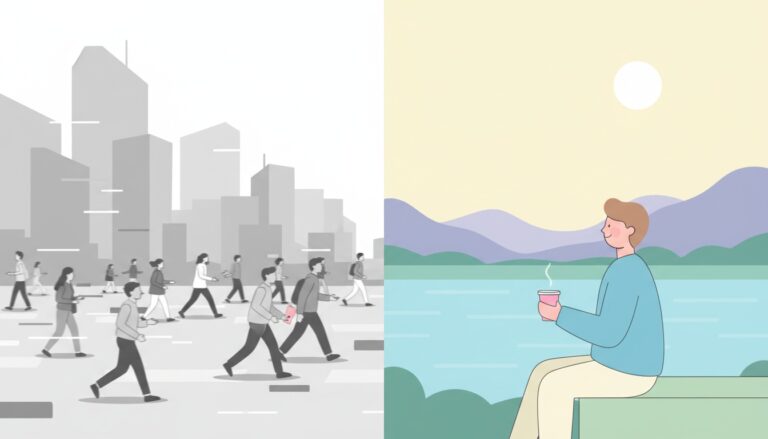
You know the scene. In a K-Drama, the protagonist is running breathless through the streets of Seoul, grabbing a convenience store triangular kimbap (samgak-gimbap) because they have zero time. This is the “Pali-pali” (Hurry-hurry) culture in action.
But then, the scene cuts. They are sitting by the Han River with a can of beer, staring blankly at the water. A friend sits down and says something soft and comforting. They aren’t saying “Hurry up.” They are telling them to breathe.
Today, we are going to learn how to try to take it easy in a country obsessed with speed. If you only know “Pali-pali,” you might survive, but knowing how to say “Let’s take it easy” will make Koreans look at you with surprised, warm eyes. It shows you understand their struggle.
Let’s find some “Yeoyu” (composure) together. 🌿
Phase 2: Deep Dive — Key Expressions
Here are the three ways Koreans express the effort to find peace.
1. 여유를 가지다 (Yeoyu-reul gajida)
- Pronunciation: [Yeoyu-reul gajida] (“Yeo-yu” sounds a bit like “Yo-yo” but softer, with a ‘u’ at the end)
- Meaning: To have composure / To have peace of mind (Literal: To possess space/spare time)
- K-Culture Moment: Think of an idol on a V-Live saying, “I’ve been too busy lately, so I’m trying to find some peace.” They aren’t just sleeping; they are looking for mental space.
- Editor’s Insight: Yeoyu isn’t just about time; it’s about a state of mind. You can have free time but no yeoyu (if you are anxious). You can be busy but still have yeoyu.
- Situation Spectrum:
[🚫 Boss to You] ———— [⚠️ Colleague] ———— [✅ Friends/Self]
(Usually used to describe oneself or give advice to a friend)- 🤔 Think About It: Why do Koreans treat “peace of mind” as something you must “possess” or “grab” (가지다)? Is relaxation a luxury here?
2. 쉬엄쉬엄 하다 (Swieom-swieom hada)
- Pronunciation: [Swieom-swieom hada] (Imagine a whispering wind: She-om She-om)
- Meaning: To take it easy / To do things little by little without rushing.
- K-Culture Moment: You are hiking a mountain (a national pastime!). An older hiker (Ajumma) passes you, panting, and hands you a cucumber. She says, “쉬엄쉬엄 가요!” (Go easy, don’t rush!).
- Editor’s Insight: This is my favorite Korean phrase. It acknowledges that you still have to do the work, but you should do it with breaks. It’s the perfect compromise between laziness and burnout.
- Situation Spectrum:
[🚫 Strict Meeting] ———— [✅ Colleagues] ———— [✅ Elders/Friends]- 🤔 Think About It: Does your language have a specific adverb for “working, but taking frequent breaks because health comes first”?
3. 힐링하다 (Hilling-hada)
- Pronunciation: [Hilling-hada] (Yes, it’s just the English word “Healing” + hada)
- Meaning: To recharge emotionally / To do something therapeutic.
- K-Culture Moment: Instagram captions! A photo of a nice cafe, a camping trip, or delicious food. The caption is always: “Today is healing time.”
- Editor’s Insight: Koreans use “Healing” differently than English speakers. It’s not about recovering from surgery. It’s about recovering from life. Eating spicy Tteokbokki can be “healing.”
- Situation Spectrum:
[✅ Universal Usage]
Phase 3: Textbook vs. Real Life
| Situation | 📖 Textbook Korean | 🗣️ Real Korean | 💡 Why different? |
|---|---|---|---|
| Telling someone to relax | 쉬세요. (Please rest.) | 무리하지 마세요. (Don’t overdo it.) | “Rest” sounds like a command to stop. “Don’t overdo it” shows care for their effort. |
| “I want to relax.” | 저는 쉬고 싶어요. (I want to rest.) | 멍 때리고 싶어요. (I want to space out.) | Modern Koreans value “doing nothing” (Mung-hitting) as the ultimate brain detox. |
| “Take your time.” | 천천히 하세요. (Do it slowly.) | 급할 거 없어요. (There is no rush.) | “Slowly” can feel frustrating in a fast culture. “No rush” relieves pressure. |
💡 Bottom Note: Use “무리하지 마세요” to your coworkers. You will instantly become the most popular person in the office.
Phase 4: Cultural Deep Dive — The Art of “Mung” (멍)
4-1. Non-verbal Communication: The Deep Sigh (한숨)
In Korea, hearing a deep sigh isn’t always rude; it’s a signal of stress. If your friend sighs, don’t ignore it. That is your cue to say, “쉬엄쉬엄 해” (Take it easy).
4-2. K-Culture Connection: The “Space-Out” Competition
Did you know there is an annual “Space-out Competition” (멍 때리기 대회) at the Han River? People compete to see who can stare into nothingness the longest with the most stable heart rate. This exists because Koreans find it so hard to just “be.” They had to turn relaxation into a competition to justify doing it!
Common “Mung” types:
– 🔥 Bul-mung (불멍): Staring at a campfire.
– 🌊 Mul-mung (물멍): Staring at water.
– 🌲 Sup-mung (숲멍): Staring at the forest.
Phase 5: Immersive Roleplay — The Burnout Crisis
Setting: A Friday afternoon in a shared office in Gangnam. Everyone is typing furiously (takataka-taka!). Your colleague, Minji, looks like a zombie. She has dark circles under her eyes.
Characters:
– YOU: A new team member who values work-life balance.
– Minji: Your Korean colleague who hasn’t left her desk in 4 hours.
Dialogue:
Minji: (Rubbing her neck) 아, 진짜 힘들다… 언제 다 하지?
(Ah, jinjja himdeulda… eonje da haji?)
(English) Ah, this is really hard… when will I finish all this?
YOU: (Approaching her with an iced coffee)
🔀 Your Turn! How do you comfort her?
A) “빨리 끝내고 집에 가요!” (Finish quickly and let’s go home!)
B) “좀 쉬엄쉬엄 해요. 커피 마시면서.” (Take it easy. While drinking coffee.)
C) “제가 도와줄까요?” (Shall I help you?)✅ Best Choice: B
Why? Option A adds pressure (classic Pali-pali stress). Option C is kind, but B shows emotional support and acknowledges she needs a break right now. It creates “Yeoyu.”
Minji: (Taking the coffee) 고마워요. 덕분에 좀 살 것 같네요.
(Gomawoyo. Deokbune jom sal geot ganneyo.)
(English) Thanks. I feel like I can live now thanks to you.
Phase 6: 10-Second Shadowing Drill
Let’s practice the magic spell for relaxation. Say this warmly, like you are patting someone on the back.
🥺 Caring Tone:
너무 / 무리하지 말고 / 쉬엄쉬엄 / 해요.
(Neomu / murihaji-malgo / swieom-swieom / haeyo.)
Translation: Don’t push yourself too hard, and take it easy.
Phase 7: K-Culture Mini Glossary
| Korean | Romanization | Meaning | Context |
|---|---|---|---|
| 소확행 | So-hwak-haeng | Small but certain happiness | Finding joy in small things (like a beer after work) instead of big goals. |
| 워라밸 | Wo-ra-bael | Work-Life Balance | Konglish abbreviation. Every young Korean wants this. |
| 호캉스 | Ho-kang-se | Hotel + Vacance | Booking a hotel in your own city just to do nothing. |
| 불금 | Bul-geum | Burning Friday | Working hard so you can party/relax hard on Friday night. |
Phase 8: Traveler’s Survival Kit — Finding Peace in Seoul
If the city is too loud, you need to find a cafe. But not just any cafe—a place allowing Yeoyu.
🆘 Survival Phrase #1
– 🇰🇷 “혹시 시간 제한 있나요?” (Hoksi sigan jehan innayo?)
– 🗣️ Pronunciation: [Hok-shi she-gan je-han in-na-yo?]
– 📍 Where: Popular Cafes / Study Cafes
– 💡 Meaning: “Is there a time limit?”
– Why use this? Many popular cafes in Korea have a 2-hour limit. Asking this ensures you can actually relax without being kicked out.📌 Editor’s Travel Note
To truly experience Yeoyu, visit a Hanok Cafe (traditional house cafe) in Ikseon-dong or Bukchon. The architecture is designed for sitting and staring at the sky. Order a tea, not an espresso, to match the vibe.
Phase 9: Think Deeper — The Paradox of Productivity
Topic: Why is “Doing Nothing” a Crime?
In Korea, asking someone “What did you do on the weekend?” and hearing “Nothing” can be awkward. There is a social pressure to be productive even during leisure time (hence “self-development” hobbies). The rise of terms like “Mung-hitting” (spacing out) is a counter-movement. It is the younger generation’s way of reclaiming their right to pause without guilt.
🧠 Think Deeper: In your culture, is doing nothing considered “lazy” or “restorative”? Do you feel guilty when you are not productive?
Phase 10: FAQ & Troubleshooting
Q: Can I say “Relax!” (진정해!) to a angry taxi driver driving too fast?
A: 🚫 NO! “진정해” (Calm down) sounds condescending and can make things worse. Instead, politely say “기사님, 천천히 가주셔도 돼요” (Driver, it’s okay to go slowly).
Q: Is it rude to sit in a cafe for 3 hours?
A: It depends. If it’s a franchise (Starbucks), it’s totally fine (Koreans study there all day). If it’s a small private cafe and you only ordered one drink, it’s polite to order another one or leave after 2 hours.
❌ Common Mistake:
Don’t say “Take your time” (천천히 하세요) to a waiter or clerk who is hurrying. They have to hurry because of their boss. It might sound sarcastic. Just say “감사합니다” (Thank you) with a smile.
Phase 11: Wrap-up & Action Mission
One-Liner Summary: finding Yeoyu (peace of mind) and doing things Swieom-swieom (little by little) is the secret to surviving the Korean speed.
🚀 Your Mission:
– 🥉 Bronze: Look in the mirror when you are stressed and say, “Ah, swieom-swieom haja!” (Let’s take it easy).
– 🥈 Silver: On a friend’s social media post about being busy, comment: “무리하지 말고 쉬엄쉬엄 해!” (Don’t overdo it, take it easy!).
– 🥇 Gold: Go to a park or a cafe, put your phone away, and practice “Mung-hitting” for 10 minutes. Feel the Yeoyu.
K-Culture Mission: Search for “Han River Space Out Competition” on YouTube. Watch how serious they are about doing nothing!
Phase 12: Quiz — Do You Have Nunchi?
Scenario: Your boss gives you a huge pile of work at 5 PM on Friday.
Q1. What is the risky thing to say?
– A) 네, 알겠습니다. (Okay, understood.)
– B) 아… 저 오늘 힐링이 필요한데요. (Ah… I need healing today.)
– C) 네, 월요일까지 하겠습니다. (Okay, I will do it by Monday.)
Answer: B is Risky!
While we want Yeoyu, telling your boss you need “healing” right when they give you work can seem irresponsible. Better to negotiate the deadline (C) or just accept it (A) and vent to your friends later with “So-hwak-haeng” (beer).
Frequently Asked Questions (FAQ)
Q: What does "여유를 가지다 (Yeoyu-reul gajida)" mean in Korean and how do you pronounce it?
A: In Korean, "여유를 가지다 (Yeoyu-reul gajida)" is pronounced [Yeoyu-reul gajida] and means: To have composure / To have peace of mind (Literal: To possess space/spare time)
Q: What does "쉬엄쉬엄 하다 (Swieom-swieom hada)" mean in Korean and how do you pronounce it?
A: In Korean, "쉬엄쉬엄 하다 (Swieom-swieom hada)" is pronounced [Swieom-swieom hada] and means: To take it easy / To do things little by little without rushing.
Q: What does "힐링하다 (Hilling-hada)" mean in Korean and how do you pronounce it?
A: In Korean, "힐링하다 (Hilling-hada)" is pronounced [Hilling-hada] and means: To recharge emotionally / To do something therapeutic.







