

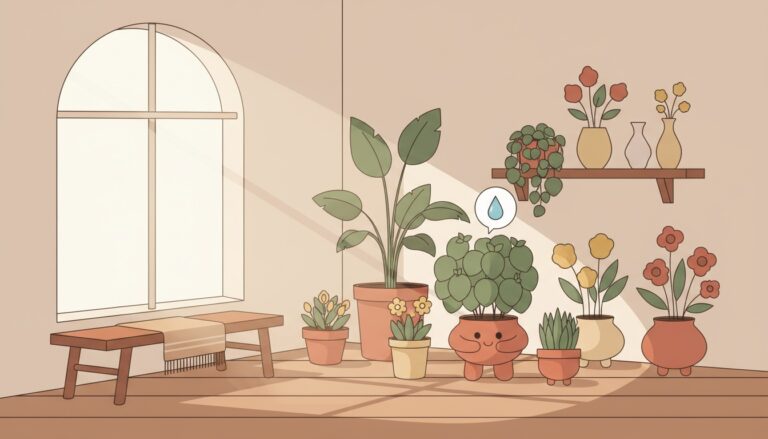
Phase 1: The “Plant Killer” Redemption 🌵
Hello there! It’s your editor at Daily Hangul.
Let’s be honest. We have all been there. You walk past a flower shop in Hongdae or a street stall in Gangnam. You see a cute little cactus or a pot of basil. You think, “This is it. This is the start of my eco-friendly life.”
Two weeks later? It’s brown, crispy, and dead. 💀
In K-Dramas, the main characters treat plants like people. Remember Captain Ri in Crash Landing on You talking to his tomato plant? That is the level of dedication we are aiming for today. But before you can whisper sweet nothings to your plant, you need to keep it alive.
Today, I’m going to teach you the most critical survival phrase for your green friends: “How often do I water this?”
Trust me, asking this one question prevents you from becoming a “serial plant killer” in Korea.
Phase 2: The Magic Phrases (Deep Dive)
Here are the three phrases you actually need. Forget the complex botany terms.
1. 물은 얼마나 자주 줘요? (Mureun eolmana jaju jwoyo?)
- Pronunciation: [Mool-eun] [ol-ma-na] [ja-ju] [jwo-yo?]
- Sound-alike: Mool (sounds like ‘Moon’ with an L) + Jwo-yo (sounds like ‘Joy-yo’)
- Meaning: “How often do I give water?”
- Context: This is your go-to phrase. You are holding the pot, looking into the eyes of the florist, and asking for the schedule.
- Situation Spectrum:
[🚫 Formal boss] ———— [✅ Shop Owner] ———— [✅ Friend]- 🤔 Think About It: Notice we say “give water” (물 줘요), not “irrigate.” It feels like you are feeding a pet. Why do you think Korean uses the same verb for giving a gift and watering a plant?
2. 일주일에 한 번요? (Il-ju-il-e han beon-yo?)
- Pronunciation: [Il-ju-il-e] [han] [bon-yo?]
- Meaning: “Once a week?”
- Editor’s Insight: This is my favorite trick. Sometimes, open-ended questions are scary because you might not understand the answer (e.g., “Every three days excluding weekends if it rains”). Instead, guess first. Ask “Once a week?” The owner will simply say “Ne” (Yes) or “Aniyo” (No, twice a week).
- K-Culture Moment: It’s like the “Up-Down” game often played in Korean variety shows. You guess a number, and they correct you.
3. 햇빛 많이 봐야 해요? (Haet-bit mani bwaya haeyo?)
- Pronunciation: [Hat-bit] [ma-ni] [bwa-ya] [hae-yo?]
- Meaning: “Does it need to see a lot of sunlight?”
- Literal Translation: “Must it see a lot of sunlight?”
- Editor’s Insight: Again, the plant is personified. It “sees” the sun. Use this if your apartment is a semi-basement (banjiha) like in the movie Parasite, where sunlight is luxury.
Phase 3: Textbook vs. Real Life
Textbooks make you sound like a robot. Let’s fix that.
| Situation | 📖 Textbook Korean | 🗣️ Real Street Korean | 💡 Why? |
|---|---|---|---|
| Asking frequency | 물을 주는 빈도가 어떻게 됩니까? (What is the frequency of watering?) | 물 언제 줘요? (When [do I] give water?) | “Frequency” is for science class. “When” is for real life. |
| Checking soil | 흙이 마르면 물을 주세요. (Please water when the soil is dry.) | 겉흙 마르면 주세요. (Give when topsoil dries.) | Koreans love efficiency (Pali-pali culture). We drop obvious words. |
Phase 4: Cultural Context — The “Companion Plant”
4-1. The “Ban-ryeo” (Companion) Concept
In English, you have pets. In Korea, we have 반려동물 (Companion Animals). But recently, a new word appeared: 반려식물 (Companion Plants).
It’s not just decoration. It’s a roommate.
4-2. K-Drama Connection
In K-Dramas, when a character is lonely or waiting for love, they tend to a plant. It represents their heart. If you see a scene where the protagonist is carefully wiping the leaves of a plant with a cloth, pay attention. They are probably thinking about their crush.
Non-verbal Tip: When asking the florist, don’t just point with one finger. Hold the pot gently with two hands or gesture with an open palm. It shows you respect the “life” you are buying.
Phase 5: Roleplay Scenario 🎭
Setting: A small, jungle-like flower shop in a hip neighborhood like Seongsu-dong. It smells like damp earth and coffee. You found a cute Basil plant.
Characters:
– YOU: Excited plant parent-to-be.
– Boss: Stylish florist in an apron.
YOU: (Holding the basil) 사장님, 이거 뭐예요?
(Sajang-nim, igeo mwo-yeyo? / Boss, what is this?)
Boss: 아, 바질이에요. 요리할 때 좋아요. 🌿
(Ah, it’s basil. Good for cooking.)
YOU: 오, 예뻐요. [ 1. YOUR CHOICE ]
🔀 Decision Point:
– A) “물은 얼마나 자주 줘요?” (Mureun eolmana jaju jwoyo?) -> Standard & Safe.
– B) “이거 죽어요?” (Igeo jugeoyo? / Will this die?) -> Dramatic but funny.
✅ If you chose A:
Boss: 일주일에 두 번 주세요. 물 좋아해요.
(Twice a week. It likes water.)
YOU: 아, 네. 햇빛 많이 봐야 해요?
(Ah, okay. Does it need a lot of sun?)
Boss: 네, 창가에 두세요.
(Yes, put it by the window.)
Phase 6: 10-Second Shadowing Drill 🗣️
Read this aloud. Don’t worry about being perfect. Just get the rhythm.
- 🤔 Curious: 물은 / 얼마나 / 자주 줘요? (Mureun / eolmana / jaju jwoyo?)
- 📝 Checking: 일주일에 / 한 번요? (Il-ju-il-e / han beon-yo?)
- 🌞 Caring: 햇빛 / 좋아해요? (Haet-bit / joa-haeyo?)
Phase 7: K-Culture Mini Glossary
| Korean | Romanization | Meaning | Context |
|---|---|---|---|
| 화분 | Hwabun | Flower pot | Usually refers to the whole potted plant unit. |
| 꽃집 | Kkot-jip | Flower Shop | Literally “Flower House.” |
| 사장님 | Sajang-nim | Boss/Owner | Call any shop owner this. Even if the shop is tiny. It shows respect. |
| 키우다 | Ki-u-da | To raise | Used for kids, pets, and plants. |
Phase 8: Survival Kit (Living in Korea) 🆘
If you buy a plant, you need to carry it home. In Korea, plastic bags are not free (usually 50 or 100 won).
🛍️ Survival Phrase:
– 🇰🇷 “봉투에 담아 주세요.” (Bongtu-e dama juseyo.)
– 🗣️ Meaning: “Please put it in a bag.”
– 💡 Pro Tip: If the pot is heavy, ask: “들고 갈 수 있을까요?” (Can I carry this? / Is it portable?)
Phase 9: Think Deeper — “Why so many plants?”
🧠 Food & Identity:
Have you noticed how many edible plants Koreans grow at home? Lettuce, perilla leaves, peppers. It’s not just about gardening; it’s about “Ssam” (wrapping culture). We want to be ready to grill meat and wrap it in fresh leaves at any moment. The boundary between a “garden” and a “pantry” is very thin in a Korean home.
💬 Your Turn: Do you grow plants to look at, or plants to eat? Let me know in the comments!
Phase 10: FAQ & Troubleshooting
- Q: Can I bargain at a flower shop?
- Editor: Generally, no. Unless you are at a huge wholesale market like Yangjae Flower Market and buying in bulk. At a local shop, the price is fixed. Don’t try to cut the price of a living thing; it’s bad karma!
- Q: What if I don’t understand the watering schedule?
- Editor: Ask them to write it down. Say: “써 주세요.” (Sseo juseyo – Please write it.) Most florists will stick a little post-it on the pot for you.
Phase 11: Wrap-up & Mission
One-Liner: To keep your plant alive, just remember: “Mureun eolmana jaju jwoyo?”
🚀 Action Mission:
– 🥉 Bronze: Look at a plant in your house and ask it, “Mureun eolmana jaju jwoyo?”
– 🥈 Silver: Go to a flower shop, point to a plant, and ask the price in Korean.
– 🥇 Gold: Buy a small succulent and ask the owner specifically about sunlight and water in Korean.
Phase 12: Pop Quiz 📝
1. You think the florist said “Water everyday,” but you want to check. What do you say?
– A) 매일요? (Mae-il-yo?)
– B) 물 싫어해요? (Mul si-reo-hae-yo?)
2. True or False?
– In Korea, it is common to call a plant a “Companion Plant.”
(Scroll down for answers)
.
.
.
Answers:
1. A (Mae-il means “Everyday”. B means “Does it hate water?”)
2. True (Ban-ryeo-sik-mul is a very popular concept!)
Frequently Asked Questions (FAQ)
Q: What does "물은 얼마나 자주 줘요? (Mureun eolmana jaju jwoyo?)" mean in Korean and how do you pronounce it?
A: In Korean, "물은 얼마나 자주 줘요? (Mureun eolmana jaju jwoyo?)" is pronounced [Mool-eun] and means: "How often do I give water?"
Q: What does "일주일에 한 번요? (Il-ju-il-e han beon-yo?)" mean in Korean and how do you pronounce it?
A: In Korean, "일주일에 한 번요? (Il-ju-il-e han beon-yo?)" is pronounced [Il-ju-il-e] and means: "Once a week?"
Q: What does "햇빛 많이 봐야 해요? (Haet-bit mani bwaya haeyo?)" mean in Korean and how do you pronounce it?
A: In Korean, "햇빛 많이 봐야 해요? (Haet-bit mani bwaya haeyo?)" is pronounced [Hat-bit] and means: "Does it need to see a lot of sunlight?"







